


In this guide14 sections
- Key Points
- Does a Lip Lift Change the Shape of Your Nose?
- Does a Lip Lift Change Your Nose Tip and Nasolabial Angle?
- Does a Lip Lift Change Your Nostrils or Alar Base?
- Why Does My Nose Look Different After a Lip Lift?
- Can You Have a Lip Lift and a Nose Job at the Same Time?
- Is It Better to Get a Lip Lift or a Nose Job First?
- Can a Nose Job Make Your Upper Lip Look Longer?
- What Is the Ideal Philtrum Length?
- Nose Swelling After a Lip Lift: Recovery and What to Expect
- What Are the Downsides of a Lip Lift?
- Frequently Asked Questions
- Lip Lift and Rhinoplasty Consultation in London
- References
Key Points
- Does a lip lift change your nose? A lip lift does not reshape the nose itself, but it can change how the nose looks. The incision sits at the base of the nose, and shortening the skin beneath it alters the relationship between the nose tip and the upper lip.
- What the research shows: in a 2020 review of 55 women who had a subnasal lip lift without rhinoplasty, the nasolabial angle narrowed by an average of 4.6 degrees and the width of the nostril base increased by 2.2%. The columellar-lobular angle did not change significantly[1].
- The nose tip can look more prominent. The same study described a “pseudo-overprojection” of the tip, an optical effect of a shorter lip rather than a change in the cartilage.
- Nostril shape and the alar base are most at risk when the incision extends into the nostril sill. Sill widening and alar distortion are described complications, and most are avoidable with careful technique[5].
- A lip lift and rhinoplasty can be combined. A 45-patient series reported high satisfaction (4.4 out of 5) when closed rhinoplasty and a subnasal lip lift were performed together[2].
- Swelling near the nose is temporary, but it can make the nose and lip look different for the first weeks, so judge the result once the tissues have settled.
A lip lift is performed through an incision placed directly beneath the nose, so it is natural to ask whether it can alter the nose itself. People searching this question tend to have one of three worries: that the tip will rotate or look bigger, that the nostrils will change shape, or that a lip lift will clash with a nose job they have had or are planning.
This guide sets out what the published evidence says about how a lip lift affects the nose tip, nostrils, columella and nasolabial angle, why the nose can look different afterwards, when surgeons combine a lip lift with rhinoplasty, which operation usually comes first and what recovery looks like. If you are still deciding which technique suits you, our guides to the bullhorn lip lift and to bullhorn versus corner lip lift explain the differences.
Does a Lip Lift Change the Shape of Your Nose?
A standard subnasal (bullhorn) lip lift removes a thin strip of skin from the area between the base of the nose and the upper lip, then raises the lip and stitches it to the nasal base. The cartilage that gives the nose its shape is not touched. In that sense a lip lift does not reshape the nose.
What changes is the space around it. The nose and the upper lip share a boundary, and moving one side of that boundary moves the angles and proportions of the other. That is why the more accurate answer to “does a lip lift change your nose?” is that it can change the way the lower nose looks without changing its structure.
The most direct evidence comes from a 2020 retrospective review in the Journal of Oral and Maxillofacial Surgery ↗ of 55 women, average age 52, who had a subnasal lip lift without a rhinoplasty and were followed for an average of 14 months. Lip length fell by 21.5%, the visible pink of the upper lip (vermilion show) increased by 31.5% and tooth show rose by 1.52 mm. For the nose, the nasolabial angle decreased by 4.56 degrees, alar width increased by 2.2% and nasal projection, measured by the Simons analysis, increased by 26.3%. The columellar-lobular angle and a second projection measure, the Crumley analysis, did not change significantly. The authors concluded that a subnasal lip lift can significantly affect lower nasal aesthetics[1].
A 2026 systematic review of seven studies and 1,754 patients ↗ found that bullhorn techniques and their modifications shortened the philtrum from around 14.0 to 14.5 mm to 10.8 to 12.0 mm, with high patient satisfaction and mostly mild, temporary complications. Its main outcomes were lip measurements, satisfaction and complications, and the authors rated the overall quality of the studies as moderate[3]. In other words, the evidence base for how a lip lift changes the nose is small, and most of it comes from single-surgeon case series.
Does a Lip Lift Change Your Nose Tip and Nasolabial Angle?
The nasolabial angle is the angle between the underside of the nose (the columella) and the upper lip. It is one of the measurements surgeons use to judge tip rotation. A lip lift raises the lip towards the nose, and in the 2020 review the angle narrowed by an average of 4.56 degrees[1]. That is a small average change, but it points in a particular direction: the lip comes closer to the underside of the nose, so the tip can seem to sit further forward.
The review’s authors described this as a possible “pseudo-overprojection” of the nasal tip. The tip itself has not moved, but with a shorter lip beneath it, the eye reads the nose as slightly more prominent. Whether you notice it is likely to depend on your starting proportions.
The direction of change is different when the nose is operated on as well. In a 2019 study of 30 patients in Plastic and Reconstructive Surgery ↗, a lip lift combined with nasal tip plasty shortened the philtrum and the nasolabial angle opened from an average of 91.3 to 105.6 degrees, because the tip was deliberately rotated upwards at the same time[4]. The two studies describe different techniques and different patient groups, so they cannot be compared directly, but together they show that the angle at the base of the nose is shaped by both the lip and the tip.
A drooping tip and a long upper lip often go together as the face ages. A 2021 series of 45 patients in Facial Plastic Surgery ↗ who had closed rhinoplasty with an indirect subnasal lip lift in one operation reported an average 23.5% shortening of the lip and a 10.9% reduction in nasolabial angle at one year, with satisfaction rated 4.4 out of 5. The authors argued that the nose and lips should be assessed together rather than as separate features[2]. The columellar-lobular angle, which describes the junction between the columella and the tip, did not change significantly in the lip-lift-only review[1].
Does a Lip Lift Change Your Nostrils or Alar Base?
Nostril shape is the second most common worry. The skin removed in a bullhorn lip lift lies just beneath the nostrils, and the incision follows the crease where the nose meets the lip. Two things can affect the nostrils: how the incision is placed, and what the alar base was like to start with.
In the 2020 review, alar width increased by an average of 2.2% after a subnasal lip lift[1]. That is a small group-average change, and none of the studies identified here measured how much of the nostril shows from the front, so it would be wrong to promise either that nostrils will or will not look different. Surgeons who describe an endonasal variation, in which part of the incision is placed inside the nostril, report that sill widening, under-correction and alar distortion are mostly avoidable or correctable, while disruption of the nasal sill remains an unavoidable drawback of that approach that careful technique can minimise[5].
Patient selection matters here. Published guidance on lip lift planning lists alar base width, lip height, vermilion height, upper incisor show and skin type as factors to assess before surgery[6]. If your alar base is already wide, a plan that looks only at the lip may miss the effect on the nose. A consultation that photographs and measures the nose and lip together is the practical safeguard.
Why Does My Nose Look Different After a Lip Lift?
If your nose looks different after a lip lift, one or more of the following is usually responsible:
- A shorter philtrum changes proportion. Take away a few millimetres of lip and the nose is surrounded by less skin, so it can look longer or more projecting, even though it has not changed shape.
- The nasolabial angle has narrowed. The small average change described above can be visible in profile photographs[1].
- Swelling. The upper lip and the base of the nose swell after surgery, which can broaden the nostril base and blunt the tip for a few weeks. This settles with time.
- Tension and anchoring. A lift that relies only on skin tension may pull on the tissues around the nose or relax over time. Modified techniques describe releasing the deeper tissue layer and suspending it securely rather than relying on the skin closure alone[7].
- Pre-existing asymmetry. Most noses and lips are slightly asymmetrical, and a closer look at the area after surgery can make existing asymmetry more noticeable.
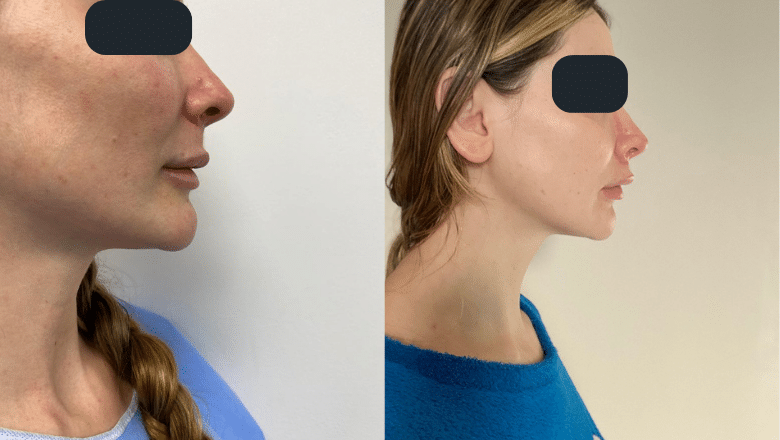
If the difference is still obvious after the swelling has gone, which can take several months, speak to your surgeon. A review in person is the only reliable way to tell the difference between normal healing and a result that needs attention. Our guide to how long a lip lift lasts explains how the result is expected to change over the years.
Can You Have a Lip Lift and a Nose Job at the Same Time?
Yes, they can be done in the same operation, and published case series describe the pairing. The 45-patient series above combined closed rhinoplasty with an indirect lip lift[2], and the 30-patient series paired a subnasal lip lift with nasal tip plasty[4]. One surgical team has also described a lip lift technique in which the same incisions allow caudal rhinoplasty work on the lower nose, reasoning that the two areas can be treated together[5].
The people most likely to be offered both are those whose nose tip has dropped with age and whose upper lip has lengthened at the same time. Treating only the lip leaves a tip that still droops, and treating only the nose leaves a long lip. Our guides to tip rhinoplasty and profileplasty explain how the nose, lips and chin are balanced as a whole.
There are trade-offs. A combined operation is longer, involves a single recovery rather than two, and produces more swelling to settle before either result can be judged. The evidence is also limited to small case series from individual centres, without controlled comparisons against doing each operation separately. If the nose is your main concern, rhinoplasty recovery and aftercare is worth reading before you decide.
Is It Better to Get a Lip Lift or a Nose Job First?
No trial has compared the two orders, so there is no evidence-based rule. The reasoning behind the choice is more useful than a fixed sequence.
Rhinoplasty can itself change the upper lip. In a 2020 review of 67 rhinoplasty patients in the British Journal of Oral and Maxillofacial Surgery ↗, frontal upper lip length increased in 46 of them, and tip rotation techniques moved the position of the subnasal area and vermilion in profile[8]. If the nose is operated on first, the surgeon can measure the lip once the new tip position is stable, and plan a lip lift that fits the finished nose. The nose, particularly the tip, is also slow to settle, which is explained in our guide to rhinoplasty swelling.
Doing both at once avoids a second operation and lets the surgeon plan the lip and nose as a single change. Staging them gives each result time to settle before the next decision is made. Which is right depends on how much each area needs to change, your tolerance for a longer operation and your surgeon’s judgement, and it is a decision to make at consultation with photographs of your own face.
Can a Nose Job Make Your Upper Lip Look Longer?
It can. The same 2020 study found that rhinoplasty often increases upper lip length, particularly with techniques such as a columella strut or release of the depressor septi muscle[8]. A review of rhinoplasty dynamics adds that changes to the anterior nasal spine influence tip projection, upper lip length and the nasolabial angle, and that narrowing the alar base can create an illusion of increased tip projection[9].
That is the mirror image of the question in this article, and it is covered in our guide to whether a nose job changes your smile. If a longer lip after a nose job is bothering you, a lip lift is one way surgeons shorten it, but that decision should wait until the nose has healed.
What Is the Ideal Philtrum Length?
There is no single ideal, and the research reflects that. The philtrum is the groove between the base of the nose and the top of the upper lip, and it tends to lengthen with age, along with thinning of the lip and loss of volume[10]. In the systematic review, the typical philtrum before a bullhorn lip lift was about 14.0 to 14.5 mm, falling to 10.8 to 12.0 mm afterwards[3]. These are research averages, not targets for an individual face.
Preferences also vary. A 2025 survey of 570 people in Aesthetic Plastic Surgery ↗, who rated digitally altered faces, found that the most favoured upper incisor show was between 0 and 1 mm depending on ethnic group, and that the least favoured was 4 mm, which suggests that more is not always better[11]. A good plan shortens the lip enough to correct a long philtrum, rather than aiming for a number. If volume rather than length is the issue, how a lip lift compares with fillers is covered on our lip lift surgery page.
Nose Swelling After a Lip Lift: Recovery and What to Expect
Swelling and tightness around the nose and upper lip are normal after a lip lift. The lip can look larger than expected at first, and the tissue under the nose may feel pulled upwards. Most people find that the swelling settles over the first few weeks and that the tight feeling eases as the tissues relax, although healing times vary from person to person.
Sutures under the nose are usually removed after about seven to ten days, and many people return to work after around a week. The scar can stay pink for a while and can often be covered with make-up once the wound has closed. Follow the aftercare instructions you are given.
On longevity, a 2021 retrospective study of 52 patients in Facial Plastic Surgery & Aesthetic Medicine ↗ found that the 5 mm lift was largely maintained, with a slow decline over time. Patients less than five years from surgery had a 50.1% improvement in lip show compared with 40.3% for those five years or more out, a difference that was not statistically significant[12]. For a full explanation, see how long a lip lift lasts.
What Are the Downsides of a Lip Lift?
A lip lift was generally well tolerated in the studies reviewed, but it is surgery, and the downsides are worth knowing:
- A scar. The incision sits in the crease under the nose, where it usually fades well, but it is permanent and some people heal with a more visible or pigmented line.
- Under- or over-correction. Too little lift is a disappointment; too much can leave the lip looking short and expose too much of the upper teeth.
- Asymmetry. Small differences between the left and right sides can occur.
- Changes around the nose, including the nasal sill, alar base and nasolabial angle, as covered above[5].
- Revision. Across the studies in the 2026 systematic review, revision rates ranged from 0.6% to 6.7%, and most complications were mild and temporary[3].
If you are weighing a lip lift against other ways of treating a downturned mouth or thin lip, our guides to a corner lip lift and a downward turned mouth may help, and our guide to lip lift cost in London sets out how the price of a lip lift is worked out.
Frequently Asked Questions
Does a lip lift make your nose look bigger?
A lip lift does not enlarge the nose, but a shorter lip can make the nose tip look more prominent. In a 2020 review, the nasolabial angle narrowed by an average of 4.6 degrees and the authors described a possible pseudo-overprojection of the tip[1]. Discuss your nose profile with your surgeon beforehand.
Can a lip lift ruin your nose?
A lip lift does not alter the nasal cartilage, so a ruined nose is not an expected result. Noticeable nostril or sill changes are described as complications, mostly avoidable with careful technique[5]. Careful planning and technique reduce the risk, but it is not zero.
Is a lip lift scar visible inside the nose?
In a standard bullhorn lip lift the scar lies in the crease at the base of the nose, outside the nostrils. Some modified techniques place part of the incision inside the nostril, which is reported to improve scar appearance but disrupts the nasal sill[5]. Ask your surgeon exactly where your incision will lie.
Can you have a lip lift and a nose job on the same day?
Yes. Published series describe closed rhinoplasty and nasal tip plasty performed together with a subnasal lip lift, with high satisfaction[2][4]. The evidence comes from small case series, and some surgeons prefer to stage the operations so each can settle.
Is it better to get a lip lift or a nose job first?
No trial has compared the two orders. Rhinoplasty can lengthen the upper lip[8], so some surgeons operate on the nose first and plan the lip lift afterwards. Others combine them. The right order depends on how much each area needs to change.
Is a lip lift better than filler?
They do different jobs. A lip lift shortens a long upper lip and shows more of the teeth and pink of the lip, while filler adds volume and is temporary. Neither is better for everyone, and the choice depends on whether length or volume is the problem. See our comparison of a lip lift and fillers.
How soon after a nose job can you get lip fillers?
There is no agreed interval in the studies reviewed here. The tissues around the nose and upper lip stay swollen for some time after rhinoplasty, so ask the surgeon who performed your nose job before having anything injected nearby.
What are the downsides of a lip lift?
The main downsides are a permanent scar under the nose, asymmetry, under- or over-correction and changes around the nostril base or nasolabial angle. A 2026 systematic review reported revision rates of 0.6% to 6.7%, with mostly mild, temporary complications[3].
Lip Lift and Rhinoplasty Consultation in London
If you are worried about how a lip lift will affect your nose, or you are considering both operations, a consultation can assess your nose, philtrum length, tooth show and alar base together and show how each choice would look on your own face. Find out more about lip lift surgery at Centre for Surgery and rhinoplasty, or contact us to arrange a consultation.
References
- Marechek A, Perenack J, Christensen BJ. Subnasal lip lift and its effect on nasal esthetics. Journal of Oral and Maxillofacial Surgery 2020;79(4):895–901. doi:10.1016/j.joms.2020.12.007 ↗
- Pascali M, Marchese G, Diaspro A. The rhino-lip-lifting: a novel proposal for midface profileplasty performed as a single surgical procedure. Facial Plastic Surgery 2021;37(3):340–347. doi:10.1055/s-0041-1722906 ↗
- Komisarek O, Banasiak Ł, Olichwer V, Burduk P. The bullhorn and beyond: evidence-based review and clinical recommendations for lip lift techniques. Journal of Cosmetic Dermatology 2026;25(3):e70703. doi:10.1111/jocd.70703 ↗
- Jung JA, Kim KB, Park H, Dhong ES, Han SK, Kim WK. Subnasal lip lifting in aging upper lip: combined operation with nasal tip plasty in Asians. Plastic and Reconstructive Surgery 2019;143(3):701–709. doi:10.1097/PRS.0000000000005315 ↗
- Raphael P, Harris R, Harris SW. The endonasal lip lift: personal technique. Aesthetic Surgery Journal 2014;34(3):457–468. doi:10.1177/1090820X14524769 ↗
- Salibian AA, Bluebond-Langner R. Lip lift. Facial Plastic Surgery Clinics of North America 2019;27(2):261–266. doi:10.1016/j.fsc.2019.01.004 ↗
- Talei B. The modified upper lip lift: advanced approach with deep-plane release and secure suspension, 823-patient series. Facial Plastic Surgery Clinics of North America 2019;27(3):385–398. doi:10.1016/j.fsc.2019.04.004 ↗
- Tosan F, Esmaeelinejad M, Ghorbani R. Effects of open rhinoplasty on upper lip position in profile and frontal views. British Journal of Oral and Maxillofacial Surgery 2020;59(2):174–178. doi:10.1016/j.bjoms.2020.08.012 ↗
- Xia TY, Punjabi A, Oh JH, Wee C, Guyuron B. Updated dynamics of rhinoplasty: a review of the literature and comprehensive list of the findings. Aesthetic Plastic Surgery 2020;44(3):904–909. doi:10.1007/s00266-020-01619-z ↗
- Tonnard PL, Verpaele AM, Ramaut LE, Blondeel PN. Aging of the upper lip: part II. Evidence-based rejuvenation of the upper lip, a review of 500 consecutive cases. Plastic and Reconstructive Surgery 2019;143(5):1333–1342. doi:10.1097/PRS.0000000000005589 ↗
- Zeng R, Glaue E, Moellhoff N, et al. Revealing the perfect smile: how philtrum length shapes lip beauty. Aesthetic Plastic Surgery 2025;49(13):3561–3571. doi:10.1007/s00266-025-04752-9 ↗
- Nagy C, Bamba R, Perkins SW. Rejuvenating the aging upper lip: the longevity of the subnasal lip lift procedure. Facial Plastic Surgery & Aesthetic Medicine 2021;24(2):95–101. doi:10.1089/fpsam.2021.0077 ↗







