


In this guide17 sections
- Key Points
- What Is a Corner Lip Lift?
- What Does a Corner Lip Lift Do?
- What Causes Downturned Mouth Corners?
- Who Is a Good Candidate for a Corner Lip Lift?
- How Is a Corner Lip Lift Performed?
- Corner Lip Lift vs Bullhorn Lip Lift: What Is the Difference?
- Corner Lip Lift Before and After: What Results Can You Expect?
- Corner Lip Lift Recovery: What to Expect
- Does a Corner Lip Lift Leave a Scar?
- What Are the Risks of a Corner Lip Lift?
- Corner Lip Lift Alternatives: Anti-Wrinkle Injections, Filler and Facelift
- How Much Does a Corner Lip Lift Cost in the UK?
- Corner Lip Lift Consultation at Centre for Surgery
- Frequently Asked Questions
- Corner Lip Lift in London
- References
Key Points
- What is a corner lip lift? A short operation, also called a smile lift, grin lift or mouth corner lift, that removes a small wedge of skin at each corner of the mouth so downturned corners sit level or slightly higher.
- It is surgery, not a filler. The change is permanent, but it leaves a small scar at each mouth corner, and that scar is usually easier to see than the one from a bullhorn lip lift.
- The operation is quick. A corner lip lift on its own takes about 45 minutes under local anaesthetic, with optional oral sedation, and you go home the same day.
- Recovery is short. Stitches come out at day 5 to 7, most people are back at a desk after 7 to 10 days, and the scar settles over about 6 months.
- It does not shorten a long philtrum. The gap between nose and upper lip needs a bullhorn lip lift, and the two operations can be combined in one session.
- Non-surgical options exist. Anti-wrinkle injections and dermal fillers can soften a downturned mouth for a few months, and a facelift suits wider lower face sagging.
If your mouth looks sad, tired or stern when you feel perfectly fine, a corner lip lift is the operation designed to change that. It lifts the corners of the mouth directly, which is why it is often called a smile lift or mouth corner lift. It is one of several lip lift surgery techniques, and it solves a different problem from the more common bullhorn lip lift, which shortens the skin between the nose and the upper lip.
This guide explains how a corner lip lift works, who it suits, what the scars and recovery are like, and how it compares with anti-wrinkle injections, dermal fillers and a facelift. If you are still working out why your mouth turns down, start with our guide to the causes of a downward turned mouth.
What Is a Corner Lip Lift?
A corner lip lift, also known as a lip corner lift or corner of mouth lift, is a surgical procedure that raises the corners of the mouth (the oral commissures). A small wedge of skin is removed just above and beside each corner, and the wound is closed so the corner is held in a higher position. A 2025 technique review in Facial Plastic Surgery ↗ describes it as a way to treat angular depression of the lateral lip, a lack of visible red lip at the sides and skin that hoods the lip, and notes that it can be used alone or combined with a subnasal lip lift[1]. The same review describes three types of corner lip lift for different degrees of lateral lip deficiency, so a mild downturn needs a smaller lift than a marked one.
A corner lip lift does not change the size of your lips and it does not shorten the philtrum. It repositions the corner. For a long gap between the nose and the lip, the answer is a bullhorn lip lift, and our comparison of bullhorn vs corner lip lift explains how the choice is made.
What Does a Corner Lip Lift Do?
The aim is a neutral or gently upturned resting mouth rather than a fixed smile. Once the corners no longer angle down, the face usually looks calmer and less tired. The skin that folds down from the corner towards the chin, which contributes to marionette lines, can look softer as well, although a corner lip lift does not treat the lines themselves.
The result is permanent because the skin that is removed does not grow back. A 2023 systematic review of upper lip lift techniques found that surgical lifts last longer than non-surgical ones, with good patient satisfaction and no severe complaints, and that the scar is the unavoidable trade-off[2]. That review looked at upper lip lifts rather than corner lifts specifically, but the same principle applies: a permanent change comes with a permanent scar. Natural ageing carries on from the new baseline. Our guide to how long a lip lift lasts covers the long-term picture.
Will a corner lip lift make me look like I am always smiling?
No. The goal is to remove the downward angle, so the mouth looks neutral at rest and your normal smile stays your own. A surgeon who aims for a visible upturn at rest risks an unnatural, fixed expression, which is why conservative planning matters.
What Causes Downturned Mouth Corners?
Three things usually combine. The first is anatomy you were born with: some people have mouth corners that angle down from a young age. The second is muscle pull. The depressor anguli oris is the muscle that draws the corner of the mouth downward, and an Italian consensus of 14 experts reported that correcting downturned oral commissures is its strongest aesthetic treatment indication[3]. The third is ageing: the cheeks lose volume and descend, skin loses elasticity and the tissue around the mouth slips down, so the corners follow.
Which of these dominates decides the right treatment. Muscle-driven downturn responds to injections, volume loss responds to filler, and true skin excess at the corner is what a corner lip lift removes. The lines that often come with it are covered in our guides to marionette lines and nasolabial folds.
Who Is a Good Candidate for a Corner Lip Lift?
A corner lip lift tends to suit you if:
- your mouth corners angle downwards at rest, and people comment that you look sad, tired or unhappy when you are not
- you want a permanent change and accept a scar at each mouth corner
- you are 18 or over, in good general health and have realistic expectations
- you are a non-smoker, or can stop all nicotine, including vaping, for four weeks before and after surgery
It suits you less well if the real issue is a long philtrum, thin lips or a gummy smile, because a corner lift changes none of these. It is also not the right first step if your downturn comes mainly from sagging jowls and cheeks, where a lower facelift addresses the cause. Your surgeon will look at your teeth and smile as well as the corners, since the technique review lists dental influences and age-related drooping of the lip among the points to weigh when planning[1]. If you also have a long philtrum, a corner lift can be combined with a bullhorn lift, and our long philtrum guide explains how it is measured.
How Is a Corner Lip Lift Performed?
At Centre for Surgery a corner lip lift on its own is done under local anaesthetic, with mild oral sedation if you would like it, and takes around 45 minutes. A combined corner and bullhorn lift takes around an hour and a half. The steps are:
- Your surgeon marks the planned wedge at each mouth corner while you sit upright, so the lift is judged against your natural expression.
- Local anaesthetic is infiltrated around the area. It stings briefly, then the skin goes numb.
- A small wedge of skin is removed at each corner, shaped to follow the natural contour of the lip.
- The wound is closed in layers with fine stitches, lifting the corner into its new position.
You recover in our suite for 30 to 60 minutes, then go home the same day. If you have oral sedation, a responsible adult needs to collect you.
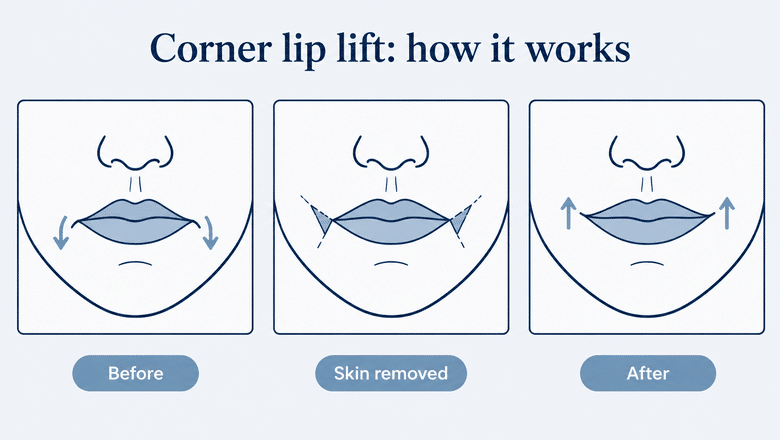
A standalone corner lift keeps you awake but comfortable throughout. When it is combined with larger surgery, such as a facelift, TIVA (total intravenous anaesthesia) may be used instead.
Corner Lip Lift vs Bullhorn Lip Lift: What Is the Difference?
The two operations treat different parts of the mouth. A bullhorn lip lift removes skin under the nose to shorten the philtrum and roll more pink lip into view, and its scar hides in the crease at the base of the nose. A corner lip lift removes skin at the mouth corners to correct the angle of the mouth, and its scar sits at the corner, where there is constant movement.
A simple way to tell which applies to you is to look in a mirror with a neutral face. If the space between your nose and lip looks long and your upper teeth barely show, that points to a bullhorn lift. If the corners angle downwards, that points to a corner lift. If both are true, they can be done together. The main lip lift treatment page shows how the options fit together, and our guide to whether a lip lift changes your nose applies to the bullhorn technique only.
Corner Lip Lift Before and After: What Results Can You Expect?
People searching for corner lip lift before and after photos want to see the angle of the mouth change, and the honest answer is that the difference is subtle but noticeable. You should expect the corners to move from a downward angle to level, and a more relaxed look at rest, rather than a dramatic change in the shape of the face. Early results often look over-lifted and tight while swelling settles, so the outcome is judged at about 12 months.

Corner Lip Lift Recovery: What to Expect
Recovery is short compared with most facial surgery because the operation is small. A typical timeline is:
- Days 1 to 2: mild to moderate swelling and some bruising, and the mouth feels tight. Paracetamol, cold compresses for the first 24 hours and sleeping on two pillows help.
- Days 5 to 7: the surface stitches are removed.
- Days 7 to 10: most people return to desk work, although you may not feel ready for a public-facing job until swelling and scabbing settle.
- Week 2: bruising has largely gone and gentle exercise is fine.
- Week 4: full exercise, including weights.
- Months 2 to 3: most of the final result is visible and the scar fades from pink to pale.
- 6 to 12 months: the scar matures fully and the result is judged.
You will have reviews at 5 to 7 days, six weeks and three months.
Aftercare after a corner lip lift
- Avoid nicotine, including vaping, for four weeks before and after surgery, as it slows healing and worsens scars.
- Avoid straws and dental work for two weeks, and keep wide yawning and exaggerated expressions to a minimum for the first week.
- Protect the scars from the sun for three months, as early sun exposure can darken them permanently.
Your surgical team will give you written instructions that take priority over this general list.
Does a Corner Lip Lift Leave a Scar?
Yes. A scar is part of the operation, and it is the main downside. With a corner lip lift the scar sits at the outer edge of the mouth, in an area that moves every time you talk, eat or smile, so it can take longer to mature and may stay more visible than a bullhorn scar hidden under the nose. Most scars fade to a fine pale line over about six months. A minority become thickened (hypertrophic), which can be treated with silicone products or steroid injections. Smokers and people with darker skin tones are at higher risk of poor scarring or darkening, and you should discuss this at consultation if it applies to you.
If a permanent scar at the corner of the mouth does not feel like an acceptable price for a permanent lift, a non-surgical option may suit you better.
What Are the Risks of a Corner Lip Lift?
Serious complications are uncommon, but every operation carries risk, and the general risks of cosmetic surgery apply alongside these:
- Visible or thickened scars at the mouth corners, as described above.
- Asymmetry. The two corners may not sit exactly level. Minor differences usually settle over two to three months, and no face is perfectly symmetrical to begin with.
- Over- or under-correction. Removing too much skin can leave an unnatural, fixed expression and is hard to reverse, while removing too little gives less change than hoped. Surgeons deliberately err towards conservative removal.
- Altered sensation. Numbness or tingling around the mouth is common for a few weeks and rarely lasts.
- Infection or wound opening. Uncommon, and usually treated with antibiotics or re-suturing.
- Dissatisfaction with a permanent result. A corner lip lift is not reversible, which is why we recommend a two-week cooling-off period after your consultation before you book.
Corner Lip Lift Alternatives: Anti-Wrinkle Injections, Filler and Facelift
Surgery is not the only way to lift the corners of the mouth, and for many people a temporary option is the sensible place to start.

Can anti-wrinkle injections lift the corners of the mouth?
Sometimes. Anti-wrinkle injections into the depressor anguli oris weaken the muscle that pulls the corner down, which lets the corner rise a little. A 2026 randomised trial in Plastic and Reconstructive Surgery ↗ measured oral commissure position with three-dimensional photography and found that every injection pattern improved it, that a lower injection site worked better than a higher one, and that adding the platysma gave further lifting and higher satisfaction[4]. The muscle also sits in a different place from person to person: an ultrasound study of 290 patients found it was displaced from the standard landmark in about 80% of them[5], so placement by an experienced injector matters. Effects last a few months, and the change is modest. Our team can tell you whether anti-wrinkle injections are likely to be enough for your face.
Does lip filler lift the corners of the mouth?
A little. Filler supports the corner and the fold below it, but it adds volume rather than removing skin. In a 2024 study of 50 patients in Aesthetic Surgery Journal ↗, a nine-point lip filler technique lifted the lip corners by about 1 mm at three months[6]. That is a subtle effect, which is why filler is better for supporting the corner and softening the shadow beneath it than for correcting a pronounced downturn. A recent review describes neurotoxins and fillers as effective, minimally invasive options for perioral rejuvenation when the patient is selected carefully[7]. Our guides to whether lip filler lifts the corners of the mouth, lip fillers and dermal fillers explain what each can do, and our comparison of lip filler and lip flip shows how the other lip-area treatments differ. Injections and filler can also be combined for a fuller non-surgical result.
What about thread lifts or a facelift?
Centre for Surgery does not offer thread lifts, so we would not recommend one as part of a plan here. If your downturned corners are part of wider sagging of the cheeks, jowls and jawline, a facelift or lower facelift treats the cause rather than only the corner. Where injections are the chosen route, ultrasound guidance, which a 2026 systematic review linked with better injection accuracy and higher patient satisfaction, can also help[8].
How Much Does a Corner Lip Lift Cost in the UK?
The cost of a corner lip lift depends on whether it is done alone or with a bullhorn lift, the type of anaesthetic and whether it is combined with other surgery such as a facelift or rhinoplasty. Your surgeon confirms the exact figure at consultation, after assessing you, and it is set out in writing so there are no surprises. Our lip lift cost guide explains what influences the price, and finance options are available, subject to status.
Corner Lip Lift Consultation at Centre for Surgery
A corner lip lift is carried out by GMC-registered plastic surgeons at our CQC-regulated hospital on Baker Street, and the surgeon who assesses you is the surgeon who performs your operation. At consultation we will:
- look at your resting expression and smile, and work out whether the downturn comes from muscle, volume loss, skin or the position of the whole lower face
- tell you honestly whether a corner lip lift, a bullhorn lift, a combination or a non-surgical treatment is most likely to give you what you want
- explain the scar, the recovery and the risks in plain terms, and offer a two-week cooling-off period before you decide
You can read more about our Baker Street hospital before you visit.
Frequently Asked Questions
How is a lip lift performed?
A lip lift removes a measured strip or wedge of skin and closes the wound so the lip or corner sits higher. For a corner lip lift, a small wedge is removed at each mouth corner under local anaesthetic, and the wound is closed in layers with fine stitches. It takes around 45 minutes, and you go home the same day.
How painful is lip lift surgery?
Most people find it only mildly uncomfortable. The local anaesthetic stings for 15 to 20 seconds, then you feel pressure but not pain. Once the anaesthetic wears off after three to four hours, the corners feel tight and sore for a few days, and paracetamol is usually enough. Oral sedation is available if you are nervous.
How long does it take to look normal after a lip lift?
Most people look normal enough for desk work after 7 to 10 days, once the stitches are out. Bruising has largely gone by two weeks. The scars stay pink for several weeks, and early results often look over-lifted, which settles over two to three months.
Does a lip lift change your smile?
A corner lip lift changes your resting expression more than your smile. The corners no longer angle down, so your face looks more positive at rest, while your smile movement stays the same. A bullhorn lip lift changes how much of your upper teeth show, so a smile can look different after that operation.
What is the best age for a lip lift?
There is no single best age. A corner lip lift suits adults who have always had downturned corners, and older adults whose corners have dropped with age. We are cautious with younger patients if the downturn is slight, as surgery should treat your current anatomy and not a future one.
What are the downsides of a lip lift?
The main downsides are a permanent scar at each mouth corner, one to two weeks of swelling and bruising, and the chance of over- or under-correction. Over-lifting is the hardest problem to fix, so surgeons remove skin conservatively. Smokers and people prone to thick scars carry a higher scar risk.
Does lip filler lift the corners of the mouth?
A little. Filler can support the corner and soften the shadow beneath it, but studies measure the lift in about a millimetre, so it suits a mild downturn. A corner lip lift gives a stronger and permanent change, with a scar. Filler can also be dissolved with hyaluronidase if you are unhappy with it.
Is a lip lift better than filler?
Neither is better for everyone. A corner lip lift suits a clear downward angle and someone who wants a permanent fix, while filler suits a mild downturn, a wish to avoid surgery or a trial before committing. Some people have both, with filler added at least four weeks after surgery.
Corner Lip Lift in London
If your mouth corners make you look sad or tired, a consultation with a plastic surgeon will establish whether a corner lip lift, a bullhorn lift or a non-surgical treatment is right for you. Learn more about lip lift surgery at Centre for Surgery.
Phone: 020 7993 4849 | Address: 95–97 Baker Street, Marylebone, London W1U 6RN
Contact us to schedule a consultation
References
- Talei B, Danielian A. A simplified algorithm for corner lip lifting. Facial Plastic Surgery 2025;41(5):632–636. doi:10.1055/a-2626-9347 ↗
- Zhao H, Wang X, Qiao Z, Yang K. Different techniques and quantitative measurements in upper lip lift: a systematic review. Aesthetic Plastic Surgery 2023;47(4):1364–1376. doi:10.1007/s00266-023-03302-5 ↗
- Fundarò S, Molinari P, Brunelli G, et al. Italian consensus and review in lower face mimetic muscle treatment with botulinum toxin-A. Toxins 2026;18(8):332. doi:10.3390/toxins18080332 ↗
- Zhang M, Yang Y, Zhao N, et al. Optimizing injection sites of botulinum toxin type A for improving oral commissure position: a two-stage, prospective, double-blind, randomized trial. Plastic and Reconstructive Surgery 2026. doi:10.1097/PRS.0000000000013362 ↗
- Urso SU, Calabria E, Franceschelli A, et al. Determining the position, morphology, and location of the depressor anguli muscle through ultrasound in the Caucasian population. Aesthetic Surgery Journal Open Forum 2026;8:ojag091. doi:10.1093/asjof/ojag091 ↗
- Kim JS. 9-point injection technique for lip augmentation and lip corner lifting using sonographic imaging of the labial artery pathway. Aesthetic Surgery Journal 2024;44(10):1080–1090. doi:10.1093/asj/sjae086 ↗
- Lorenz FJ, Schopper HK, Walen SG. The role of toxins and fillers in optimizing perioral rejuvenation. Facial Plastic Surgery 2025;41(5):637–649. doi:10.1055/a-2626-9218 ↗
- Chowdhury R, Schiff B, Lee YH, Mohan S. Ultrasound guidance for botulinum toxin injection of muscles innervated by the facial nerve: a systematic review of anatomical precision, safety, and outcomes. Aesthetic Surgery Journal 2026;46(2):195–201. doi:10.1093/asj/sjaf175 ↗







