

Real nose job before and after results from patients treated at our Baker Street day surgery facility, grouped by concern. These are UK rhinoplasty patients — male and female, primary and revision — photographed under consistent conditions. Jump to Primary Rhinoplasty, Dorsal Hump & Bridge, Tip & Functional, Septorhinoplasty, Non-Surgical, Ethnic, Male or Revision.
Results vary from patient to patient. All photos are published with written patient consent and are examples of outcomes achieved at Centre for Surgery, not guaranteed results. After photos were taken at least six months after surgery or treatment unless the caption says otherwise. No photograph has been retouched or filtered; some are cropped or masked only to protect patient privacy. Full disclaimer below, and how to read these photos.
Nose job before and after — primary rhinoplasty, front and profile
27 photographs
A selection of primary rhinoplasty results across front, oblique and side-profile views, showing natural-looking refinement in balance with each patient’s features.

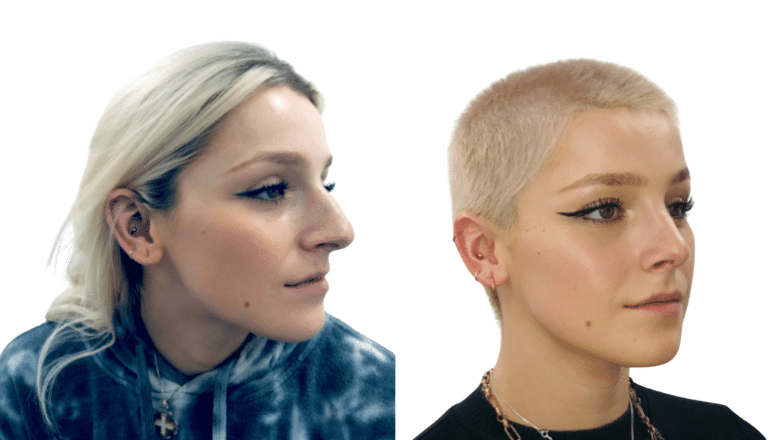


Dorsal hump before and after — bridge reduction nose job
14 photographs
A dorsal hump is one of the most common reasons patients seek a rhinoplasty. These results show reduction of the bony-cartilaginous hump and straightening of the nasal bridge for a smoother side profile. For more on the causes of nasal bumps, see our guide to the dorsal hump and removal options.


Tip rhinoplasty before and after — bulbous tip and functional rhinoplasty
6 photographs
A bulbous tip is one of the commonest reasons patients ask about a nose job, and it can often be addressed without altering the bridge. Read more about tip rhinoplasty.
Tip rhinoplasty refines a bulbous, drooping or poorly defined nasal tip, and can be combined with functional correction to improve breathing. Related reading: what causes a droopy nose.


Septorhinoplasty before and after — crooked nose and deviated septum
3 photographs
These patients had a functional and a cosmetic concern addressed together. Read more about septorhinoplasty, or septoplasty if only the breathing needs correcting.
Septorhinoplasty combines cosmetic reshaping with functional correction of a deviated septum, straightening a crooked nose while improving the airway. See our overview of nose surgery and the pros and cons of deviated septum surgery.

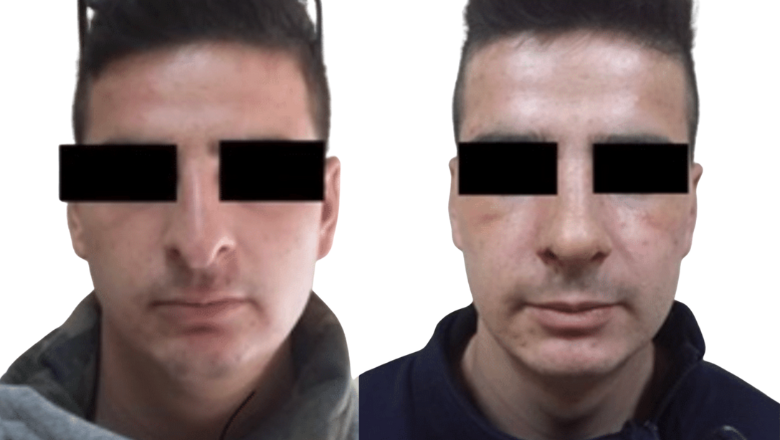

Liquid nose job before and after — non-surgical rhinoplasty
1 photograph
Filler can camouflage a dorsal hump or lift a drooping tip, but it adds volume rather than removing it and the result is temporary. Read more about non-surgical rhinoplasty.
Non-surgical rhinoplasty uses dermal filler to camouflage minor irregularities and refine nasal contour without surgery; most people go back to normal activities the same day. It suits selected concerns only; a surgical rhinoplasty remains the option for structural change. This section is seeded with one example and will grow as further cases are added.

Ethnic Rhinoplasty — Before & After
6 photographs
Ethnic rhinoplasty refines nasal shape while preserving the patient’s ethnic identity and facial harmony. Learn more about ethnic rhinoplasty and Indian and Pakistani rhinoplasty.


Men’s nose job before and after — male rhinoplasty
7 photographs
Male rhinoplasty aims at a different endpoint from female rhinoplasty — a straighter dorsum, a less rotated tip, and preservation of a defined nasofrontal angle. Read more about male rhinoplasty.
Male rhinoplasty preserves stronger nasal lines and a profile in proportion with typically broader male features, while addressing the patient’s specific concerns such as hump removal, tip projection or bridge asymmetry. Explore rhinoplasty at Centre for Surgery.


Revision rhinoplasty before and after — correcting a previous nose job
3 photographs
These are patients whose first operation was performed elsewhere. Read more about revision rhinoplasty and what makes a second operation more complex than a first.
Revision rhinoplasty corrects or improves the result of a previous nose job — a technically complex procedure requiring specialist expertise in working with scar tissue and altered anatomy. Our surgeons handle a wide range of revision cases, from minor refinements through to full reconstructive corrections.


About These Rhinoplasty Before and After Photos
The rhinoplasty before and after photos above are presented for educational purposes only and should be interpreted subjectively. They do not represent the opinion or view of any patient regarding their result, and they are not intended to suggest the result that any other patient may achieve. No two patients are alike, and no two results are necessarily alike. Only a personal consultation with your surgeon can provide you with a reasonable expectation of the results you may achieve from any specific procedure. All patients featured have given written consent for their photographs to be published.
How to Read Rhinoplasty Before and After Photos
Before and after photographs are the most useful evidence available to someone choosing a surgeon — and the easiest to present misleadingly. Knowing how to read them properly is worth more than looking at a hundred of them.
Compare like with like
A front-view “before” set against an oblique “after” is not a comparison. The nose is a three-dimensional structure, and rotating the head even slightly changes its apparent width, tip projection and dorsal line. Every pair in the gallery above shows the same view before and after. If a gallery elsewhere switches angles between the two frames, treat the result as unproven rather than impressive.
Watch the chin
Tilting the chin upward shortens the nose and lifts the apparent tip; tilting it down lengthens and droops it. This single variable can manufacture the appearance of a tip rotation that never happened. In a trustworthy photograph, the Frankfort horizontal — an imaginary line from the ear canal to the base of the eye socket — is level in both frames.
Check the lighting
Harsh side-lighting exaggerates a dorsal hump by casting a shadow beneath it; flat frontal lighting flattens it. A hump can be made to look larger before and smaller after with no surgery at all. Look for consistent light direction and intensity across the pair.
Look at the whole face
A good rhinoplasty is judged in the context of the face, not in isolation. Photographs cropped tightly to the nose remove the very information you need — whether the new nose is in proportion with the chin, the brow and the midface. Every image above shows enough of the face to make that judgement.
Ask when the photograph was taken
This is the question almost nobody asks, and it matters more than any other. See below.
What Stage of Healing You’re Looking At
A rhinoplasty result does not arrive on a fixed date. Swelling resolves unevenly across the nose and over a long period, which means the same patient photographed at six weeks, six months and two years will appear to have had three different operations.
The bony bridge settles comparatively early. The tip is the slowest part of the nose to declare itself, because the skin there is thickest and the underlying framework has been most disturbed. Patients with thicker, more sebaceous skin wait longest of all — the definition achieved on the operating table is masked by soft tissue that may take a year or more to redrape.
At Centre for Surgery, most patients return to work within two weeks, and the final result continues to settle over approximately twelve months.
The practical consequence for anyone browsing photographs: an early post-operative photograph systematically understates the result. A tip that looks slightly full at three months may be well-defined at twelve. Conversely, a gallery that publishes only long-interval photographs is showing you the most flattering moment. Neither is dishonest on its own — but you are entitled to ask which you are looking at, and any surgeon should be able to tell you.
The after photographs in this gallery were taken at least six months after surgery or treatment, unless the caption says otherwise. For what to expect at each stage before then, see our rhinoplasty recovery guide.
What These Photographs Cannot Show You
There is a limit to what any gallery can tell you, and a clinic that pretends otherwise is selling rather than informing.
- Breathing. A septorhinoplasty may transform a patient’s airway while barely altering the photograph. The most important result of a functional rhinoplasty is invisible.
- Your skin. Skin thickness governs how much definition is achievable. A patient with thin skin will show fine structural detail; thicker skin conceals it. This is the single most common reason two technically identical operations produce different-looking results, and it is decided before the surgeon begins.
- Your starting anatomy. The bone and cartilage beneath the skin differ from person to person. A result achieved on one nasal framework is not a prediction of what can be achieved on yours.
- The scar. In open rhinoplasty a small incision crosses the columella, the strip of skin between the nostrils. It is rarely visible in a standard front or profile view — so its absence from these photographs is not evidence of its absence from the patient.
- How it felt. Photographs record noses, not recovery, not the weeks of congestion, and not whether the patient felt properly informed beforehand. For that, read our independent patient reviews ↗.
None of this is a reason to distrust before and after photographs. It is a reason to treat them as the beginning of a conversation with a surgeon rather than the end of one.
Rhinoplasty Results: Common Questions
How long does a rhinoplasty last?
The structural changes are permanent: bone and cartilage that are removed or reshaped do not grow back. Swelling settles slowly, particularly at the tip, so the final shape can take 12 months or more to show. After that, the nose ages with the rest of the face, and the skin and soft tissue continue to change gradually over the decades.
What is the best age for a nose job?
Surgery is usually considered once the nose has finished growing, which is typically by the late teens. There is no upper age limit. General health and skin quality matter more than age, because thicker or older skin affects how much definition a rhinoplasty can show. Having a nose job in your thirties or later is common.
How risky is a nose job?
Rhinoplasty is a routine operation, but like any surgery it carries risks, including bleeding, infection, prolonged swelling, changes in breathing, numbness at the tip, asymmetry and a result you are unhappy with. Some patients go on to need revision surgery. Your surgeon will explain the risks that apply to your nose, and we recommend a two-week cooling-off period before you decide.
Rhinoplasty Surgery at Centre for Surgery
Centre for Surgery is a private hospital for plastic and cosmetic surgery on Baker Street in Marylebone, London, registered with and independently inspected by the Care Quality Commission. Our surgeons perform primary, revision and functional rhinoplasty, and each patient’s treatment plan is designed around their individual anatomy, facial proportions, and aesthetic goals.
Specialist Rhinoplasty Surgeons
Every surgeon on our team is GMC-registered and independently verifiable on the General Medical Council register. Our surgeons work across the full rhinoplasty spectrum — from tip refinement and hump removal through to complex revision cases requiring structural reconstruction. Every operation is performed under TIVA anaesthetic at our purpose-built facility, and you have your surgeon’s direct number for the first 24 hours after surgery.
Personalised Consultations with 3D Imaging
At your consultation, your surgeon will assess your nasal anatomy in detail and discuss your goals openly. We use 3D imaging technology to help you visualise potential outcomes before you commit to anything, ensuring your expectations are well-founded and your decision is fully informed. Imaging is a communication tool, not a guarantee — it shows what your surgeon is aiming for, not what is promised.
Aftercare and Follow-Up
You have your surgeon’s direct number for the first 24 hours after your procedure, and our nursing team is available from 9am to 6pm, Monday to Saturday. You will be seen by your surgeon at regular post-operative appointments, and our scar management programme is included as standard. Most patients return to work within two weeks and see their final result settle over 12 months.
Verified Patient Reviews
We invite you to read what our rhinoplasty patients say on independent, verified review platforms. Every review is publicly verifiable, dated, and linked to a real named patient.
- Google Reviews: Read our Google reviews ↗ — rated 4.6 stars based on hundreds of verified patient reviews.
- Patient reviews page: Read patient reviews by procedure — Google and Trustpilot reviews brought together on our own site.
As a CQC-regulated provider, every surgeon on our team is GMC-registered and independently verifiable. View our CQC rating.
Related Reading
- Can Rhinoplasty Fix a Wide Nose?
- At What Age Can I Have A Rhinoplasty?
- Is Ultrasonic Rhinoplasty Less Painful Than Traditional Nose Surgery?
Explore More Before and After Galleries
View our full collection of plastic surgery before and after photos, or browse related facial procedure galleries: Blepharoplasty Before and After Photos | Facelift Before and After Photos | Neck Lift Before and After Photos
Subject to status, we offer finance options with Chrysalis Finance. For a full price breakdown, see our rhinoplasty cost guide. Learn more on our About Us page, browse our Plastic Surgery Blog, or find answers in our Clinic FAQs.
To book a consultation, call us on 020 7993 4849 or complete the contact form below.