


In this guide10 sections
- What Is the Minimum Age for Breast Augmentation in the UK?
- Why 18? Two Factors That Matter
- Are There Exceptions Under 18?
- Breast Augmentation Later in Life — Is There an Upper Age Limit?
- Timing Around Pregnancy and Breastfeeding
- What Your Surgeon Actually Assesses at Consultation
- Choosing the Right Time — Beyond Age
- What Age Do Most Patients Choose Breast Augmentation?
- Frequently Asked Questions
- Breast Augmentation at Centre for Surgery
“What is the ideal age for a breast augmentation?” is one of the most common questions our surgeons hear at consultation. The honest answer has two parts. There’s a legal minimum — 18 in the UK — that applies to everyone. And there’s a personal “right time,” which has much more to do with where you are in life than how many candles were on your last birthday cake.
This guide covers both — the best age for breast implants from a purely legal standpoint, and the best age for breast augmentation from a personal-readiness one. We’ll explain why 18 is the minimum, what — if anything — changes below that age, whether there’s an upper limit for older patients, how a consultation actually assesses suitability, and how to think about timing around pregnancy, family planning, and your own readiness — so you can make a genuinely informed decision rather than guessing at what “normal” looks like.
What Is the Minimum Age for Breast Augmentation in the UK?
The minimum age for breast augmentation in the UK is 18. This isn’t a clinic policy that varies from surgeon to surgeon — it reflects the position taken across UK cosmetic surgery, and it’s the age at which someone is legally recognised as an adult with full autonomy over decisions about their own body, including elective surgery.
At Centre for Surgery, we do not perform breast augmentation for cosmetic reasons on anyone under 18. This is a firm position, not a case-by-case judgement call — and it’s worth being upfront about why.
Why 18? Two Factors That Matter
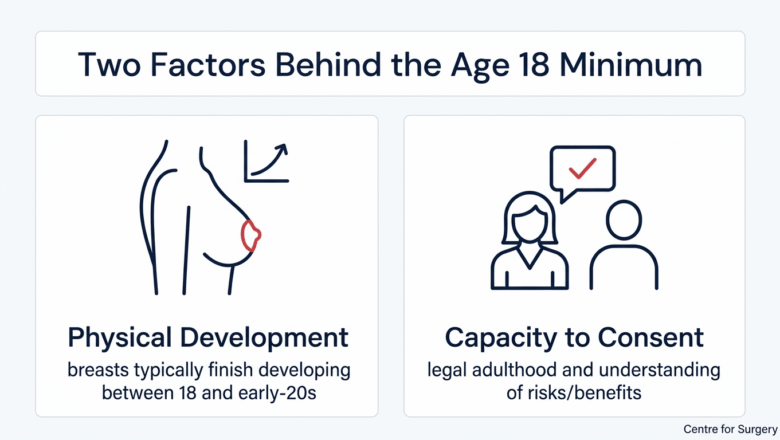
Physical breast development
Breast development is a process, not an event. It typically takes place over two to five years and, for most people, is largely complete by around 17 to 18. But “most people” isn’t “everyone” — a meaningful number of women continue to see subtle changes in breast size and shape into their early 20s, as hormonal patterns settle and body composition stabilises.
This matters because breast augmentation works with what’s already there — an implant sits behind existing breast tissue, and its final appearance depends on that tissue’s shape, elasticity, and volume. Operating before development is complete risks a result that looks proportionate today and disproportionate in three years, once the breast has continued to change around an implant that hasn’t. It also makes accurate implant sizing far harder, since you’d be sizing against a moving target. This is one of the reasons your surgeon will assess breast development directly at consultation, not just check your date of birth.
Capacity to give informed consent
The second factor is less about the body and more about the decision itself. Breast augmentation is elective, carries a genuinely permanent-feeling outcome (implants don’t last forever, but the decision to have surgery is not something to treat lightly), and involves real risks — bleeding, infection, capsular contracture, the eventual need for revision surgery, changes in nipple sensation. Eighteen is the age at which the law recognises someone as having full legal capacity to weigh those risks and benefits and consent to surgery on their own behalf, without a parent or guardian’s involvement being a legal requirement.
That’s a legal line, not a claim that every 18-year-old is automatically ready and every 17-year-old isn’t. Readiness is genuinely individual — which is exactly why the consultation process exists: to have that conversation properly, rather than assume it from an age on a form.
Are There Exceptions Under 18?
Occasionally. UK clinical guidance recognises that in rare, specific medical circumstances, breast surgery in a patient under 18 may be appropriate. The circumstances usually involved include:
- Significant congenital breast asymmetry — where one breast has developed substantially differently from the other, beyond the mild asymmetry that’s normal for almost everyone.
- Tuberous (tubular) breast deformity — a developmental condition where tight, constricted breast tissue results in a narrow, elongated breast shape rather than typical development.
- Reconstruction following injury or illness — where the breast has been damaged by trauma or a medical condition and surgery is needed to restore its structure, not just its appearance.
Where a case like this is genuinely medical rather than cosmetic, it’s typically assessed and managed through NHS specialist paediatric or oncoplastic breast services, which are set up for exactly this kind of case — with the multidisciplinary input, safeguarding processes, and long-term follow-up that it requires.
Centre for Surgery is a private cosmetic surgery clinic, not a paediatric or reconstructive breast unit, and we don’t perform breast augmentation on under-18s under any circumstances, medical or cosmetic. If you’re a parent or a young person dealing with a genuine congenital breast concern, your GP is the right first point of contact for a referral to NHS specialist care. If you’re an adult with lifelong asymmetry or a condition like tuberous breasts that you’d like addressed now, that’s exactly the kind of case our breast asymmetry correction service is built for.
Breast Augmentation Later in Life — Is There an Upper Age Limit?
No. There is no upper age limit for breast augmentation. Patients in their 50s, 60s, and beyond have breast augmentation regularly, and age on its own is not a barrier.
What matters for older patients isn’t age as a number — it’s general health and fitness for anaesthesia. Breast augmentation at Centre for Surgery is performed under TIVA (Total Intravenous Anaesthesia) as a day case, and your surgeon and anaesthetist will assess your overall health, any medications you take, and any underlying conditions at consultation, exactly as they would for a patient of any age. Healing can be marginally slower with age, and that’s factored into your recovery plan — it’s a practical consideration, not a reason to rule surgery out.
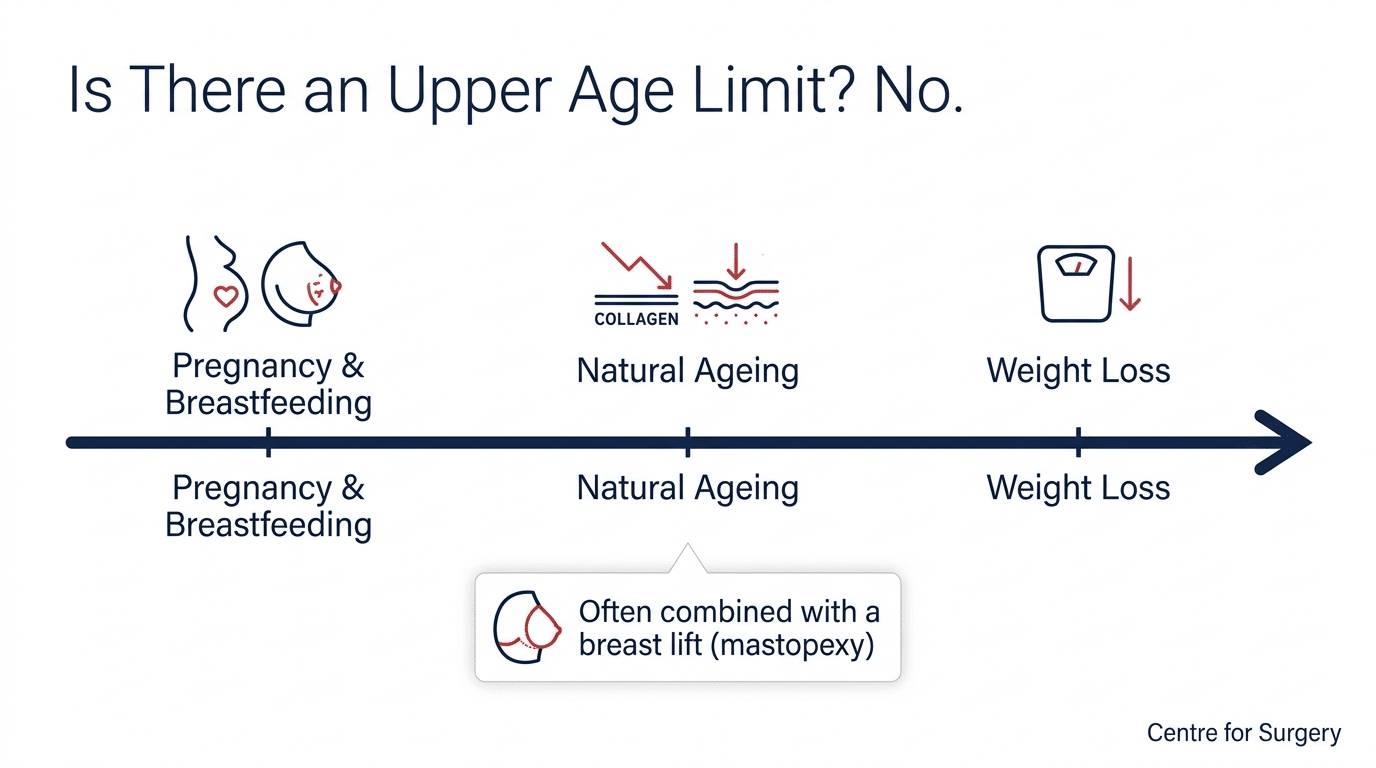
There are also common, entirely normal reasons why breast implants after 50 — or later — become relevant, rather than earlier:
- Pregnancy and breastfeeding change breast volume and shape, sometimes considerably — many patients come to breast augmentation specifically to address the after-effects, once their family is complete.
- Natural ageing reduces skin elasticity as collagen and elastin break down over time, which can lead to volume loss and a change in breast position.
- Weight loss, whether gradual or significant, often leaves the breasts smaller and less full than before.
In many of these cases, volume loss is accompanied by some degree of sagging — which means an implant alone may not give the result you’re picturing. An implant restores volume; it doesn’t lift tissue that has dropped. Where that’s the case, your surgeon may recommend combining augmentation with a breast lift (known as augmentation-mastopexy) to address position and shape as well as size. We cover this life stage in more detail in our dedicated guide to breast augmentation in your 50s and 60s.
Timing Around Pregnancy and Breastfeeding
If you know you’d like to have children in the future, it’s generally worth waiting until your family is complete before having breast augmentation. Pregnancy and breastfeeding change breast tissue regardless of whether implants are present, and those changes can affect the appearance of a previous augmentation — sometimes enough that patients choose to have revision surgery afterwards to restore the result they originally had.
This isn’t a hard rule. Plenty of women have breast augmentation before having children and are glad they did — it’s simply useful to understand that pregnancy afterwards may change your result, and that’s a normal, expected part of the picture rather than something having gone wrong. If you do have implants and later breastfeed, our guide on breastfeeding with implants covers what to expect in detail.
What Your Surgeon Actually Assesses at Consultation
Age is one data point among many at your consultation — and, on its own, one of the least informative. Here’s what your surgeon is genuinely assessing, regardless of how old you are:
Breast development and existing tissue
Your surgeon will examine your breasts directly — their current size, shape, symmetry, skin elasticity, and how much natural tissue is present to work with. This tells them far more about what’s achievable than your date of birth does, and it’s the basis for discussing realistic implant sizes and profiles.
Whether augmentation is even the right procedure
Not every patient who books a breast augmentation consultation actually needs one. If your primary concern is sagging rather than lost volume, an implant alone won’t solve it — you may need a breast lift instead, or in combination. Part of a thorough consultation is your surgeon telling you honestly if a different procedure, or a combination, would serve you better than the one you walked in asking for.
General health and anaesthetic fitness
Your surgeon and anaesthetist will review your medical history, current medications, and any underlying conditions to confirm you’re fit for TIVA anaesthesia and day-case surgery. This applies at every age — it’s simply a more detailed conversation for patients with existing health conditions, which becomes statistically more common later in life, though it’s never assumed based on age alone.
Your goals and expectations
What are you actually hoping to change, and is it achievable with your anatomy? Photos of results you like are a useful starting point, but your surgeon’s job is to translate that into what’s realistic for your specific breast tissue, chest shape, and skin quality — not to promise a look that belongs to someone else’s body.
Every consultation at Centre for Surgery includes a recommended two-week cooling-off period before surgery, regardless of how ready you feel on the day. This isn’t a sales delay tactic — it’s a genuine safeguard to ensure the decision is yours, made with time to reflect, rather than one made in the moment.
Choosing the Right Time — Beyond Age
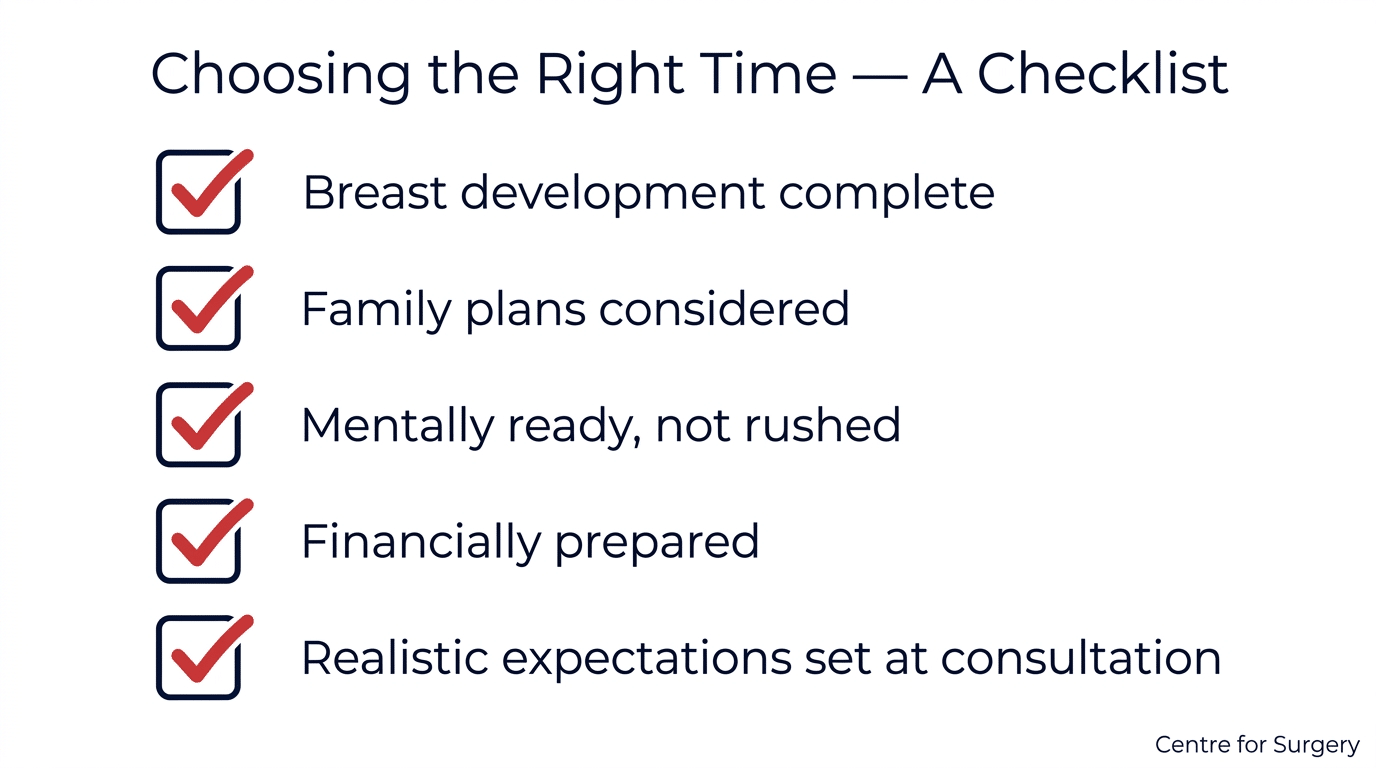
Once the legal minimum is satisfied, age tells you very little about whether now is the right time. A few things matter far more:
Mental readiness
Breast augmentation should be a decision you’ve arrived at yourself, with time to research and reflect, rather than one made in a hurry or under pressure from someone else — a partner, a trend, or a milestone birthday. Patients who take the time to understand what the procedure actually involves — including recovery, the realistic range of outcomes, and the fact that implants aren’t a lifetime device — tend to be considerably more satisfied with their results than those who rush in without that groundwork.
Financial readiness
Current prices for breast augmentation with Silimed silicone implants, on its own or combined with a breast lift (augmentation-mastopexy), are set out in our breast augmentation cost guide. This is a genuine investment, and we’d always recommend budgeting for it properly rather than stretching finances to have surgery sooner than you’re ready to pay for. Your final quote is confirmed after your in-person consultation, once your surgeon has assessed your anatomy and agreed a surgical plan with you. We offer finance through Chrysalis Finance to help spread the cost — see our finance options for details.
Realistic expectations
The best outcomes come from patients who understand what breast augmentation can and can’t do for their specific anatomy. That’s the whole purpose of your consultation — it’s where your surgeon examines your existing breast tissue, discusses your goals, and gives you an honest picture of what’s achievable, rather than a generic promise that fits every body the same way.
Life stage and stability
Are you about to go through a major life change — a house move, a new job, planned pregnancy, significant weight change? None of these rule out breast augmentation, but recovery is easier and results are more predictable when your weight and general circumstances are relatively stable in the months around surgery.
What Age Do Most Patients Choose Breast Augmentation?
There’s no single typical age — patients come to us anywhere from their late teens through to their 70s, for genuinely different reasons at each stage, and all of them are equally valid.
Younger patients, in their late teens and early 20s, are often addressing breasts they feel are disproportionately small for their frame, or a longstanding asymmetry they’re now old enough to decide to correct for themselves. Patients in their 30s and 40s frequently come in after pregnancy and breastfeeding, sometimes combining augmentation with a mummy makeover to address several post-pregnancy changes in one operation. Patients in their 50s and beyond are often addressing volume loss from ageing or significant weight loss, frequently alongside a breast lift.
None of these is more “correct” than the others — what matters is that the timing is right for you, not that it matches a particular statistic or what a friend or family member did at your age.
Frequently Asked Questions
What is the best age for breast implants?
Legally, the earliest is 18 — the minimum age for breast augmentation in the UK. Beyond that legal floor, there’s no single “best” age: it depends on your breast development, family plans, and personal readiness, which is exactly what your consultation is for.
What is the youngest age you can get a boob job in the UK?
18. This is the minimum age for breast augmentation for cosmetic reasons in the UK, and Centre for Surgery does not perform this procedure on anyone younger, regardless of circumstances.
Is there an age limit for breast implants?
There’s a minimum age of 18, but no upper age limit. Older patients are assessed on general health and fitness for anaesthesia rather than age alone, and breast augmentation remains a safe, well-established option well into later life.
Can I have breast augmentation if my breasts haven’t fully developed?
It’s not advisable. Operating before breast development is complete makes accurate sizing difficult and risks a result that becomes disproportionate as the breast continues to change afterwards. Your surgeon will assess whether your breasts are fully developed at consultation, not just check your age.
Should I wait until after having children to get breast implants?
If you know you want children in the future, waiting until your family is complete is generally advisable, since pregnancy and breastfeeding can change the appearance of a previous augmentation. It isn’t a strict requirement, but it’s worth factoring into your decision and discussing with your surgeon.
Is 40, 50, or 60 too old for breast augmentation?
No. Age alone is not a barrier at any of these stages — general health and fitness for anaesthesia are what matter. Many patients in this age range choose breast augmentation, often combined with a breast lift, to address changes from ageing, weight loss, or pregnancy.
How much does breast augmentation cost at Centre for Surgery?
Current prices are set out in our breast augmentation cost guide. Your exact price is confirmed at your in-person consultation. Finance is available through Chrysalis Finance.
Does my surgeon ever recommend waiting, even if I meet the age requirement?
Yes, and this happens more often than people expect. If your surgeon feels your breast development isn’t yet complete, that a breast lift would serve you better than an implant, or simply that you’d benefit from more time to consider the decision, they’ll say so directly rather than proceeding regardless.
Breast Augmentation at Centre for Surgery
Centre for Surgery is a CQC-regulated clinic at 95–97 Baker Street, London, rated “Good” overall by the Care Quality Commission. All breast augmentation is performed by GMC-registered plastic surgeons, under TIVA anaesthesia, using Silimed silicone implants. Our medical content is reviewed by Specialist Plastic Surgeon Dr Spyridon Vlachos (GMC 7522950).
Whatever stage of life you’re at, the right next step is the same: a face-to-face consultation, where your surgeon can assess your individual anatomy and goals and give you an honest answer about what’s achievable and when — including telling you if now isn’t quite the right time yet.
To book a consultation, call 020 7993 4849, email contact@centreforsurgery.com, or use our contact form.
Related Articles
- Breast Augmentation in Your 50s and 60s: What You Need to Know
- Breast Reduction Age: What’s the Minimum Age in the UK?
- Pregnancy and Breastfeeding After Breast Enlargement
- Tuberous or Tubular Breasts