


In this guide11 sections
- Brow Lift vs Blepharoplasty — The Short Answer
- The Brow Position Test — How to Tell Which You Need
- What Upper Blepharoplasty Does
- What a Brow Lift Does
- Why the Wrong Choice Causes Problems
- Can You Have Both?
- Recovery Compared
- Which Is Better Value?
- Who Is Not Suitable for Either
- Frequently Asked Questions
- How We Assess Which You Need
If your upper eyelids look heavy, there are only two operations that will meaningfully change it — and choosing the wrong one is the single most common reason people are disappointed with eyelid surgery. A blepharoplasty removes excess skin from the eyelid itself. A brow lift raises the eyebrow that is pressing down on it. They look similar in before-and-after photographs and they are not interchangeable.
The distinction matters because a patient whose heaviness comes from a descended brow will get a poor result from blepharoplasty alone — and, worse, removing eyelid skin from that patient can pull the brow down further and make the problem look worse. This guide explains how to tell which one you need, using the same assessment a surgeon performs at consultation.
Brow Lift vs Blepharoplasty — The Short Answer
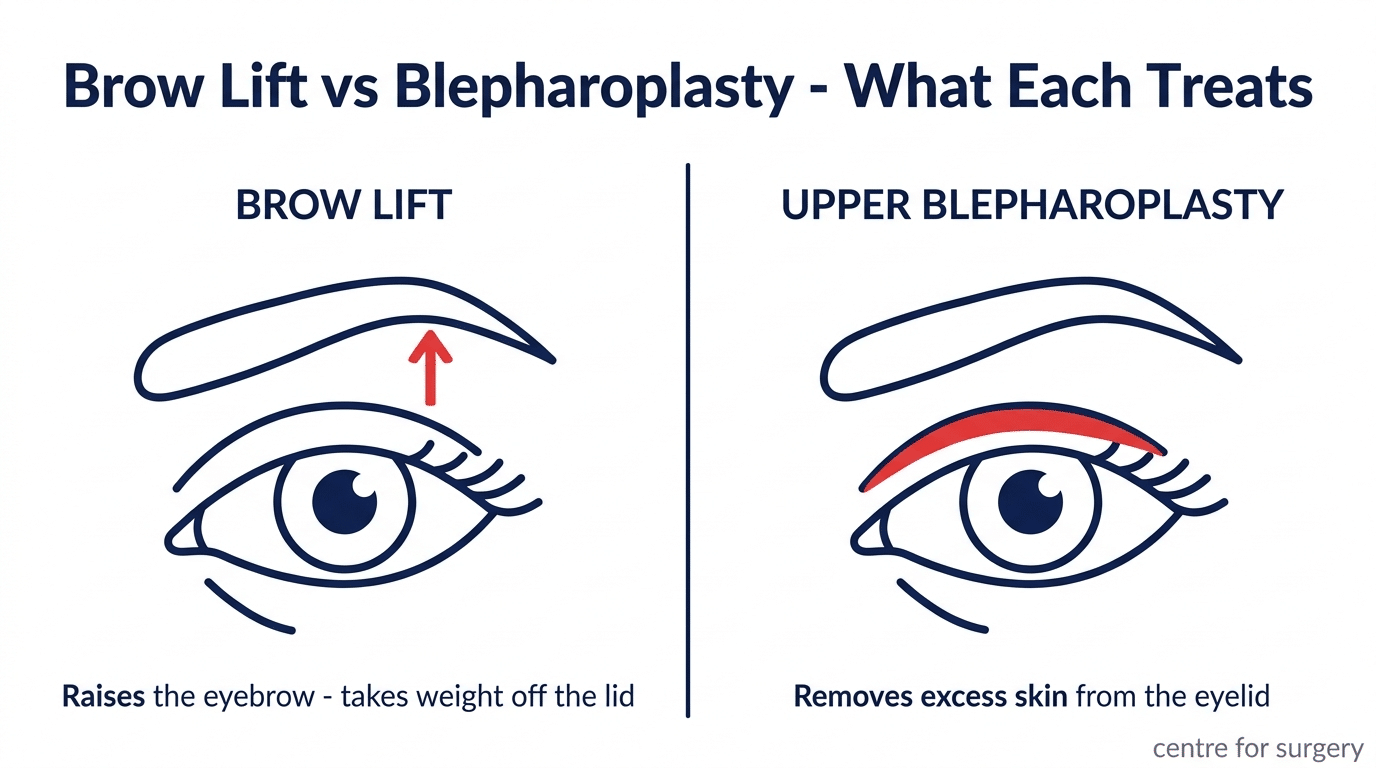
The two procedures treat different structures at different heights of the face:
- Upper blepharoplasty removes a measured strip of excess skin from the upper eyelid, with conservative fat adjustment where needed. The incision sits in the natural eyelid crease. It treats the eyelid.
- Brow lift repositions the eyebrow and forehead tissue upward to its natural height, taking weight off the upper lid. It treats the brow.
If the heaviness is skin sitting on the lid, blepharoplasty is the answer. If the heaviness is your eyebrow sitting too low and pushing tissue down onto the lid, a brow lift is the answer. A significant proportion of patients have both, and in those cases the two are performed together.
The Brow Position Test — How to Tell Which You Need
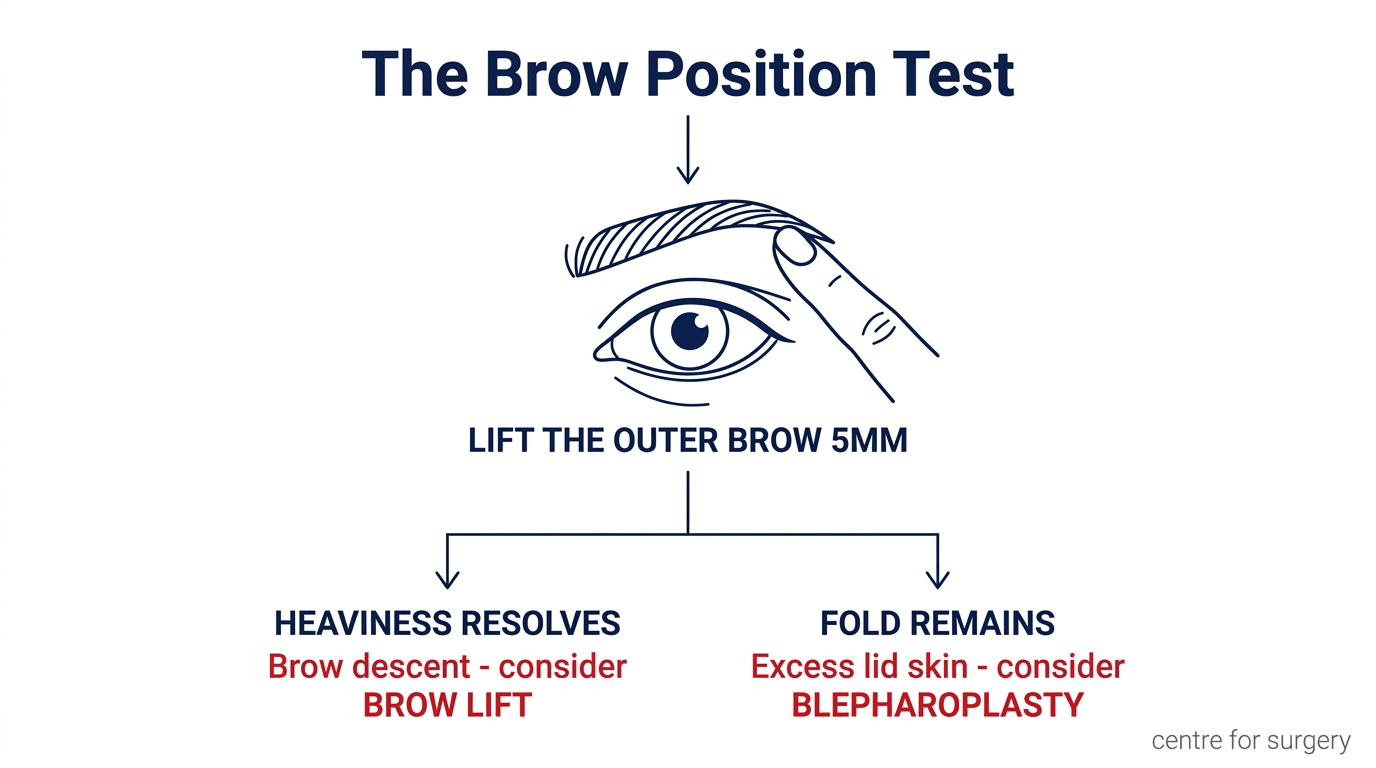
There is a simple self-assessment that gives you a strong indication before you ever see a surgeon. It is the same manoeuvre performed at consultation.
Stand in front of a mirror in even light, face relaxed, eyes open and looking straight ahead. Do not raise your eyebrows — most people with heavy lids lift their brows unconsciously, so consciously let the forehead go slack. Then:
- Place a fingertip on the tail of one eyebrow, at the outer end.
- Lift the brow gently upward by about half a centimetre — roughly to where it sat in photographs of you ten years ago.
- Watch what happens to the heaviness over the eyelid.
If lifting the brow resolves most of the heaviness, the problem is largely brow descent, and a brow lift is likely to be the more appropriate procedure. Removing eyelid skin in this situation treats the symptom rather than the cause.
If the fold of skin remains obvious even with the brow lifted, you have genuine excess eyelid skin, and upper blepharoplasty is indicated.
If lifting helps but a fold still remains, both are contributing — which is the most common finding in patients over fifty, and the reason combined procedures are so frequently recommended.
This test is indicative rather than diagnostic. Brow height, eyelid skin quality, levator muscle function, the position of the fat pads and the height of the natural crease all interact, and a proper assessment measures several of them. But it will tell you which conversation to have.
What Upper Blepharoplasty Does
Upper blepharoplasty is the removal of redundant upper eyelid skin — clinically termed dermatochalasis — through an incision placed in the natural crease of the lid, where the healed scar sits hidden within the fold.
The measurement is the operation. Too little skin removed and the hooding persists; too much and the eye cannot close fully, producing exposure, dryness and in severe cases corneal damage. A conservative approach that leaves adequate skin for complete closure is not caution for its own sake — it is the difference between a refreshed result and a complication that is difficult to reverse.
Where a small amount of fat has prolapsed forward, usually at the inner corner, this is trimmed or repositioned at the same time. Aggressive fat removal here creates a hollowed, skeletal upper lid that ages the face and is the clearest signal of an over-done blepharoplasty.
Blepharoplasty is the right choice when: the brow sits at a reasonable height, the excess is clearly in the lid skin, the fold persists when the brow is manually lifted, and the concern is a heavy or hooded lid rather than a low eyebrow.
What a Brow Lift Does
A brow lift repositions the eyebrow and the forehead soft tissue upward, restoring the brow to a natural height. The brow sits directly above the eyelid, so lowering of the brow transfers weight onto the lid and produces hooding even where the eyelid skin itself is unchanged. Raising the brow removes that load.
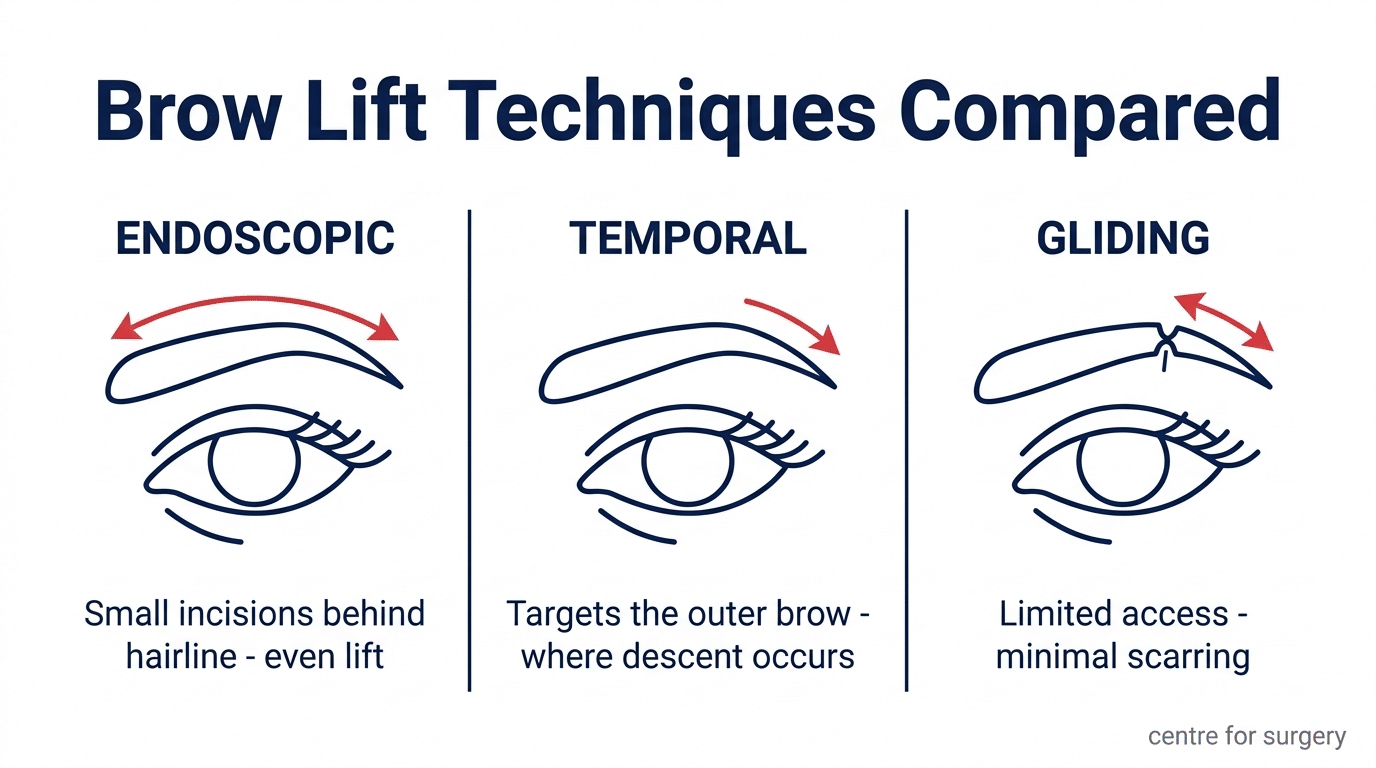
Several techniques exist, and the right one depends on how much lift is needed and where:
- Endoscopic brow lift — small incisions behind the hairline, camera-guided, suited to moderate lift across the whole brow with minimal scarring.
- Temporal brow lift — targets the outer third of the brow, where descent is usually most pronounced and most ageing.
- Gliding brow lift — repositions the brow through very limited access, with minimal visible scarring.
A brow lift is the right choice when: the eyebrow sits at or below the orbital rim, the heaviness largely resolves on the brow position test, the outer brow has dropped, or you find yourself constantly raising your forehead to open your eyes — a compensatory habit that produces deep horizontal forehead lines over time.
Why the Wrong Choice Causes Problems
This is the part most comparison articles omit, and it is the reason the distinction matters clinically rather than academically.
If a patient with significant brow descent has upper blepharoplasty alone, two things happen. First, the result underwhelms — the skin is gone but the brow is still pressing down, so the eye still looks heavy. Second, and more importantly, removing eyelid skin can tether the brow slightly lower, because the eyelid skin was contributing to holding it up. The patient may end up looking marginally worse in the brow region while having spent several thousand pounds and taken two weeks off work.
The reverse error is less damaging but still wasteful: a brow lift performed on a patient whose problem is genuinely excess lid skin will raise the eyebrow into an unnaturally high, surprised position while leaving the hooding largely intact.
This is why the assessment matters more than the procedure, and why a surgeon who recommends the same operation to every patient with heavy eyelids should be treated with caution.
Can You Have Both?
Yes, and in patients over fifty it is frequently the best answer. Combining an upper blepharoplasty with a brow lift in a single session addresses both the lid skin and the brow position together, produces a more harmonious result than either alone, and means one recovery period rather than two.
The sequencing matters technically. The brow is lifted first, because raising the brow changes how much eyelid skin is genuinely surplus. Measuring the eyelid before the brow is repositioned risks removing too much — one of the more avoidable causes of over-correction.
Recovery Compared

| Upper blepharoplasty | Brow lift | |
| Anaesthetic | Local, or TIVA | TIVA |
| Procedure time | 1–1.5 hours | 1–2 hours |
| Sutures out | 5–7 days | 7–10 days |
| Back to desk work | 7–10 days | 10–14 days |
| Bruising resolved | ~2 weeks | 2–3 weeks |
| Full exercise | 4–6 weeks | 6 weeks |
| Settled result | 3–6 months | 3–6 months |
| Longevity | 10+ years | Varies by technique |
Combined procedures follow the longer of the two timelines. Full detail is in our guide to blepharoplasty recovery.
Which Is Better Value?
Neither is inherently better value — the cheaper operation is poor value if it is the wrong one. A blepharoplasty that fails to address a descended brow is money spent on an unsatisfactory result, and revision surgery costs more than getting it right initially.
Current pricing is set out on our blepharoplasty cost and brow lift cost pages. Finance is available through Chrysalis Finance on treatments over £1,500, subject to status.
Who Is Not Suitable for Either
- True eyelid ptosis — where the levator muscle is weak and the lid margin itself droops. This needs ptosis repair, not skin removal or brow elevation.
- Significant dry eye — both procedures can worsen it, and it needs assessment first.
- Thyroid eye disease or uncontrolled glaucoma — require ophthalmology input before any surgical plan.
- Active smoking — the strongest predictor of poor healing; you will be asked to stop for six weeks either side.
- Very high hairline with brow descent — some brow lift techniques raise the hairline further and may be unsuitable.
Frequently Asked Questions
Is a brow lift or blepharoplasty better for hooded eyes?
It depends entirely on whether the hooding comes from eyelid skin or brow descent. Use the brow position test above: if lifting the brow resolves the heaviness, a brow lift is likely more appropriate. If the fold persists, blepharoplasty is indicated. Many patients with hooded eyes need both.
Which procedure has the shorter recovery?
Upper blepharoplasty. Most patients return to desk work in 7 to 10 days versus 10 to 14 for a brow lift, and bruising settles roughly a week sooner.
Will a brow lift make me look surprised?
Not when the amount of lift is judged correctly. The surprised appearance comes from over-elevation, particularly of the inner brow. Modern technique lifts the outer brow more than the inner, which is where descent actually occurs and which preserves a natural brow shape.
Can a brow lift replace blepharoplasty?
Only where brow descent is the sole cause. Where genuine excess eyelid skin is present, a brow lift will not remove it.
Does either procedure treat under-eye bags?
No. Both address the upper third of the eye area. Under-eye bags are a lower lid problem — see our guide to how to get rid of eye bags.
How long do the results last?
Upper blepharoplasty typically lasts 10 years or more. Brow lift longevity varies by technique and by individual ageing pattern. Neither halts ageing from the point of surgery onward.
Can non-surgical treatments do the same thing?
Only to a limited and temporary degree. Anti-wrinkle injections can produce a modest brow lift of one to two millimetres lasting three to four months, useful for mild brow descent. Nothing non-surgical removes excess eyelid skin.
How We Assess Which You Need
At consultation your surgeon measures brow height against the orbital rim, assesses the quantity and quality of upper lid skin, checks levator function to exclude ptosis, evaluates the position of the natural crease, and performs the manual brow elevation test to see how much of the heaviness is brow-driven.
You will be told directly if the procedure you came in asking about is not the right one — including where the honest answer is that neither is needed yet.
All eyelid and brow surgery at Centre for Surgery is performed by GMC-registered plastic surgeons at our day-surgery facility at 95–97 Baker Street, Marylebone. We are regulated by the Care Quality Commission and rated Good overall. We recommend a two-week cooling-off period before any procedure is booked.
Verified Patient Reviews
Our reviews are independently verified and can be read on Google Reviews ↗, or on our own patient reviews page. We are rated 4.6 on Google.
Book a Consultation
Phone: 020 7993 4849
Email: contact@centreforsurgery.com
Address: 95–97 Baker Street, Marylebone, London W1U 6RN
Contact us to schedule your consultation
Your initial in-person consultation is £100, redeemable against the cost of surgery if you proceed.