

In this guide15 sections
- Key Points
- What Is a Bleph? Bleph Meaning Explained
- What the BBC Investigation Found About Cheap Blephs Abroad
- The “Liverpool Bleph Lady”: Cheap Blephs Are Not Only an Abroad Problem
- Why Is Blepharoplasty Abroad So Cheap?
- Can’t Close Your Eyes After Blepharoplasty? Lagophthalmos Explained
- Other Blepharoplasty Complications to Know About
- Flying After Blepharoplasty: Why the First 24 Hours Matter
- What to Do If Your Eyes Won’t Close After Bleph Surgery
- Bleph Abroad vs Bleph in the UK: What You Are Actually Paying For
- How to Check a Blepharoplasty Surgeon, Wherever You Go
- Blepharoplasty Before and After
- Frequently Asked Questions
- Blepharoplasty at Centre for Surgery
- References
Key Points
- A bleph is eyelid surgery, not a tweakment. Upper blepharoplasty removes skin, and sometimes muscle and fat, from the eyelid. Once removed, that skin cannot be put back. If you want a non-surgical option, see our guide to non-surgical alternatives to blepharoplasty.
- The most common problem UK surgeons now see after a cheap bleph abroad is eyes that will not close properly. That was the top complication reported by 63 members of the British Oculoplastic Surgery Society in a survey for a September 2026 BBC investigation [1].
- An eye that cannot close is a medical problem, not just a cosmetic one. The surface of the eye dries out overnight, which can lead to pain, infection and scarring of the cornea if it is not managed. See our guide to dry eyes after blepharoplasty.
- Technique matters. In a meta-analysis of randomised trials, removing a strip of eyelid muscle along with the skin made incomplete closure around eight times more likely than removing skin alone [2].
- The riskiest window is the first 24 hours. Bleeding behind the eye affects roughly 1 in 2,000 eyelid operations, mostly within the first three hours, and can threaten sight if it is not treated quickly [5]. That is the window many overseas packages spend at the airport; our guide to flying after cosmetic surgery explains the timings.
- Most complications can be improved, but not quickly. Eye protection comes first; corrective eyelid surgery usually waits several months and can involve a skin graft.
Blepharoplasty, often shortened to “bleph” on social media, has become one of the most talked-about cosmetic procedures in the UK and one of the most common facial plastic surgeries. It has also become one of the most heavily discounted forms of eyelid surgery abroad, with overseas clinics advertising an upper bleph for a fraction of the UK price and marketing it as a quick, low-downtime fix. In September 2026 a BBC investigation reported on UK women left with open wounds and eyes that could not close after cheap eyelid surgery in mainland Europe, and UK eyelid surgeons said most of the complications they had seen in the past year followed surgery abroad.
This guide explains what a bleph actually involves, why some overseas procedures leave people unable to close their eyes, what the other blepharoplasty risks are, what to do if it has happened to you, and how to check any surgeon before you book. The NHS also publishes independent advice on cosmetic surgery abroad. If you are weighing up eyelid surgery, our blepharoplasty page covers the procedure in full, our guide to upper vs lower blepharoplasty explains which one you need, and if you are already dealing with a poor result, our guide to botched eyelid surgery covers correction.
What Is a Bleph? Bleph Meaning Explained
“Bleph” is short for blepharoplasty, surgery to the eyelids. An upper bleph removes excess skin from the upper lid to reduce hooding and droopy eyelids, sometimes with a small amount of muscle or fat. A lower bleph treats under-eye bags by removing or repositioning fat, and sometimes tightening skin, through an incision inside the lid or just below the lashes.
Upper blepharoplasty is often done under local anaesthetic and takes around an hour, which is partly why it is marketed as quick and easy. But it is still surgery on one of the most delicate and functionally important structures in the face. The upper eyelid protects the eye, spreads the tear film with every blink, and has to close completely during sleep. Every millimetre of skin removed changes how it does that, which is why eyelid surgery can be functional as well as cosmetic, and why it can change your eye shape if it is not planned carefully. Our guide to blepharoplasty under local anaesthetic or asleep explains how the anaesthetic is chosen.
Many people seeking an upper bleph have genuinely hooded eyelids. Others have a low brow that makes the lid look heavy, where removing eyelid skin is the wrong operation entirely and a brow lift is needed instead. Telling the two apart is one of the most important parts of a proper consultation, and one of the first things lost when the assessment happens over a video call or a messaging app. Our guides to heavy eyelids, the ideal age for blepharoplasty and how long blepharoplasty lasts cover what a good assessment looks at.
What the BBC Investigation Found About Cheap Blephs Abroad
The BBC investigation, published in September 2026, spoke to UK women who had travelled to mainland Europe for low-cost upper blepharoplasty after finding the procedure on social media. It reported that:
- UK eyelid surgeons said that when they had seen patients with blepharoplasty complications over the previous 12 months, most had been treated abroad
- In a survey of 63 members of the British Oculoplastic Surgery Society, the most common problem after overseas procedures was patients not being able to close their eyes properly
- Surgeons also reported complications after procedures by unregistered practitioners in the UK, including blephs carried out in living rooms
- Videos about blephs posted by UK social media accounts had been viewed nearly 150 million times in three years
Most of the women who spoke to the BBC had been treated by one company, Faceland, which offered an upper bleph for around €750 and told the BBC it had performed more than 2,950 procedures on UK patients at its clinics in the Netherlands, Germany and Switzerland since October 2024. The company said it offers safe, quality treatment, that all patients have a consultation and sign consent forms, and that fewer than 1% of procedures have led to a complaint. The BBC noted that this figure does not include everyone who needed revision surgery, and that the total number of complications is not known.
This is not a problem unique to one clinic or one country. UK hospital data show the same pattern across cosmetic surgery: at one London hospital, 96% of patients presenting with complications after cosmetic surgery had been operated on abroad, most of them in Turkey [8].
The “Liverpool Bleph Lady”: Cheap Blephs Are Not Only an Abroad Problem
The risks of a cheap bleph are not confined to clinics overseas. In July 2025, an undercover 5 News investigation filmed a woman with no verified UK medical qualifications offering upper and lower eyelid procedures from a flat above a restaurant in Liverpool, after reports that some patients had been left with serious facial disfigurement. Dubbed the “Liverpool bleph lady” on social media, the case went viral again in 2026, and the Liverpool Echo has since reported that she is planning a comeback in Germany. Responding to the 5 News footage, Health Secretary Wes Streeting said he would look at the law to close loopholes that allow unsafe, unregulated practice.
The case shows that the country matters less than the safeguards. An operation in a flat in Liverpool and a high-volume package abroad can share the same missing pieces: no specialist surgeon, no proper assessment, no regulated setting and no one to call when something goes wrong. The checks in our section on how to check a blepharoplasty surgeon apply wherever the surgery happens.
Why Is Blepharoplasty Abroad So Cheap?
Eyelid surgery has become one of the most common reasons UK patients travel for medical tourism, and prices abroad are often a fraction of UK eye surgery costs. The operation itself is not what makes the difference. A bleph costs broadly the same in time and materials wherever it is done. The saving usually comes from what is left out around it:
- The consultation. Assessment by photo, video call or WhatsApp, with the first in-person meeting on the day of surgery. That leaves no time to examine the brow, lid strength, tear film or existing dry eye, and no cooling-off period.
- Who operates. Some providers describe the person operating as a “practitioner” or “doctor” rather than a surgeon on the GMC specialist register with eyelid training. Our guide to choosing an eyelid surgeon explains what to look for.
- Volume. High-throughput clinics schedule many procedures a day. Patients in the BBC report described one clinic as running like a conveyor belt.
- Aftercare. Many packages involve arriving the day before and flying home the day after, or even the same day. Follow-up happens by email or message, if at all, and any problem is left to you, your GP and the NHS once you are home.
- Language and legal recourse. Explaining a problem to a clinic in another language, at a distance, is harder than it sounds, and if something goes wrong, making a complaint or a legal claim against a provider in another country is far more difficult than in the UK.
None of this shows up in the price you are quoted, but it is exactly where the risk sits. The advertising can make it harder to see: in 2024 the UK’s advertising regulator, the ASA, issued an enforcement notice to overseas cosmetic surgery providers targeting UK patients, citing ads that trivialised surgery, played down risks and pushed discounts. For UK prices and what they include, see our blepharoplasty cost guide.
Can’t Close Your Eyes After Blepharoplasty? Lagophthalmos Explained

The medical term for an eye that cannot close fully is lagophthalmos. After upper blepharoplasty it has three common causes:
- Too much skin removed. The upper lid needs enough skin to stretch down over the eye. Surgeons commonly aim to leave around 20 mm of skin between the lower edge of the eyebrow and the lash line, and mark the excision with the patient sitting up so the brow is in its natural position. Remove more than that and the lid is simply too short to close.
- Too much muscle removed. The orbicularis muscle that sits under the skin is the muscle that closes the eye. In a meta-analysis of 12 randomised trials, removing a strip of muscle along with the skin made lagophthalmos around eight times more likely than a skin-only excision, with no difference in patient satisfaction [2]. A split-face trial reached the same conclusion: slower closure, lagophthalmos and dry eye were all more common on the side where muscle was removed [3].
- Scarring and tightness. Swelling and early scar contracture can pull the lid up in the first weeks, and a poorly placed or tight closure can make it worse.
Some difficulty closing the eyes fully is common in the first days after any upper bleph while the lids are swollen, and it usually settles as swelling goes down. Closure that has not improved after a few weeks, or that leaves the eye visibly open during sleep, needs assessment.
Why an eye that won’t close matters
The front of the eye relies on the lids to keep it covered and moist. If the eye stays slightly open at night, the cornea dries out, becoming gritty, red, painful and watery, and in more severe cases it can ulcerate or become infected. Dry eye after blepharoplasty is common even when surgery goes well: in a review of 892 cases, around a quarter of patients reported dry eye symptoms afterwards, and lagophthalmos was one of the factors that significantly increased the risk [4]. The more skin and muscle removed, the more likely it becomes.
Other Blepharoplasty Complications to Know About
- Lower lid pulling down (retraction or ectropion). After lower blepharoplasty through a skin incision, the lower lid can be pulled down or outward, showing white below the iris and causing watering and irritation. It is more likely where the lid was already lax and was not supported during surgery.
- A hollow, sunken look. Removing too much fat, particularly from the lower lids, can leave the eyes looking hollow and older rather than fresher.
- Asymmetry and crease problems. Creases at different heights, multiple creases or uneven lids are among the most common reasons for revision. Our guide to eyelid surgery for asymmetrical eyes explains how this is assessed.
- Wound problems and infection. Open or gaping wounds, as described by patients in the BBC report, and infection are uncommon after eyelid surgery in a regulated setting, but harder to manage when the surgeon is in another country.
- Bleeding behind the eye. Rare but the most serious. It is covered in the next section.
Lumps along the scar are a separate and usually minor issue; our guide to lumps after blepharoplasty explains the common causes.
Flying After Blepharoplasty: Why the First 24 Hours Matter
Bleeding into the space behind the eye (orbital or retrobulbar haemorrhage) is the complication eyelid surgeons worry about most. In a survey covering 269,433 cosmetic eyelid operations, it occurred in about 1 in 2,000 cases, and permanent loss of vision in about 1 in 22,000. Most bleeds happened within the first three hours after surgery, and the risk fell significantly after the first 24 hours [5]. A separate UK and US survey of 752,816 blepharoplasties put permanent visual loss at around 1 in 30,000, with symptoms peaking in the first hour and again at six to 12 hours [6].
The warning signs are severe pain, pressure, a bulging or very tight eye, and blurred or lost vision. Outcome depends on speed: in a systematic review, faster treatment and surgical decompression were the strongest predictors of full visual recovery [7].
This is why timing matters. A patient who is discharged within hours of surgery and spends that evening in an airport, on a plane, or in a hotel in a country where they do not speak the language is at their most vulnerable in exactly the window when this complication is most likely, and furthest from the team that operated. Flying soon after surgery also carries a risk of blood clots in the legs (DVT). After a short bleph under local anaesthetic that risk is low, but it rises with TIVA, longer flights and combined procedures. Our guide to travelling after cosmetic surgery recommends waiting at least two weeks before flying after blepharoplasty, and our blepharoplasty recovery guide sets out the full timeline.
What to Do If Your Eyes Won’t Close After Bleph Surgery
If you have severe pain, a tense or bulging eye, or any loss of vision after eyelid surgery, go to A&E or call 999 immediately. Do not wait to contact the clinic that operated.
For eyes that do not close fully but are not an emergency:
- Protect the eye first. Your GP, optometrist or eye casualty department may recommend preservative-free lubricating drops during the day and a lubricating ointment at night, and sometimes taping the lid closed or moisture goggles for sleep. Follow the advice you are given.
- Get the eye examined. Redness, pain, sensitivity to light or blurred vision can mean the cornea is affected and needs prompt treatment.
- Keep records. Ask the original clinic for your operation notes, including exactly what was removed. These make any later correction safer and more predictable.
- Do not rush corrective surgery. Unless the cornea is at risk, revision usually waits until swelling has settled and the scars have matured, often several months. Mild cases can improve with time and massage. Where too much skin was removed, correction may need scar release and sometimes a skin graft to lengthen the lid. Our revision blepharoplasty page explains how corrective eyelid surgery is planned.
The NHS will treat urgent complications, but cosmetic revision is not normally available on the NHS. Treating complications of surgery abroad has been estimated to cost the NHS between around £1,000 and £19,500 per patient [10]. Our guide to blepharoplasty gone wrong covers the other problems that can need correction. For eyes that do not close for other reasons, such as facial nerve weakness, see our facial palsy guide.
Bleph Abroad vs Bleph in the UK: What You Are Actually Paying For
The headline price of blepharoplasty abroad is only one part of the comparison. This is what typically sits behind it.
| What to compare | Typical low-cost package abroad | Regulated UK hospital |
|---|---|---|
| Consultation | Photos, video call or messages; first meeting often on the day | Face-to-face assessment of brow, lids and eyes before surgery |
| Who operates | May be described as a practitioner or doctor | GMC-registered surgeon |
| Time to decide | Often none between meeting and surgery | Cooling-off period before any surgery |
| First 24 hours | Hotel, airport or flight | Recovery near the hospital, with a responsible adult |
| Follow-up | Email or messaging, if any | In-person wound check and review |
| If something goes wrong | Your GP and the NHS | The team that operated |
| Regulation | Varies by country and clinic | Care Quality Commission (in England) and GMC |
UK outcome data show why this matters. In a Guy’s and St Thomas’ study of patients treated for complications after cosmetic surgery abroad, cost was the main reason for travelling for 40 of 48 patients surveyed, and 26 said they regretted the decision [9]. Our guides to the BBL in Turkey and the mummy makeover abroad cover the same issues for body surgery.
How to Check a Blepharoplasty Surgeon, Wherever You Go
Whether you have surgery in the UK or abroad, these are the questions that matter most for eyelid surgery:
- Who exactly will operate, and are they on a specialist register? In the UK, check the GMC register for a specialist in plastic surgery or ophthalmology. Abroad, ask for the equivalent registration and check it independently.
- Do they have specific eyelid training? Oculoplastic training, or a large blepharoplasty practice, matters more for eyelids than general cosmetic experience. Our guide to plastic surgeons vs cosmetic surgeons explains the difference.
- Will they examine you in person before the day of surgery? Including your brow position, lid strength and any dry eye.
- Will they explain how much skin they plan to remove, and whether they will remove muscle?
- How long will you stay nearby afterwards, and who do you call at night?
- What happens if you need a revision, and who pays?
- Is the clinic regulated? In England, check the CQC rating.
If a clinic cannot answer these clearly, or the answers change once you have paid, that tells you what you need to know. Our wider guide, is cosmetic surgery safe?, covers the same checks for any procedure.
Blepharoplasty Before and After


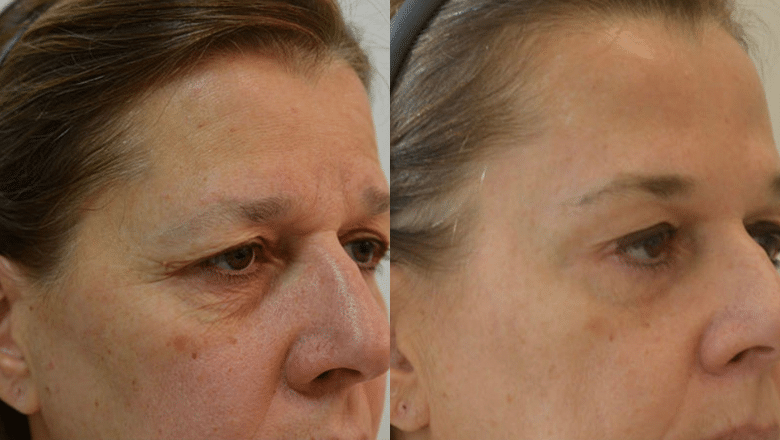
More results are in our blepharoplasty before and after gallery.
Frequently Asked Questions
Is it safe to have blepharoplasty abroad?
It can be, with the right surgeon, a proper face-to-face assessment and enough time nearby afterwards. The problems UK surgeons are seeing come mostly from low-cost, high-volume packages where the assessment is remote, the person operating may not be a specialist eyelid surgeon, and patients fly home within a day.
Is blepharoplasty in Turkey safe?
Turkey is the most common destination for UK patients having cosmetic surgery abroad. In one London hospital series, 73% of patients treated for complications after surgery abroad had been operated on there [8]. That largely reflects how many people go, not proof that one country is worse than another; there are skilled eyelid surgeons in Turkey, Poland, Lithuania, the Netherlands and elsewhere. The risk comes mainly from the package: remote assessment, flying home within a day and no local aftercare. The checks in our section on how to check a blepharoplasty surgeon apply wherever you go.
Why can’t I close my eyes after blepharoplasty?
In the first days it is usually swelling, and it settles. If it persists, the most common cause is too much skin, and sometimes muscle, having been removed from the upper lid, so the lid is too short to reach the lower lid. Scarring can also pull the lid up. It needs examining, and the eye needs protecting with lubrication in the meantime.
Is it normal not to fully close your eyes after a bleph?
A small gap in the first few days while the lids are swollen is common. Closure that has not improved after a few weeks, or an eye that is sore, red or blurry, is not something to wait out and should be checked.
How long after blepharoplasty can you fly?
The most serious bleeding complications are most likely in the first 24 hours, and particularly the first three hours, so flying on the day of surgery is not advisable. Your surgeon will confirm timing; our recovery guide sets out typical milestones.
Can a botched bleph be fixed?
Often it can be improved, but correction is more complex than the original surgery. Where too much skin has been removed, it cannot simply be put back, and revision may need scar release and a skin graft. It usually waits several months until the tissues have settled.
Will the NHS fix a bleph done abroad?
The NHS will treat urgent problems such as infection, bleeding or a threatened eye. Revision to improve the appearance or function after cosmetic surgery is not normally funded.
Is a bleph a tweakment?
No. It is a surgical operation that removes tissue from the eyelid. It is often done under local anaesthetic, but the effects are permanent and the risks are those of surgery.
How much does eyelid surgery cost in the UK?
It depends on whether you need upper, lower or both, and the anaesthetic used. Current prices are in our blepharoplasty cost guide, and finance is available.
What should I ask before booking a bleph?
Who will operate and what their specialist registration and eyelid training are, whether you will be examined in person before the day, how much skin and muscle they plan to remove, how long you need to stay nearby, and who manages complications once you are home.
Blepharoplasty at Centre for Surgery
Eyelid surgery at Centre for Surgery is performed by surgeons with oculoplastic training at our CQC-regulated private hospital at 95–97 Baker Street, Marylebone, rated Good overall. The surgeon who assesses you is the surgeon who performs your surgery. An initial virtual consultation is available, but you are always examined face to face before surgery, and we recommend a two-week cooling-off period after any consent. For patients travelling from further away, the consultation and pre-operative appointment can usually be combined into one visit; see travelling to us for surgery.
We also see patients for revision after eyelid surgery elsewhere, including abroad. A primary consultation is £100, redeemable against treatment if you go ahead; a revision consultation is £250 and isn’t redeemable against treatment. Our published clinical outcomes and patient safety data set out how we measure results.
Finance is available through Chrysalis Finance, subject to status. See our Finance Options page.
Phone: 020 7993 4849 | Email: contact@centreforsurgery.com | Address: 95–97 Baker Street, Marylebone, London W1U 6RN
Contact us to arrange a consultation
References
- BBC News Investigations. Open wounds and eyes that can’t close – women warn about cheap bleph eyelid surgery. BBC News, September 2026. bbc.co.uk/news/articles/c9rk3rdp644mo
- Todorov D, Mitchell S, Al-Hashimi M, et al. Functional and aesthetic outcomes after upper blepharoplasty: a systematic review and meta-analysis of randomized control trials. Aesthetic Surgery Journal 2025;45(6):554–562. doi:10.1093/asj/sjaf022
- Kiang L, Deptula P, Mazhar M, Murariu D, Parsa FD. Muscle-sparing blepharoplasty: a prospective left-right comparative study. Archives of Plastic Surgery 2014;41(5):576–583. doi:10.5999/aps.2014.41.5.576
- Prischmann J, Sufyan A, Ting JY, Ruffin C, Perkins SW. Dry eye symptoms and chemosis following blepharoplasty: a 10-year retrospective review of 892 cases in a single-surgeon series. JAMA Facial Plastic Surgery 2013;15(1):39–46. doi:10.1001/2013.jamafacial.1
- Hass AN, Penne RB, Stefanyszyn MA, Flanagan JC. Incidence of postblepharoplasty orbital hemorrhage and associated visual loss. Ophthalmic Plastic and Reconstructive Surgery 2004;20(6):426–432. doi:10.1097/01.iop.0000143711.48389.c5
- Mejia JD, Egro FM, Nahai F. Visual loss after blepharoplasty: incidence, management, and preventive measures. Aesthetic Surgery Journal 2011;31(1):21–29. doi:10.1177/1090820X10391212
- Christie B, Block L, Ma Y, Wick A, Afifi A. Retrobulbar hematoma: a systematic review of factors related to outcomes. Journal of Plastic, Reconstructive & Aesthetic Surgery 2018;71(2):155–161. doi:10.1016/j.bjps.2017.10.025
- Whiteman E, Romain K, Welman T, et al. The rising NHS burden from cosmetic surgery procedures performed abroad and non-surgical procedures performed in the United Kingdom. Journal of Plastic, Reconstructive & Aesthetic Surgery 2025;102:39–41. doi:10.1016/j.bjps.2025.01.017
- Pezas T, Oregi P, Hussein S, et al. Outbound cosmetic tourism from the United Kingdom: patient experiences following a decade of complication management at a tertiary plastic surgery unit. Journal of Plastic, Reconstructive & Aesthetic Surgery 2026;114:273–281. doi:10.1016/j.bjps.2026.01.035
- England C, Bromham N, Needham-Taylor A, et al. Complications and costs to the UK National Health Service due to outward medical tourism for elective surgery: a rapid review. BMJ Open 2026;16(1):e109050. doi:10.1136/bmjopen-2025-109050
Related Articles
- Botched Eyelid Surgery and Blepharoplasty Complications
- Blepharoplasty Recovery and Aftercare
- Upper vs Lower Blepharoplasty
- The Dangers of Cosmetic Surgery Tourism
- Blepharoplasty Cost