


In this guide19 sections
- Key Points
- How Long Does Blepharoplasty Last?
- Is Eyelid Surgery Permanent, or Do the Results Wear Off?
- How Long Does Upper Eyelid Surgery Last?
- How Long Does Lower Blepharoplasty Last?
- How Long Does Double Eyelid Surgery Last?
- What Affects How Long Eyelid Surgery Lasts?
- Blepharoplasty Before and After: What Do Results Look Like?
- Does a Brow Lift Help Blepharoplasty Last Longer?
- Can Eyelid Surgery Be Combined With Other Treatments?
- How Many Times Can You Have Blepharoplasty?
- How Long Does It Take to See the Final Results of Blepharoplasty?
- How Can I Make Blepharoplasty Last Longer?
- Is Eyelid Surgery Worth It? Success Rate and Patient Satisfaction
- What Is the Ideal Age for Blepharoplasty?
- Blepharoplasty at Centre for Surgery: What Happens at Consultation?
- Frequently Asked Questions
- Blepharoplasty in London
- References
Key Points
- How long does blepharoplasty last? Upper eyelid results are commonly quoted at 5 to 10 years or longer, and lower eyelid results at 10 years to lifelong. No single figure applies to everyone, because the eyelids keep ageing after surgery.
- Removed skin and fat do not grow back. What changes over time is the tissue that remains, along with your brow, cheek and skin quality.
- Lower blepharoplasty usually outlasts upper blepharoplasty, because under-eye bags are driven by fat that has been removed or repositioned, while the upper lid is more affected by a descending brow.
- Genetics, sun exposure, smoking and brow position have the biggest influence on how long eyelid surgery lasts, and you can control some of them.
If you are weighing up blepharoplasty, one of the first things to ask is how long eyelid surgery lasts, and whether you will need it done again. The honest answer is that blepharoplasty is long lasting rather than permanent: the excess skin and fat that your surgeon removes will not return, but your eyelids, brow and cheeks continue to age. For many people that means results that stay noticeable for a decade or more.
This guide sets out what to expect from an eyelid lift, with separate answers for the upper and lower eyelids, what shortens or extends the result, what happens if your eyelids droop again, and how to protect your investment. If you are still deciding which operation you need, our guides to upper vs lower blepharoplasty and whether eyelid surgery changes your eye shape cover that decision, and droopy eyelids and hooded eyes explain what is causing the problem in the first place.
How Long Does Blepharoplasty Last?
Results of eyelid surgery are usually described in years rather than months, and the range is wide. The figures you will see most often are 5 to 10 years for the upper eyelids and 10 years to a lifetime for the lower eyelids. These are clinical estimates drawn from experience rather than the output of a single large trial, and the published research tends to follow patients for months to a few years rather than decades. A 2021 study of 226 patients in Aesthetic Surgery Journal ↗, for example, found that under-eye bags were corrected in 86.7% of patients and that MRI scans confirmed the repositioned fat was still viable at 6 to 8 months[1]. It shows the operation works, but it does not tell us what the eyelids will look like in 20 years.
What we can say with confidence is how the result behaves. The operation permanently removes or relocates tissue, which resets the starting point, which the next section explains. From there, your eyelids age along the same curve as everyone else’s, so the improvement is lasting even though the ageing process is not stopped. That is why two people who have the same operation on the same day can be looking at very different results ten years later.
Is Eyelid Surgery Permanent, or Do the Results Wear Off?
Strictly speaking, blepharoplasty is long lasting rather than permanent. The skin and fat that are removed do not regrow, so most people can expect to look better than they would have without surgery, even years later. What does not stop is ageing: skin loses elasticity, muscles weaken and gravity keeps acting on the brow and cheeks. An eyelid lift resets the starting point rather than freezing the clock.
Genetics, sun exposure, smoking and weight changes all influence how quickly the eyes age again, which is why eyelid lift results differ so much between people. The operation is also designed to refresh the eyes rather than reshape them, and our guide on whether eyelid surgery changes your eye shape explains what to expect.
How Long Does Upper Eyelid Surgery Last?
Upper blepharoplasty removes excess skin, and sometimes a little muscle and fat, from the upper lid through an incision hidden in the natural crease. Results are commonly quoted at 5 to 10 years, and many people enjoy them for longer. The skin that was removed does not grow back, so the improvement does not wear off. What changes is that the remaining skin continues to lose elasticity and the eyebrow tends to drift downwards with age, which can bring back a feeling of heaviness over time.
That is the main reason the upper lid tends to have a shorter quoted lifespan than the lower lid. If the brow is already low when you have surgery, it can keep pressing down on the new lid. A 2026 prospective study of 41 patients in Aesthetic Plastic Surgery ↗ found that brow position after a direct brow lift stayed stable at 12 months, and 35 of the 41 patients had upper blepharoplasty at the same time[2]. Our guide to brow lift vs blepharoplasty explains how a surgeon decides which structure is doing the work.
If your concern is a hooded fold, the first question is whether it is your eyelid or your brow. Getting that choice right matters for how long upper eyelid surgery lasts.
How Long Does Lower Blepharoplasty Last?
Lower blepharoplasty treats under-eye bags, which come from fat pads that bulge forward as the supporting tissue weakens, along with loose skin and a tear trough hollow. The fat that is removed does not regenerate, and when fat is moved rather than removed, it has been shown to survive in its new position. For that reason the lower lid is generally regarded as the longer-lasting operation, often a decade or more and in many people for life.
A review in Facial Plastic Surgery describes lower lid transcutaneous blepharoplasty as providing excellent long-term aesthetic outcomes with minimal downtime, while stressing that the anatomy is complex and that technique matters[3]. Our guide to how to get rid of eye bags compares the approaches.

Does fat grow back after lower blepharoplasty?
No. Fat cells that are removed do not regrow, so the bags you had will not return in the same form. What can develop over the years is a different problem: as the cheek descends and the skin thins, the lower lid can start to look hollow or lined again. A prospective study of lower blepharoplasty in Aesthetic Plastic Surgery found that the volume of the lower periorbital region fell significantly one year after standard fat removal, which is one reason many surgeons now prefer to reposition fat rather than remove all of it[4]. After about a decade, a minor touch-up can address any new fullness or laxity.
How Long Does Double Eyelid Surgery Last?
Asian blepharoplasty, or double eyelid surgery, creates an upper lid crease where one is absent or faint, so its longevity is defined by how well that crease holds. A 2026 multicentre retrospective cohort study in Aesthetic Plastic Surgery ↗ followed buried suture double eyelid patients for about four and a half years. It found that 17.0% of patients who had upper eyelid fat removed needed a repeat operation for crease loss, against 33.5% of those who did not[5].
Technique and anatomy shape durability. Our guide to how Asian blepharoplasty differs from traditional eyelid surgery explains the techniques, and our Asian blepharoplasty (double eyelid surgery) page sets out what is offered at Centre for Surgery.
What Affects How Long Eyelid Surgery Lasts?
No two sets of eyelids age at the same rate. The factors below are the ones that shift the timeline most.
- Skin quality and genetics: thin, lax or heavily sun-damaged skin loosens sooner. If your parents developed heavy lids early, you may too.
- Sun exposure: ultraviolet light breaks down collagen, so daily SPF 30 or higher and sunglasses protect the result.
- Smoking: it slows healing and accelerates skin ageing. Your surgeon will ask you to stop for at least four weeks before and after surgery, and stopping for good protects the outcome.
- Brow position: a low or falling brow can bring back upper lid heaviness, whatever was done to the lid itself.
- Weight changes: large swings in weight alter the fat around the eyes and the quality of the skin.
- Surgical technique: a conservative, anatomy-led operation ages better than an over-aggressive one, as explained below.

Can eyelids droop again after blepharoplasty?
Yes, over time. Upper eyelids can become heavy again as the skin loosens and the brow descends, which is a normal part of ageing rather than a failed operation. A droop that appears soon after surgery is different. If the eyelid itself sits low, this may be ptosis, a weakness of the lid-lifting muscle that blepharoplasty does not treat. Our guide to cosmetic and functional eyelid surgery explains how that is assessed.
Blepharoplasty Before and After: What Do Results Look Like?
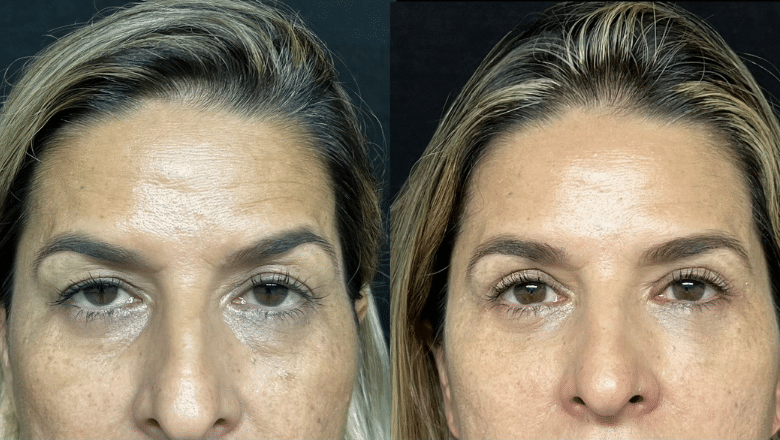
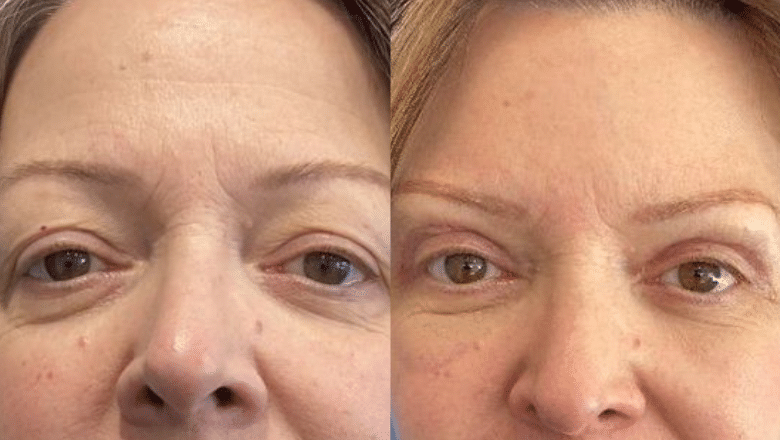
Look for natural change rather than dramatic change: a smoother upper lid, a visible crease and less heaviness, without a startled or hollow look. These are real patients treated at Centre for Surgery, and individual results vary. See more in our blepharoplasty before and after gallery.
Does a Brow Lift Help Blepharoplasty Last Longer?
Sometimes, and it is worth asking about at consultation. When the brow has dropped, it pushes the upper lid skin down and can undo some of the benefit of eyelid surgery over time. A brow lift repositions the brow so that the lid is not carrying its weight, and some patients have the two together. Our guide to the gliding brow lift describes one option, and the endoscopic vs traditional brow lift comparison covers the others.
For wider ageing, see the facelift, mini facelift and Trifecta lift vs blepharoplasty guide.
Can Eyelid Surgery Be Combined With Other Treatments?
Many people pair eyelid surgery with other treatments for a more balanced result. A brow lift addresses sagging eyebrows, while skin-quality treatments such as SmoothEye laser can help the skin around the eyes. Dermal fillers and anti-wrinkle injections are available for the surrounding areas, although neither replaces or repeats the result of the operation. We do not offer thread lifts.
If you are not ready for surgery, our guides to non-surgical alternatives to eyelid surgery and traditional vs non-surgical blepharoplasty compare what each can and cannot do. Non-surgical options are temporary and suit milder concerns; when there is true excess skin or fat, surgery is the only treatment that removes it.
How Many Times Can You Have Blepharoplasty?
There is no fixed limit, but each operation leaves less tissue to work with, so surgeons are careful about repeating it. A second operation is usually a small touch-up many years later, or a correction when something was over-treated the first time. Most people who consider one wait a decade or more, and many never do. A repeat procedure can be less extensive when much of the original problem has already been corrected, although that depends on how much tissue remains. A 2026 retrospective study of 481 patients ↗ reported that early complications after upper blepharoplasty, including temporary difficulty closing the eye and swelling, settled on their own, and that medial canthal scarring needed revision in four patients in the conventional group[6].
If you have had surgery elsewhere and are unhappy with the result, our revision blepharoplasty service assesses what can be improved. We also explain the risks of surgery abroad in our guide to blepharoplasty abroad.
How Long Does It Take to See the Final Results of Blepharoplasty?
Bruising and swelling are greatest in the first week and mostly settle within two to three weeks. Fine swelling can linger for a few months, and scars keep fading for up to a year, so most people judge their result at around three months and again at one year. Our blepharoplasty recovery and aftercare guide gives a week-by-week timeline, and our article on blepharoplasty scars shows how they heal.
One concern that comes up is dry eyes. A 2024 prospective comparison in Current Eye Research ↗ followed patients for around four years and found no significant long-term dry eye signs after upper blepharoplasty alone, in contrast to a group who also had a ptosis operation[7]. You can read more in our guide to whether blepharoplasty can cause dry eyes.
How Can I Make Blepharoplasty Last Longer?
You cannot stop your eyelids ageing, but a few habits slow it down:
- Wear sunglasses and an SPF 30 or higher sunscreen around the eyes every day.
- Do not smoke or vape, which harms skin quality and slows healing.
- Keep your weight stable once you are at a healthy level.
- Look after your general skin health with a balanced diet, good hydration, moderate alcohol and enough sleep. These are sensible habits rather than proven ways to extend eyelid surgery results, as research on eyelid longevity specifically is limited.
- Follow your aftercare instructions exactly, including keeping your head raised and avoiding rubbing the eyes while they heal.
- Choose a surgeon who plans around your brow, cheek and skin quality. Our guide to choosing an eyelid surgeon in London explains what to look for, and laser eyelid tightening is a non-surgical option for skin quality.
Is Eyelid Surgery Worth It? Success Rate and Patient Satisfaction
There is no single eyelid surgery success rate, because studies measure different things, usually with patient-reported questionnaires such as FACE-Q. A 2024 prospective study of 79 patients in Aesthetic Plastic Surgery ↗ found significant improvements in satisfaction with the eyes after upper blepharoplasty, and visual field testing improved in the group with the most excess skin[8]. A 2024 randomised trial of 348 patients in Medicina ↗ reported improvements in satisfaction with the outcome and in psychological and social function, with minimal adverse effects that improved over time[9].
A cohort of 583 patients found that satisfaction six months after upper blepharoplasty was strongly linked to how patients rated their appearance afterwards, rather than to their starting characteristics[10]. These studies cannot promise a result for you. Our guide to cosmetic and functional eyelid surgery explains when lifting the lid is also a vision question.
What Is the Ideal Age for Blepharoplasty?
There is no ideal number: the right time is when your eyelids begin to bother you or affect your vision. Many people have surgery in their forties and fifties, and some earlier when heavy lids run in the family. Our guides to the ideal age for blepharoplasty and eyelid surgery in your 30s, 40s, 50s and 60s go through each decade, and the NHS has a useful overview of eyelid surgery ↗.
Blepharoplasty at Centre for Surgery: What Happens at Consultation?
At Centre for Surgery, blepharoplasty is carried out by GMC-registered surgeons at our CQC-regulated hospital on Baker Street. At consultation your surgeon examines your eyelids and brow, tests your lid support and tear film, reviews your medical history and talks through what is realistic. Surgery can be done under local anaesthetic or asleep with TIVA, depending on what suits you; see our guides to blepharoplasty under local anaesthetic or asleep and anaesthesia for cosmetic surgery.
Costs are confirmed in writing after your consultation; see our guide to what blepharoplasty costs in London. If you are a man considering surgery, our article on blepharoplasty for women and men covers the differences.
Frequently Asked Questions
How long does blepharoplasty last?
Upper eyelid results are commonly quoted at 5 to 10 years or longer, and lower eyelid results at 10 years to lifelong. The skin and fat removed do not grow back, but ageing carries on, so the improvement softens gradually rather than disappearing. Genetics, sun exposure, smoking and brow position all play a part.
How many times can you have blepharoplasty?
There is no set number, but every operation uses up tissue, so repeats are approached with care. A second procedure is usually a modest touch-up a decade or more later, or a correction of an earlier result. A surgeon will assess whether enough skin and fat remain before agreeing to operate again.
Why do I look older after blepharoplasty?
Usually because too much fat or skin was removed, which can leave a hollow or tight look, or because swelling is still settling. Early swelling resolves over weeks. Hollowing from over-resection is harder to fix and may need fat transfer or revision surgery, which is why a conservative operation matters. Our guides to sunken eyes and botched eyelid surgery and how to avoid complications cover the warning signs.
Do eyes look bigger after blepharoplasty?
Often they look more open, because removing hooded skin reveals more of the eye and the lash line. The eyes themselves do not change size. Lower eyelid surgery can also make the eyes look less tired. The change is meant to look natural, and your surgeon can show you what to expect during your consultation. Our guide to whether eyelid surgery changes eye shape goes further.
What are the disadvantages of blepharoplasty?
The main drawbacks are bruising and swelling for one to two weeks, temporary dryness or watering, and a small risk of asymmetry, scarring, difficulty closing the eye or the need for further surgery. Serious complications are uncommon. Our guide to the risks of blepharoplasty explains them in detail.
How long does eyelid surgery take?
Upper eyelid surgery often takes somewhere between one and two hours, and lower eyelid or combined surgery can take longer, depending on the technique and anaesthetic. Both eyes are normally operated on in the same session. Your surgeon will give an estimate for your own operation at consultation.
Will there be visible scars after eyelid surgery?
Upper eyelid incisions are placed in the natural crease, and lower eyelid incisions sit just below the lashes or inside the lid, so scars are usually discreet. They keep fading for up to a year, although healing varies between people. Our guide to blepharoplasty scars shows how they heal.
Can eyelid surgery improve vision?
Sometimes. When excess upper eyelid skin hangs into the line of sight, removing it can widen the visual field, and one 2024 study found measurable improvement in patients with the most excess skin[8]. Whether surgery is cosmetic or functional is decided at assessment. See our guide to droopy eyelids.
Is eyelid surgery safe?
Blepharoplasty is widely performed and serious complications are uncommon, but all surgery carries risks, including bleeding, infection, dry eyes, asymmetry, scarring and, rarely, problems with vision. Seeing a suitably qualified surgeon and following aftercare advice reduces risk. Our guide to the risks of blepharoplasty covers them in full.
Blepharoplasty in London
If you would like to know how long eyelid surgery would last for you, a consultation with a plastic surgeon is the quickest way to find out. Find out more about blepharoplasty at Centre for Surgery.
Phone: 020 7993 4849 | Address: 95–97 Baker Street, Marylebone, London W1U 6RN
Contact us to schedule a consultation
References
- Chen J, Zhang T, Zhu X, Huang W. Fat repositioning with a combination of internal fixation and external fixation in transconjunctival lower blepharoplasty. Aesthetic Surgery Journal 2021;41(8):893–902. doi:10.1093/asj/sjab059 ↗
- Marangi GF, Gratteri M, Porso D, et al. Direct brow lift: a prospective study on aesthetic, long-term efficacy, scar-related outcomes and patient satisfaction. Aesthetic Plastic Surgery 2026;50(13):4838–4850. doi:10.1007/s00266-026-05909-w ↗
- Yapa S, Raghavan U. Lower eyelid transcutaneous blepharoplasty, minimizing complications and correction of lower eyelid malposition. Facial Plastic Surgery 2023;39(1):8–19. doi:10.1055/a-1973-7656 ↗
- Choi J, Lee T, Hong J, et al. Complete preservation of orbital fat by restoration of attenuated orbital septa using an acellular dermal matrix in lower blepharoplasty. Aesthetic Plastic Surgery 2024;48(8):1537–1546. doi:10.1007/s00266-023-03845-7 ↗
- Okumura K, Tamura T, Funakoshi Y, Teranishi H. Effect of upper eyelid fat removal on reoperation rate and long-term stability in buried suture double eyelid surgery: a 4.5-year retrospective cohort study. Aesthetic Plastic Surgery 2026;50(3):871–877. doi:10.1007/s00266-025-05492-6 ↗
- Akyurek M, Battal BB, Karaemir G, Ali O. A muscle-based approach to superior orbital sulcus hollowness: preseptal orbicularis oculi flap in upper blepharoplasty. Aesthetic Plastic Surgery 2026;50(15):6022–6027. doi:10.1007/s00266-026-06020-w ↗
- Zloto O, Alcalay I, Klain B, Ben Simon G. The long-term effect on dry eye of posterior approach ptosis surgery vs. upper eyelid blepharoplasty. Current Eye Research 2024;49(5):538–542. doi:10.1080/02713683.2024.2302546 ↗
- Marangi GF, Mirra C, Savani L, et al. Is the severity of preoperative eyelid dermatochalasis directly correlated with patient satisfaction after upper blepharoplasty? A prospective study based on PROMs. Aesthetic Plastic Surgery 2024;48(20):4114–4120. doi:10.1007/s00266-024-04214-8 ↗
- Vasović DD, Karamarković ML, Jovanović M, et al. Comprehensive evaluation of quality of life following upper eyelid blepharoplasty: a prospective analysis. Medicina (Kaunas) 2024;60(3):500. doi:10.3390/medicina60030500 ↗
- Luong KP, Vissers LCM, Domela Nieuwenhuis I, et al. Factors associated with treatment outcome satisfaction six months after upper blepharoplasty: a large cohort study. Plastic and Reconstructive Surgery Global Open 2023;11(9):e5260. doi:10.1097/GOX.0000000000005260 ↗







