


In this guide19 sections
- Key Points
- What Is Non-Surgical Blepharoplasty?
- How Does Non-Surgical Blepharoplasty Work?
- Does Non-Surgical Blepharoplasty Work?
- Non-Surgical Blepharoplasty Before and After
- What Is Traditional Blepharoplasty?
- Blepharoplasty vs Non-Surgical Eyelid Lift: Which Is Right for You?
- What Is the Best Eyelid Lift Without Surgery for Hooded Eyes?
- How Long Does Non-Surgical Blepharoplasty Last?
- Is Non-Surgical Blepharoplasty Worth It?
- Is Eyelid Surgery Safe? Risks Compared With Non-Surgical Options
- Blepharoplasty Recovery vs Non-Surgical Downtime
- Can I Get an Upper Bleph on the NHS?
- Can You Get a Lower Bleph Without Anaesthesia?
- When Should You See a Doctor About Your Eyelids?
- What Happens at a Consultation at Centre for Surgery?
- Frequently Asked Questions
- Eyelid Surgery and Non-Surgical Eye Lift in London
- References
Key Points
- What is non-surgical blepharoplasty? It is an umbrella term for treatments that tighten or refresh the eyelids without cutting: lasers, plasma devices, radiofrequency and some injectables. None of them removes skin, so none can match the result of surgery.
- Does non-surgical blepharoplasty work? For mild skin laxity and crepey texture, modestly. A 2024 study of plasma treatment concluded it suits only the mildest grades of upper eyelid skin excess, with surgery giving better results for anything more advanced.[2]
- Results are subtle and temporary. Most non-surgical eyelid lifts need a course of sessions and maintenance. Eyelid surgery (blepharoplasty) is the treatment that removes excess skin and fat and is generally regarded as the permanent option.[1]
- Hooded eyes are not always an eyelid problem. A dropped eyebrow can push skin onto the lid, and then a brow lift, not eyelid treatment of any kind, is the fix.
- Surgery has risks too. In one series of 892 blepharoplasty cases, 26.5% of patients reported dry eye symptoms afterwards.[7] Choosing between the two routes is a matter of matching the treatment to the cause.
- The NHS only funds eyelid surgery in functional cases, usually where drooping skin restricts vision, not for cosmetic reasons.
Searches for non surgical blepharoplasty are rising because the idea is so appealing: a lifted, more open eye with no incisions, no stitches and no time off. The reality sits somewhere in between. Non-surgical treatments can smooth and gently firm eyelid skin, but heavy hooding, fat bags and a dropped brow are structural, and structure is what blepharoplasty changes.
This guide compares the two routes honestly: what a non-surgical eyelid lift can and cannot do, how it differs from an eyelid lift operation, how long each lasts, what the risks are, and how to tell which one suits your eyes. If your lids look heavy, our guides to hooded eyes and droopy eyelids explain the causes first, and our wider review of non surgical alternatives to eyelid surgery covers the full list of options.
What Is Non-Surgical Blepharoplasty?
Blepharoplasty is the medical name for eyelid surgery. Non-surgical blepharoplasty, also called a non-surgical eyelid lift, non-invasive blepharoplasty or non-surgical eye lift, is a marketing term rather than a single procedure. It describes a group of energy-based and injectable treatments aimed at the same problems that eyelid surgery treats: loose, crepey or sagging skin, early hooding and a tired-looking upper face.[3]
A 2023 mini-review in the World Journal of Clinical Cases ↗ sorted these techniques by the problem they target. Lasers and plasma exeresis address skin laxity, dermal fillers address volume loss, and deoxycholic acid can be considered for small pockets of fat. The same review notes that surgery remains the first choice when a permanent and effective result is the goal.[1]
Is a non-surgical eyelid lift the same as an eyelid lift?
No. An eyelid lift in the surgical sense removes or repositions skin, muscle and fat through a small incision hidden in the natural crease. A non-surgical eyelid lift leaves the tissue in place and tries to make it tighter or fuller. That is why the two give different results and suit different eyes.
How Does Non-Surgical Blepharoplasty Work?
Each method works differently, so it helps to know what is behind the label before you book.
Laser eyelid tightening
A non-ablative laser warms the deeper layer of the eyelid skin without breaking the surface, which tightens existing collagen and encourages new collagen over the following months. At Centre for Surgery this is SmoothEye laser eye lift, a needle-free Fotona protocol given as a short course of sessions. It suits crepey texture, fine lines and early laxity. Our guide to laser eyelid tightening explains what a course involves and what to expect afterwards.
Plasma exeresis (plasma pen eyelid lift)
Plasma devices, often sold as a plasma pen or fibroblast treatment, use an electrical arc to cause tiny controlled points of superficial skin damage. As the skin heals it contracts slightly. In a 2024 study of 21 eyes in Lasers in Medical Science ↗, three sessions of ablative radiofrequency microplasma improved lateral upper eyelid skin excess. The authors found the improvement was greater the more severe the excess, yet concluded the treatment is suited to the mildest grades only, with surgery giving better results for more advanced cases.[2] Plasma pens near the eye also carry a risk of burns and pigment change, so they should only be used by a properly trained, regulated practitioner.
Radiofrequency skin tightening
Radiofrequency heats the deeper skin to tighten it. It is used more often on the lower face and jawline, where FaceTite works on loose skin, than on the thin skin of the eyelid itself. Around the eyes the energy settings are limited by how close the eye is.
Injectables for volume loss and tear troughs
Some hollowing under the eye is volume loss rather than excess skin, and that is treated with filler rather than by tightening. A 2024 narrative review of 20 studies in the Journal of Personalized Medicine ↗ found that hyaluronic acid fillers give immediate, minimally invasive results but need periodic maintenance, while fat repositioning lasts longer but carries higher surgical risk.[4] Neither treats a hooded fold of skin. Our guide to how to get rid of eye bags sets out which bags respond to which treatment.
Does Non-Surgical Blepharoplasty Work?
It works within limits. The published evidence is small: mostly short follow-up, small groups and single clinics. Taken together it supports three fairly consistent messages:
- Non-surgical treatments can improve skin texture and mild laxity.
- The effect is modest compared with surgery and fades as the skin keeps ageing.
- The more skin there is, the less well they work.
An overview of non-surgical upper eyelid techniques in the Journal of Plastic, Reconstructive and Aesthetic Surgery ↗ lists fractional CO2 laser, hyaluronic acid fillers and plasma exeresis among the options now in use, which shows how varied the field is rather than how well any one method performs.[3]
So does non-surgical blepharoplasty work for hooded eyes? Only if the hooding is mild and mostly skin quality. A true fold that rests on the lashes, or lids that you lift your eyebrows to see past, will not be corrected by any laser or plasma device.
Non-Surgical Blepharoplasty Before and After
Non surgical blepharoplasty before and after photos are the main way these treatments are sold, so look at them critically. Check that the lighting, angle, make-up and brow position match, that the photographs come from the clinic itself, and when the “after” was taken. A change at four weeks may not be present a year later.

The change you can realistically expect from a skin-tightening treatment is smoother, firmer skin and softer lines. It will not reveal a lid crease that is hidden under a fold. For that comparison, see the genuine blepharoplasty before and after photos.
What Is Traditional Blepharoplasty?
Eyelid surgery removes excess skin and, where needed, a small amount of muscle and fat. In the upper lid the incision sits in the natural crease. In the lower lid it is either just below the lashes or inside the lid, which leaves no external scar. It is usually a day-case procedure, and our guides to upper vs lower blepharoplasty and blepharoplasty under local anaesthetic or sedation explain the choices in detail.
Acquired excess upper eyelid skin, or dermatochalasis, is very common: one study puts it at around 65% of people over 60.[9] It can be purely cosmetic, or it can weigh the lid down enough to cause heaviness, brow ache and a restricted upper field of vision, a distinction explained in our guide to cosmetic and functional eyelid surgery.

Blepharoplasty vs Non-Surgical Eyelid Lift: Which Is Right for You?
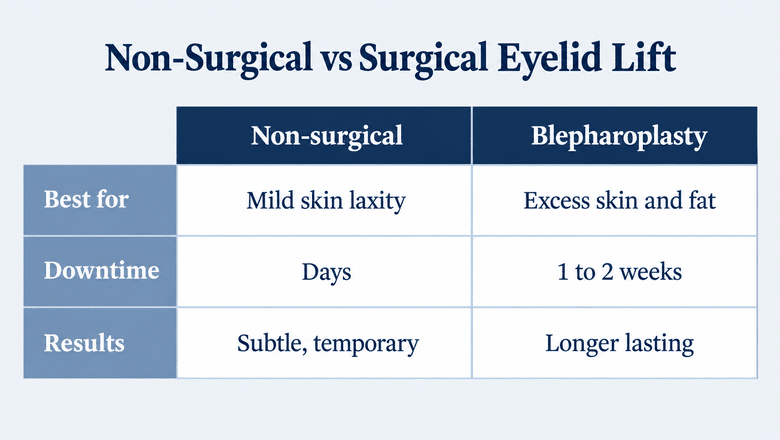
The deciding factor is how much tissue there is to deal with. The table below summarises the main differences.
When non-surgical treatment is reasonable
- Fine, crepey skin on the upper or lower lid.
- Early, mild laxity without a visible overhanging fold.
- A wish to avoid surgery or anaesthesia, or a medical reason not to have an operation.
- Crow’s feet and lines at rest. Our guides to crow’s feet and under-eye wrinkles compare the options for these.
When blepharoplasty is the better choice
- A fold of skin that rests on or over the lashes.
- Lids that feel heavy, or vision that is partly blocked by skin.
- Fat bags under the eyes, which no laser or plasma device removes.
- A wish for a long-lasting result. Our guide to how long blepharoplasty lasts sets out what to expect.
Satisfaction after surgery does not depend on how severe the excess skin was. In a 2024 prospective study of 79 patients in Aesthetic Plastic Surgery ↗, validated FACE-Q questionnaires showed significant improvements in upper eyelid appearance and satisfaction with the eyes, and there was no link between how much skin there was beforehand and how satisfied patients were afterwards.[5] That finding supports having a proper assessment rather than assuming you are “not bad enough” for surgery.
What Is the Best Eyelid Lift Without Surgery for Hooded Eyes?
Which eyelid lift works without surgery depends on why the eyes look hooded. Work through the question in this order:
- Is it the brow? Gently lift the outer end of your eyebrow with a fingertip. If the heaviness disappears, a descended brow is doing most of the work, and a brow lift is the logical treatment. Our guide to brow lift vs blepharoplasty explains the test in full, and droopy eyebrows covers the causes.
- Is it skin quality? Crepey, thin skin with mild laxity is what laser and plasma treatments can improve.
- Is it excess skin? If a fold remains when the brow is held up, the skin itself needs to come out, which only surgery does.
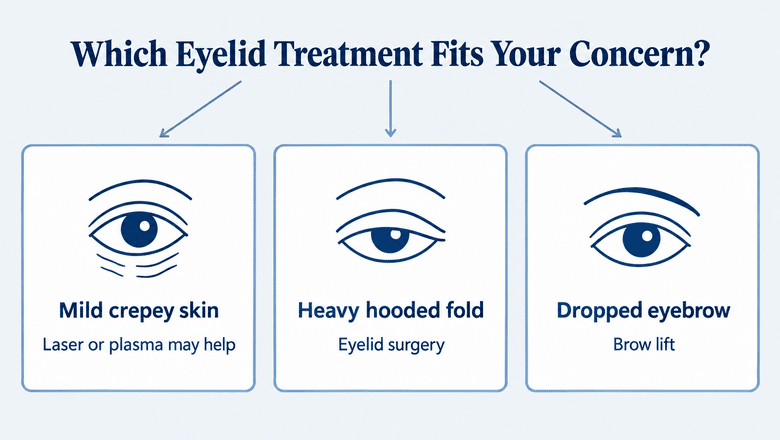
A non-surgical option for the brow exists too. Botulinum toxin and fillers can raise the brow slightly, but a narrative review of 56 references found these methods are temporary and that the endoscopic approach is the most popular surgical brow lift.[8] If you are weighing a lift without an operation, our guide to getting an eyebrow lift without surgery sets out the limits.
How Long Does Non-Surgical Blepharoplasty Last?
Not long, compared with surgery. Skin-tightening treatments usually last somewhere around a year, and often less, depending on the device, how many sessions you have and how your skin ages. Most plans include maintenance sessions to hold the result. Injectable filler needs topping up periodically.[4]
Surgical results last far longer because the excess skin and fat have been removed and cannot return. The eye area will still age, but you start from a different baseline. For the longer picture, read are results from eyelid surgery permanent.
Is Non-Surgical Blepharoplasty Worth It?
That depends on what you want from it. It is worth considering if your concern is skin texture, you have mild laxity, and you accept that the effect is gentle and needs maintenance. It is poor value if you are hoping to remove a hood or a bag, because the treatment cannot do that however many sessions you book. Many people find that repeated courses over several years add up to more than they expected, while surgery is a single event. Costs vary with the device, the number of sessions and the practitioner, and they are confirmed in writing at consultation. Our guide to blepharoplasty cost explains how surgical fees are built up.
Is Eyelid Surgery Safe? Risks Compared With Non-Surgical Options
Non-surgical treatments carry smaller risks: redness, swelling, peeling, temporary pigment change and, rarely, burns when devices are used incorrectly. Surgery carries more, though most are uncommon and a surgeon will discuss them in detail.
Dry eye is the one patients ask about most. In a 2013 retrospective review of 892 cases in JAMA Facial Plastic Surgery ↗, 26.5% of patients reported dry eye symptoms and 26.3% had chemosis (swelling of the surface of the eye) after blepharoplasty. Both were more common after combined upper and lower surgery, and risk was higher in people with existing dry eye symptoms or on hormone therapy.[7] That is why a thorough eye assessment is part of any surgical consultation. Our guides to dry eyes after blepharoplasty and the risks and complications of eyelid surgery go further.
The safest route in both cases is an experienced, regulated practitioner. A poor result from surgery is hard to fix, which is why our guide on how to avoid blepharoplasty complications and the advice on blepharoplasty abroad are worth reading before you decide.
Blepharoplasty Recovery vs Non-Surgical Downtime
Downtime is where non-surgical treatment wins. After laser, plasma or radiofrequency treatment around the eyes you can usually expect redness, swelling and some flaking for a few days, and many people return to work within a day or two. After surgery, bruising and swelling typically settle over 10 to 14 days, stitches come out at around a week, and full exercise returns at around four to six weeks. Our guide to blepharoplasty recovery and aftercare has the full timeline.
Can I Get an Upper Bleph on the NHS?
Sometimes, but not for cosmetic reasons. NHS eligibility for upper eyelid surgery is usually based on functional problems: visual field loss, eyelid position or the skin covering the pupil. A 2026 narrative review in Orbit ↗ notes that visual field restriction is an important indication for publicly funded upper eyelid surgery but is not a complete measure of the burden, since patients also report heaviness, headaches and tearing.[6] The NHS guide to eyelid surgery ↗ sets out what to expect. Referral criteria vary between local commissioning areas, so speak to your GP or optometrist first. Non-surgical treatments are not funded.
Can You Get a Lower Bleph Without Anaesthesia?
Lower lid surgery is not done without any anaesthetic, but it does not have to mean being fully asleep. At Centre for Surgery, eyelid operations are carried out under local anaesthetic with sedation or TIVA, so you are comfortable and numb throughout. The choice depends on the extent of surgery, your health and your preference, and your surgeon and anaesthetist will advise on it. Our guide to blepharoplasty under local anaesthetic or asleep compares them.
When Should You See a Doctor About Your Eyelids?
Book an assessment if your lids feel heavy, you notice your vision is partly blocked, you tilt your head back or lift your brows to see, or the skin irritates your lashes. A sudden droop of one lid, double vision or changes in the pupil need urgent medical review rather than a cosmetic opinion. Our guide to saggy eyelids and the signs you are ready for an eyelid lift lists the points that suggest surgery is worth discussing. Age matters less than anatomy, as the ideal age for blepharoplasty explains.
What Happens at a Consultation at Centre for Surgery?
At your consultation we assess the skin quality, the position of your brow, any fat bags and how well your eyes make tears and close. We then explain which of the options would suit you, including those that do not need surgery. Our consultants are GMC-registered, and the surgeon who assesses you is the surgeon who operates. Surgery takes place at our CQC-regulated hospital on Baker Street, and finance options are available. If you are choosing a surgeon, our guide on how to choose an eyelid surgeon sets out the questions to ask, and Trifecta lift vs blepharoplasty compares a combined face-lifting approach.
Frequently Asked Questions
What is non-surgical double eyelid surgery?
It is an attempt to create or deepen an upper lid crease without cutting, using glue, tape, threads or injections. Results are often short-lived, and these approaches can irritate the skin or leave a lopsided crease. A lasting crease is made surgically. See Asian blepharoplasty (double eyelid surgery).
What is Korean blepharoplasty?
“Korean blepharoplasty” is shorthand for double eyelid surgery that creates a natural-looking upper lid crease in eyes that did not have one, a concept explained in our guide to monolid eyes and double eyelid surgery. It differs from standard upper blepharoplasty, which mainly removes excess skin from an existing crease.
What is the regret rate for blepharoplasty?
There is no single reliable figure, because studies measure satisfaction differently. Patients generally report high satisfaction, and the 2024 FACE-Q study found significant gains in satisfaction with the eyes whatever the starting severity.[5] Regret usually follows unrealistic expectations or too much skin being removed. A cautious surgeon and a frank consultation reduce the chance of regret.
Which country is best for blepharoplasty?
The country matters less than the surgeon’s training, the hospital’s regulation and what happens if something goes wrong after you fly home. Eyelid problems often need quick review. Read our guide to blepharoplasty abroad before deciding.
How much does non-surgical blepharoplasty cost?
It depends on the treatment, the number of sessions and whether maintenance is included. As courses and top-ups repeat, compare the total over a few years, not a single appointment. Costs are confirmed in writing after your consultation, and our Fotona laser cost guide explains what influences them.
Does non-surgical blepharoplasty work for hooded eyes?
Only for mild hooding caused by thin or crepey skin. A true overhanging fold needs surgery, and a dropped brow needs a brow lift. See heavy eyelids: causes and treatments for the other possibilities.
Is non-surgical blepharoplasty available in London?
Yes. SmoothEye laser eyelid tightening is available at our Baker Street clinic, and you can also have a surgical assessment on the same visit if you want to compare options. Heavy hooding and fat bags will still need surgery.
Eyelid Surgery and Non-Surgical Eye Lift in London
If you are unsure whether your eyes need a laser, a brow lift or eyelid surgery, a consultation will establish what is causing the heaviness and what will change it. Find out more about blepharoplasty at Centre for Surgery.
Phone: 020 7993 4849 | Address: 95–97 Baker Street, Marylebone, London W1U 6RN
Contact us to schedule a consultation
References
- Miotti G, Zeppieri M, Pederzani G, Salati C, Parodi PC. Modern blepharoplasty: from bench to bedside. World Journal of Clinical Cases 2023;11(8):1719–1729. doi:10.12998/wjcc.v11.i8.1719 ↗
- Nemet AY, Solomon-Cohen E, Aronovich A, et al. Ablative radiofrequency microplasma for lateral dermatochalasis: indications and treatment recommendations. Lasers in Medical Science 2024;39(1):299. doi:10.1007/s10103-024-04061-8 ↗
- Theodorelou-Charitou SA, Xanthos T, Nikas IP, Ntinioti T. New era in upper eyelid rejuvenation: a brief overview of non-surgical blepharoplasty techniques. Journal of Plastic, Reconstructive & Aesthetic Surgery 2021;74(7):1633–1701. doi:10.1016/j.bjps.2021.01.008 ↗
- Christodoulou S, Tzamalis A, Tsinopoulos I, Ziakas N. Surgical and non-surgical approach for tear trough correction: fat repositioning versus hyaluronic acid fillers. Journal of Personalized Medicine 2024;14(11):1096. doi:10.3390/jpm14111096 ↗
- Marangi GF, Mirra C, Savani L, et al. Is the severity of preoperative eyelid dermatochalasis directly correlated with patient satisfaction after upper blepharoplasty? A prospective study based on PROMs. Aesthetic Plastic Surgery 2024;48(20):4114–4120. doi:10.1007/s00266-024-04214-8 ↗
- Whitelaw TA. Beyond visual field restriction: reconsidering functional assessment in upper eyelid dermatochalasis. Orbit 2026:1–10. doi:10.1080/01676830.2026.2727052 ↗
- Prischmann J, Sufyan A, Ting JY, Ruffin C, Perkins SW. Dry eye symptoms and chemosis following blepharoplasty: a 10-year retrospective review of 892 cases in a single-surgeon series. JAMA Facial Plastic Surgery 2013;15(1):39–46. doi:10.1001/2013.jamafacial.1 ↗
- Karimi N, Kashkouli MB, Sianati H, Khademi B. Techniques of eyebrow lifting: a narrative review. Journal of Ophthalmic & Vision Research 2020;15(2):218–235. doi:10.18502/jovr.v15i2.6740 ↗
- Dus S, Buono U, Aiello V, Paduano FP, Inchingolo F, Paduano S. Upper blepharoplasty in dermatochalasis: a retrospective study of our cases. Journal of Maxillofacial and Oral Surgery 2025;25(2):592–600. doi:10.1007/s12663-025-02446-y ↗