


In this guide17 sections
- Key Points
- What Causes Saggy Eyelids?
- Saggy Eyelids vs Droopy Eyelids vs Hooded Eyes: What Is the Difference?
- What Are the Signs You Need an Eyelid Lift?
- Can Saggy Eyelids Affect Your Vision?
- How Do You Fix Saggy Eyelids Without Surgery?
- What Is the Surgical Treatment for Saggy Eyelids?
- What Happens During Eyelid Surgery?
- How Long Is Recovery After Eyelid Lift Surgery?
- What Are the Risks of Eyelid Surgery?
- Does Eyelid Surgery Work? What Do Patients and Studies Say?
- How Long Do Eyelid Lift Results Last?
- How Much Does Eyelid Surgery for Saggy Eyelids Cost in London?
- What Happens at an Eyelid Surgery Consultation?
- Frequently Asked Questions
- Saggy Eyelids Treatment in London
- References
Key Points
- What causes saggy eyelids? Mostly ageing. Skin loses collagen and elasticity, the fat pads behind the lid push forward and the brow can lower, so the upper lid looks heavy. Genetics, sun damage and eye rubbing add to it.
- Saggy eyelids are not always the same as droopy eyelids. Excess skin (dermatochalasis) is different from a lid muscle that has weakened (ptosis), and the two need different treatment.
- Signs you may need an eyelid lift: skin resting on your lashes, lifting your brows to see, heavy tired-looking eyes, make-up creasing on the lid, or a blocked view at the top of your vision.
- Creams, exercises and make-up do not remove excess eyelid skin. They may help with mild crepiness, but only surgery lifts and removes genuinely saggy upper eyelid skin.
- The surgical treatment is blepharoplasty (eyelid lift), sometimes combined with a brow lift. Studies show improved visual field and high patient satisfaction, with recognised risks such as dry eye and scarring.
- See a doctor urgently if one eyelid drooping comes on suddenly or with double vision, headache, weakness or speech changes.
Saggy eyelids are one of the earliest and most noticeable signs of ageing around the eyes, and they are a common reason people look into eyelid lift surgery. For many people the change is mainly about appearance: eyes that look tired, older or sad when you feel nothing of the sort. For others it is practical, because heavy upper lids can crowd the top of your vision and make your forehead ache from holding your brows up.
This guide explains what makes eyelids sag, how to tell saggy eyelids from droopy eyelids and hooded eyes, the signs that it may be time to see a surgeon, what you can and cannot do without surgery, and what blepharoplasty involves, including recovery, risks and how long results last. If your main concern is puffiness underneath the eye rather than skin above it, our guide to how to get rid of eye bags is the better starting point.
What Causes Saggy Eyelids?
Eyelid skin is the thinnest on the body, and it has very little support underneath it. Over the years, several changes happen together. Collagen and elastin fall, so the skin stretches and no longer springs back. The muscles you use to blink and squint weaken. The membrane that holds back the fat of the eye socket (the orbital septum) loosens, letting fat bulge forward. The eyebrow, which carries part of the weight of the upper lid, can lower. A 2018 review in Facial Plastic Surgery ↗ lists dermatochalasis, fat herniation, blepharoptosis, brow ptosis, deep tear troughs and cheek fat descent as the age-related changes that make up the ageing eye[8].
Why do eyelids sag as you get older?
How early it starts surprises many people. In a 2019 comparison of photographs of 80 people at 20, 40 and 60 years old ↗, published in Ophthalmic Plastic and Reconstructive Surgery, excess upper eyelid skin was already present in 55% at age 40 and in 67.5% at age 60. Herniated fat in the upper lid rose from 13.7% at 40 to 31.2% at 60. More than half of the people studied showed no true drop of the eyebrow, which suggests the eyelid itself, rather than the brow, is often the main change[1]. A separate retrospective study estimates that about 65% of people over 60 have this kind of upper-lid skin excess[2].
Can you have saggy eyelids at a young age?
Yes. Saggy eyelids in your 30s or even 20s are usually down to family traits: a heavy brow, a naturally deep upper lid fold or fuller orbital fat. The same photo study found that excess skin was more common in men than in women at 40[1]. If you have always had hooded lids, it is worth reading our guides on eyelid surgery in your 30s, 40s, 50s and 60s and the ideal age for blepharoplasty.
What else makes eyelids look saggy?
Ageing is not the only cause. Smoking and sun damage break down collagen faster, and weight loss can leave skin looser than before. Long-term eye rubbing, for example from hay fever or allergies, stretches the delicate skin and the tendon that lifts the lid. Contact lens wear, eye surgery such as cataract removal and thyroid eye disease can all change how the lid sits. Puffy eyes from fluid, allergy or poor sleep can look like sagging but usually settle, whereas true excess skin does not.

Saggy Eyelids vs Droopy Eyelids vs Hooded Eyes: What Is the Difference?
These terms are used interchangeably online, but they describe different problems, and the difference matters because it decides the operation.
- Saggy or hooded eyelids (dermatochalasis): loose, excess skin that folds over the natural crease and sometimes rests on the lashes. The lid margin itself sits normally. Our guide to hooded eyes and hooded eyelids goes into the detail.
- Droopy eyelids (ptosis): the muscle that raises the lid has stretched or weakened, so the edge of the lid sits too low and can cover part of the pupil. Moorfields Eye Hospital explains ptosis ↗ and our own article covers droopy eyelid causes and treatment.
- Brow ptosis: the eyebrow has dropped and pushes the skin down onto the lid. This is treated by lifting the brow, not by removing eyelid skin.
Many people have a mixture. The practical test is simple to try at home: look in a mirror and gently lift the outer end of each eyebrow by a few millimetres. If the heaviness disappears, the brow is contributing. If the fold stays, the problem is skin. Our guide to brow lift vs blepharoplasty walks through how that decision is made, and a simple at-home test is no substitute for an examination.
When do saggy or droopy eyelids need urgent medical attention?
Gradual sagging over years is rarely an emergency. A lid that droops suddenly, over hours or days, is different. Seek urgent medical advice if it comes with eye pain, double vision, a severe headache, weakness in the face or arm, or slurred speech, because these can point to a problem with a nerve or with the brain. If you have face or arm weakness or slurred speech, call 999: see the NHS stroke guidance ↗. Sudden changes should never be put down to ageing or treated with cosmetic surgery until a doctor has ruled out a medical cause.
What Are the Signs You Need an Eyelid Lift?
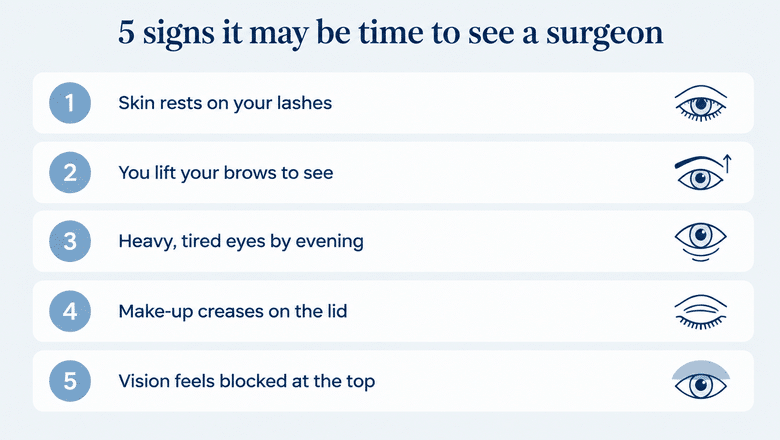
There is no fixed threshold at which saggy eyelids “qualify” for surgery, and surgery is always a personal choice. These are the signs that most often lead people to ask for an assessment:
- Skin rests on your lashes. When you look straight ahead, the fold of skin touches or hides your upper lashes, and the upper lid has less visible surface than it used to.
- You lift your brows to see. If you find yourself raising your eyebrows or tilting your chin back to see clearly, you are compensating for a heavy lid. This often causes forehead lines and a tired ache across the brow by the end of the day.
- Your eyes look tired, older or sad. Friends comment that you look tired when you are not, or you feel your eyes no longer match how you feel.
- Eye make-up creases or smudges on the lid. When there is no visible lid space for eyeshadow or liner, make-up transfers onto the skin fold.
- Your upper field of vision feels blocked. Driving, reading, climbing stairs or looking up all feel restricted, which is the most important sign medically.
A sixth consideration is whether you are willing to accept the downsides. Surgery means a recovery period of a couple of weeks, a fine scar hidden in the eyelid crease and the usual risks of any operation. If the answer to “is my vision or my confidence affected?” is yes and the answer to “can I accept recovery?” is also yes, a consultation is a sensible next step. Our guide to cosmetic vs functional eyelid surgery explains where the line falls between the two.
Can Saggy Eyelids Affect Your Vision?
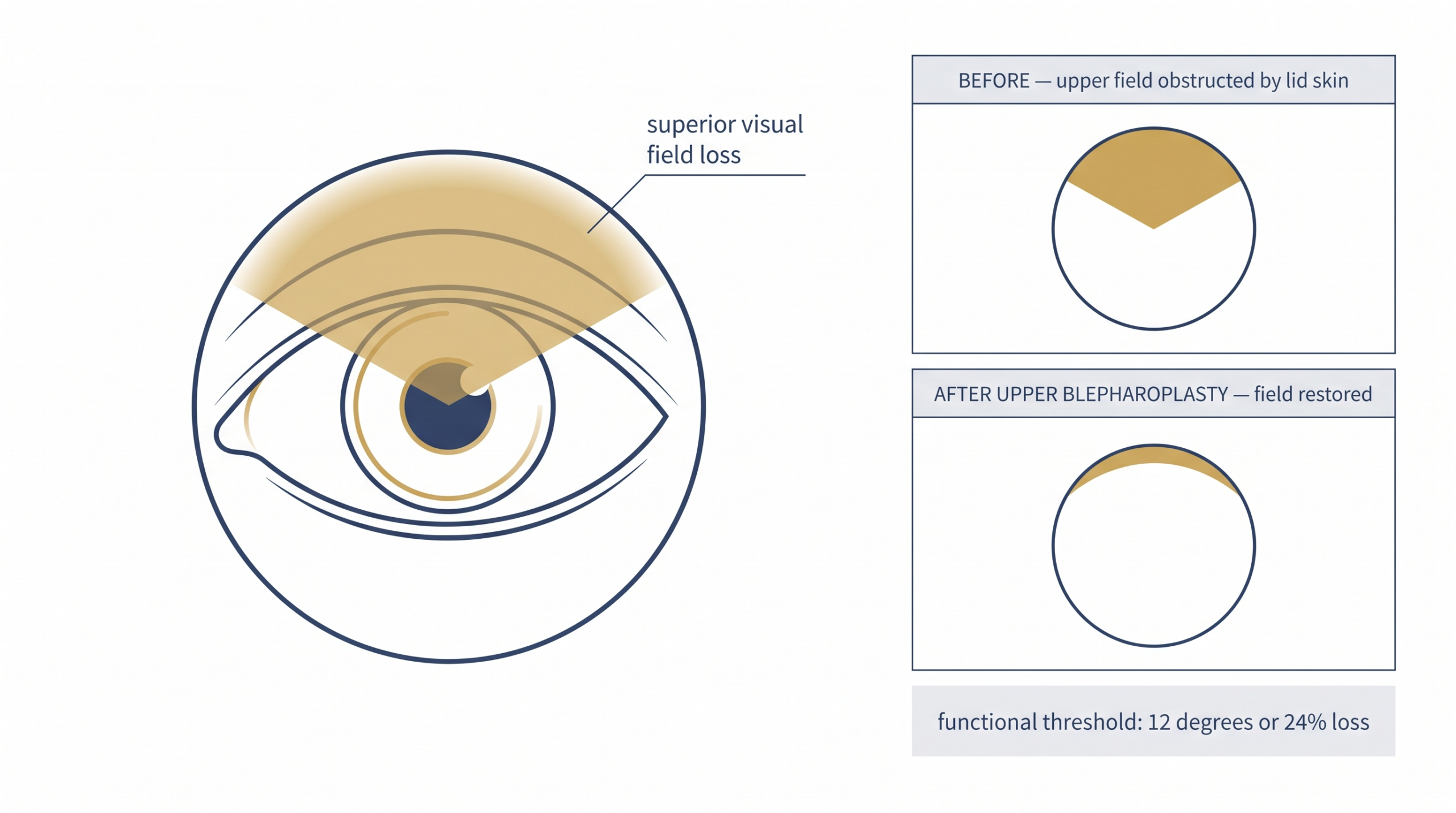
Yes, when the excess skin is heavy enough. Upper eyelid skin that hangs low can block the top of your visual field, make your eyes feel strained and cause headaches from constant brow lifting. In a 2024 prospective study of 40 patients in the Journal Français d’Ophtalmologie ↗, the visible area of the visual field measured on formal testing increased from 46.2 before upper eyelid surgery to 56.7 at one month and 66.0 at three months after surgery[3]. A 2026 narrative review of dermatochalasis found that benefits also include less eyelid heaviness, less tearing and better headache-related quality of life, although no single symptom questionnaire captures everything, and how much skin you have does not reliably predict how much you will benefit[7].
Is eyelid surgery available on the NHS for saggy eyelids?
Sometimes, but not for cosmetic reasons. NHS criteria are usually centred on visual field loss, eyelid position or the lid covering the pupil, and they vary between areas[7]. A GP or optometrist can refer you for assessment if you think your vision is affected. If your concern is mainly appearance, or you do not meet the local criteria, private surgery is the route. Our article on functional and cosmetic eyelid surgery sets out the distinction, and if your vision is badly restricted you should not drive until it has been assessed.
How Do You Fix Saggy Eyelids Without Surgery?
The honest answer is that skin which has genuinely become loose and redundant cannot be removed without surgery, and many things marketed for it do little. What can help depends on what you are trying to change. Our guide to non-surgical alternatives to eyelid surgery compares the main choices in more depth.
Do eye creams work for saggy eyelids?
Creams can moisturise and may slightly improve the look of fine, crepey skin over weeks, particularly formulations with retinoids or peptides, but they cannot tighten a fold of excess skin or move fat. If a product promises to “lift” saggy eyelids in days, treat the claim with caution.
Do eyelid exercises tighten saggy eyelids?
There is no good evidence that facial exercises reverse eyelid sagging, and constant pulling at the delicate skin may do more harm than good. Eyelid skin has no muscle you can build the way you build a bicep.
Can make-up help with saggy eyelids?
Techniques such as keeping shadow above the crease, using matte neutral shades and applying liner at the lash line can make a hooded lid look more open. This is cosmetic camouflage, and it has to be redone every day.
What non-surgical eyelid tightening is there?
For mild crepey skin without a significant overhang, a laser treatment such as SmoothEye laser eyelid tightening uses controlled heat to stimulate collagen and tighten the skin without cutting it. It suits people whose main problem is texture and mild laxity, and it does not replace surgery for a true overhang of skin. Dermal fillers and anti-wrinkle injections have a place around the eyes, but injections here need an experienced practitioner: a published 2021 case report ↗ describes a patient whose repeated filler injections left hard material in the upper eyelid, causing heaviness that was relieved only when blepharoplasty removed it[9].
When saggy eyelids are caused mainly by a low brow, treating the brow rather than the lid is the logical step, and our guide to getting an eyebrow lift without surgery explains what is realistic.
What Is the Surgical Treatment for Saggy Eyelids?
The main operation is blepharoplasty, often called an eyelid lift or eyelid surgery. It removes excess skin, and sometimes a little fat and muscle, from the upper lids, the lower lids or both. The cut is placed in the natural fold of the upper lid or just below the lashes on the lower lid, so scars are well hidden. Read our overview of blepharoplasty at Centre for Surgery for the full procedure.
What is the difference between upper and lower blepharoplasty?
Upper blepharoplasty treats the loose skin and hooding above the eye. Lower blepharoplasty treats bags, puffiness and loose skin beneath it. Most people who describe “saggy eyelids” need the upper operation, but some need both. Our comparison of upper vs lower blepharoplasty explains how the choice is made.
When is a brow lift needed as well?
If the brow has dropped, removing eyelid skin alone can leave the brow lower still. A brow lift raises the eyebrow and takes weight off the lid, and some patients have both operations together. Older patients whose faces show wider laxity sometimes combine eyelid work with a facelift; see blepharoplasty and mini facelift at the same time for how that works.
What if the lid margin itself is too low?
If examination shows the muscle that lifts the lid has weakened (ptosis), skin removal alone will not fully correct it. We assess and treat ptosis at Centre for Surgery, so your surgeon will check lid height and muscle function and explain whether a ptosis correction is needed on its own or alongside blepharoplasty.
What Happens During Eyelid Surgery?
Your surgeon marks the planned skin removal while you are sitting upright, because gravity shows where the excess really lies. Upper blepharoplasty can be done under local anaesthetic, with or without sedation, or with TIVA, where sedation is given through a drip; our guide to blepharoplasty under local or asleep explains how to choose. The excess skin is removed, any bulging fat is treated, and the incision is closed with fine stitches. Most patients go home on the same day. The length of the operation depends on whether upper lids, lower lids or both are treated, and your surgeon will give you an estimate at consultation.

You can see more examples in our blepharoplasty before and after gallery.
How Long Is Recovery After Eyelid Lift Surgery?
Expect tightness, swelling and bruising in the first days, which peak at about 48 hours. Cold compresses and sleeping with your head raised help. Stitches are normally removed after about a week, and most people are comfortable returning to desk work after one to two weeks, although this varies. Bruising fades over two to three weeks, light exercise is usually allowed after a few weeks and full exercise at around four to six weeks. Swelling can take longer to settle completely, and the scar continues to fade for several months. Our full guide to blepharoplasty recovery and aftercare covers the timeline in more detail, including when you can wear make-up and when it is safe to drive.
Will I have visible scars after eyelid surgery?
Scars are usually fine and well hidden, because they lie in the natural upper lid crease or just below the lower lashes. They are pink at first and fade over months. See what blepharoplasty scars look like as they heal.
What Are the Risks of Eyelid Surgery?
Eyelid surgery is generally well tolerated, but it is real surgery near the eye, and risks should be understood before you decide. Common temporary effects are swelling, bruising, tightness and dry or gritty eyes. A 2024 study that measured the eye surface after upper blepharoplasty found that, alongside the improvement in the visual field, the tear film became slightly less stable at three months, so dry eye symptoms are worth discussing with your surgeon beforehand[3]. Less common risks include asymmetry, infection, bleeding, a noticeable scar, difficulty closing the eye fully if too much skin has been removed, and, rarely, serious bleeding behind the eye that threatens vision and needs emergency treatment.
Most of these risks are lowered by good patient selection and a conservative technique. The issues and how to avoid them are covered in the risks and complications of eyelid surgery, can blepharoplasty cause dry eyes and how to avoid blepharoplasty complications. Smoking, uncontrolled thyroid eye disease, significant dry eye and some medicines can increase risk, and your surgeon will check for them at consultation.
Does Eyelid Surgery Work? What Do Patients and Studies Say?
On the evidence available, upper eyelid surgery gives most patients a result they are happy with. A 2024 prospective study of 79 patients in Aesthetic Plastic Surgery ↗ using the FACE-Q patient-reported questionnaire found significant improvement in how patients rated their upper eyelids and their satisfaction with their eyes after surgery. Satisfaction did not depend on how severe the sagging had been before surgery, which supports the idea that even moderate hooding is a reasonable reason to consider treatment[4].
A larger 2024 randomised trial of 348 patients aged 49 to 87 in Medicina ↗ found significant improvements in satisfaction with the eyes, satisfaction with the face overall, psychological function and social function after upper eyelid surgery, with minimal adverse effects that improved over time[5]. Another study of 583 patients found that satisfaction at six months was strongly linked to how patients rated their appearance after surgery and to feeling that the decision had been right for them[6].
Studies like these measure averages. Individual outcomes vary, and no surgeon can promise a particular result. What a good consultation does is match the operation to the cause of your saggy eyelids.
How Long Do Eyelid Lift Results Last?
Removed skin does not grow back, so the result from upper blepharoplasty lasts many years, but ageing continues, so the eyelids and brow carry on changing. Many people find the improvement holds for a decade or more. Our articles on how long blepharoplasty lasts and whether eyelid surgery results are permanent explain what affects longevity.
How Much Does Eyelid Surgery for Saggy Eyelids Cost in London?
The cost depends on whether you are having upper lids, lower lids or both, whether a brow lift is added, the type of anaesthetic and the facility. A fixed quotation is only possible after your surgeon has examined you. Our blepharoplasty cost guide explains what is included, and finance options are available if you prefer to spread the cost.
What Happens at an Eyelid Surgery Consultation?
At Centre for Surgery, your consultation is with a GMC-registered plastic surgeon, and the surgeon who assesses you is the surgeon who performs your operation. The appointment covers your medical and eye history, a careful examination of the skin, the fat, the lid position and the brow, and a discussion of whether you need upper blepharoplasty, lower blepharoplasty, a brow lift or a combination. You will be told plainly if surgery is not the right answer. Surgery takes place at our CQC-regulated hospital on Baker Street, and you can look around the hospital on Baker Street before making a decision. If you are comparing clinics, our guide on how to choose an eyelid surgeon lists what to ask, and men and women often have different priorities, as covered in blepharoplasty for women and men.
Frequently Asked Questions
How can I fix saggy eyelids?
Mild crepey skin may improve with moisturising and a laser tightening treatment, but genuinely loose, hooded skin is corrected by upper blepharoplasty. If the brow has dropped, a brow lift may be needed too. An examination will show which applies.
What causes saggy eyelids?
Mostly ageing: the skin loses collagen, the muscles weaken and fat pushes forward. Genetics, sun damage, smoking, weight loss and eye rubbing contribute. A low brow can make the lids look heavier still.
Can saggy eyelids affect your vision?
Yes. Heavy upper lid skin can block the top of your field of vision, cause eye strain and lead to brow aches from constantly lifting your brows. Studies show the visual field can improve after upper eyelid surgery.
What is the difference between saggy eyelids and ptosis?
Saggy eyelids usually mean excess skin folding over the lid. Ptosis means the lid muscle has weakened and the lid margin sits too low. They can occur together and are treated differently.
How can I tighten the skin on my eyelids?
Skincare, sun protection and non-smoking help slow further changes. Laser treatment can tighten mild looseness. Surgery is the only treatment that removes real excess skin.
Do eyelid exercises or creams work for saggy eyelids?
There is no good evidence that exercises reverse sagging, and creams do not remove excess skin. They may improve the feel of dry, fine skin, but they will not lift a hooded lid.
Is eyelid surgery for saggy eyelids painful?
Most people describe tightness, tenderness and swelling rather than severe pain. You are numbed or asleep during surgery, and simple painkillers are usually enough afterwards. Tell your surgical team if pain increases instead of easing or your vision changes.
Is eyelid surgery available on the NHS?
Only when the sagging causes a functional problem, such as visual field loss, and criteria vary by area. Cosmetic eyelid surgery is not funded. Your GP or optometrist can advise on referral.
How long does recovery take after an eyelid lift?
Stitches usually come out after about a week and many people return to desk work within one to two weeks. Bruising fades over two to three weeks and the scar keeps improving for several months.
Saggy Eyelids Treatment in London
If saggy eyelids are bothering you, a consultation will establish whether skin, fat, the brow or the lid muscle is responsible and which treatment would suit you. Find out more about eyelid surgery at Centre for Surgery.
Phone: 020 7993 4849 | Address: 95–97 Baker Street, Marylebone, London W1U 6RN
Contact us to schedule a consultation
References
- De Biasio F, Miotti G, Zingaretti N, Castriotta L, Parodi PC. Study on the aging dynamics of the periorbital region: from observation to knowledge of physiopathology. Ophthalmic Plastic and Reconstructive Surgery 2019;35(4):333–341. doi:10.1097/IOP.0000000000001247 ↗
- Dus S, Buono U, Aiello V, Paduano FP, Inchingolo F, Paduano S. Upper blepharoplasty in dermatochalasis: a retrospective study of our cases. Journal of Maxillofacial and Oral Surgery 2025;25(2):592–600. doi:10.1007/s12663-025-02446-y ↗
- Ulas B, Ozcan A, Yar K, Kaya I, Binokay H. Evaluation of visual field and ocular surface parameters by clinical comparison after blepharoplasty for dermatochalasis. Journal Français d’Ophtalmologie 2024;47(4):104135. doi:10.1016/j.jfo.2024.104135 ↗
- Marangi GF, Mirra C, Savani L, Cogliandro A, Romano FD, Segreto F, et al. Is the severity of preoperative eyelid dermatochalasis directly correlated with patient satisfaction after upper blepharoplasty? A prospective study based on PROMs. Aesthetic Plastic Surgery 2024;48(20):4114–4120. doi:10.1007/s00266-024-04214-8 ↗
- Vasović DD, Karamarković ML, Jovanović M, Stojičić M, Rašić DM, Marjanović I, et al. Comprehensive evaluation of quality of life following upper eyelid blepharoplasty: a prospective analysis. Medicina (Kaunas) 2024;60(3). doi:10.3390/medicina60030500 ↗
- Luong KP, Vissers LCM, Domela Nieuwenhuis I, Hazenkamp LS, Hummelink S, Slijper HP, et al. Factors associated with treatment outcome satisfaction six months after upper blepharoplasty: a large cohort study. Plastic and Reconstructive Surgery Global Open 2023;11(9):e5260. doi:10.1097/GOX.0000000000005260 ↗
- Whitelaw TA. Beyond visual field restriction: reconsidering functional assessment in upper eyelid dermatochalasis. Orbit 2026:1–10. doi:10.1080/01676830.2026.2727052 ↗
- Bayrak SB, Kriet JD, Humphrey CD. Selecting the best eyelid techniques. Facial Plastic Surgery 2018;34(5):497–504. doi:10.1055/s-0038-1672148 ↗
- Maione L, Vinci V, Costanzo D, Battistini A, Lisa A, Di Maria A. Upper eyelid blepharoplasty following hyaluronic acid injection with improved facial aesthetics and eye symptoms: a case report. Journal of Medical Case Reports 2021;15(1):248. doi:10.1186/s13256-020-02641-0 ↗







