


In this guide14 sections
- Key Points
- How Do I Choose an Eyelid Surgeon?
- Who Can Perform Eyelid Surgery: Plastic Surgeon or Oculoplastic Surgeon?
- How Do I Check an Eyelid Surgeon Is on the GMC Register?
- How Much Experience Should an Eyelid Surgeon Have?
- How Do I Judge Blepharoplasty Before and After Photos?
- What Questions Should I Ask at a Blepharoplasty Consultation?
- Is Eyelid Surgery Done Under Local or General Anaesthetic?
- What Happens if Something Goes Wrong After Eyelid Surgery?
- What Should a CQC-Regulated Eyelid Surgery Clinic Provide?
- Warning Signs When Choosing an Eyelid Surgeon
- Choosing an Eyelid Surgeon in London at Centre for Surgery
- Frequently Asked Questions
- References
Key Points
- How do I choose an eyelid surgeon? Check that they are on the GMC register, ask which specialty they trained in and how often they perform the exact operation you need, look at before and after photographs of patients with a similar starting point, and make sure the clinic is regulated by the Care Quality Commission (CQC).
- Cosmetic surgery is not a specialty on the GMC register. Blepharoplasty is performed by surgeons from more than one specialty, so look at what the register shows about the individual surgeon rather than the title they use.
- Experience matters, but no one has set a minimum number for blepharoplasty. Studies of other operations link surgeon experience with fewer revisions and complications, so ask how many eyelid operations your surgeon performs and how they handle problems.
- Anaesthetic depends on the operation. Upper eyelid surgery on its own is often done under local anaesthetic, while lower eyelid and combined surgery are often done asleep. Ask who gives the anaesthetic and why they recommend it for you.
- Serious complications are uncommon but need a plan. Bleeding behind the eye is the one to know about: a 2004 survey put it at about 1 in 2,000 operations, mostly within the first hours. Ask what happens if something goes wrong and who you ring.
- A good consultation includes limits. Be wary of any surgeon who promises a result, rushes you or does not ask about your medical history.
Searching for an eyelid surgeon in London turns up long lists of clinics describing their surgeons in glowing terms, and very little that helps you tell them apart. No independent body ranks eyelid surgeons, so what you can do is check a few public facts, ask questions that are hard to answer vaguely, and judge how the consultation feels. This guide covers how to choose an eyelid surgeon for blepharoplasty (eyelid surgery) in the UK, what to check on the GMC register, how to read before and after photographs, and what to look for in the clinic.
It applies to any clinic, including ours. If you are still deciding whether you need surgery at all, see non-surgical alternatives to eyelid surgery, and upper vs lower blepharoplasty explains which operation treats which problem.
How Do I Choose an Eyelid Surgeon?
There is no single qualification that guarantees a good result, so choosing well means building up a picture from several checks: the surgeon’s registration and training, how often they perform the exact operation you need, their results, the consultation itself, the anaesthetic and aftercare arrangements, and the clinic. The sections below take each in turn.
Who Can Perform Eyelid Surgery: Plastic Surgeon or Oculoplastic Surgeon?
Eyelid surgery is performed in the UK by surgeons from more than one background. Plastic surgeons train in the whole body and many develop a particular interest in the face. Oculoplastic surgeons are usually ophthalmologists (eye surgeons) who have gone on to train in surgery of the eyelids, tear ducts and the tissues around the eye. Some ear, nose and throat surgeons and maxillofacial surgeons also operate on the eyelids as part of facial surgery.
So is an oculoplastic surgeon better than a plastic surgeon for eyelid surgery? Neither title is a guarantee, and we are not aware of good evidence that one route produces consistently better results. An oculoplastic background means detailed knowledge of how the eyelids protect and lubricate the eye, which matters for dry eyes or a lower lid that is already loose. A plastic surgery background means broad experience of facial aesthetics and of combining eyelid surgery with a brow lift or facelift. What matters more than the label is what the individual surgeon does day to day, and whether eyelid surgery is a regular part of it.
If your problem is mainly functional, such as eyelids that obscure your vision, our guide to the difference between cosmetic and functional eyelid surgery explains how the two are assessed.
How Do I Check an Eyelid Surgeon Is on the GMC Register?
Every doctor who practises in the UK must be registered with the GMC and hold a licence to practise. The GMC’s online medical register ↗ is free to search by name or by the surgeon’s seven-digit GMC reference number, and it takes a couple of minutes. Check three things:
- Do they hold a licence to practise? Registration alone is not enough, as the register shows whether the licence is current.
- Are they on the specialist register, and in which specialty? Specialist registration records that a doctor has completed recognised specialist training in a named specialty, such as plastic surgery or ophthalmology.
- Are there any restrictions? The register also shows conditions, undertakings or warnings that apply to a doctor’s practice.
There is one point that surprises many patients. “Cosmetic surgery” is not a specialty on the GMC’s specialist register, and “cosmetic surgeon” is not a protected title. A doctor with no surgical specialist training could in principle describe themselves that way. That is why the entry on the register is more informative than the description on a clinic website. Likewise, oculoplastic surgery is generally a sub-specialty interest within ophthalmology rather than a separate entry, so a surgeon who describes themselves that way should be able to tell you about their ophthalmic training and their eyelid fellowship or equivalent experience.
Membership of a professional association, such as BAAPS, BAPRAS or the British Oculoplastic Surgery Society, can be verified on the association’s own website. It is a useful extra, not a substitute for the register. If the surgeon will not give you their GMC number, or you cannot find them, treat that as a reason to stop.
How Much Experience Should an Eyelid Surgeon Have?
There is no recognised minimum number of blepharoplasty operations a surgeon must have performed, and we are not aware of any study that sets a threshold for eyelid surgery. It would be misleading to quote a number. What the wider surgical literature does show is that experience tends to count.
In a 2025 single-surgeon study of 1,182 breast reconstruction flaps in the Journal of Reconstructive Microsurgery ↗, the later part of the surgeon’s career was independently associated with fewer revision operations and shorter hospital stays than the earlier part, even after allowing for differences in patients[1]. A separate study of knee ligament reconstruction found that greater surgeon experience was associated with fewer complications and shorter operating times[2]. These are very different, much larger operations, so the findings cannot be transferred directly to eyelid surgery. They do support a sensible principle: a surgeon who performs an operation often has more chances to refine technique and to meet unusual anatomy.
Rather than asking “how experienced are you?”, ask specific questions:
- How many upper, lower or combined blepharoplasties do you perform in a typical year?
- How many involve eyelids like mine, and what additional training have you had in eyelid surgery?
- How often do you perform revision surgery, and on whose original operations?
An honest surgeon will answer in approximate numbers and will tell you if your case is outside their usual practice. If your concern is more specialised, such as Asian blepharoplasty (double eyelid surgery), where the techniques and aesthetic goals differ from traditional eyelid surgery, ask specifically about experience with that operation. Our Asian blepharoplasty and male eyelid surgery pages explain how these differ.
How Do I Judge Blepharoplasty Before and After Photos?
Before and after photographs are the most useful evidence you can see, provided you read them critically. Look for the following:
- Whose patients are they? Ask whether the photographs are of the surgeon who would operate on you, not a colleague, a previous clinic or stock images.
- Are they consistent? Check lighting, angle and expression match, and that the after photograph is taken several months post-operatively.
- Do the patients look like you? A result on a mild bag at 30 tells you little about heavy, hooded upper lids at 60.
- Is there a range? A gallery of only flawless results should prompt a question about how images are chosen. Individual results always vary.
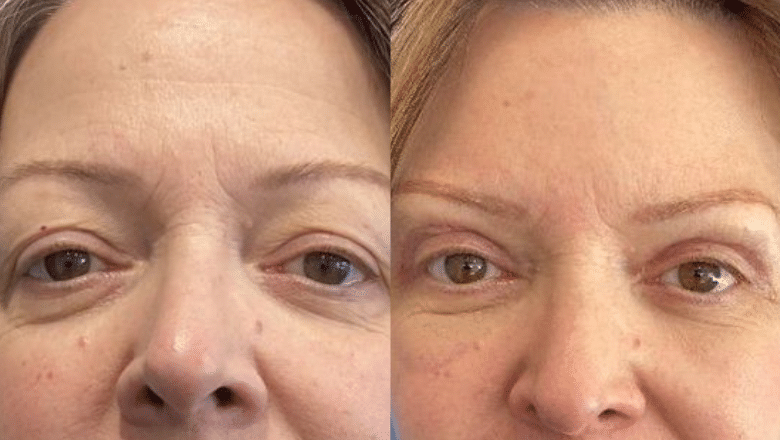
When it goes well, patients are generally pleased: a systematic review of 26 studies of upper blepharoplasty found people were generally satisfied with both the result and the scar[3]. When patients are unhappy, the commonest complaint is not what many expect. In a review of 138 patient complaints about blepharoplasty-related procedures, asymmetry was the most frequent cause of dissatisfaction after double eyelid surgery, and incomplete resection of under-eye puffiness was the commonest after lower blepharoplasty[4]. That is a useful prompt to ask your surgeon how they assess and plan for asymmetry, which most people have to some degree before surgery. You can see examples of our own patients’ results in our blepharoplasty before and after photos gallery.
What Questions Should I Ask at a Blepharoplasty Consultation?
A good consultation is a conversation in both directions. The surgeon should examine your eyelids, brows and tear film, take a medical history and ask what bothers you, and you should leave knowing why a particular operation is being suggested. Questions worth asking:
- Which operation do you recommend for me and why, and what are the alternatives, including doing nothing?
- What are the risks, and how often do they happen in your own practice?
- Who will operate, who will give the anaesthetic, and who will I see afterwards?
- What happens if I develop a complication or am unhappy with the result? Is revision surgery included, and on what terms?
Two parts of a thorough consultation are easy to overlook. The first is your own expectations. Body dysmorphic disorder, a condition in which a person becomes preoccupied with a perceived flaw, is more common among people seeking cosmetic surgery than in the general population, with a 2025 meta-analysis estimating it at around 24% of plastic surgery patients[5]. A responsible surgeon will ask about your motivation and, where it seems appropriate, may suggest speaking to someone before surgery or decline to operate. That is a sign of care, not of reluctance.
The second is your medical history. Tell the surgeon about every medicine you take, including aspirin and blood thinners, and about dry eyes, thyroid eye disease, previous eye surgery and skin conditions. A retrospective study of 392 people having upper blepharoplasty found no significant difference in complications between those taking anticoagulant or antiplatelet medicines and those who were not, although it was a single-centre study and the authors called for larger studies[6]. The practical message is that the surgeon and anaesthetist need to know, and that medicines should only be stopped on medical advice. A systematic review, mostly of case reports, also found complications after facial procedures in people with underlying skin conditions, which is another reason to say what you have been diagnosed with[7].
Our blepharoplasty recovery and aftercare guide will help you ask more informed questions.
Is Eyelid Surgery Done Under Local or General Anaesthetic?
The answer depends on the operation, your health and your preference, and it is a fair question to ask any surgeon. As a general guide, upper eyelid surgery on its own is often performed under local anaesthetic, with or without sedation. Lower eyelid surgery, and combined upper and lower surgery, is often performed under general anaesthetic, which at some clinics is given as total intravenous anaesthesia (TIVA), where anaesthetic drugs are given through a drip rather than as a gas. Neither option is better in every case. What matters is that the choice is explained to you, that an anaesthetist is responsible for your safety if you are sedated or asleep, and that you can ask who they are. You are entitled to look the anaesthetist up on the GMC register as well. Our guide to blepharoplasty under local anaesthetic or asleep sets out the differences, and you should be cautious of any clinic that quotes one anaesthetic for everyone before it has seen you.
What Happens if Something Goes Wrong After Eyelid Surgery?
Most people have no serious problems, but the way a surgeon talks about complications tells you a lot. A 2025 systematic review of 36 articles on lower blepharoplasty described an overall low complication profile, with no major complications resulting in ocular or visual disturbance reported, and most functional and aesthetic problems resolving with conservative treatment or revision surgery. It also noted that more rigorous studies are needed to compare techniques[8].
The complication to understand is bleeding behind the eye (orbital haemorrhage), because it needs urgent treatment. In a 2004 survey covering 269,433 cosmetic eyelid operations ↗, about 1 in 2,000 patients had orbital haemorrhage and about 1 in 22,000 had permanent loss of vision, with most bleeds happening in the first hours after surgery[9]. That is why it matters where you recover and who is available in that first night.
Other problems the surgeon should be able to explain include:
- Dry or watery eyes. A 2025 meta-analysis of randomised trials found dry eye symptoms were less common after upper blepharoplasty than before, but removing muscle as well as skin was linked with more cases of incomplete eyelid closure[10]. Ask how much tissue the surgeon usually removes and why.
- Lower eyelid pulling down (ectropion or retraction). Surgeons use a range of techniques to help prevent this, although a 2025 review rated the quality of the evidence as low[11]. Ask what they do to minimise the risk.
- Asymmetry, scarring, lumps and a result that is not what you hoped for. Our guides to the risks and complications of eyelid surgery and botched eyelid surgery and how to avoid blepharoplasty complications explain what is normal healing and what is not.
Put the practical questions to the surgeon directly. Who do I ring in the first 24 hours, and where do I go out of hours? Is there a follow-up appointment in the first week or so? If the result is not right, what would revision involve? A clinic that has thought these through will answer without hesitation. If you are comparing the cost of surgery abroad with the UK, remember that aftercare and revision rarely appear in the quote; our guide to blepharoplasty abroad explains what can go wrong after a flight home.
What Should a CQC-Regulated Eyelid Surgery Clinic Provide?
In England, hospitals and clinics that carry out surgery must be registered with the Care Quality Commission (CQC), the independent regulator of health and social care. You can search for any provider on the CQC website ↗ and read its inspection reports. Registration shows that a provider is subject to inspection and has to meet fundamental standards of safety and care, but it does not tell you about an individual surgeon’s results, so use it alongside the checks above.
Ask the clinic whether an anaesthetist is present, what emergency equipment and trained staff are on site, who your named contact is after you go home, and whether the surgeon who sees you at consultation is the one who will operate.
Be cautious about offers of surgery in hotels or beauty salons, and about any clinic that pressures you with time-limited deals. The NHS guidance on eyelid surgery ↗ explains what the operation involves and what its risks are, and is a useful companion to the checks above.
Warning Signs When Choosing an Eyelid Surgeon
Any one of the following is a reason to pause and ask more questions:
- The surgeon cannot or will not give you a GMC number, or their entry on the register does not match what you have been told.
- You are offered surgery without being examined by the person who will operate, or the consultation is rushed and risks are not discussed.
- Photographs are of other surgeons’ work or never show any imperfect result.
- You are offered a guaranteed or “permanent” result. Eyelid skin keeps ageing after surgery, and no surgeon can promise an outcome.
- Deposits or decisions are pushed within hours.
If you have already had surgery and are unhappy, the first step is usually to speak to your original surgeon. Revision surgery is more complex than the first operation, so choose a surgeon with specific experience of it.
Choosing an Eyelid Surgeon in London at Centre for Surgery
Centre for Surgery is a CQC-registered private hospital at 95-97 Baker Street, London, offering upper and lower blepharoplasty, Asian blepharoplasty and male eyelid surgery. The surgeon who assesses you at your consultation is the surgeon who performs your operation, and follow-up reviews are part of the care pathway. We would encourage you to apply every check in this guide to us as well: look up our surgeons on the GMC register, view our gallery of results, and ask us the questions above.
The aim of a consultation is for you to be able to make an informed decision, which sometimes means deciding not to go ahead. If you would like to discuss eyelid surgery, you can contact us to arrange a consultation. Our blepharoplasty cost guide explains what a quote should and should not include.
Phone: 020 7993 4849 | Address: 95–97 Baker Street, Marylebone, London W1U 6RN
Contact us to schedule a consultation
Frequently Asked Questions
How do I choose a reliable eyelid surgeon?
Check their entry on the GMC register, ask which specialty they trained in and how many operations of your type they perform each year, look at before and after photographs of their own patients, and make sure the clinic is CQC-registered. Choose someone who explains the risks and limits plainly and does not rush you.
Is an oculoplastic surgeon better than a plastic surgeon for eyelid surgery?
Not necessarily. Oculoplastic surgeons bring detailed knowledge of the eyelid’s function and the eye, and plastic surgeons bring broad facial aesthetic experience. The most reliable guide is how often the individual surgeon performs the operation you need and how they handle complications.
How many blepharoplasty operations should a surgeon have done?
There is no agreed minimum number for eyelid surgery. Studies of other operations link greater surgeon experience with fewer revisions and complications, so ask how many upper, lower and combined blepharoplasties your surgeon performs each year, and how many involve eyelids like yours.
How do I check if a surgeon is on the GMC register?
Search by name or GMC number on the GMC’s online medical register, which is free. It shows whether the doctor holds a licence to practise, whether they are on the specialist register and in which specialty, and any restrictions on their practice. You can check the anaesthetist in the same way.
Is eyelid surgery done under local or general anaesthetic?
Both are used. Upper eyelid surgery alone is often done under local anaesthetic with or without sedation, while lower eyelid and combined surgery are often done under general anaesthetic, which can include TIVA. The choice depends on your operation, health and preference, and your surgeon and anaesthetist should explain the reasons.
What can go wrong with eyelid surgery?
Most people recover without serious problems. Risks include bruising and swelling, dry or watery eyes, asymmetry, scarring, lower eyelid malposition and, rarely, bleeding behind the eye, which needs urgent treatment. A 2004 survey found about 1 in 2,000 patients had this bleeding, and permanent loss of vision was about 1 in 22,000.
Can eyelid surgery be fixed if it goes wrong?
Often it can be improved. A 2025 systematic review of lower blepharoplasty found that most functional and aesthetic complications could be managed conservatively or with revision surgery. Revision is more complex than a first operation, so wait until healing has settled and see a surgeon with specific experience of it.
Is it safe to have eyelid surgery abroad?
It can be, but the risks are different. Bleeding behind the eye is most likely in the first hours after surgery, and problems can appear days later when you may be on a flight or back in the UK with no surgeon to ask. Check how aftercare and revision would be handled before booking.
References
- Rothchild E, Smith IT, Popoola SO, Ricci JA, Tanna N. Surgeon experience and outcomes in microsurgical breast reconstruction: a 10-year single surgeon analysis. Journal of Reconstructive Microsurgery 2025;42(6):461–465. doi:10.1055/a-2687-0207 ↗
- Berzolla E, Lezak BA, Magister S, et al. Surgeon experience in multi-ligament knee injury reconstruction is associated with decreased complications and surgical time. European Journal of Orthopaedic Surgery & Traumatology 2025;35(1):97. doi:10.1007/s00590-025-04233-4 ↗
- Hollander MHJ, Schortinghuis J, Vissink A, et al. Aesthetic outcomes of upper eyelid blepharoplasty: a systematic review. International Journal of Oral and Maxillofacial Surgery 2020;49(6):750–764. doi:10.1016/j.ijom.2019.10.014 ↗
- Su X, Chen D, Zhuang J, et al. A 7-year analysis of complaints related to Asian blepharoplasty. Journal of Cosmetic Dermatology 2025;24(3):e16271. doi:10.1111/jocd.16271 ↗
- Pérez-Buenfil A, Morales-Sánchez A. Prevalence of body dysmorphic disorder: a systematic review and meta-analysis. Journal of Cosmetic Dermatology 2025;24(4):e70121. doi:10.1111/jocd.70121 ↗
- Viscardi JA, Giordano S. Upper blepharoplasty under anticoagulant or antiplatelet therapy: is safety still a concern? Aesthetic Plastic Surgery 2026;50(13):4866–4872. doi:10.1007/s00266-026-05944-7 ↗
- Perez SM, Kennedy DJ, Ascher B, Tosti A, Landau M. Implications of dermatologic disorders in facial cosmetic surgery: a systematic review. Annals of Plastic Surgery 2026;96(5):404–412. doi:10.1097/SAP.0000000000004731 ↗
- Gimenez AR, Rohrich R, Borab Z, Fisher S, Fagien S, Rohrich RJ. Safety and complications in lower eyelid blepharoplasty: a systematic review. Plastic and Reconstructive Surgery Global Open 2025;13(9):e7102. doi:10.1097/GOX.0000000000007102 ↗
- Hass AN, Penne RB, Stefanyszyn MA, et al. Incidence of postblepharoplasty orbital hemorrhage and associated visual loss. Ophthalmic Plastic and Reconstructive Surgery 2004;20(6):426–432. doi:10.1097/01.iop.0000143711.48389.c5 ↗
- Todorov D, Mitchell S, Al-Hashimi M, et al. Functional and aesthetic outcomes after upper blepharoplasty: a systematic review and meta-analysis of randomized control trials. Aesthetic Surgery Journal 2025;45(6):554–562. doi:10.1093/asj/sjaf022 ↗
- Yalcin CE. Holding the lid: suspension techniques to prevent lower eyelid ectropion, a systematic review. Facial Plastic Surgery 2025;42(4):451–456. doi:10.1055/a-2695-3754 ↗







