


In this guide19 sections
- Key Points
- What Is Asian Blepharoplasty?
- How Does Asian Blepharoplasty Differ From Traditional Eyelid Surgery?
- Why Do Some Eyelids Have No Crease? Eyelid Anatomy Explained
- What Is an Epicanthic Fold, and Does It Need Surgery?
- What Types of Double Eyelid Crease Are There?
- Which Techniques Are Used for Double Eyelid Surgery?
- Who Is a Good Candidate for Asian Blepharoplasty?
- Asian Blepharoplasty vs Upper Blepharoplasty: Which Do You Need?
- Asian Blepharoplasty Before and After: What Do Results Look Like?
- How Long Does Recovery Take After Double Eyelid Surgery?
- What Are the Risks of Asian Blepharoplasty?
- Can You Get a Double Eyelid Without Surgery?
- Is It Safe to Have Double Eyelid Surgery Abroad?
- How Much Does Asian Blepharoplasty Cost?
- What Happens at an Asian Blepharoplasty Consultation?
- Frequently Asked Questions
- Asian Eyelid Surgery in London
- References
Key Points
- How does Asian blepharoplasty differ from traditional eyelid surgery? Traditional blepharoplasty mainly removes excess skin and fat from an eyelid that already has a crease. Asian blepharoplasty, also called double eyelid surgery, usually creates or refines the upper eyelid crease itself.
- The anatomy is different. Many East Asian upper eyelids have a low or absent crease, a fuller layer of fat in front of the tarsal plate and an epicanthic fold at the inner corner, so the operation is planned around those features.
- Three techniques exist: non-incisional (suture), partial-incision and full-incision. The right one depends on your skin thickness, fat and age, not on which is fashionable.
- The aim is to refine your own eyes. A good result keeps your natural eye shape and ethnic features, and a well-planned crease should look like it was always there.
- Risks and recovery: swelling and bruising settle over two to three weeks, the crease keeps softening for several months, and asymmetry, fold loss and scarring are recognised risks.
- Asian blepharoplasty is not a substitute for standard blepharoplasty. Some patients need one, some need the other and some need elements of both, which a consultation will establish.
If you have searched for Asian eyelid surgery, you have probably noticed that clinics use several names for it: Asian blepharoplasty, double eyelid surgery, East Asian blepharoplasty and “double bleph”. They all describe a procedure that is related to, but not the same as, traditional blepharoplasty. Our own Asian blepharoplasty service is built around that difference.
This guide explains what separates the two operations: the goal, the eyelid anatomy, the techniques, the recovery and the risks. It is written to be respectful and clinical. Asian blepharoplasty is not about looking Western, and a surgeon who treats it that way is not the right surgeon. If you are still working out whether you have a monolid or a hooded lid, our guides to eye shapes and hooded eyelids are a good place to start.
What Is Asian Blepharoplasty?
Asian blepharoplasty is eyelid surgery designed for the anatomy that is common in people of East Asian descent. Its best-known form is double eyelid surgery: creating or defining a crease in the upper eyelid, medically called the supratarsal crease. In a younger patient the aim is usually to enhance the natural features of the eye rather than to remove tissue[1].
Some people are born with a visible crease and some are not. A lid without a crease is often called a monolid or single eyelid; our guide to monolid eyes and double eyelid surgery covers that anatomy and the temporary options in full, while this article compares the two operations. Both are normal variations, and neither needs treatment. Patients seek surgery for personal reasons: eyes that look more open, a crease that is uneven between the two sides, make-up that smudges into a heavy lid, or simply a long-held wish for a defined fold.
Is Asian blepharoplasty the same as double eyelid surgery?
Yes, in everyday use. Asian blepharoplasty, Asian eyelid surgery, double eyelid plastic surgery and double eyelid surgery all refer to creating or refining an upper eyelid crease. The name “Asian” refers to the anatomy and the surgical approach rather than to who may have it, because people of any background can lack a crease.
How Does Asian Blepharoplasty Differ From Traditional Eyelid Surgery?
The two operations start from different questions. Traditional upper blepharoplasty asks what can be removed: loose skin that hangs over the lashes, and fat that bulges, in an eyelid that already has a crease. The incision is hidden in that natural crease, and the crease stays where it is.
Asian blepharoplasty asks where the crease should be. The surgeon decides its height, its length and its shape, and then builds it so that it stays. Published descriptions of the Asian approach describe working out both the height and the length of the crease, shaping the anatomy beneath it, rebuilding the crease and adding an inner-corner procedure when it is needed[2]. Skin removal is often small or none, because the problem is rarely a surplus.
The practical differences come down to four things:
- Goal: create or refine a crease, versus remove excess skin and fat.
- Crease: designed from scratch, versus guided by the natural crease.
- Inner corner: the epicanthic fold is assessed and sometimes altered, versus usually left alone.
- Technique: a choice of suture, partial-incision or full-incision methods, versus skin and fat excision.
Why Do Some Eyelids Have No Crease? Eyelid Anatomy Explained
In a lid with a crease, fine fibres from the levator muscle, the muscle that lifts the lid, reach through to the skin and pull a fold into it each time the eye opens. In a lid without a crease, those attachments are weaker or lower, so the skin glides straight down over the lashes. The orbital septum, a thin membrane that holds back the fat of the eye socket, also tends to join the levator lower down, which lets fat sit closer to the lash line and can make the lid look fuller.
That is the classic explanation, but real anatomy is messier. A 2012 anatomical study of 26 cadaver upper eyelids in Ophthalmic Plastic and Reconstructive Surgery ↗ found that the thickness and bending shape of the orbicularis muscle, and the thickness of the skin at the crease, were the main differences in lids with a double fold, while the levator and fat features were not definite causes[3]. In other words, the lid is a system, and a good surgeon plans for all of it.
What Is an Epicanthic Fold, and Does It Need Surgery?
An epicanthic fold is a small fold of skin that covers the inner corner of the eye. It is common in people of East Asian descent and many other groups, and it is not a defect. It matters in eyelid surgery because it determines how a new crease can meet the inner corner.
If the fold is mild, the crease can simply tuck into it. If it is prominent, a crease that stops short of the corner can look unnatural, and some patients choose an inner-corner procedure called epicanthoplasty at the same time. A 2025 retrospective study of 16 patients in Aesthetic Plastic Surgery described revising unsatisfactory blepharoplasty results by adjusting the epicanthic fold so that it matched the double eyelid, which shows how closely the two features work together[4]. Whether to alter the fold is a decision to make carefully, as it changes the shape of the inner eye. A related operation that reshapes the outer corner is canthoplasty.
What Types of Double Eyelid Crease Are There?
Choosing the crease is the most personal part of the operation. The usual descriptions are:
- In-fold (nasally tapered): the crease starts at the inner corner and rises gently towards the outer edge, merging with the epicanthic fold. It is subtle and keeps the natural almond shape.
- Out-fold (parallel): the crease runs above and roughly parallel to the lash line from corner to corner, leaving the epicanthic fold below it. It is more defined and more visible.
- Semi-parallel or tapered-parallel: a middle ground that starts slightly out from the corner and tapers.
Height matters as much as shape. A crease is usually designed a few millimetres to about a centimetre above the lash line, and a lower crease generally looks more natural and more understated. Your surgeon should show you the options on your own face, and bring reference photos. If the photos are heavily filtered or edited, expect your surgeon to talk you through what is realistic.
Which Techniques Are Used for Double Eyelid Surgery?
The central problem is making a crease that stays. A 2026 review of 19 studies in the Asia-Pacific Journal of Ophthalmology describes how techniques have moved from simple fixation of the skin to the tarsus towards methods that create a more natural, dynamic crease, and groups them by the layer they fix to[5]. In practice there are three families.

Non-incisional (suture) double eyelid surgery
Tiny stitches are passed through the lid and tied beneath the skin to link it to the tissue that lifts it, with no skin removed and only pinpoint marks. It suits younger patients with thin skin and little fat, and recovery is the quickest. The trade-off is durability. In a 2013 study of 349 patients in the Journal of Plastic, Reconstructive and Aesthetic Surgery ↗, the double fold was lost in 26% of those who had buried sutures alone, against 9.6% when a small incision was also used to remove a strip of pretarsal muscle, although the rate of ptosis (a drooping lid) potentially rose with the muscle resection[7].
Partial-incision (small-incision) technique
Two or three short cuts allow the surgeon to remove a little fat and fix the crease more firmly while keeping scars short. It is a middle path for people with fuller lids but little excess skin. A 2023 systematic review of 4,177 patients in Aesthetic Plastic Surgery ↗ found that single- and three-incision techniques both had a pooled complication rate of 5% and a pooled fold-loss rate of 2%, with no significant difference between groups[6].
Full-incision (open) technique
A continuous incision along the planned crease lets the surgeon remove excess skin, adjust fat and muscle, and fix the crease firmly. It gives the most control and the most lasting crease, and it is usually the right choice for thicker or heavier lids, and for patients over about 30 who have some excess skin. It also leaves the longest scar, hidden in the crease, and the longest recovery.
Which method is best depends on the lid in front of the surgeon, not on a ranking. No single technique suits everyone.
Who Is a Good Candidate for Asian Blepharoplasty?
Whether you are considering monolid surgery or a refinement of an existing crease, good candidates are in good general health, are at least 18, do not smoke (or will stop for the weeks around surgery), and have clear, internal reasons for wanting the change. The conversation about motivation is part of the assessment. If the aim is to look like someone else, or to take on a different ethnic appearance, the surgery cannot deliver it and a responsible surgeon will say so. A patient with signs of body dysmorphic disorder should be supported to get the right help first; our guide to body dysmorphia and cosmetic surgery explains why.
Conditions that need attention before any eyelid surgery include dry eye, thyroid eye disease, ptosis and other active eye problems. In an older patient, the picture changes: the same review that describes the Asian eyelid notes that ageing eyelids should be assessed for loose skin, ptosis and brow descent as well as the crease[1]. The ideal age for blepharoplasty varies, and there is no single right time.
Asian Blepharoplasty vs Upper Blepharoplasty: Which Do You Need?
A simple way to decide is to ask what your lid is doing. If you have a natural crease and the problem is loose, heavy or hooded skin, with or without puffiness, you are likely to need upper blepharoplasty rather than Asian blepharoplasty. If you have little or no crease, or an uneven crease, and your main wish is definition, you are likely to need Asian blepharoplasty.

Many patients need a mix. An older patient with a monolid may have both a missing crease and excess skin, and the plan combines crease creation with skin removal. A patient with a low brow may find that their lid looks heavy because the brow has dropped, in which case a brow lift may be part of the answer; our guide to brow lift vs blepharoplasty explains how that decision is made. It is also worth knowing that eyelid surgery can change brow position: a 2023 meta-analysis found that brow height fell by about 2.5 mm on average after double eyelid surgery, which is one reason the brow is assessed beforehand[9].
Asian Blepharoplasty Before and After: What Do Results Look Like?
The best results look like you, with a crease. Anyone who knows you should recognise you at once, not wonder what has changed. Our surgeons use two basic looks: a natural, low, in-fold crease that preserves the inner corner, and a gently refined crease for patients who already have a faint one. Compare these with the photos clinics publish, and treat before-and-after pictures that look like a change of identity as a warning sign. More examples are in our eyelid surgery before and after gallery.
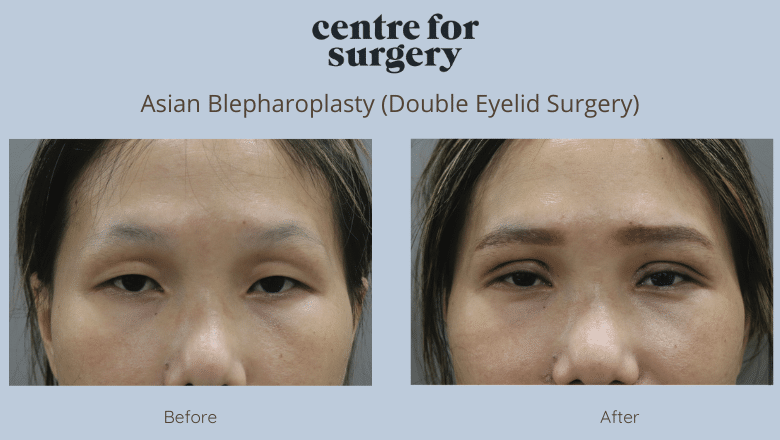

How satisfied are patients overall? In a 2022 series of 193 patients with at least 12 months of follow-up, 74.6% rated their result as much or very much improved, while 6.2% judged it worse[8]. That is a good reminder that surgery involves chance, and that an honest surgeon talks about the downside as well as the upside.
How Long Does Recovery Take After Double Eyelid Surgery?
Recovery depends on the technique, but a typical pattern is:
- First 2 to 3 days: the swelling peaks. Cold compresses and sleeping with your head raised help.
- Day 5 to 7: stitches are removed after full or partial-incision surgery.
- Week 1 to 2: most people are back at desk work after about a week to two weeks, and sooner after suture surgery. Bruising fades.
- Around week 4: full exercise is usually allowed.
- Months 3 to 6: the crease settles to its final height and the scar fades.
The crease looks higher and more dramatic in the first weeks because of swelling, and the two sides often settle at different speeds. Asymmetry that looks alarming at week two commonly evens out by three months, which is why final judgements are left until then. Our full guide to blepharoplasty recovery and aftercare covers make-up, driving, contact lenses and exercise, and the scar guide shows what eyelid surgery scars look like as they heal.
What Are the Risks of Asian Blepharoplasty?
Every operation carries risk, and eyelid surgery is no exception. The risks specific to a new crease are worth knowing in advance:
- Asymmetry: the most common complication of double eyelid surgery, caused by either a difference that was there before surgery or a technical fault[10]. See our guide to whether surgery can fix asymmetrical eyes.
- Fold loss or a crease that is too high, low or multiple: in one series, complete fold loss occurred in 2.6% and partial fold loss in 4.1%[8].
- Visible scarring, bruising, infection, dry or watery eyes and ptosis.
- Rare but serious complications such as bleeding behind the eye, which is a medical emergency.
Many problems can be improved, sometimes once the swelling has settled. If you are unhappy with a previous operation, revision blepharoplasty is its own skilled discipline. Our general guide to the risks and complications of eyelid surgery and the article on how to avoid blepharoplasty complications go further.
Can You Get a Double Eyelid Without Surgery?
Temporary methods exist: eyelid tape, glue and make-up techniques can imitate a crease for a day. They do not last, and repeated pulling on the skin can irritate it or stretch it over time. Surgery is the only way to make a crease permanent. Whether you want a temporary or lasting solution is worth deciding before you book.
Is It Safe to Have Double Eyelid Surgery Abroad?
Double eyelid surgery is offered in many countries and is very popular in several of them. Safe surgery abroad is possible, but it adds questions about follow-up, language, revision and who treats a complication once you are home. The difficulty is not the standard of every overseas surgeon; it is that something going wrong is harder to manage from a distance. Our article on eyelid surgery abroad sets out what to ask.
How Much Does Asian Blepharoplasty Cost?
The cost depends on the technique, whether an inner-corner procedure is added, the facility and the surgeon. A fixed price can only be given after a consultation. Our blepharoplasty cost guide explains what is and is not included, and finance options are available if you would like to spread the cost.
What Happens at an Asian Blepharoplasty Consultation?
At Centre for Surgery, your consultation is with a GMC-registered surgeon who is experienced in eyelid surgery, and the surgeon who assesses you is the surgeon who operates. The visit covers your health and eye history, a careful examination of crease, skin, fat and inner corner, and a discussion of which technique and which crease style suit you. You will be asked about your reasons and your expectations, and you will be told if surgery is not right for you.
Surgery takes place at our CQC-regulated hospital on Baker Street, and you can see the hospital before you decide. If you want to compare surgeons first, read our guide to choosing an eyelid surgeon. For a wider view of the options, see our overview of eyelid surgery in London.
Frequently Asked Questions
What is the difference between Asian blepharoplasty and regular blepharoplasty?
Regular blepharoplasty removes excess skin and fat from a lid that already has a crease. Asian blepharoplasty creates or refines the crease, and deals with features such as a fuller pretarsal layer and the epicanthic fold. The incisions, the aim and the planning differ.
Is double eyelid surgery the same as Asian blepharoplasty?
Yes. Double eyelid surgery is the common name for Asian blepharoplasty. Both describe creating or refining an upper eyelid crease, using suture, partial-incision or full-incision methods.
Why do Asians get double eyelid surgery?
Reasons are personal and varied. Common ones are wanting eyes that look more open, a crease that is even on both sides, easier make-up and a long-held preference. It is not simply about looking Western, and a good surgeon will keep your natural eye shape and features.
How long does a double eyelid last?
A surgically created crease is intended to be permanent, although it can soften or fade, especially after suture-only methods and with age. Fold loss affects a minority of patients: a pooled review of small-incision techniques found about 2%[6], while one series of suture-only surgery reported 26%[7]. If a crease is lost, a revision can often restore it.
Is double eyelid surgery painful?
Most people describe tightness, tenderness and swelling rather than severe pain. Local anaesthetic numbs the lid during surgery, and simple painkillers are usually enough afterwards. Tell your surgical team if the pain is increasing rather than easing, or if your vision changes.
How long does it take to recover from Asian blepharoplasty?
Swelling and bruising settle in about two to three weeks, and stitches come out after five to seven days. Many people return to desk work within one to two weeks. The final crease takes three to six months to settle.
Is double eyelid surgery risky?
It is generally well tolerated, and one large review found a pooled complication rate of about 5% with small-incision techniques[6]. Risks include asymmetry, fold loss, scarring, infection, dry eye and ptosis, and rarely serious bleeding. Choosing an experienced surgeon and following aftercare reduces them.
How much does Asian blepharoplasty cost?
The cost is confirmed at consultation because it depends on the technique, whether an inner-corner procedure is added and the setting. Our cost guide explains the factors, and finance options are available.
What age is best for eyelid surgery?
There is no single best age. Many people have double eyelid surgery in their twenties and thirties, while older patients may need skin removal and ptosis assessment as well. Surgery is for adults, and a mature, settled decision matters more than the date on your birth certificate.
Asian Eyelid Surgery in London
If you are considering Asian blepharoplasty, a consultation will establish which crease, which technique and which approach suit your anatomy. Find out more about Asian blepharoplasty at Centre for Surgery.
Phone: 020 7993 4849 | Address: 95–97 Baker Street, Marylebone, London W1U 6RN
Contact us to schedule a consultation
References
- Kao WK, Ho T. Managing the Asian eyelid. Facial Plastic Surgery Clinics of North America 2022;30(4):471–480. doi:10.1016/j.fsc.2022.07.009 ↗
- Wang C, Pu LLQ. Asian upper blepharoplasty: a comprehensive approach. Clinics in Plastic Surgery 2023;50(1):101–109. doi:10.1016/j.cps.2022.07.006 ↗
- Kakizaki H, Takahashi Y, Nakano T, Asamoto K, Ikeda H, Iwaki M, et al. The causative factors or characteristics of the Asian double eyelid: an anatomic study. Ophthalmic Plastic and Reconstructive Surgery 2012;28(5):376–381. doi:10.1097/IOP.0b013e31825e6a88 ↗
- Wang Y, Ding F, Shan S, Gu C, Yu W, Yu S, et al. The role of epicanthoplasty modification in revising unsatisfactory upper blepharoplasty outcomes: a retrospective study. Aesthetic Plastic Surgery 2025;49(16):4607–4614. doi:10.1007/s00266-025-05051-z ↗
- Ng AKH, Kikkawa DO, Sa HS, Jaru-Ampornpan P, Chong KKL, Yuen HKL. Mechanisms of supratarsal crease formation in incisional blepharoplasty among Asian patients: a review. Asia-Pacific Journal of Ophthalmology 2026;15(3):100326. doi:10.1016/j.apjo.2026.100326 ↗
- Yu P, Chen S, Gu T, Zhao M, Teng L, Lu J. Small-incisional techniques for double-eyelid blepharoplasty: a systematic review. Aesthetic Plastic Surgery 2023;47(3):1067–1075. doi:10.1007/s00266-022-03154-5 ↗
- Mizuno T. Two modified techniques to decrease complications of buried suture double-eyelid blepharoplasty. Journal of Plastic, Reconstructive and Aesthetic Surgery 2013;66(4):e95–e100. doi:10.1016/j.bjps.2012.11.019 ↗
- Sun Y, Liu R, Yu N, Zhang D, Chen J, Huang J, et al. Tarsus-orbicularis-septum fixation in double-eyelid blepharoplasty: a reliable and flexible technique. Clinical, Cosmetic and Investigational Dermatology 2022;15:1125–1132. doi:10.2147/CCID.S367202 ↗
- Liu R, Sun Y, Huang J, Long X. Brow position change and its potential risk factors following upper blepharoplasty: a systematic review and meta-analysis. Aesthetic Plastic Surgery 2023;47(4):1394–1409. doi:10.1007/s00266-023-03288-0 ↗
- Kim CY, Jang JW. The causes and management of asymmetrical double eyelids. Facial Plastic Surgery 2020;36(5):575–583. doi:10.1055/s-0040-1717145 ↗







