


In this guide19 sections
- Key Points
- What Are the Risks of Blepharoplasty?
- How Safe Is Blepharoplasty?
- Upper Eyelid Surgery Risks
- Lower Eyelid Surgery Risks
- Can Blepharoplasty Cause Dry Eyes?
- Can Eyelid Surgery Cause Blindness?
- What Does Eyelid Surgery Gone Wrong Look Like?
- Medical Risks of Eyelid Surgery: Bleeding, Infection and Anaesthetic
- Who Is Not a Good Candidate for Blepharoplasty?
- How Can You Reduce the Risks of Blepharoplasty?
- What Should You Do If Something Goes Wrong After Eyelid Surgery?
- Is Eyelid Surgery Abroad Riskier?
- Do People Regret Blepharoplasty?
- Blepharoplasty Before and After Photos
- What Happens at a Blepharoplasty Consultation?
- Frequently Asked Questions
- Blepharoplasty Risks Consultation in London
- References
Key Points
- What are the risks of blepharoplasty? The commonest are temporary: swelling, bruising, tightness, watery or dry eyes and mild asymmetry. Less common problems include visible scarring, a lower lid that sits too low (lid retraction) and an eye that does not close fully.
- Serious complications are rare. A survey of more than 750,000 blepharoplasties found sight loss in about 1 in 20,000 operations, and permanent sight loss in about 1 in 30,000[1].
- Bleeding behind the eye is the emergency to know about. Severe one-sided pain, a hard swollen eye or sudden blurring in the first 24 hours needs immediate help, because early treatment protects vision.
- Upper and lower eyelid surgery carry different risks. Lower lid surgery is more likely to cause lid retraction and hollowing, while over-removal of upper lid skin is the main route to an eye that will not close.
- Most risks can be reduced. Stopping smoking, reviewing blood-thinning medicines, controlling blood pressure and choosing a conservative, GMC-registered surgeon make the biggest difference.
- Complications can usually be treated. Many settle with time and eye care, and some need revision surgery once the tissues have healed.
Blepharoplasty is a common facial operation, and for the right person it is a predictable one. It is still an operation on the most delicate tissue of the face, next to the eye itself, so understanding the risks of blepharoplasty matters as much as understanding the benefits. This guide sets out the blepharoplasty risks and complications patients ask about most: what is common and temporary, what is uncommon, what is rare but serious, and what can be done about each.
It covers upper and lower eyelid surgery separately, because the risks are not the same, and explains how to lower your own risk before and after surgery. If you are earlier in your research, our guides to blepharoplasty recovery and the cost of blepharoplasty in London cover the rest of the picture.
What Are the Risks of Blepharoplasty?
The risks of eyelid surgery fall into three groups, and it helps to think of them this way when you are weighing up a decision:
- Aesthetic risks: asymmetry, visible scarring, hollowing under the eye, under-correction (not enough change) and over-correction (a surprised or tight look).
- Functional risks: dry or gritty eyes, watery eyes, difficulty closing the eye fully, a lower lid pulled downwards and, very rarely, double vision.
- Medical risks: bleeding, infection, reactions to anaesthetic or medicines, delayed healing and, rarely, a sight-threatening bleed behind the eye.
Almost everyone has some swelling, bruising and tightness after eyelid surgery. These are expected parts of healing rather than complications, and our blepharoplasty recovery and aftercare guide explains how long they last. A complication is something beyond that: a problem that lasts longer than expected, affects how the eye works, or needs treatment.
How Safe Is Blepharoplasty?
Blepharoplasty is generally regarded as a low-risk operation in healthy adults, and most people heal without a serious problem. The most useful figures come from large surveys of surgeons. In a 2011 survey of surgeons in the US and UK, published in Aesthetic Surgery Journal ↗, respondents reported 752,816 blepharoplasties and 39 cases of visual loss: roughly 1 in 20,000 overall, with permanent loss in about 1 in 30,000. Symptoms usually started within 24 hours, and high blood pressure was the commonest risk factor[1].
Those numbers describe the rarest and most serious outcome. Minor problems are far more frequent, and published rates vary widely with the technique used, the part of the eyelid treated, how complications are defined and how long patients are followed. No honest surgeon can give you a single figure that applies to everyone. What a consultation can do is estimate your own risk, based on your eyelid anatomy, eye health, medical history and the operation planned.
Is blepharoplasty dangerous?
For a healthy adult having the operation with a regulated surgeon in an appropriate facility, it is not generally considered dangerous. It is still real surgery, and the risks rise when medical conditions are poorly controlled, when someone smokes, when blood-thinning medicines are not managed, or when too much tissue is removed.
Upper Eyelid Surgery Risks
Upper blepharoplasty removes excess skin, and sometimes a strip of muscle or a little fat, through an incision hidden in the natural eyelid crease. Its main risks are:
- Dry, gritty or irritated eyes. Surgery temporarily changes how the lid sweeps tears across the eye. A 2025 meta-analysis of 12 randomised trials in Aesthetic Surgery Journal ↗ found that dry eye symptoms were on average lower after upper blepharoplasty than before it, which makes sense when a heavy lid has been interfering with blinking. The same review found that removing muscle along with skin made difficulty closing the eyes (lagophthalmos) more likely than removing skin alone[3].
- An eye that does not close fully. Taking away too much skin leaves too little to close the eye comfortably, especially while asleep. Mild, temporary tightness is common in the first weeks. Persistent difficulty closing is a complication that needs prompt attention, because the surface of the eye can dry and become damaged.
- Asymmetry. Eyelids are never perfectly matched to begin with, and healing is never identical on both sides. Small differences in crease height or swelling are common early on and often settle over several months.
- Scarring. The incision sits in the crease, so the scar is usually fine and well hidden once it matures, but some people heal with a thicker, pink or raised line for a time. Our guide to what blepharoplasty scars look like shows the stages of healing.
- Small lumps or cysts along the scar. Tiny white bumps (milia) and firmness along the incision are common and usually resolve. See what causes lumps after blepharoplasty.
- A low or uneven eyelid position (ptosis). Swelling or an effect on the lifting muscle can leave an upper lid drooping a little after surgery, which is usually temporary but occasionally needs correction.
Lower Eyelid Surgery Risks
The lower lid has less spare tissue and more support to maintain, so its risks differ. A lower blepharoplasty may be done through the inside of the lid (transconjunctival, with no skin scar) or through an incision just below the lashes, depending on whether loose skin needs removing.
- Lower lid retraction and ectropion. Lid retraction means the lower lid sits lower than before, showing white of the eye (scleral show). Ectropion is a more marked version in which the lid turns outwards. Lower lid retraction is a recognised and prevalent complication of blepharoplasty, and a 2017 systematic review of 19 studies in Aesthetic Surgery Journal ↗ found no spacer graft material clearly better than another for correcting it, so prevention matters[4].
- Why the approach matters. A 1994 case series of 148 eyelids in Ophthalmology ↗ reported no retraction or ectropion after transconjunctival fat removal, and the authors pointed out that the technique avoids scarring at the level of the orbital septum[5]. That is a small series and not a guarantee, but it is why surgeons often choose the inside-the-lid route when only fat needs to be treated.
- Hollowing. Removing too much fat can leave a sunken, tired-looking lower lid, which is why many surgeons now reposition or preserve fat rather than remove it all. Facial fat transfer can restore lost volume.
- Contour irregularity, lumps and under-correction when fat is repositioned or grafted. A 2024 meta-analysis of 33 studies in Annals of Plastic Surgery ↗ covering 4,671 patients estimated an overall complication rate of about 11% after fat grafting and repositioning for under-eye pouches with a tear trough, most often unsatisfactory correction or contour irregularity[6]. A separate meta-analysis of tear trough fat grafting reported a similar pooled complication rate of about 10%, mostly minor[7].
- Watery eyes. The tear drainage system sits close to the operating area, and swollen or tight lids often cause watering for a few weeks. Our guide to watery eyes after blepharoplasty explains when to expect it to settle.
Surgeons use several techniques to support the lower lid and lower the risk of ectropion, including lid-tightening and suspension stitches. A 2025 systematic review concluded that these approaches generally appear effective, but that the quality of the evidence is low[8]. Lower lid surgery therefore depends heavily on careful assessment of the lid’s tone and on conservative skin removal.

Can Blepharoplasty Cause Dry Eyes?
Yes, it can, especially in the first weeks. Dry or gritty eyes after blepharoplasty happen because swelling and tightness change how completely you blink and how the tear film spreads. In most people it improves as swelling settles, and lubricating drops are usually enough. Dry eye is more likely if you had dry eyes before surgery, which is one reason your eyes are assessed at consultation, and if the eyelids are left too tight. Our dedicated guide to dry eyes after blepharoplasty covers drops, warning signs and treatment in more detail.
Contact your surgeon promptly if the eye is painful, red, light-sensitive, or if you cannot close it fully. These can signal damage to the surface of the eye and should not be left to settle by themselves.
Can Eyelid Surgery Cause Blindness?
This is the question behind many searches for blepharoplasty risks, and the honest answer is that it can, but extremely rarely. The cause is almost always a retrobulbar haematoma: bleeding into the space behind the eyeball, which raises pressure on the optic nerve. In the 2011 surgeon survey ↗, symptoms most often began within 24 hours, with peaks during or just after surgery and again six to twelve hours later. Pain and pressure were the commonest warning symptoms[1].
The outcome depends on speed. A 2018 systematic review of 93 cases of retrobulbar haematoma in the Journal of Plastic, Reconstructive & Aesthetic Surgery ↗ (about three-quarters after trauma and a quarter after surgery of any kind, not blepharoplasty alone) found that 51% recovered their vision completely, 27% partially and 22% became blind. Faster treatment and surgical decompression were each linked to better recovery, and younger age also helped[2]. Case reports of optic nerve injury after orbital bleeding following blepharoplasty show how quickly pressure inside the eye socket can threaten sight[9].
What this means in practice:
- Tell your surgeon about high blood pressure, and have it controlled before surgery, as it was the commonest risk factor in the survey.
- Tell the team about aspirin, anti-inflammatory medicines, blood thinners and herbal supplements, which can increase bleeding.
- Keep your head raised and rest in the first days, use cold compresses as advised, and avoid straining, heavy lifting and bending.
- Know the emergency symptoms below, and have the clinic’s out-of-hours number to hand.
What Does Eyelid Surgery Gone Wrong Look Like?
Searches for eyelid surgery gone wrong usually describe one of a small number of outcomes. Understanding them helps you ask the right questions beforehand and recognise a problem early. Our guide to botched eyelid surgery and how to avoid blepharoplasty complications goes deeper into prevention.
- Too much skin removed. The eyes look wide, tight or permanently surprised, and may not close fully. This is the most important complication to avoid because it affects eye health as well as appearance.
- Too little skin removed. The lids still look heavy or hooded. This is usually easier to correct than over-resection.
- A hollow or sunken look. Typically a lower lid problem, from over-removal of fat.
- A pulled-down lower lid. Scleral show, rounded outer corners or an outward-turning lid.
- Visible, uneven or raised scars. More common if healing is poor, for example in smokers.
- Persistent asymmetry. Differences in lid height or crease position that remain after swelling has settled.
Why do I look older after blepharoplasty?
Early on, swelling, bruising, tightness and a flatter-looking lid can make you look more tired rather than more rested, and this usually improves over weeks to months. A lasting older look can come from removing too much fat from the lower lid (hollowing) or from a lower lid that sits too low. Surgery also does not stop ageing. The brow, cheek and surrounding skin continue to change, which is why some patients are better served by a brow lift or facelift alongside, or instead of, eyelid surgery. Our comparison of brow lift vs blepharoplasty explains how to tell which is causing a heavy upper lid.
Medical Risks of Eyelid Surgery: Bleeding, Infection and Anaesthetic
Bleeding and bruising
Some bruising is expected. A larger collection of blood under the skin (a haematoma) is uncommon and may need drainage. The rare bleed behind the eye is covered above. Stopping medicines that thin the blood, as your surgeon advises, lowers the chance of bleeding.
Infection
Eyelid skin has a rich blood supply and infection after blepharoplasty is uncommon. Signs include spreading redness, increasing pain, warmth, discharge or fever, and these need a same-day call so that antibiotics can be started.
Anaesthetic risks
At Centre for Surgery, blepharoplasty is performed under local anaesthetic, with or without sedation (TIVA), depending on the extent of surgery and your preference. Risks include allergic reactions and, with sedation, the general risks of anaesthesia, which are assessed individually before surgery. Our guides to blepharoplasty under local anaesthetic or asleep and anaesthesia for cosmetic surgery explain the options.
Double vision and blurred vision
Blurred vision for a few days is common, mostly from swelling and ointment. Double vision is rare and may follow bruising or swelling of the small muscles around the eye. Persistent or new double vision should always be reported.
Who Is Not a Good Candidate for Blepharoplasty?
Not everyone who wants eyelid surgery should have it, or have it now. A careful assessment may advise delay, a different operation or no surgery. Factors that raise risk or call for caution include:
- Severe dry eye or eye surface disease.
- Active thyroid eye disease, or unstable thyroid function.
- Uncontrolled high blood pressure or bleeding tendencies.
- Smoking, which impairs healing.
- Unrealistic expectations, or wanting to change the eye’s shape rather than refine it.
- A very low brow position that is the real cause of the heavy lid.
- Recent eye surgery. See how soon you can have blepharoplasty after laser eye surgery.
Age on its own is not a barrier, but the timing and technique are worth discussing. Our guide to the ideal age for blepharoplasty covers it.
How Can You Reduce the Risks of Blepharoplasty?
Many of the steps that lower risk are within your control.
- Stop smoking and nicotine well before surgery and for several weeks afterwards. Smoking reduces blood flow to healing skin. See smokers and cosmetic surgery.
- Review every medicine and supplement with your surgeon, including aspirin, ibuprofen, blood thinners, fish oil and vitamin E.
- Get blood pressure checked and controlled before the operation.
- Tell the surgeon about your eyes: dry eye, contact lens use, previous eye surgery, thyroid problems, glaucoma.
- Choose a conservative plan. Taking a little less is safer than taking a little more, and a second small procedure is easier than correcting an over-resection.
- Follow aftercare closely: head raised, cold compresses, no straining, and prompt reporting of warning signs.
- Allow time to think. A cooling-off period between consultation and surgery is good practice, and it is built into our process. See the two-week cooling-off period.
What Should You Do If Something Goes Wrong After Eyelid Surgery?
Know in advance what is expected and what is not. The diagram below gives you a quick reference.

Call 999 or go to accident and emergency straight away if you have
- Sudden loss or dimming of vision.
- Severe pain in or behind one eye, especially if it is getting worse.
- A tense, hard or rapidly swelling eyelid or eye.
- Bulging of the eye, or new double vision with pain.
Then tell the clinic. Do not wait for a phone call back.
Call the clinic the same day if you have
- Increasing redness, warmth, discharge or fever.
- An eye that will not close, or a painful, gritty or light-sensitive eye.
- Swelling or bruising much worse on one side.
- Stitches that look infected or wound edges that open.
Can complications be fixed?
Often, yes. Dry eye, watering, early asymmetry and scar thickening usually respond to time, eye care and simple treatment. Mild lid retraction may improve with massage in the early weeks. Persistent problems such as over-resection, ectropion or marked asymmetry may need revision surgery, which surgeons usually delay until swelling has fully settled, often several months. Revision is technically more demanding than a first operation, which is why experienced assessment matters. Our revision blepharoplasty service treats patients whose eyelid surgery has left functional or cosmetic problems, and the same principles apply to anyone seeking correction.
Is Eyelid Surgery Abroad Riskier?
The operation is the same, but the context can differ. Problems arise when a patient meets the surgeon only on the day, when follow-up is limited, and when a complication appears after the flight home. Closing difficulties and dry eye after over-resection are the problems UK surgeons are often asked to manage. If you are considering travelling, read our guide to blepharoplasty abroad and check who would manage a problem in the first weeks.
Do People Regret Blepharoplasty?
Most people who choose eyelid surgery for realistic reasons are satisfied, but regret does occur, and it is worth being honest about why. Regret is most often tied to expectations that were not matched by the plan: wanting a dramatic change from a modest operation, being unprepared for the recovery, or ending up with an overdone look. A useful question to ask yourself is what exactly bothers you about your eyelids and whether surgery is the right answer. A non-surgical alternative may suit mild changes, and our guide to how long blepharoplasty lasts sets out what to expect over time. Saggy eyelids and hooded lids can be assessed at consultation to establish whether blepharoplasty is the right fix.
Blepharoplasty Before and After Photos
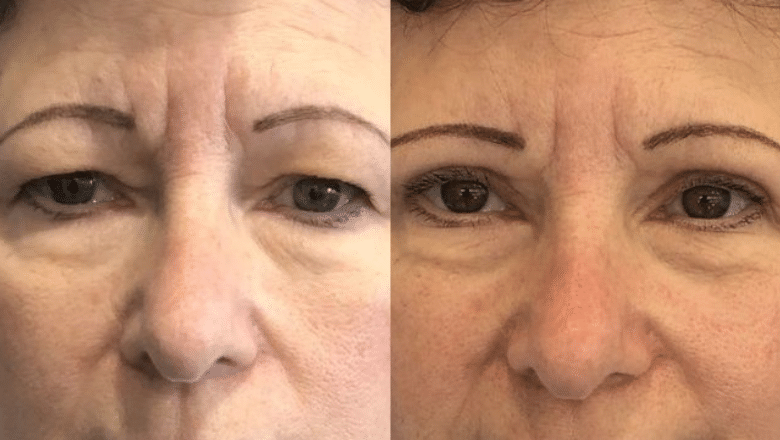
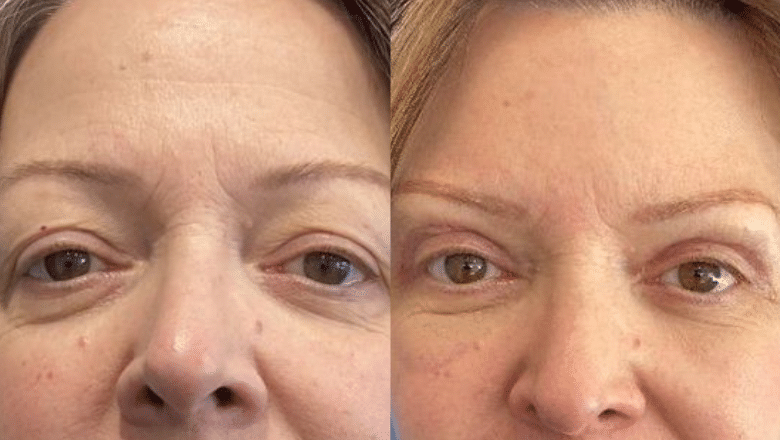
Real results help set realistic expectations, including the subtlety of a well-planned result. These are genuine Centre for Surgery patients, and individual results vary. More examples are in our blepharoplasty before and after gallery.
What Happens at a Blepharoplasty Consultation?
A consultation is where most risk is managed. At Centre for Surgery, the GMC-registered surgeon who assesses you is the surgeon who operates. You can expect:
- A review of your medical history, medicines, smoking status, eye conditions and blood pressure.
- An examination of lid position, skin quality, tear film and brow height, including tests of lid tone for lower lid surgery.
- A frank discussion of the specific risks for your operation and which technique reduces them.
- A clear plan, a written description of what to expect during recovery, and emergency contact details.
- Time to decide. Finance options are available, and costs are confirmed at consultation. See finance options.
Surgery takes place at our CQC-regulated hospital on Baker Street, and aftercare is overseen by the team who treated you. If you are travelling home after the operation, our guide on when it is safe to drive after blepharoplasty helps with planning.
Frequently Asked Questions
How safe is a blepharoplasty?
Blepharoplasty is regarded as a low-risk procedure in healthy adults. Minor, temporary effects such as swelling, bruising and dry eyes are common, while serious complications are rare. A large surgeon survey put sight loss at about 1 in 20,000 operations. Your own risk depends on your health, eyes and the technique used.
Who is not a good candidate for blepharoplasty?
People with severe dry eye, active thyroid eye disease, uncontrolled high blood pressure, bleeding problems or active eye infection may be advised to wait or avoid surgery. Smokers are asked to stop, and anyone with unrealistic expectations may be better served by another approach. A consultation establishes suitability.
What are the downsides of blepharoplasty?
The downsides are a recovery period of swelling and bruising, a small chance of dry or watery eyes, asymmetry, scarring, and rarely a lid position problem or bleeding that needs treatment. Results are long-lasting, but ageing continues, and surgery cannot stop it.
Why do I look older after blepharoplasty?
Early swelling and tightness can make you look tired for a few weeks. A lasting older look is usually caused by hollowing after too much fat removal, or by a lower lid sitting too low. A revision or volume restoration with fat transfer may help once healing is complete.
Do you regret blepharoplasty?
Many people are pleased with their results, but regret does happen, most often when expectations were unrealistic or the result was overdone. Choosing a conservative plan, looking at genuine before and after photos and allowing a cooling-off period all reduce the chance.
Can blepharoplasty cause blindness?
Very rarely. Blindness is almost always caused by bleeding behind the eye, which is a surgical emergency. Fast recognition and treatment improve the chance of recovery. Severe one-sided pain, a hard swollen eye or sudden loss of vision in the first 24 hours needs immediate emergency care.
What is blepharochalasis syndrome?
Blepharochalasis is a rare condition in which attacks of eyelid swelling recur, over time thinning and stretching the upper lid skin. It is different from the age-related skin excess that blepharoplasty usually treats, and surgery is normally considered only after the swelling episodes have stopped.
Will people notice I had blepharoplasty?
A well-planned, conservative blepharoplasty tends to look natural, and people often say you look rested rather than operated on. Bruising and swelling are noticeable for one to two weeks, and the scar fades over months.
Blepharoplasty Risks Consultation in London
If you are considering eyelid surgery and want your own risks assessed honestly, book a consultation with one of our surgeons. Find out more about blepharoplasty at Centre for Surgery, or if you have had surgery elsewhere and are worried about the result, see revision blepharoplasty.
Phone: 020 7993 4849 | Address: 95–97 Baker Street, Marylebone, London W1U 6RN
Contact us to schedule a consultation
References
- Mejia JD, Egro FM, Nahai F. Visual loss after blepharoplasty: incidence, management, and preventive measures. Aesthetic Surgery Journal 2011;31(1):21–29. doi:10.1177/1090820X10391212 ↗
- Christie B, Block L, Ma Y, Wick A, Afifi A. Retrobulbar hematoma: a systematic review of factors related to outcomes. Journal of Plastic, Reconstructive & Aesthetic Surgery 2018;71(2):155–161. doi:10.1016/j.bjps.2017.10.025 ↗
- Todorov D, Mitchell S, Al-Hashimi M, et al. Functional and aesthetic outcomes after upper blepharoplasty: a systematic review and meta-analysis of randomized control trials. Aesthetic Surgery Journal 2025;45(6):554–562. doi:10.1093/asj/sjaf022 ↗
- Park E, Lewis K, Alghoul MS. Comparison of efficacy and complications among various spacer grafts in the treatment of lower eyelid retraction: a systematic review. Aesthetic Surgery Journal 2017;37(7):743–754. doi:10.1093/asj/sjx003 ↗
- Doxanas MT. Minimally invasive lower eyelid blepharoplasty. Ophthalmology 1994;101(8):1327–1332. doi:10.1016/s0161-6420(94)31166-3 ↗
- Xu Z, Zheng F, Zhao X, et al. Complications of fat grafting and repositioning for correction of lower eyelid pouch with tear trough deformity or lid-cheek junction: a systematic review. Annals of Plastic Surgery 2024;93(3):e9–e25. doi:10.1097/SAP.0000000000004022 ↗
- Li X, Yao J, Liu Y, et al. Efficacy and safety of stromal vascular fraction in the treatment of tear trough deformity: a systematic review and meta-analysis. Aesthetic Plastic Surgery 2025;49(4):1130–1138. doi:10.1007/s00266-024-04557-2 ↗
- Yalcin CE. Holding the lid: suspension techniques to prevent lower eyelid ectropion – a systematic review. Facial Plastic Surgery 2025;42(4):451–456. doi:10.1055/a-2695-3754 ↗
- Baserga MC, Biga M, Morocho Hermosa G, et al. Posterior ischemic optic neuropathy (PION) secondary to acute orbital haemorrhage: a case report and literature review. Archivos de la Sociedad Española de Oftalmología 2026;101(10):502588. doi:10.1016/j.oftale.2026.502588 ↗







