


In this guide16 sections
- Key Points
- Brow Lift vs Blepharoplasty: What Is the Difference?
- How Do I Know If I Need a Brow Lift or Blepharoplasty?
- What Is Upper Blepharoplasty?
- What Is a Brow Lift and Which Types Are There?
- Am I Ready for a Brow Lift? Who Is a Good Candidate
- What Happens If You Have the Wrong Operation?
- Can You Have a Brow Lift and Blepharoplasty at the Same Time?
- Brow Lift vs Blepharoplasty Recovery
- Can You Lift Your Brows Without Surgery?
- How Much Does a Brow Lift Cost vs Blepharoplasty?
- Who Is Not Suitable for a Brow Lift or Blepharoplasty?
- What Happens at a Brow Lift Consultation?
- Frequently Asked Questions
- Brow Lift and Blepharoplasty in London
- References
Key Points
- Brow lift vs blepharoplasty: a blepharoplasty removes excess skin from the eyelid, while a brow lift raises an eyebrow that has dropped. They treat different structures and are not interchangeable.
- A simple brow position test (lifting the outer eyebrow gently in a mirror) gives an indication of which operation you may need. It is a guide only, and a surgeon assesses several other features.
- Many people over fifty have both a low brow and loose eyelid skin, and the two procedures can be done in one operation.
- Brow height often drops slightly after upper blepharoplasty. A 2023 meta-analysis found a small average fall, which is why a surgeon checks the brow before planning eyelid surgery[1].
- Recovery is usually shorter after blepharoplasty than after a brow lift, and combined surgery follows the longer of the two timelines.
- Anti-wrinkle injections can lift the brow a little and only temporarily. They do not remove eyelid skin.
If your upper eyelids look heavy, two operations can change it: blepharoplasty, which removes excess skin from the eyelid itself, and a brow lift, which raises the eyebrow that may be pressing down on it. They can look similar in before-and-after photographs, but they are not interchangeable, and choosing the wrong one is a common reason for disappointment with eyelid surgery.
The distinction matters because a person whose heaviness comes mainly from a low brow may get an underwhelming result from eyelid surgery alone. This guide explains how to tell which one you may need, who is a good candidate for a brow lift, what each operation involves and how recovery compares, using the same assessment a surgeon performs at consultation. If your main concern is hooded eyes or heavy eyelids, those guides cover the causes in more detail.
Brow Lift vs Blepharoplasty: What Is the Difference?
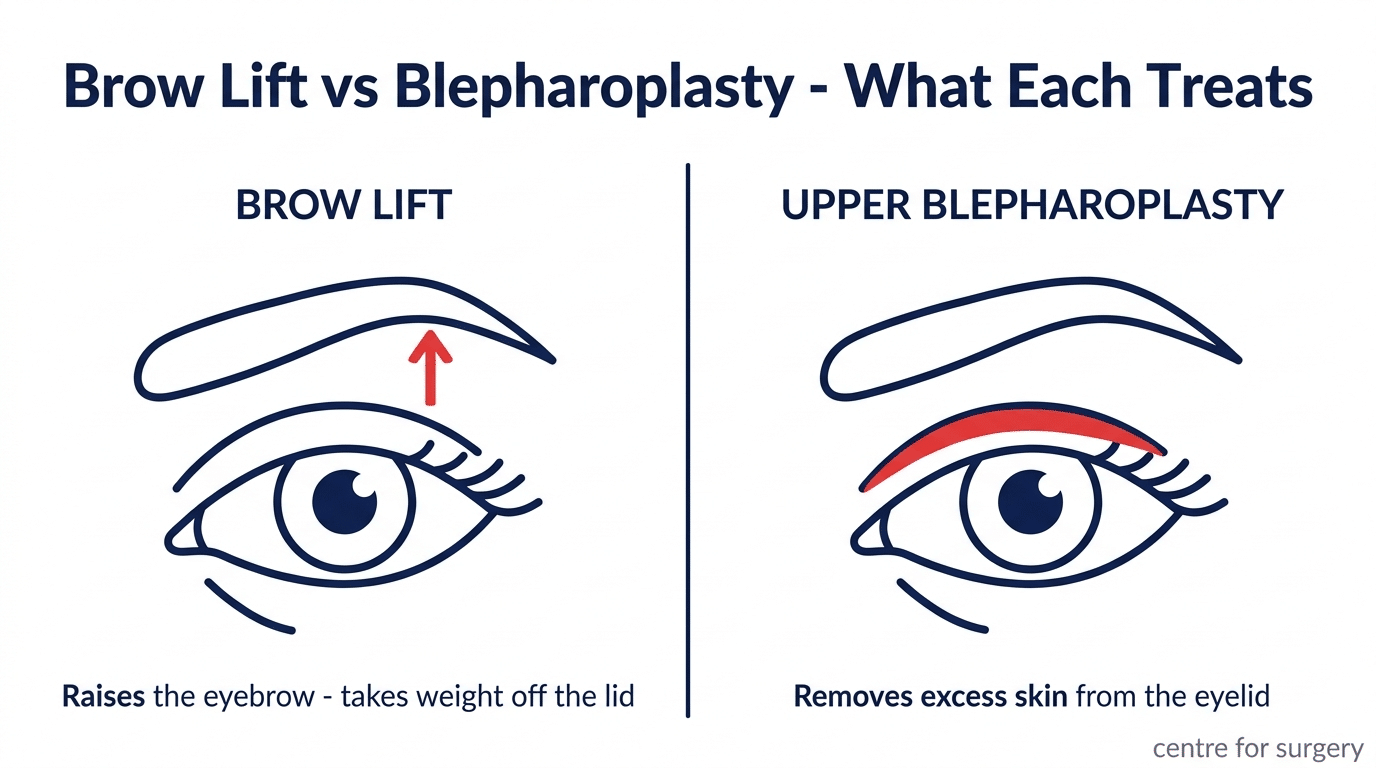
The two procedures treat different structures at different heights of the face:
- Upper blepharoplasty (eyelid lift) removes a measured strip of excess skin from the upper eyelid, with conservative fat adjustment where needed. The incision sits in the natural eyelid crease. It treats the eyelid.
- Brow lift (eyebrow lift) repositions the eyebrow and forehead tissue upward, taking weight off the upper lid. It treats the brow.
If the heaviness is skin sitting on the lid, blepharoplasty is usually the answer. If it is the eyebrow sitting too low and pushing tissue down onto the lid, a brow lift is more likely to help. A significant proportion of patients have both, and in those cases the two can be performed together. Our guide to upper vs lower blepharoplasty covers the other common eyelid decision.
How Do I Know If I Need a Brow Lift or Blepharoplasty?
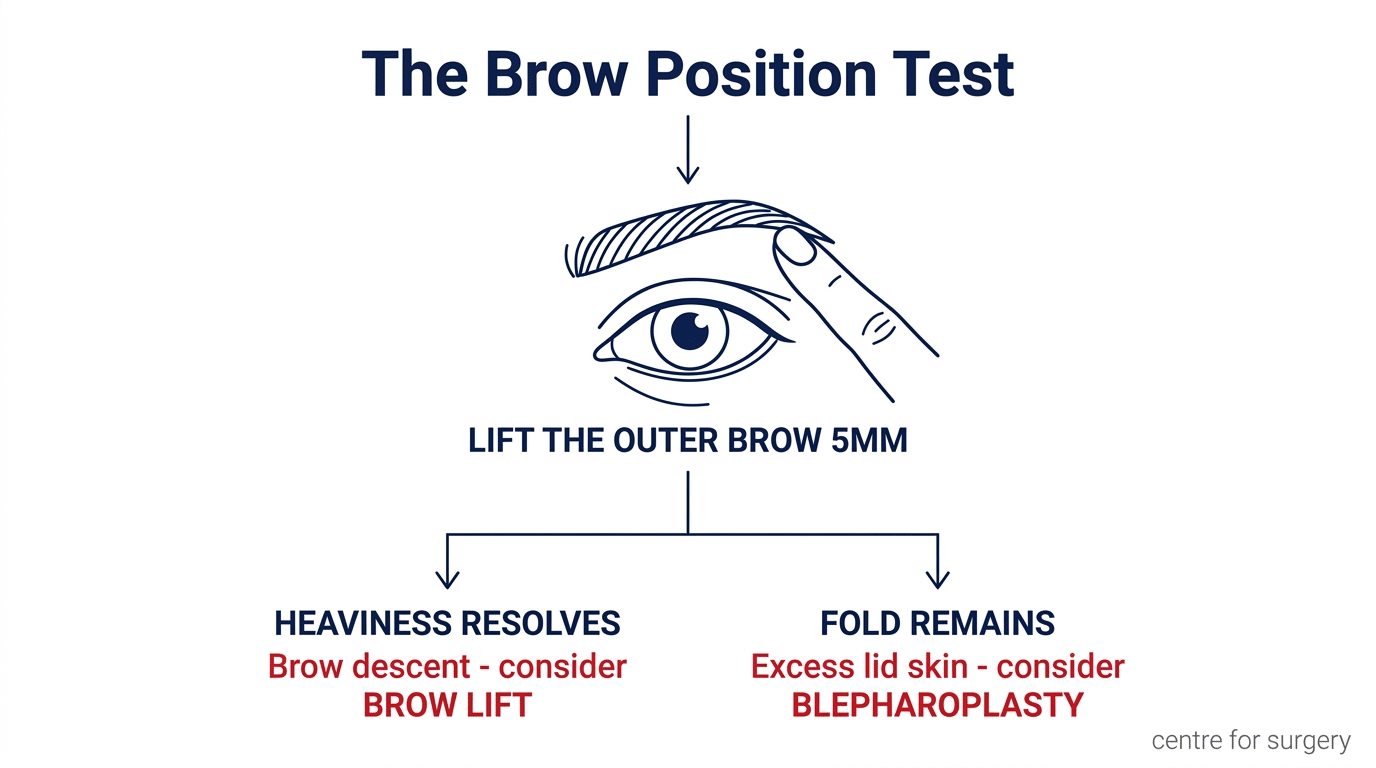
There is a simple self-assessment that gives you an indication before you see a surgeon. It is the same manoeuvre performed at consultation.
Stand in front of a mirror in even light, face relaxed, eyes open and looking straight ahead. Do not raise your eyebrows. Many people with heavy lids lift their brows unconsciously, so let the forehead go slack. Then:
- Place a fingertip on the tail of one eyebrow, at the outer end.
- Lift the brow gently upward by about half a centimetre, roughly to where it sat in photographs of you ten years ago.
- Watch what happens to the heaviness over the eyelid.
If lifting the brow resolves most of the heaviness, the problem is largely brow descent, and a brow lift may be the more appropriate procedure.
If the fold of skin remains obvious even with the brow lifted, you may have genuine excess eyelid skin (dermatochalasis), and upper blepharoplasty is likely to be indicated.
If lifting helps but a fold still remains, both are probably contributing. This is a common finding in older patients and a frequent reason combined procedures are discussed.
This test is indicative rather than diagnostic. Brow height, eyelid skin quality, levator muscle function, the position of the fat pads and the height of the natural crease all interact, and a proper assessment measures several of them. It will tell you which conversation to have.
What Is Upper Blepharoplasty?
Upper blepharoplasty is the removal of redundant upper eyelid skin, clinically termed dermatochalasis, through an incision placed in the natural crease of the lid, where the healed scar sits hidden within the fold. Our blepharoplasty scars guide shows how those incisions typically heal.
The measurement is the operation. Too little skin removed and the hooding persists; too much and the eye may not close fully, causing dryness and, in severe cases, damage to the surface of the eye. A conservative approach that leaves enough skin for complete closure is the difference between a refreshed result and a complication that is difficult to reverse. The risks and complications of eyelid surgery are worth reading before consultation.
Where a small amount of fat has prolapsed forward, usually at the inner corner, it can be trimmed or repositioned at the same time. Aggressive fat removal creates a hollowed upper lid that ages the face.
Eyelid surgery is not only cosmetic. In a 2024 prospective study of 79 patients, upper blepharoplasty improved patient-reported satisfaction and eyelid-related function, and visual field testing improved in the group with the most severe skin excess[5]. See our guide to cosmetic and functional eyelid surgery for more on that distinction.
Blepharoplasty is more likely to be the right choice when: the brow sits at a reasonable height, the excess is clearly in the lid skin, the fold persists when the brow is manually lifted, and the concern is a heavy or hooded lid rather than a low eyebrow.
What Is a Brow Lift and Which Types Are There?
A brow lift repositions the eyebrow and forehead soft tissue upward. The brow sits directly above the eyelid, so a low brow transfers weight onto the lid and produces hooding even where the eyelid skin itself is unchanged. Raising the brow removes that load, and it can also soften forehead lines and the frown between the eyebrows.
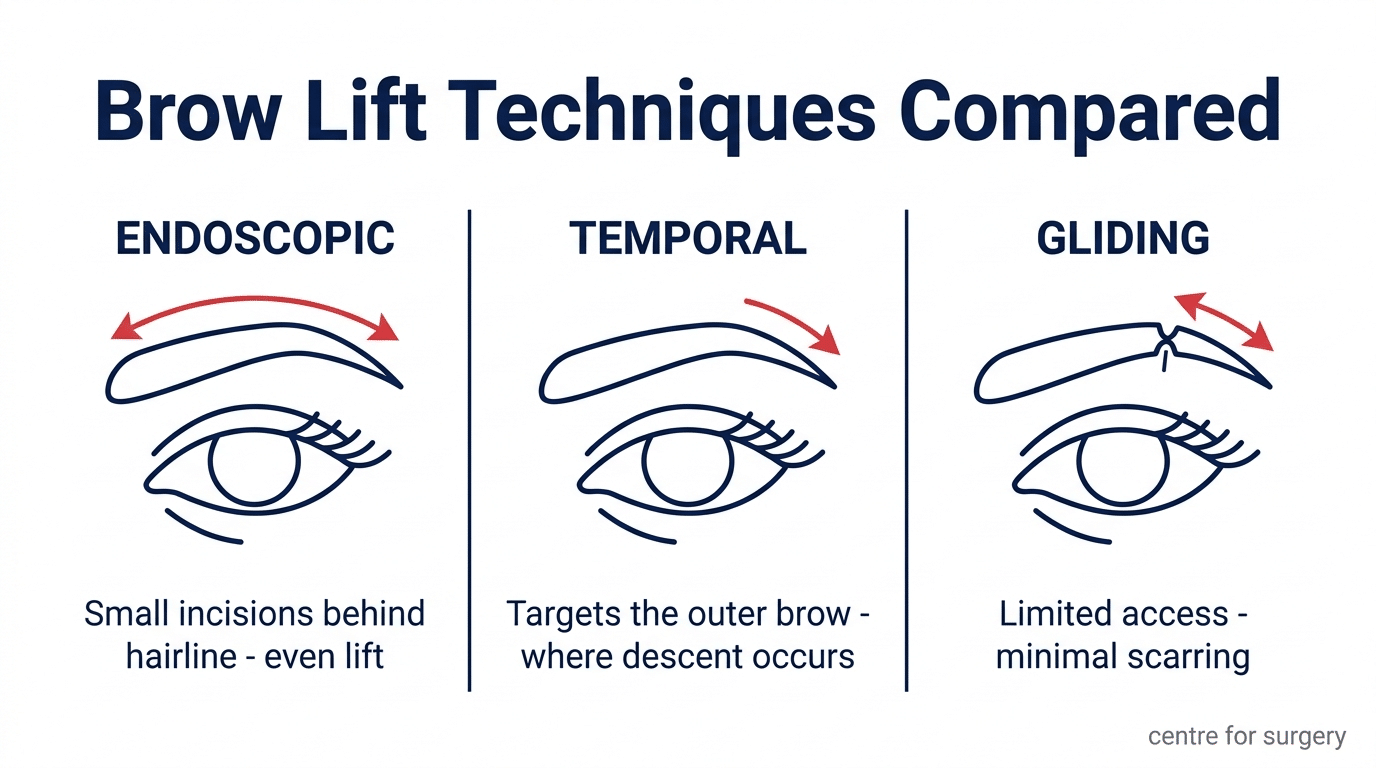
There is no single way to perform a brow lift. The technique depends on your facial anatomy, skin quality, hairline position and goals. A systematic review of complications across brow lift techniques found that each has a different complication profile, for example numbness was most often reported after direct brow lifts and temporary hair loss after endoscopic ones[8].
Endoscopic brow lift
The endoscopic brow lift uses several small incisions hidden within the hairline and a camera to work on the deeper tissues, avoiding a long scalp incision. It is suited to moderate lift across the whole brow. A 2025 systematic review and meta-analysis of 12 studies pooled the long-term elevation at around 3 to 4 mm, depending on where along the brow it was measured, and noted that long-term stability remains debated[6]. For a fuller comparison, see endoscopic vs traditional brow lift.
Temporal (lateral) brow lift
A temporal brow lift, also called a lateral or limited-incision brow lift, targets the outer third of the brow, where descent is often most noticeable. It uses short incisions at the temples hidden within the hair and suits people who feel only the outer brow is dropping. Some versions can be performed under local anaesthetic, which your surgeon will discuss with you.
Direct brow lift
A direct brow lift removes a strip of skin immediately above the eyebrow. It is typically considered for people with deep forehead creases, a receding or high hairline, or too little hair to hide other incisions. Its advantage is precise control of brow height and shape, and its main drawback is a visible scar along the brow. A 2026 review of ten studies describes scar-minimising refinements such as bevelled incisions and layered closure, with inconspicuous scars reported in most cases[10].
Coronal brow lift
The traditional coronal brow lift uses a long incision across the top of the scalp, usually concealed behind the hairline, to raise the whole forehead. It is used less often today and is generally unsuitable for people with a high hairline or significant hair loss.
Gliding brow lift
The gliding brow lift repositions the brow through very limited access with minimal visible scarring. A 2026 systematic review of 15 studies suggested endoscopic and minimally invasive techniques, including gliding brow lifts, offer comparable or better cosmetic results with lower complication rates than traditional open lifts, although the authors note that study quality varies[7]. An earlier review found no clear evidence that open methods are inferior[9], so the right technique is a matter for individual assessment rather than a rule.

Am I Ready for a Brow Lift? Who Is a Good Candidate
You may be a good candidate for brow lift surgery if your eyebrows have lowered noticeably over time, if you find your upper eyelids look hooded because the brow is sitting low, or if you notice that people read your expression as tired, stern or sad when you feel nothing of the sort. When the inner brow descends, the face can look tense; when the outer brow falls, it can look fatigued.
A brow lift is more likely to be the right choice when: the eyebrow sits at or below the bony rim above the eye, the heaviness largely resolves on the brow position test, the outer brow has dropped, or you constantly raise your forehead to open your eyes, a habit that can deepen horizontal forehead lines.
People in good general health, with specific concerns about the brow or upper face and realistic expectations, are typically suitable for assessment. Hairline height, hair loss, skin quality and whether you have forehead lines you want treated all influence the technique. Eyelid surgery in your 30s, 40s, 50s and 60s looks at how the picture changes with age.
What Happens If You Have the Wrong Operation?
This is the part most comparison articles skip, and it is the reason the distinction matters clinically.
If a person with significant brow descent has upper blepharoplasty alone, the result may underwhelm. The skin is gone but the brow is still pressing down, so the eye can still look heavy. The evidence on whether eyelid surgery lowers the brow further is mixed. A 2023 systematic review and meta-analysis of 17 studies found that brow height decreased significantly after upper eyelid surgery on average, by a small amount in simple blepharoplasty, although the review found that skin excision itself did not affect brow height[1]. In a 2024 study of 48 patients, brow position fell by around 6% after blepharoplasty alone, whereas it rose slightly when an internal browpexy (a stitch-based brow stabilisation) was added[2]. Earlier work in patients who already had a low brow found most showed no significant change after blepharoplasty, but a small number had noticeable worsening[3].
The practical message is that the brow should be assessed before any eyelid surgery is planned. A surgeon who recommends the same operation to everyone with heavy eyelids, without examining the brow, should be questioned.
The reverse error is less damaging but still unhelpful. A brow lift in someone whose problem is genuinely excess lid skin may raise the eyebrow to an unnaturally high position while leaving the hooding largely in place. If you are concerned about a previous result, see our article on botched eyelid surgery and how to avoid blepharoplasty complications.
Can You Have a Brow Lift and Blepharoplasty at the Same Time?
Yes. Combining an upper blepharoplasty with a brow lift in one session addresses both the lid skin and the brow position, and it means one recovery period rather than two. Many patients combine a brow lift with a facelift or other facial surgery too, which is covered in our guide to combining cosmetic surgery procedures.
The sequencing matters technically. The brow is usually lifted first, because raising the brow changes how much eyelid skin is genuinely surplus. Measuring the eyelid before the brow is repositioned risks removing too much skin.
Brow Lift vs Blepharoplasty Recovery
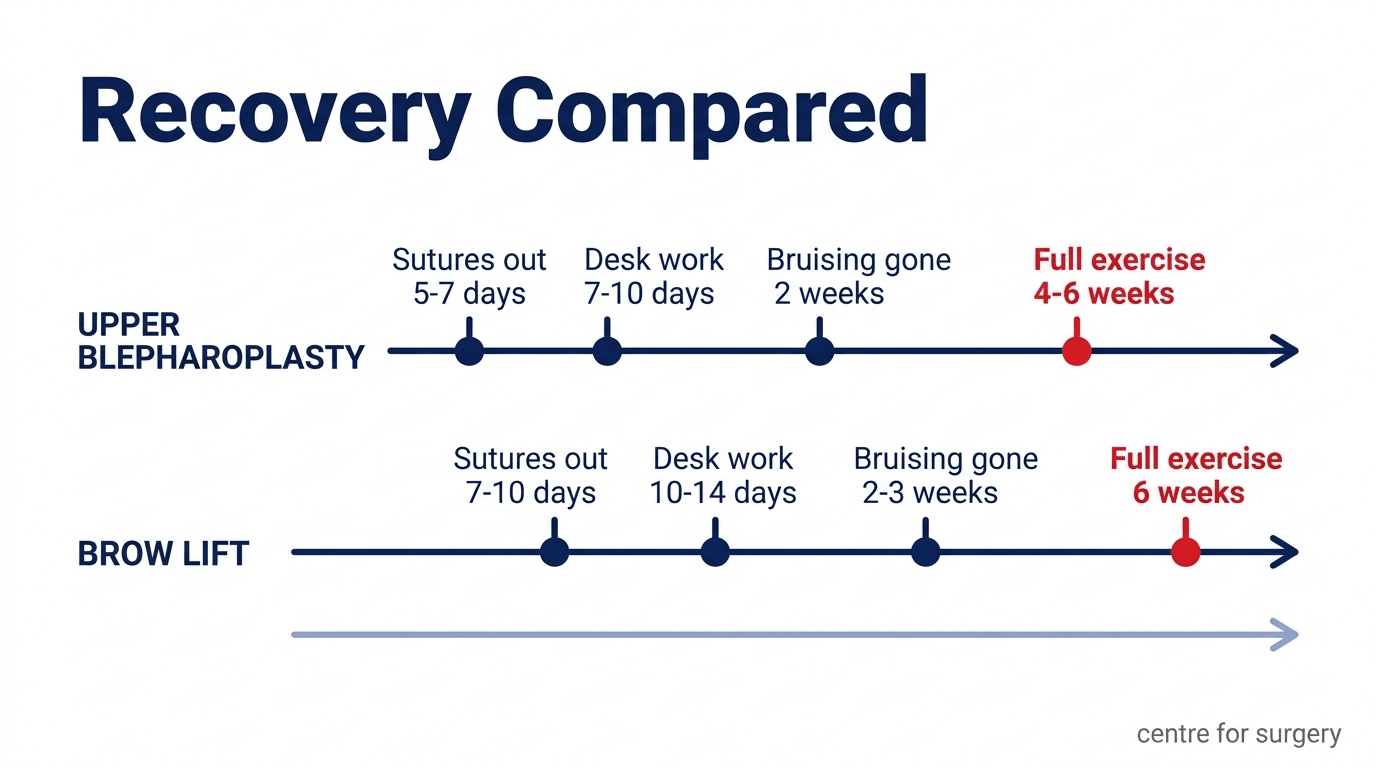
Both are usually day-case operations, so you go home the same day. The table shows typical timings; your surgeon will give you a plan that reflects your technique and healing.
| Upper blepharoplasty | Brow lift | |
| Anaesthetic | Local, or TIVA | Usually TIVA; some temporal lifts under local |
| Procedure time | 1–1.5 hours | 1–2 hours |
| Sutures out | 5–7 days | 7–10 days |
| Back to desk work | 7–10 days | 10–14 days |
| Bruising resolved | About 2 weeks | 2–3 weeks |
| Full exercise | 4–6 weeks | About 6 weeks |
| Settled result | 3–6 months | 3–6 months |
After a brow lift, the forehead may feel tight and parts of the skin can feel numb for a while, which usually improves gradually. Scars are placed within the hairline or follow natural contours, and they typically fade over time. Final swelling and scar maturation can take many months, so judge the result at the three to six month point rather than in the first weeks. Combined procedures follow the longer of the two timelines. Full detail is in our guides to blepharoplasty recovery and brow lift recovery and aftercare.

Can You Lift Your Brows Without Surgery?
Only to a limited, temporary degree. Anti-wrinkle injections (botulinum toxin) placed to relax the muscles that pull the brow down can give a modest lift for mild descent, and they need repeating. Dermal filler can add support around the brow in some people. Neither removes excess eyelid skin or provides the structural correction of surgery. Our guides to getting an eyebrow lift without surgery and non-surgical alternatives to eyelid surgery compare the options, and laser eyelid tightening is another option for mild skin laxity.
How Much Does a Brow Lift Cost vs Blepharoplasty?
Neither is inherently better value. A less expensive operation is poor value if it is the wrong one for your anatomy. Cost depends on the technique, whether the procedures are combined, the anaesthetic and the surgeon, and a written quote follows consultation. Current information is set out on our blepharoplasty cost and brow lift cost pages.
Who Is Not Suitable for a Brow Lift or Blepharoplasty?
- True eyelid ptosis — where the levator muscle is weak and the lid margin itself droops. This needs ptosis assessment and repair, not skin removal or brow elevation alone. In one study of 93 patients having ptosis surgery, the brow lowered in 61% as the compensatory forehead lifting relaxed[4]. Our guide to droopy eyelids explains the difference.
- Significant dry eye — both procedures can worsen it, and it needs assessment first.
- Thyroid eye disease or uncontrolled glaucoma — these require ophthalmology input before any surgical plan.
- Active smoking — it impairs healing, and you will usually be asked to stop beforehand.
- Very high hairline with brow descent — some brow lift techniques raise the hairline further and may be unsuitable.
What Happens at a Brow Lift Consultation?
At consultation your surgeon measures brow height against the bony rim above the eye, assesses the quantity and quality of upper lid skin, checks levator function to exclude ptosis, evaluates the position of the natural crease, and performs the manual brow elevation test to see how much of the heaviness is brow-driven. They will discuss the hairline, forehead lines, technique options, scarring, risks and what a realistic result looks like for your face.
You will be told directly if the procedure you asked about is not the right one, including where the honest answer is that neither is needed yet. We recommend a cooling-off period before any procedure is booked.
Brow and eyelid surgery at Centre for Surgery is performed by GMC-registered plastic surgeons at our CQC-regulated hospital at 95–97 Baker Street, Marylebone. You can read patient feedback on Google Reviews ↗ or our own patient reviews page.
Frequently Asked Questions
Is a brow lift or blepharoplasty better for hooded eyes?
It depends on whether the hooding comes from eyelid skin or brow descent. Use the brow position test above: if lifting the brow resolves the heaviness, a brow lift may be more appropriate. If the fold persists, blepharoplasty is more likely to be indicated. Many people with hooded eyes need both.
What is the difference between a brow lift and blepharoplasty?
A brow lift raises the eyebrow and forehead tissue, while blepharoplasty removes excess skin (and sometimes fat) from the eyelid. One treats the brow, the other the lid.
Can you have a brow lift and blepharoplasty at the same time?
Yes. They are commonly combined, which means one anaesthetic and one recovery. Recovery follows the longer of the two procedures.
Does blepharoplasty lower the eyebrows?
Brow height can fall slightly after upper eyelid surgery. A 2023 meta-analysis found a small average drop[1], and a surgeon assesses the brow beforehand so that a brow lift or browpexy can be considered when needed.
Will a brow lift make me look surprised?
Not when the amount of lift is judged correctly. A surprised look comes from over-elevation, particularly of the inner brow. Planning usually focuses on lifting the outer brow, where descent is most common, while preserving a natural brow shape.
Who is a good candidate for a brow lift?
Typically someone in good health whose eyebrows have lowered over time, who has hooding that improves when the brow is lifted, and who has realistic expectations. A consultation confirms whether a brow lift, blepharoplasty or both suits you.
Which has the shorter recovery, a brow lift or blepharoplasty?
Upper blepharoplasty generally. Most people return to desk work in around 7 to 10 days, compared with about 10 to 14 days after a brow lift, though healing varies.
How long does a brow lift last?
Longevity depends on the technique and on how your face ages. Research on endoscopic brow lifts shows a measurable lift persisting in the long term, but how well it holds is still debated[6]. Neither operation stops ageing.
Can anti-wrinkle injections work as a brow lift?
They can give a modest, temporary lift for mild brow descent when the injections are placed to rebalance the muscles. They do not remove eyelid skin.
Does either procedure treat under-eye bags?
No. Both address the upper part of the eye area. Under-eye bags are a lower lid issue; see how to get rid of eye bags.
Brow Lift and Blepharoplasty in London
If you are unsure whether you need a brow lift, blepharoplasty or both, a consultation with a plastic surgeon will establish where the heaviness comes from and what would address it. Find out more about brow lift surgery and eyelid surgery at Centre for Surgery.
Phone: 020 7993 4849 | Email: contact@centreforsurgery.com | Address: 95–97 Baker Street, Marylebone, London W1U 6RN
Contact us to schedule a consultation
References
- Liu R, Sun Y, Huang J, Long X. Brow position change and its potential risk factors following upper blepharoplasty: a systematic review and meta-analysis. Aesthetic Plastic Surgery 2023;47(4):1394–1409. doi:10.1007/s00266-023-03288-0 ↗
- Menderes A, Çağlı HB. Change in brow position after upper blepharoplasty with or without internal browpexy. Annals of Plastic Surgery 2024;93(4):420–424. doi:10.1097/SAP.0000000000004068 ↗
- Fagien S. Eyebrow analysis after blepharoplasty in patients with brow ptosis. Ophthalmic Plastic and Reconstructive Surgery 1992;8(3):210–214. doi:10.1097/00002341-199209000-00009 ↗
- Katayama R, Oka A, Ochiai H. Background factors for postoperative eyebrow descent in blepharoptosis: a retrospective case-control study of 93 patients. Journal of Plastic, Reconstructive & Aesthetic Surgery 2025;102:20–26. doi:10.1016/j.bjps.2025.01.005 ↗
- Marangi GF, Mirra C, Savani L, et al. Is the severity of preoperative eyelid dermatochalasis directly correlated with patient satisfaction after upper blepharoplasty? A prospective study based on PROMs. Aesthetic Plastic Surgery 2024;48(20):4114–4120. doi:10.1007/s00266-024-04214-8 ↗
- Şibar S, Dikmen AU, Erdal AI. Long-term stability in endoscopic brow lift: a systematic review and meta-analysis of the literature. Aesthetic Surgery Journal 2025;45(3):232–240. doi:10.1093/asj/sjae225 ↗
- Alabdulkarim A, Altamimi LA, Alharbi AM, Aldor SM, AlQhtani AZ. Comparative outcomes of traditional versus endoscopic brow lift techniques: a systematic review. Plastic and Reconstructive Surgery Global Open 2026;14(2):e7477. doi:10.1097/GOX.0000000000007477 ↗
- Cho MJ, Carboy JA, Rohrich RJ. Complications in brow lifts: a systemic review of surgical and nonsurgical brow rejuvenations. Plastic and Reconstructive Surgery Global Open 2018;6(10):e1943. doi:10.1097/GOX.0000000000001943 ↗
- Graham DW, Heller J, Kirkjian TJ, Schaub TS, Rohrich RJ. Brow lift in facial rejuvenation: a systematic literature review of open versus endoscopic techniques. Plastic and Reconstructive Surgery 2011;128(4):335e–341e. doi:10.1097/PRS.0b013e3182268d41 ↗
- Khan AZ, Boberg-Ans LC, Fineide FA, et al. Contemporary concepts and techniques for scar minimization in direct brow lift: a literature review. Journal of Clinical Medicine 2026;15(12). doi:10.3390/jcm15124445 ↗







