


In this guide16 sections
- Key Points
- Is Blepharoplasty Different for Men and Women?
- How Do Male and Female Eyelids Differ?
- Do Men Get Droopy Eyelids and Eye Bags Differently?
- Does Eyelid Surgery Make a Man Look Feminine?
- Which Blepharoplasty Do I Need: Upper, Lower or Both?
- Do I Need a Brow Lift as Well as Eyelid Surgery?
- Can I Get Blepharoplasty on the NHS?
- How Long Is Recovery After Blepharoplasty for Men and Women?
- What Are the Risks and Downsides of Blepharoplasty?
- How Long Do Eyelid Surgery Results Last and Are Patients Satisfied?
- When Is the Right Age for Eyelid Surgery?
- What Happens at a Blepharoplasty Consultation in London?
- Frequently Asked Questions
- Eyelid Surgery for Men and Women in London
- References
Key Points
- Is blepharoplasty different for men and women? The operation is the same in principle: excess skin and, where needed, fat are removed from the upper and/or lower eyelids. The planning differs, because men and women have different brows, skin and eye shapes.
- Men usually want a subtle, natural result. The aim of male blepharoplasty is a more rested, alert look without a higher, more arched or more rounded eye that reads as feminine.
- Anatomy explains the difference. On average, men have a lower, flatter brow and thicker skin, and tend to show less upper lid, so surgeons take less skin and keep the crease low.
- Upper, lower or both. Heavy, hooded upper lids need upper blepharoplasty, under-eye bags need lower blepharoplasty, and many people have both. A low brow may need a brow lift as well.
- Recovery is similar. Most people are back at desk work within about a week to ten days, with bruising fading over two to three weeks and the final result settling over several months.
- Risks are real but uncommon. Dry eyes, asymmetry and scarring are the commonest concerns; serious complications are rare. Costs and suitability are confirmed at a consultation.
Eyelid surgery has become one of the most commonly performed cosmetic operations in the UK, and it is now popular with men as well as women. Both groups usually come for the same reasons: heavy upper lids that make them look tired or cross, baggy lower lids, or skin that crowds the lashes and, in some cases, narrows the field of vision. If you are wondering whether blepharoplasty works differently for men and women, the short answer is that the technique is shared but the design of the result is not.
This guide sets out how male and female eyelids differ, what a natural result looks like in each, how upper and lower eyelid surgery are chosen, what recovery and risks involve, and what happens at a consultation. If you are specifically looking for the male procedure, our page on male blepharoplasty covers it in detail, and the article on hooded eyes explains the most common starting point.
Is Blepharoplasty Different for Men and Women?
Blepharoplasty is the medical name for eyelid surgery, sometimes called an eyelid lift or eyelid reduction. In both sexes it removes loose skin, and sometimes a little muscle or fat, through fine incisions hidden in the natural lid crease (upper lids) or just under the lashes or inside the lower lid. The surgical steps are the same for a man and a woman.
What changes is the target. A woman often wants a lid that looks more open, with a visible crease and a softly lifted outer corner. A man more often wants the heaviness gone without the eye looking altered at all. Taking too much skin, lifting the brow too far or creating a high, sharp crease can pull a male eye towards a more feminine shape, so the plan is usually more conservative. The rest of this guide explains why, and what it means for each stage of treatment.
How Do Male and Female Eyelids Differ?
The differences are averages, not rules, and individuals vary widely. They are still the reason a surgeon plans two patients of different sexes differently.
Brow position and shape
In a 2023 photogrammetric study of 300 professional male models ↗ in Plastic and Reconstructive Surgery, the typical male eyebrow was flat and low-lying, sitting on the bony rim of the eye socket, with its peak about two-thirds of the way along the brow[1]. A female brow, by comparison, usually sits above the rim and arches more. Measurements of adult faces show the same pattern: brow height and the height of the visible upper lid are greater in women, while the distance from the brow peak to the hairline tends to be greater in men[2].
This matters because the skin of a man’s upper lid has less room to “show”. A low, straight brow sits close to the lid, so even a small amount of extra skin can look heavy. It also means that lifting the brow too far in a man tends to look surprised or feminine.
Skin thickness and quality
On average, men have thicker skin with more oil and sweat glands, and women tend to show fine lines earlier. A cadaver study of lip skin, for example, found deeper wrinkles in women and more sebaceous and sweat glands in men[3]. Eyelid skin is the thinnest on the face in everyone, but the same general trend applies: male lid skin often ages by sagging and thickening rather than by crepey fine lines, and it can be less elastic to reshape. Thicker skin and a heavier brow are part of why male eyelids tend to look “hooded” before they look wrinkled.
Fat and bone structure
Men often have a deeper-set eye with a stronger brow ridge. The upper lid commonly shows less than in women, and a man’s lower eyelid fat pads can bulge earlier in life, particularly where bags run in the family. Both of these affect how much fat is removed or repositioned, and how a surgeon judges the eye in profile.

Do Men Get Droopy Eyelids and Eye Bags Differently?
Both sexes lose skin tone and fat support around the eyes with age, and both can inherit the tendency. Many people tell us they feel youthful but that loose skin around the eyes makes them look older than they are, and a family history of heavy lids or bags is very common.
The differences are in timing and presentation. Men generally show eyelid ageing a little later than women, and the first sign is more likely to be a heavy upper lid that makes them look tired or stern than visible creasing. Women are more affected by the hormonal changes of the menopause, which thin and loosen skin, so they may notice lid and under-eye changes earlier or more rapidly. If your lids look heavy, it is worth working out whether the cause is excess lid skin, a low brow or a true droopy eyelid (ptosis), because the treatments differ. Our guide to getting rid of eye bags covers the lower lid in the same way.
Does Eyelid Surgery Make a Man Look Feminine?
Done well, no. This is one of the commonest worries men raise, and it is a fair one. Over-resection of skin, an overly high crease and an excessive brow lift are the usual reasons a male result looks wrong. A careful surgeon plans to avoid all three.
In practice, male blepharoplasty tends to involve:
- A conservative skin excision. Enough skin is removed to lift the heaviness, but not so much that the lid looks tight, hollow or wide-eyed.
- A low, natural crease. The incision follows the lid crease you already have, rather than raising it to create a more rounded, open eye.
- A flat brow. If the brow needs support, it is stabilised rather than arched.
- Careful fat handling. Removing too much fat gives a hollow, ageing look, so it is repositioned or removed sparingly.
Women can usually carry a little more crease definition and lateral lift. In both sexes the principle is the same: the eye should look like yours, only rested. Our article on whether eyelid surgery changes your eye shape goes into this further.

Which Blepharoplasty Do I Need: Upper, Lower or Both?
The choice depends on where your concern sits, not on your sex. A surgeon will look at your upper lids, lower lids and brow together.
Upper blepharoplasty for heavy, hooded lids
Upper blepharoplasty removes excess skin (and sometimes a strip of muscle or a little fat) through an incision in the lid crease. It treats hooding, a heavy or tired look, skin that rests on the lashes and, where it is significant, a restricted upper field of vision. In a 2024 prospective study of 79 patients ↗ in Aesthetic Plastic Surgery, validated FACE-Q scores for satisfaction with the eyes improved significantly after upper blepharoplasty, visual field improved in the group with the most excess skin, and satisfaction did not depend on how severe the hooding had been beforehand[5].
Lower blepharoplasty for eye bags
Lower blepharoplasty treats puffy fat pads and loose skin beneath the eye. It is usually done through the inside of the lower lid (a transconjunctival approach, leaving no visible scar) or just beneath the lash line when skin also needs removing. Fat may be removed or repositioned to smooth the transition between lid and cheek. Women and men are treated in the same way, though a man’s bags are often fat-led and a woman’s may show more skin laxity or hollowing.
Combined upper and lower blepharoplasty
Many people have heavy upper lids and lower-lid bags together. Treating both at once means one anaesthetic and one recovery. The difference between the two procedures is explained in our article on upper vs lower blepharoplasty.
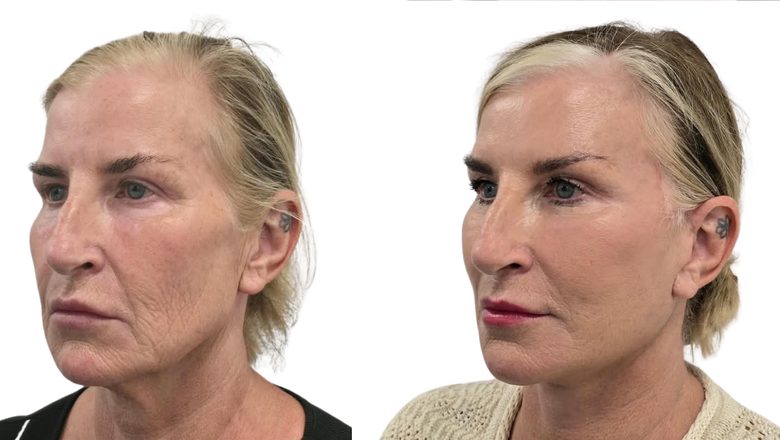
You can see more results in our blepharoplasty before and after gallery.
Do I Need a Brow Lift as Well as Eyelid Surgery?
This question comes up more often in men, whose low, flat brows are a common cause of heavy-looking lids. If the brow has dropped, removing eyelid skin alone can leave the heaviness in place or even push the brow lower. A simple test is to gently lift the outer end of the brow with a fingertip: if the heaviness disappears, the brow is contributing. Our comparison of brow lift vs blepharoplasty explains this test and the choice in detail.
When the brow does need support, options range from a full brow lift or an endoscopic brow lift to a limited stabilising stitch placed through the upper-lid incision. A small 2011 retrospective series ↗ of 21 patients aged 54 to 70, twelve of them men, found that anchoring the brow through a standard blepharoplasty incision gave happy patients and no major complications, although a series that small cannot show how often problems occur[4]. For men the goal is a stable, flat brow rather than an arched one. People who want a broader refresh sometimes combine eyelid surgery with a facelift or mini facelift, which we discuss in our article on combining blepharoplasty with a mini facelift.
Can I Get Blepharoplasty on the NHS?
Sometimes. Upper blepharoplasty may be funded when heavy lids cause a measurable functional problem rather than a cosmetic one. A 2026 narrative review in Orbit ↗ notes that current NHS eligibility criteria are commonly centred on visual field loss, eyelid position or the lid margin covering the pupil, and that these criteria vary and do not capture every symptom, such as eyelid heaviness or headache[6]. Cosmetic concerns alone, including lower-lid bags, are not usually funded. Your GP can advise whether a referral is appropriate, and our guide to the difference between cosmetic and functional eyelid surgery explains how the two are assessed.
How Long Is Recovery After Blepharoplasty for Men and Women?
Recovery is much the same in both sexes and depends mainly on whether you have upper lids, lower lids or both treated. As a general guide:
- First 48 hours: rest with your head raised, use cold compresses, and expect swelling, tightness and some blurred vision from lubricating ointment.
- Around day 7: stitches are removed or dissolve, and many people return to desk work, often wearing sunglasses.
- Weeks 2 to 3: bruising fades and make-up or contact lenses can usually be used again, subject to your surgeon’s advice.
- Weeks 4 to 6: most people can resume full exercise.
- 3 to 6 months: swelling fully settles and the scar matures to a fine line hidden in the crease.
Men’s thicker skin can make bruising show a little less, but recovery is not meaningfully quicker or slower than in women. Lower-lid surgery usually takes slightly longer to settle than upper-lid surgery. Practical advice is in our blepharoplasty recovery and aftercare guide. Whether you have the operation awake with sedation or under TIVA is explained in our guide to blepharoplasty under local anaesthetic or asleep.

What Are the Risks and Downsides of Blepharoplasty?
Eyelid surgery is generally safe when carefully planned, but it is surgery, and the area around the eye is unforgiving. A 2026 safety review in the Journal of Craniofacial Surgery ↗ found that most complications are minor and temporary, typically surface irritation of the eye, while structural problems such as lid retraction, a visible rim of white below the iris, ectropion (an outward-turning lower lid) and postoperative ptosis are less common, and rare serious events include orbital haemorrhage, double vision, infection and vision loss[7]. The same review identified pre-existing dry eye, previous eyelid surgery, eyelid laxity and blood-thinning medication as risk factors, which is why a thorough assessment matters.
The risks patients ask about most are:
- Dry or watering eyes. Temporary dryness is common; see our article on whether blepharoplasty can cause dry eyes.
- Asymmetry and tightness. Small differences between sides are normal early on and often settle.
- Taking too much skin. Over-resection can stop the eyes closing fully, which is one of the most important reasons to choose a surgeon carefully. Revision is possible; see revision blepharoplasty.
- Scarring and lumps. Scars in the crease usually fade to a fine line.
- Bleeding, infection and vision problems. These are rare but serious, and any sudden pain or loss of vision needs urgent attention.
Our guides to the risks and complications of eyelid surgery and how to avoid blepharoplasty complications go further, and the risks of going overseas are covered in blepharoplasty abroad.
How Long Do Eyelid Surgery Results Last and Are Patients Satisfied?
Upper blepharoplasty results commonly last for many years, and often a decade or more, but surgery does not stop ageing, and the brow and lower face continue to change. Lower-lid results can also last long term, although bags can return if the underlying cause is ongoing. See how long blepharoplasty lasts for detail.
Satisfaction in published studies is generally high. A 2023 cohort study of 583 patients ↗ in Plastic and Reconstructive Surgery Global Open found that baseline patient characteristics explained little of the variation in satisfaction six months after upper blepharoplasty, while how patients rated their post-operative appearance and their decision to have surgery were strongly linked to satisfaction[9]. A separate trial of 348 patients reported improvements in satisfaction with the eyes, overall satisfaction, and psychological and social function[8]. In practice, clear expectations and a conservative plan do more for satisfaction than age or sex.
When Is the Right Age for Eyelid Surgery?
There is no fixed age. Some people have inherited heavy lids in their thirties, while others do not need surgery until their sixties. The decision depends on your anatomy and how much the lids bother you. See our articles on the ideal age for blepharoplasty and eyelid surgery in your 30s, 40s, 50s and 60s. Non-surgical treatments can improve skin quality, but they cannot remove excess skin; our guide to non-surgical alternatives to eyelid surgery explains the limits.
What Happens at a Blepharoplasty Consultation in London?
Your consultation at our Baker Street hospital is with the surgeon who will perform your operation, and all our surgeons are GMC-registered. The hospital is regulated by the Care Quality Commission. You can expect:
- A discussion of what bothers you about your eyes and what you hope to change.
- An examination of your upper lids, lower lids and brow, including how you close your eyes, tear production and any signs of ptosis.
- A review of your health, medications (especially blood thinners), smoking and any eye conditions such as dry eye or thyroid eye disease.
- A recommendation on upper, lower or combined surgery, with or without brow support, and an explanation of the risks.
- A written plan with the cost, anaesthetic option and recovery time, and a cooling-off period before you commit.
The cost depends on which lids are treated and the anaesthetic you choose, so it is confirmed at consultation; our page on the cost of blepharoplasty explains what affects it, and finance options are available. Choosing the right surgeon is the most important decision, and our guide on how to choose an eyelid surgeon in London sets out what to look for.
Frequently Asked Questions
Should men get upper blepharoplasty?
Men who have heavy, hooded upper lids that make them look tired or that crowd the lashes or affect vision are common candidates. A surgeon will first check that the cause is skin rather than a low brow or a drooping lid (ptosis). Results are more reliable when expectations are realistic and the plan keeps a natural, masculine eye shape.
Can I get an upper bleph on the NHS?
Possibly, if the excess skin causes a measurable functional problem, such as restricted vision or the lid covering the pupil. Criteria vary between areas, and cosmetic reasons alone are not normally funded. Speak to your GP, who can advise whether a referral to an eye or oculoplastic service is suitable.
What is the downside of blepharoplasty?
The main downsides are temporary swelling, bruising and dry or watery eyes, a recovery period of one to two weeks before you look and feel normal, and the possibility of asymmetry, visible scarring or the need for revision. Serious complications such as bleeding or vision problems are rare. Risks are covered in full at consultation.
What is the regret rate for blepharoplasty?
No single figure applies, because studies measure it differently. Published research generally reports high satisfaction, and patient-reported scores tend to improve after surgery. Regret is more often linked to unrealistic expectations or an over-aggressive result than to the procedure itself, which is why a conservative plan matters.
Why do I look older after blepharoplasty?
Early swelling, bruising and tightness can make your eyes look different for several weeks. Longer term, taking too much skin or fat can leave hollow, tight-looking lids that look older. A conservative operation planned for your face lowers that risk, and a corrective procedure may help if it happens.
Will blepharoplasty make a man look feminine?
Not if it is planned for a male eye. Conservative skin removal, a low natural crease and a flat brow keep the eye looking like your own. Problems arise from over-resection or lifting the brow too high.
How long does male blepharoplasty recovery take?
Most men return to desk work within about a week to ten days and exercise again after four to six weeks. Bruising fades over two to three weeks, and the final result settles over three to six months. Lower-lid surgery tends to take a little longer.
Is blepharoplasty different for older and younger patients?
The technique is similar, but the plan changes. Younger patients with inherited heavy lids often need less skin removed, while older patients may need brow support or lower-lid tightening. A consultation tailors this to your anatomy.
Eyelid Surgery for Men and Women in London
If your eyes look tired or heavy, a consultation will establish whether skin, fat or your brow is responsible, and what would change it safely. Find out more about blepharoplasty at Centre for Surgery or male eyelid surgery.
Phone: 020 7993 4849 | Address: 95–97 Baker Street, Marylebone, London W1U 6RN
Contact us to schedule a consultation
References
- Pietruski P, Majak M. The male eyebrow and eyelid: an anthropometric analysis of White professional models. Plastic and Reconstructive Surgery 2023;152(2):248e–256e. doi:10.1097/PRS.0000000000010253 ↗
- Sadacharan CM, Packirisamy V. Photogrammetric analysis of eyebrow and eyelid dimensions in Indian American adults. Journal of Craniofacial Surgery 2020;31(8):e796–e800. doi:10.1097/SCS.0000000000006757 ↗
- Paes EC, Teepen HJ, Koop WA, Kon M. Perioral wrinkles: histologic differences between men and women. Aesthetic Surgery Journal 2009;29(6):467–472. doi:10.1016/j.asj.2009.08.018 ↗
- Cohen BD, Reiffel AJ, Spinelli HM. Browpexy through the upper lid (BUL): a new technique of lifting the brow with a standard blepharoplasty incision. Aesthetic Surgery Journal 2011;31(2):163–169. doi:10.1177/1090820X10395009 ↗
- Marangi GF, Mirra C, Savani L, et al. Is the severity of preoperative eyelid dermatochalasis directly correlated with patient satisfaction after upper blepharoplasty? A prospective study based on PROMs. Aesthetic Plastic Surgery 2024;48(20):4114–4120. doi:10.1007/s00266-024-04214-8 ↗
- Whitelaw TA. Beyond visual field restriction: reconsidering functional assessment in upper eyelid dermatochalasis. Orbit 2026. doi:10.1080/01676830.2026.2727052 ↗
- Taghioff SM, Munkwitz SE, Quan H, et al. Safety considerations in blepharoplasty: a comprehensive review. Journal of Craniofacial Surgery 2026. doi:10.1097/SCS.0000000000013144 ↗
- Vasović DD, Karamarković ML, Jovanović M, et al. Comprehensive evaluation of quality of life following upper eyelid blepharoplasty: a prospective analysis. Medicina (Kaunas) 2024;60(3):500. doi:10.3390/medicina60030500 ↗
- Luong KP, Vissers LCM, Domela Nieuwenhuis I, et al. Factors associated with treatment outcome satisfaction six months after upper blepharoplasty: a large cohort study. Plastic and Reconstructive Surgery Global Open 2023;11(9):e5260. doi:10.1097/GOX.0000000000005260 ↗







