


In this guide16 sections
- Key Points
- Can Surgery Fix Asymmetrical Eyes?
- Why Is One of My Eyelids Bigger Than the Other?
- Is It Normal to Have Uneven Eyes? How Common Are Uneven Eyelids?
- How Do You Fix Asymmetrical Eyes? Which Surgery Do You Need?
- Asymmetrical Eyes Surgery Before and After
- How to Fix Uneven Eyes Without Surgery
- Who Is Not a Good Candidate for Eyelid Surgery?
- What Happens at an Eyelid Asymmetry Consultation?
- Does Eyelid Surgery Hurt? Recovery After Surgery for Uneven Eyes
- Can Eyelid Surgery Make Eyes More Uneven? Risks of Surgery for Asymmetry
- How Long Do the Results Last?
- How Much Does Surgery for Uneven Eyes Cost in London?
- Frequently Asked Questions
- Asymmetrical Eyes Surgery in London
- References
Key Points
- Can surgery fix asymmetrical eyes? Often it can improve them. Which operation helps depends on the cause: excess eyelid skin responds to blepharoplasty, a dropped lid margin to ptosis repair, and a low or uneven eyebrow to a brow lift.
- Some difference between the eyes is normal. Almost everybody has it. Surgery is worth considering when the difference is obvious, has changed over time or interferes with your vision.
- The cause matters more than the operation. Eyelid skin, the position of the lid edge, brow height and the shape of the eye socket can each make eyes look uneven, and they are treated differently.
- Perfect symmetry is not a realistic goal. Surgeons aim for a clear improvement, and a small residual difference or the need for a minor touch-up is possible.
- A sudden droopy eyelid is different. A lid that drops within hours or days, especially with double vision, headache or weakness, needs urgent medical assessment and is not a cosmetic matter.
- Assessment comes first. A consultation with a GMC-registered surgeon at our CQC-regulated Baker Street hospital establishes which cause or causes apply before any operation is suggested.
Many people spend years noticing that one eye looks smaller, one eyelid sits lower or one eyebrow arches higher. If you have searched for asymmetrical eyes surgery or wondered how to fix uneven eyes, the honest answer starts with a diagnosis, because uneven eyes are a description rather than a condition. Eyelid surgery corrects some causes very well, droopy eyelids need a different operation, and a few causes sit in the bone around the eye where eyelid surgery cannot reach.
This guide explains why eyes become uneven, what counts as normal, which surgical and non-surgical options exist for each cause, how recovery and risk compare, and what to expect from a consultation. It sits alongside our guides to facial asymmetry, hooded eyes and brow lift vs blepharoplasty, which cover those topics in more depth.
Can Surgery Fix Asymmetrical Eyes?
Surgery can improve many forms of eye asymmetry, but it cannot make two eyes identical. Human faces are never perfectly symmetrical, and the eyes are the feature people look at most, so small differences are easy to notice in photographs and mirrors. A well-planned operation aims to bring the two eyes closer together in height, shape and openness so that the difference stops drawing attention.
What surgery can reliably do is correct the soft-tissue causes. Removing excess skin from one upper lid, tightening the muscle that lifts a drooping lid or raising a lower eyebrow can all make a visible difference. What it cannot do is change the bony eye socket, the position of the eyeball within it or the underlying shape of the face. A 2025 review in Facial Plastic Surgery Clinics of North America ↗ describes how eyelid asymmetry can come from bony and soft-tissue differences, variation in globe position, and nerve or mechanical problems, and how some of these need blepharoplasty, brow surgery or ptosis repair, sometimes in combination[1]. That is why a proper assessment matters more than choosing a procedure from a list.
If you are looking for blepharoplasty before and after photos, the gallery shows genuine results. Photographs only tell part of the story, though, and the sections below explain what sits behind them.
Why Is One of My Eyelids Bigger Than the Other?
When people say one eye looks bigger or smaller, the eyeballs themselves are almost always the same size. The difference comes from how much of the eye is uncovered by the lids and how the brow and socket frame it. Five causes account for most cases.
Excess eyelid skin and fat (hooding)
Skin and fat do not age evenly on both sides of the face. One upper lid may develop a heavier fold, hide more of the lid crease or sit closer to the lashes, which makes that eye look smaller and more tired. Our guide to hooded eyes and hooded eyelids explains the causes, and heavy eyelids are covered separately.
Ptosis: a lid margin that sits too low
In ptosis the edge of the upper lid sits lower than it should because the levator muscle that lifts it has weakened or stretched. One eye then looks half-closed or smaller. The cause can be age-related stretching, long-term contact lens wear, rubbing the eyes, previous eye surgery or, less often, a nerve or muscle problem, or something present from birth. The difference between a lid that droops and a fold of loose skin is easy to miss, and our guide to droopy eyelids, ptosis and surgery explains how to tell them apart.
An uneven eyebrow
A brow that sits lower on one side pushes skin down onto the lid and can mimic a droopy eyelid. The reverse also happens: people with a heavy lid often lift that eyebrow all day to see clearly, which creates a high, arched brow on one side and extra forehead lines. Treating the eyelid alone will not fix a brow problem.
Eye socket and eyeball position
The two eye sockets are rarely the same height, depth or shape. If one eyeball sits slightly further forward or lower than the other, the lids sit differently around it. That is a structural cause, and it is the one eyelid surgery cannot change. A good surgeon will explain this clearly rather than operate on lids that are not the real problem.
Medical, nerve and injury-related causes
Thyroid eye disease, nerve palsy, a previous injury or earlier eyelid surgery can all leave one eye looking different. Where the cause is medical, the underlying condition needs managing first and a surgeon who works closely with an eye specialist may be involved before any cosmetic procedure is considered.

Is It Normal to Have Uneven Eyes? How Common Are Uneven Eyelids?
Yes. Mild asymmetry is the rule rather than the exception. Mild differences between the two lids are common even in people with no eye complaints. In one study of 100 people who considered their eyes normal, the upper lids of the two eyes responded differently to the same eye drop, and about one in nine people showed a rise in one lid with a fall in the other[2]. The study was about eye drops rather than appearance, but it illustrates how much natural variation exists between two lids on the same face.
A difference of around a millimetre is usually invisible to other people. In one ptosis study, surgeons defined a successful result as upper lid heights differing by less than a millimetre[3], which tells you how fine the margins are. Photographs, camera angle, lighting, tiredness and which side you sleep on can all make the difference look larger than it is.
When uneven eyes need medical attention
See your GP, an optometrist or an eye casualty department promptly if:
- one eyelid has drooped suddenly, over hours or days;
- the droop comes with double vision, a severe headache, eye pain, a pupil that looks different in size, or weakness or numbness in the face or arm;
- one eye has started to bulge, look red or feel uncomfortable;
- the difference has appeared since an injury or eye surgery.
A sudden droop with weakness, slurred speech or a drooping face should be treated as an emergency: call 999. Cosmetic assessment is for eyes that have looked uneven for a long time or have changed slowly.
How Do You Fix Asymmetrical Eyes? Which Surgery Do You Need?
Treatment follows the cause. Many people need only one of the procedures below, and some need a combination, planned together at a single assessment.
Upper blepharoplasty for uneven eyelid skin
When one upper lid carries more skin or fat than the other, upper blepharoplasty removes the excess and reshapes the fold. The surgeon can treat each side differently, removing more on the heavier side, so the two lids end up closer to matching. The incision sits in the natural crease, which hides the scar once it has healed. Our guide to upper vs lower blepharoplasty explains how the two operations differ.
Ptosis repair for a lid margin that sits too low
If the lid edge itself is low, removing skin will not lift it. Ptosis repair tightens or shortens the levator muscle, or the small Müller’s muscle beneath it, to raise the lid edge. In a 2024 retrospective study in Plastic and Reconstructive Surgery ↗ of 278 patients with a mean age of 67 who had upper blepharoplasty, up to one in five also needed ptosis correction. Revisions were more common after the combined operation (9.2%) than after blepharoplasty alone (3.8%), which the authors considered comparable with the literature[4]. In other words, ptosis surgery is safe but technically demanding, and one-eye-at-a-time symmetry is hard to guarantee. In a 2025 comparison of two levator suturing techniques in 60 people with severe age-related ptosis, overall contour symmetry after surgery was around 72% to 76%, with both techniques improving lid height significantly[5].
Brow lift for a low or uneven eyebrow
Where the eyebrow is the main cause, lifting it takes weight off the lid and can open a heavy-looking eye without removing any lid skin. A simple self-test is to gently raise the outer part of the brow in a mirror: if the heaviness disappears, the brow is contributing. Our guide to brow lift vs blepharoplasty walks through the test, and endoscopic vs traditional brow lift compares the techniques.
Lower blepharoplasty for uneven lower lids and eye bags
If the difference is under the eye, for example one side with a more prominent fat bag, lower blepharoplasty can rebalance the two sides by removing or repositioning fat. Where only skin quality differs, a non-surgical option such as SmoothEye laser may help.
Canthoplasty for the shape of the corners
Differences in the outer corner position or tilt of the eye are treated differently from lid height. Canthoplasty can adjust the shape and tilt of the outer corner in suitable patients, although the change is small and not always the right answer for asymmetry.
Combined procedures
Brow, lid skin and lid margin interact, so combined surgery is common. For example, a lowered brow and loose lid skin may be treated together, and an experienced surgeon will explain the order and extent. Our guide to Trifecta lift vs blepharoplasty covers one combined approach.

Asymmetrical Eyes Surgery Before and After
The photographs below are real Centre for Surgery patients who had upper eyelid surgery for hooded, uneven-looking lids. Results vary and are not guaranteed. In genuine eyelid before and after photographs, the brows sometimes sit lower after surgery because the forehead muscle no longer has to hold the lids open, so look at the eye opening and lid crease rather than brow height alone.
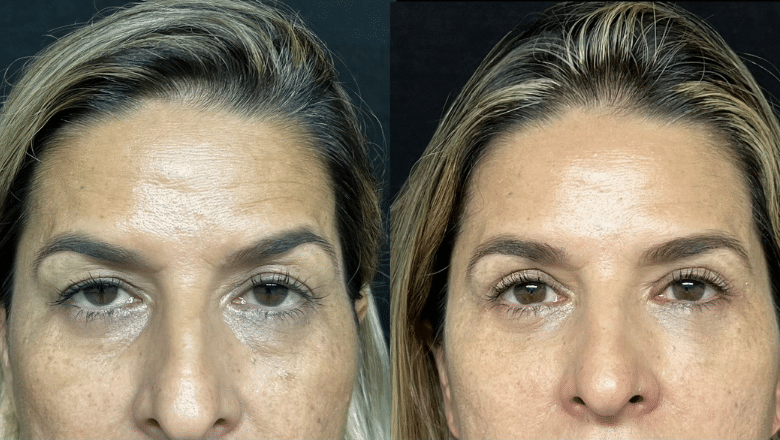
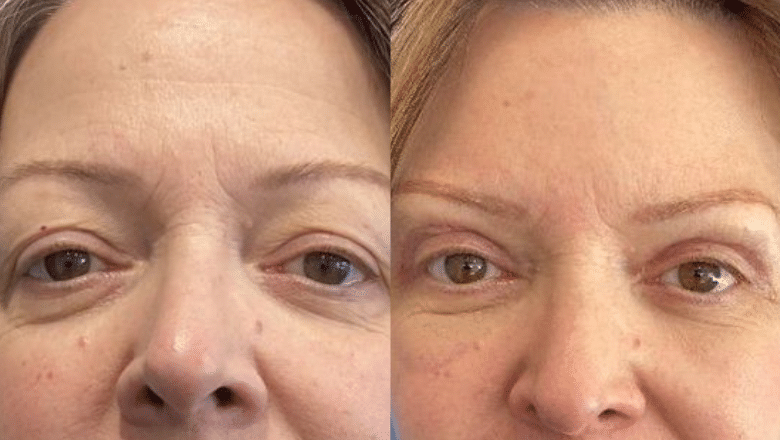
More examples are in our full blepharoplasty before and after gallery, and the guide to whether eyelid surgery changes your eye shape explains what the operation will and will not alter.
How to Fix Uneven Eyes Without Surgery
For a mild difference that does not affect your sight, non-surgical approaches are reasonable first steps:
- Make-up and brow shaping. Brow pencil, eyeliner and lash placement can disguise a small difference in lid height or brow position.
- Sleeping and habits. If you sleep on one side, rub one eye more or wear a contact lens that irritates one lid, changing these can reduce a difference that is partly temporary.
- Eye drops for mild ptosis. Eye specialists sometimes use a prescription drop called apraclonidine, off-label, to lift a mildly drooping lid by a small amount. In a study of 100 people it raised the lid in most eyes by about 0.7 mm on average, with wide variation between individuals[2]. This needs a prescription and specialist assessment, and it is not a cosmetic cure.
- Brow relaxing injections. If the unevenness comes from a lower brow on one side, anti-wrinkle injections can sometimes rebalance brow height slightly, though the effect is temporary.
- Skin tightening. For crepey or lax lid skin, laser eyelid tightening with SmoothEye can firm skin without surgery, although it cannot lift a lid margin or reposition a brow.
Our guide to non-surgical alternatives to eyelid surgery and the comparison of traditional vs non-surgical blepharoplasty set out where these options stop and surgery begins. Exercises and facial massage do not change the position of an eyelid margin or a brow, and there is no good evidence that they correct asymmetry.
Who Is Not a Good Candidate for Eyelid Surgery?
Surgery is not right for everyone with uneven eyes. A surgeon will usually advise against, or delay, an operation if:
- the difference is very small and is only noticeable to you;
- the cause is bone or eyeball position that eyelid surgery cannot change;
- you have severe dry eye, an active eye infection or uncontrolled thyroid eye disease, which raise the risk of problems after surgery;
- you smoke and are unwilling to stop for four weeks before and after surgery, since smoking slows healing;
- your health is not stable enough for the chosen anaesthetic;
- you expect perfect symmetry or a dramatic change in appearance.
Our guide to cosmetic and functional eyelid surgery explains when surgery is mainly about appearance and when it is about vision.
What Happens at an Eyelid Asymmetry Consultation?
At Centre for Surgery, your first appointment is a face-to-face consultation with the surgeon who would operate on you. The surgeon will:
- ask when you first noticed the difference, whether it has changed and whether it affects your vision;
- look at both eyes, the brows and the face as a whole, with attention to lid height, the crease, brow position and how the eyes close;
- measure the position of the lid margins and test how well the eyelid muscle works;
- explain which cause or causes apply, what each treatment can achieve and what it cannot;
- discuss risks, anaesthetic options and recovery, with time to think before you decide.
We recommend a cooling-off period before you commit. Our surgeons are GMC-registered and the hospital is regulated by the Care Quality Commission; you can check our CQC rating. The guide to choosing an eyelid surgeon lists the questions worth asking anywhere you are considering treatment.
Does Eyelid Surgery Hurt? Recovery After Surgery for Uneven Eyes
Most eyelid operations are done under local anaesthetic, with or without sedation, or under TIVA (total intravenous anaesthesia, a deeper form of sedation), depending on what is being treated and your preference. Our guide to blepharoplasty under local or asleep explains the choice, and the page on anaesthesia for cosmetic surgery goes into more detail. During the operation you should feel pressure rather than sharp pain. Afterwards, most people describe tightness and aching rather than severe pain, and simple pain relief is usually enough.
Swelling and bruising are expected and are usually at their worst in the first few days. Stitches are commonly removed after about a week, and most people feel comfortable returning to desk work and seeing people after around 10 to 14 days. Ptosis surgery and brow surgery can need longer. Scars from upper eyelid surgery sit in the natural crease and fade over several months. The full timeline is in our blepharoplasty recovery guide.
The two sides swell differently, so your eyes will often look more uneven in the first weeks than they did before surgery. That is normal and settles, and judging the result before the swelling has gone down is a common cause of unnecessary worry.
Can Eyelid Surgery Make Eyes More Uneven? Risks of Surgery for Asymmetry
Every operation carries risk, and operating to even up two sides is harder than treating two matching sides. Risks include bleeding, infection, scarring, dry or gritty eyes, temporary double vision or blurring, difficulty closing the eye fully, and a result that is under- or over-corrected. Our guide to the risks and complications of eyelid surgery covers each in more detail, and the article on dry eyes after blepharoplasty addresses the commonest concern.
For asymmetry in particular, three points are worth knowing:
- Residual asymmetry is possible. In a 2026 study of 107 patients having sling surgery for severe ptosis ↗, 68% had perfectly symmetrical lid position afterwards, while the other 32% had a difference averaging about 1 mm, and 10% needed repeat surgery[6].
- Fixing one side can reveal the other. When one droopy lid is lifted, the brain may send less effort to both lids (Hering’s law), and a milder droop on the other side can become obvious. The 2024 Plastic and Reconstructive Surgery study above recorded one such revision[4]. Surgeons check for this before operating.
- Fold asymmetry after double eyelid surgery is recognised. A series of 4,129 double eyelid operations reported crease asymmetry in 230 patients (about 5.6%)[7], and a series of 898 operations recorded asymmetry as a complication in 1.3%[8]. These were East Asian eyelid techniques, but they show that asymmetry can occur after any lid surgery.
Choosing a surgeon who diagnoses the cause correctly, plans each side separately and is open about the chance of a touch-up is the most useful protection. Our article on avoiding blepharoplasty complications explains what to look for, and the guide on blepharoplasty abroad explains why aftercare matters if a problem arises.
How Long Do the Results Last?
Surgical correction of skin excess is long-lasting, and many patients see their result last 10 years or more, but ageing continues and the lids will keep changing. A repaired ptosis or lifted brow can drift over the years. Our guides to how long blepharoplasty lasts and whether eyelid surgery results are permanent give the detail.
How Much Does Surgery for Uneven Eyes Cost in London?
The cost depends on which procedure or combination you need, the anaesthetic and the time in theatre, so it cannot be quoted accurately until you have been assessed. A single-eye adjustment, a standard blepharoplasty and a combined brow and ptosis operation are very different operations. We confirm your costs in writing after your consultation. Subject to status, finance options are available, and the blepharoplasty cost guide explains what influences the cost of eyelid surgery.
Frequently Asked Questions
Can surgery fix misaligned eyes?
It depends what misaligned means. If one eye looks different because of lid skin, a low lid margin or brow position, surgery can help. If the eyes themselves point in different directions (squint), that is a muscle problem treated by an eye specialist, not by cosmetic eyelid surgery. If one eye sits further forward or lower because of the socket, eyelid surgery cannot change that.
Who is not a good candidate for blepharoplasty?
Surgeons usually advise against it if you have severe dry eye, an active eye infection, uncontrolled thyroid eye disease or unstable general health, if you will not stop smoking around the time of surgery, or if the difference you see comes from bone rather than the lids. Unrealistic expectations of perfect symmetry are another reason to wait.
Does ptosis surgery hurt?
Most people feel pressure rather than pain during the operation, because the eyelid is numbed with local anaesthetic, sometimes with sedation or TIVA. Afterwards the area is usually tight, tender and swollen for a few days, and simple pain relief is typically enough. Contact us if pain is severe or worsening.
Why is one of my eyelids bigger than the other?
The commonest reasons are a heavier fold of skin and fat on one side, a lid margin that sits lower because the lifting muscle has stretched, and a brow that sits at a different height. Eye socket shape, thyroid eye disease, nerve problems, injury and previous surgery are other causes. An assessment identifies which applies.
How common are uneven eyelids?
Very common. Most people have a small difference in lid height, brow position or eye shape between the two sides, and many never notice it. It becomes a concern when the difference is obvious in photographs, has grown over time or interferes with sight.
How can I fix asymmetrical eyes naturally?
Make-up, brow shaping and changes to habits such as sleeping position or eye rubbing can soften a mild difference. Exercises and massage have no reliable evidence behind them. If the cause is excess skin, a low lid margin or a low brow, only surgery produces a lasting correction, and a mild case may not need any treatment.
Do people notice my eye asymmetry?
Usually much less than you do. You see your own face daily in the mirror and compare the two eyes closely, whereas other people look at your whole expression. A difference of a millimetre or so is rarely visible in conversation. If the asymmetry is large, or lifts and drops with your expression, others may notice more.
How can I correct eye asymmetry?
Start with a diagnosis. Excess lid skin is treated with blepharoplasty, a low lid margin with ptosis repair, and a low brow with a brow lift, and some people need a combination. Mild differences can be softened with make-up or skin tightening. A consultation with a surgeon will establish which route suits you.
Asymmetrical Eyes Surgery in London
If one eye looks different from the other and you would like to know whether surgery would help, a consultation will establish the cause, explain your options and tell you honestly whether surgery is worth doing. Find out more about blepharoplasty at Centre for Surgery.
Phone: 020 7993 4849 | Address: 95–97 Baker Street, Marylebone, London W1U 6RN
Contact us to schedule a consultation
References
- Holds JB. Management of the tarsal fold with ptosis management in aesthetic blepharoplasty. Facial Plastic Surgery Clinics of North America 2025;34(1):119–129. doi:10.1016/j.fsc.2025.08.013 ↗
- Kirkpatrick CA, Shriver EM, Clark TJE, Kardon RH. Upper eyelid response to topical 0.5% apraclonidine. Ophthalmic Plastic and Reconstructive Surgery 2018;34(1):13–19. doi:10.1097/IOP.0000000000000843 ↗
- Mangan MS, Bolac R, Yildiz MB, et al. Simultaneous posterior eyelid ptosis repair and strabismus surgery: a single-stage approach. Arquivos Brasileiros de Oftalmologia 2023;86(3):263–269. doi:10.5935/0004-2749.20230020 ↗
- Falcon Rodriguez L, Kuruoglu D, Salinas CA, et al. Eyelid and brow rejuvenation: technical pearls and outcomes of upper blepharoplasty with or without ptosis correction and brow lift. Plastic and Reconstructive Surgery 2024;154(6):1199–1207. doi:10.1097/PRS.0000000000011324 ↗
- Ayintap E, Aytogan H. Comparison of eyelid contour symmetry after ptosis repair via centralized versus temporally biased levator suturing techniques. BMC Ophthalmology 2025;25(1):486. doi:10.1186/s12886-025-04318-y ↗
- Kataev MG, Khulamkhanova FM, Zakharova MA, Trofimova IYu. Effectiveness of the “sliding eight” technique for the treatment of upper eyelid ptosis. Vestnik Oftalmologii 2026;142(5):32–37. doi:10.17116/oftalma202614205132 ↗
- Yang K, Xie Z, Liu Y, Wang J, Yang Q. Dermis-orbicularis oculi muscle-septoaponeurosis junctional thickening fixation technique for double eyelid blepharoplasty. Aesthetic Plastic Surgery 2025;50(3):851–860. doi:10.1007/s00266-025-05454-y ↗
- Zhao J, Chen C, Ju Z, et al. Prevention of incisional depression in double eyelid blepharoplasty using an elevated cephalad orbital septum flap technique. Annals of Plastic Surgery 2026;97(5):494–500. doi:10.1097/SAP.0000000000004855 ↗







