


In this guide13 sections
- Key Points
- What Is a Gliding Brow Lift?
- How Does a Gliding Brow Lift Work?
- Who Is a Good Candidate for a Gliding Brow Lift?
- Gliding Brow Lift vs Endoscopic Brow Lift
- Gliding Brow Lift Results: How Much Lift and How Long Does It Last?
- Gliding Brow Lift Recovery
- What Are the Risks of a Gliding Brow Lift?
- Combining a Gliding Brow Lift With Other Procedures
- Gliding Brow Lift at Centre for Surgery
- Frequently Asked Questions
- References
- Talk to a Surgeon About a Gliding Brow Lift
Key Points
- A gliding brow lift (GBL) is a minimally invasive brow lift. Through small incisions in the hairline, the skin of the forehead is released from the muscle beneath, glided up into a higher position and held there with a temporary net of stitches.
- It is a surgical procedure, not a non-surgical treatment. It avoids the long scalp incision of a traditional brow lift and does not need screws, plates or an endoscope.
- It suits people with a low or flat brow, particularly at the outer end, and those who want to reshape the brow as well as lift it. Very heavy brows may need a different technique.
- In the original 2019 study of 124 patients, the brow was successfully repositioned in 118, with no haematoma, infection, hair loss or permanent numbness.
- The stitch net is removed after a few days. Bruising settles over two to three weeks, temporary forehead numbness is common, and marks from the net can take up to three months to fade.
- A low brow is not just cosmetic for some people: a 2012 UK study found that brow lift surgery improved visual function and quality of life in people whose brows had dropped.
The gliding brow lift is one of the newer ways to raise and reshape the eyebrows. Developed by plastic surgeons in Brazil and the United States and first published in 2019, it lifts the brow by working in the layer just under the skin rather than lifting the whole forehead from the bone, which means small incisions, no fixation devices and a shorter recovery than older techniques.
This guide explains what a gliding brow lift is, how it works, who it suits, how it compares with an endoscopic brow lift, what the published results show, and what recovery involves. For an overview of every technique, see our main brow lift page, and if you are not sure whether your heaviness comes from the brow or the eyelids, our guide to brow lift vs blepharoplasty explains the difference.
What Is a Gliding Brow Lift?
A gliding brow lift is a minimally invasive brow lift that raises and reshapes the eyebrows by releasing the forehead skin from the muscles beneath and redraping it higher. It was described in 2019 by Viterbo, Auersvald and O’Daniel in a study of 124 patients in Aesthetic Plastic Surgery ↗[1], who called it a new concept in brow lifting.
The name comes from the way the brow is moved. Once the skin is freed from the frontalis muscle (which raises the brow) and the muscles around the eye, it can glide upwards and be repositioned and reshaped precisely, rather than being pulled tight from behind the hairline. It is then held in place while it heals by a temporary net of stitches on the surface of the skin, called a haemostatic net.
It is sometimes described online as non-surgical or scarless. Neither is quite right. It is an operation, done through small incisions that are hidden in the hairline and usually heal very well, but it is not a non-surgical treatment like anti-wrinkle injections. Our guide to getting an eyebrow lift without surgery covers the non-surgical options.
How Does a Gliding Brow Lift Work?

The procedure has three steps:
- Small incisions and release. Through small incisions in the hairline, usually at the temples, the surgeon separates the skin of the forehead, brows and temples from the muscles beneath, working in the layer just under the skin.
- Gliding the brow up. The freed skin and brow are moved upwards and reshaped. The surgeon can lift the outer brow more than the inner brow, which changes the shape of the arch as well as its height.
- Holding it in place. A haemostatic net, a pattern of temporary stitches through the skin, holds the skin against the muscle in its new position while it heals and closes the space underneath, which reduces the risk of bleeding. The net is removed after a few days.


Variations exist. An extended gliding brow lift releases a wider area and works in two layers to lift more of the brow and the area around the eyes, which a 2025 study of 122 patients in Plastic and Reconstructive Surgery ↗[9] found helpful when the distance between the brow and hairline is short. Some surgeons also add internal stitches to support the brow from beneath[2].
Who Is a Good Candidate for a Gliding Brow Lift?
A gliding brow lift suits people whose concern is the position or shape of the brow itself. Typical reasons include:
- A low or flat brow, often most noticeable at the outer end (the tail), which gives a tired, sad or heavy look. Our guide to droopy eyebrows explains the causes.
- Hooding over the upper eyelids caused by a descended brow rather than excess eyelid skin. See hooded eyes.
- A wish to reshape the brow, such as raising the tail for a more open, arched look.
- Wanting to avoid a long scalp scar or a raised hairline.
Can a low brow affect your vision?
In some people, yes. When the brow drops, it pushes skin down onto the upper eyelids, which can crowd the eyes and, when marked, hang into the upper part of the field of vision. In a 2012 UK study of brow ptosis in the journal Eye ↗[6], patients reported a significant improvement in visual function and quality of life after brow lift surgery, and loss of the upper visual field was the best objective predictor of who would benefit. For most people, though, a brow lift is an elective procedure chosen to look less tired, and any visual problem should be assessed properly first.
Who might need a different technique?
A gliding brow lift is less suitable when:
- The brow is very heavy, particularly in men with thick brows, where a direct brow lift through an incision along the top of the brow gives a stronger, more reliable lift.
- The main problem is excess eyelid skin rather than a low brow, which needs blepharoplasty.
- Only the outer brow needs lifting, where a temporal brow lift may be enough.
- Smoking continues, as the lifted skin relies on a good blood supply. We ask patients to stop all nicotine at least four weeks before and after surgery.
Gliding Brow Lift vs Endoscopic Brow Lift
Both are minimally invasive alternatives to the traditional coronal brow lift, which uses a long incision across the scalp. The main differences:
- Layer of work. The gliding brow lift works just under the skin. An endoscopic brow lift works deeper, on the bone, using a small camera, and lifts the whole forehead including the muscles.
- Fixation. The gliding brow lift uses a temporary stitch net on the skin. An endoscopic lift usually fixes the tissue to the bone with internal stitches, screws or small absorbable devices.
- Shaping. The gliding technique allows very precise shaping of the arch and tail. An endoscopic lift is better for lifting the whole forehead and for heavier brows.
- Equipment. The gliding brow lift needs no endoscope or implants.
A 2026 systematic review of 15 studies in Plastic and Reconstructive Surgery Global Open ↗[7] found that endoscopic and minimally invasive techniques, including the gliding brow lift, gave comparable or better results than open brow lifts, with fewer complications and shorter recovery. Our article on endoscopic vs traditional brow lift compares the older techniques in more detail.
Gliding Brow Lift Results: How Much Lift and How Long Does It Last?
The evidence is still growing, but the published results are consistent:
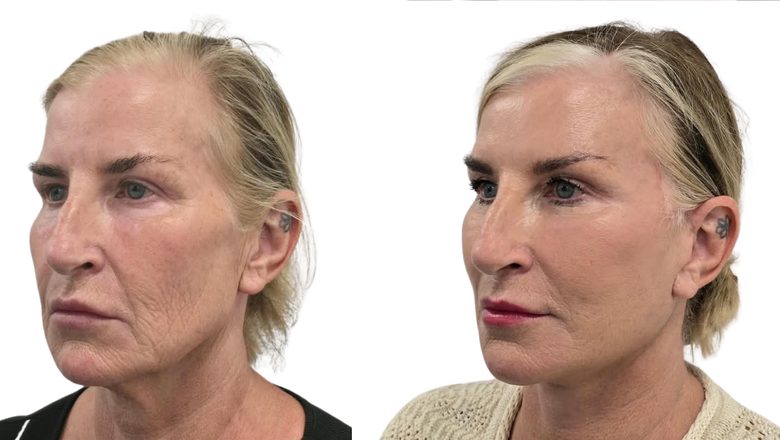
- In the original study of 124 patients[1], followed for an average of 17 months, 118 had an adequate lift and reshaping. Six had some return of the droop, and four of these had a successful repeat procedure.
- In a 2025 study of 63 patients in Aesthetic Surgery Journal ↗[3], the lift was maintained at every point measured a year after surgery, with the greatest lift at the outer brow: about 3 mm at the outer corner of the eye and 2.7 mm at the brow tail.
- A 2026 study of 30 patients[4] using the technique across the whole forehead measured average lifts of 5 to 7 mm across the brow, with almost no loss of lift at about eight months.
- A 2024 systematic review[2] concluded that the technique is effective with low complication rates, but noted that most studies are small and that longer follow-up is still needed.
A few millimetres may not sound like much, but small changes in brow height and shape make a visible difference to how open and rested the eyes look. Like any brow lift, the result softens gradually as the face continues to age.

Gliding Brow Lift Recovery
Recovery is usually quicker than after a traditional brow lift. What to expect:
- The first few days: swelling and bruising around the forehead and eyes, at their worst around days two to four. Sleeping with your head raised helps. The stitch net is removed at a clinic visit after a few days.
- Weeks one to three: bruising fades over two to three weeks. Most people feel ready to return to desk-based work after about one to two weeks.
- Numbness and itching: temporary numbness across the forehead is common and usually settles over weeks to a few months, often with some itching as feeling returns.
- Marks from the net: small marks or darker patches where the stitches passed through the skin are the most common visible side effect. A 2026 meta-analysis of haemostatic nets in Aesthetic Plastic Surgery ↗[5] found these usually settle on their own but can take up to three months.
- Exercise and swimming: avoid strenuous exercise and swimming for a few weeks, as your surgeon advises.
Our brow lift recovery guide covers the timeline for every technique.
What Are the Risks of a Gliding Brow Lift?
Complications are uncommon, but every operation carries some risk:
- Asymmetry. One brow sitting slightly higher than the other is the most common issue. In one series of 30 patients[4], five reported some asymmetry, and one needed a correction.
- Return of the droop, seen in a small number of patients and usually correctable[1].
- Pigment marks from the stitch net, usually temporary[5].
- Nerve effects. Temporary weakness of the muscle that raises the brow is rare, and published studies have reported no permanent nerve injury.
- Skin problems such as a small area of poor healing are rare, and more likely in smokers.
Bleeding under the skin (haematoma) is rare, as the stitch net closes the space where blood would otherwise collect. The original study reported no cases of haematoma, infection, hair loss or permanent numbness[1].
Combining a Gliding Brow Lift With Other Procedures
A gliding brow lift is often combined with upper eyelid surgery, as many people have both a low brow and some excess eyelid skin. Adding a brow lift to eyelid surgery does not appear to add risk: in a study of 6,126 patients in Annals of Plastic Surgery ↗[8], major complication rates were 0.4% for combined procedures, the same as for eyelid surgery alone. It can also be combined with a facelift; see procedures that complement a facelift.
Gliding Brow Lift at Centre for Surgery
Centre for Surgery offers every type of brow lift, including the gliding brow lift, endoscopic, temporal, direct and traditional techniques, so your surgeon can recommend the one that suits your brow rather than the only one available. Our brow surgery is performed by plastic surgeons, including surgeons with oculoplastic training.
- A brow lift is a day case, usually under TIVA (total intravenous anaesthesia), or local anaesthetic with sedation for smaller lifts. Your surgeon and anaesthetist decide which suits you.
- The consultant who assesses you is the consultant who performs your surgery.
- Your new brow position is planned with you sitting up, as brows sit differently lying down.
- We recommend at least two weeks between consultation and surgery, and further consultations before surgery are free.
For costs, see our brow lift cost guide.
Frequently Asked Questions
Is a brow lift the same as an eye lift?
No. A brow lift raises the eyebrows and forehead, while an eye lift (blepharoplasty) removes excess skin and fat from the eyelids. A low brow can look like heavy eyelids, so it is important to work out which is the cause. Many people benefit from both, done at the same time.
Does an eyebrow lift work?
Yes. Studies of the gliding brow lift show measurable lifts of around 3 mm at the brow tail to 7 mm across the whole brow, maintained a year or more after surgery. Non-surgical options such as anti-wrinkle injections give a much smaller lift of one to two millimetres that lasts a few months.
What are the downsides of a brow lift?
Bruising and swelling for two to three weeks, temporary numbness of the forehead, a small risk of asymmetry, and, after a gliding brow lift, marks from the stitch net that can take up to three months to fade. Traditional brow lifts also leave a longer scar and can raise the hairline.
What is the most natural-looking eyebrow procedure?
The most natural result comes from choosing the technique that matches your brow and lifting it only a little. The gliding brow lift is well suited to subtle lifting and reshaping of the tail, while very heavy brows may look more natural after an endoscopic or direct lift. Over-lifting, which gives a surprised look, is the main thing to avoid.
How long does a gliding brow lift last?
Studies show the lift is well maintained at one year and beyond, and the original study followed patients for an average of 17 months. As with any brow lift, the face continues to age, so the result softens gradually over the years.
Will I have scars after a gliding brow lift?
The incisions are small and hidden in the hairline, so scars are rarely visible. Small marks where the stitch net passed through the skin usually fade within weeks, although in some people they take up to three months.
References
- Viterbo F, Auersvald A, O’Daniel TG. Gliding brow lift (GBL): a new concept. Aesthetic Plast Surg. 2019;43(6):1536-1546. doi:10.1007/s00266-019-01486-3 ↗
- Şibar S, Erdal AI. The gliding brow lift: a systematic review of the literature. Ann Plast Surg. 2024;93(3):397-401. doi:10.1097/SAP.0000000000004050 ↗
- Orra S, Bald M, Wagner G, Grotting JC. The gliding brow lift: an analysis of outcomes and maintenance of lift in a single surgeon’s practice. Aesthet Surg J. 2025;45(3):225-231. doi:10.1093/asj/sjae224 ↗
- Lam H, Buttram JE, Jeffrey J, et al. The “gliding brow lift”: an objective analysis of outcomes for the treatment of brow ptosis. Ophthalmic Plast Reconstr Surg. 2026. doi:10.1097/IOP.0000000000003270 ↗
- Kodalak EA, Delgado LM, Ersan M, et al. Hemostatic net in facial aesthetic surgery: a systematic review and meta-analysis. Aesthetic Plast Surg. 2026. doi:10.1007/s00266-026-06335-8 ↗
- Mellington F, Khooshabeh R. Brow ptosis: are we measuring the right thing? The impact of surgery and the correlation of objective and subjective measures with postoperative improvement in quality-of-life. Eye (Lond). 2012;26(7):997-1003. doi:10.1038/eye.2012.78 ↗
- Alabdulkarim A, Altamimi LA, Alharbi AM, et al. Comparative outcomes of traditional versus endoscopic brow lift techniques: a systematic review. Plast Reconstr Surg Glob Open. 2026;14(2):e7477. doi:10.1097/GOX.0000000000007477 ↗
- Wormer BA, Rankin TM, Kaoutzanis C, et al. Does brow lift add risk to blepharoplasty? Answers from a multicenter analysis of 6126 patients undergoing aesthetic eye surgery. Ann Plast Surg. 2023;90(4):288-293. doi:10.1097/SAP.0000000000001255 ↗
- Sozer O, Ersan M, Kachare MD, et al. Extended gliding brow lift: an effective solution for brow and periorbital rejuvenation. Plast Reconstr Surg. 2026;158(2):237-247. doi:10.1097/PRS.0000000000012611 ↗
Talk to a Surgeon About a Gliding Brow Lift
If your brows have dropped or you would like to change their shape, you can book a consultation at our Baker Street clinic to find out which brow lift technique suits you, by calling 020 7993 4849 or using the form below.







