


In this guide12 sections
- What Are Jowls?
- What Causes Sagging Jowls?
- Can Jowls Develop in Your 20s?
- How Do I Know If I Need Non-Surgical or Surgical Treatment?
- The Complete Treatment Landscape
- Can You Get Rid of Jowls with Exercise?
- How to Prevent Jowls From Worsening
- What Results Look Like
- What Does Jowl Treatment Cost?
- Expert Insight
- Frequently Asked Questions: Sagging Jowls
- Sagging Jowls at Centre for Surgery
Jowls — the sagging skin and soft tissue that develops along the jawline, blurring the once-sharp line between face and neck — are one of the most common signs of facial ageing people ask us about. Saggy jowls, a sagging jawline, or a sagging jaw can appear gradually through your 30s and 40s or seem to show up almost overnight in your 50s and 60s, and how to get rid of jowls depends entirely on what’s actually causing them in your case. This guide covers what jowls are, why they develop (including in your 20s), how to tell whether you need non-surgical or surgical treatment, and what actually works — with full detail on both non-surgical and surgical routes available in our dedicated guides linked throughout.
What Are Jowls?
Jowls are the excess skin and soft tissue that accumulate along the jawline as the face ages, hanging below the bony edge of the mandible and softening what was once a crisp transition from face to neck. They typically sit on either side of the chin, sometimes accompanied by marionette lines running from the corners of the mouth downward. In more pronounced cases, jowls create a “droopy” appearance that many patients describe as making them look tired, older, or less defined even when they feel otherwise youthful.
Jowls are a normal, near-universal part of ageing — almost everyone develops some degree of jowling eventually. What varies enormously between individuals is when they appear, how quickly they progress, and how much they bother the person looking in the mirror.
What Causes Sagging Jowls?
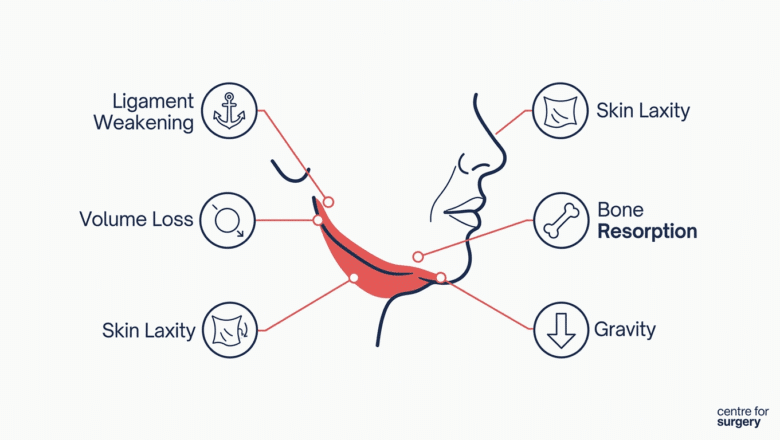
Several distinct anatomical changes combine to produce jowls, and understanding which is dominant in your case is the single biggest factor in choosing the right treatment.
Ligament weakening. The retaining ligaments that anchor facial soft tissue in its youthful position — particularly the mandibular ligament along the jaw — progressively weaken with age, allowing tissue to slide downward over years.
Volume loss. The fat compartments of the mid-face thin as we age. The cheek, which once sat high and full, flattens and loses the upward support it used to provide. The remaining lower-face fat, no longer anchored above, accumulates along the jawline instead.
Skin laxity. Declining collagen and elastin production leaves skin less able to retract and fit the tissue beneath it. Loose skin both looks sagging and mechanically allows further tissue descent over time.
Skeletal resorption. The jawbone itself gradually loses density and volume with age — a process called bone resorption — reducing the bony framework that skin and fat previously rested on. The jawline becomes measurably less defined as this happens, independent of skin changes.
Gravity and weakening facial muscles. As the platysma and other lower-face muscles lose tone, gravity has progressively less resistance, and soft tissue continues to migrate downward.
Genetics. Some people are simply predisposed to earlier or more pronounced jowling based on inherited facial structure and skin quality — the same genetic factors that determine skin type generally.
Lifestyle factors. Sun exposure, smoking, excessive alcohol consumption, chronic stress, poor sleep, and rapid or repeated weight fluctuation all accelerate the underlying processes above, independent of chronological age.
Can Jowls Develop in Your 20s?
Yes, though jowls in 20s cases are less common and usually have a different underlying cause than jowls appearing in your 40s or 50s. Early jowling in younger patients is more often driven by genetics (an inherited facial structure with less lower-face support), significant weight loss leaving deflated fat compartments, or — less commonly — early skin laxity from sun exposure or smoking. True age-related bone resorption and ligament weakening are rarely the dominant factor this early. If jowling appears in your 20s or early 30s, it’s worth a proper assessment rather than assuming it’s simply “early ageing” — the cause changes which treatment actually addresses it, and volume-restoring options like filler or fat transfer are often more appropriate than skin-tightening treatments at this stage.
How Do I Know If I Need Non-Surgical or Surgical Treatment?
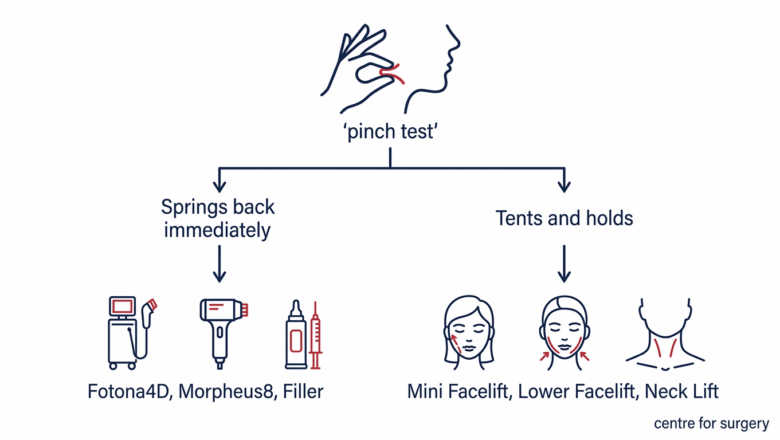
A simple, genuinely useful self-test: pinch the loose skin near your jawline gently between two fingers. If it springs back into place immediately when released, non-surgical treatment can likely produce meaningful improvement. If it tents up and holds that shape for a moment before slowly settling, that indicates significant skin laxity that non-surgical treatment cannot fully correct — surgical excision is generally needed for a comprehensive result.
Beyond the pinch test, a few other signals point toward surgery being the more appropriate route:
- Jowls visible from the front, not just in profile — indicating substantial lower-face descent
- Diminishing returns from previous non-surgical treatment, where each round produces less improvement than the last
- Multiple concurrent concerns — jowls alongside neck banding, deep marionette lines, and volume loss — which are more efficiently addressed together surgically than through extensive non-surgical work
- A desire for a single definitive result rather than an ongoing maintenance schedule
Conversely, non-surgical treatment tends to suit patients with mild to moderate jowling, reasonable skin elasticity, volume loss as a significant contributing factor, and a preference for gradual, lower-downtime improvement they’re willing to maintain periodically.
The Complete Treatment Landscape
Jowls can be treated non-surgically, surgically, or with a combination approach — the right choice depends on the causes and severity assessed above. Here’s the full landscape, with our in-depth guides linked for complete detail on each route.
Non-Surgical Options
For mild to moderate jowling, several non-surgical treatments produce genuine, measurable improvement:
- Fotona4D laser facelift — collagen stimulation and immediate skin tightening via dual-wavelength laser, including an intra-oral pass
- Morpheus8 radiofrequency microneedling — deeper collagen remodelling with some fat reduction at deeper settings; see our guide to how RF skin tightening works for how the radiofrequency options compare
- FaceTite — radiofrequency-assisted lipolysis for more pronounced tightening with a single session
- Dermal filler — restoring cheek volume to create an upward anchor, indirectly reducing jowl appearance
- Profhilo and polynucleotides — bioremodelling for overall skin quality alongside other treatments
For the complete breakdown — what each treatment involves, realistic timelines, cost, and who genuinely suits each — see our full guide: The Best Non-Surgical Treatments for Jowls.
Surgical Options
For significant jowling with substantial skin laxity, surgery remains the only route to a comprehensive, long-lasting correction:
- Mini facelift — targeted correction of the jawline and jowls with smaller incisions, for mild to moderate cases with reasonable skin elasticity
- Lower facelift — more extensive correction of the jawline, jowls, chin, and marionette lines for moderate to significant descent
- SMAS facelift or deep plane facelift — the most comprehensive correction for pronounced jowling combined with other facial ageing
- Neck lift — frequently combined with facelift where neck banding and jowls appear together
- Chin and neck liposuction — for younger patients with mild jowling driven primarily by localised fat rather than skin laxity
For the full detail on incision technique, recovery, and how these options compare — see our complete guide: Lower Facelift and Jowl Lift Surgery.
Can You Get Rid of Jowls with Exercise?
Exercise is genuinely valuable for overall health, but its direct effect on jowls is limited. General exercise improves muscle tone and reduces body fat, but it doesn’t address the primary drivers of jowl formation — skin laxity, bone resorption, ligament weakening, and gravity. Some specific facial exercises may offer subtle, temporary improvement in facial muscle tone, but the evidence for meaningful, lasting change is weak. For genuine improvement, combining sensible lifestyle habits with an appropriately chosen non-surgical or surgical treatment remains the more reliable path.
How to Prevent Jowls From Worsening
You can’t prevent the underlying ageing process, but several habits measurably slow how quickly jowls progress:
- Daily broad-spectrum sunscreen — UV exposure is one of the most significant accelerants of collagen breakdown
- Not smoking — smoking directly reduces collagen production and accelerates skin ageing
- Maintaining a stable weight — repeated weight fluctuation stretches and deflates facial tissue over time
- Staying hydrated and following a balanced, antioxidant-rich diet
- A consistent skincare routine including retinoids, which have genuine evidence behind them for collagen support
- Managing chronic stress and prioritising sleep quality
What Results Look Like
Outcomes vary so much by cause, severity, and chosen treatment that the most useful way to set expectations is by reviewing saggy jowls before and after results rather than relying on descriptions alone. Our before and after gallery includes results specifically from patients treated for jowls and jawline sagging, alongside the wider facelift portfolio. Non-surgical before and after photos typically show subtler, more gradual change across a treatment course, while surgical before and after photos show the more dramatic, immediate repositioning of tissue that non-surgical options can’t fully replicate. Reviewing both types side by side is often the clearest way to understand which category of result you’re actually looking for.
What Does Jowl Treatment Cost?
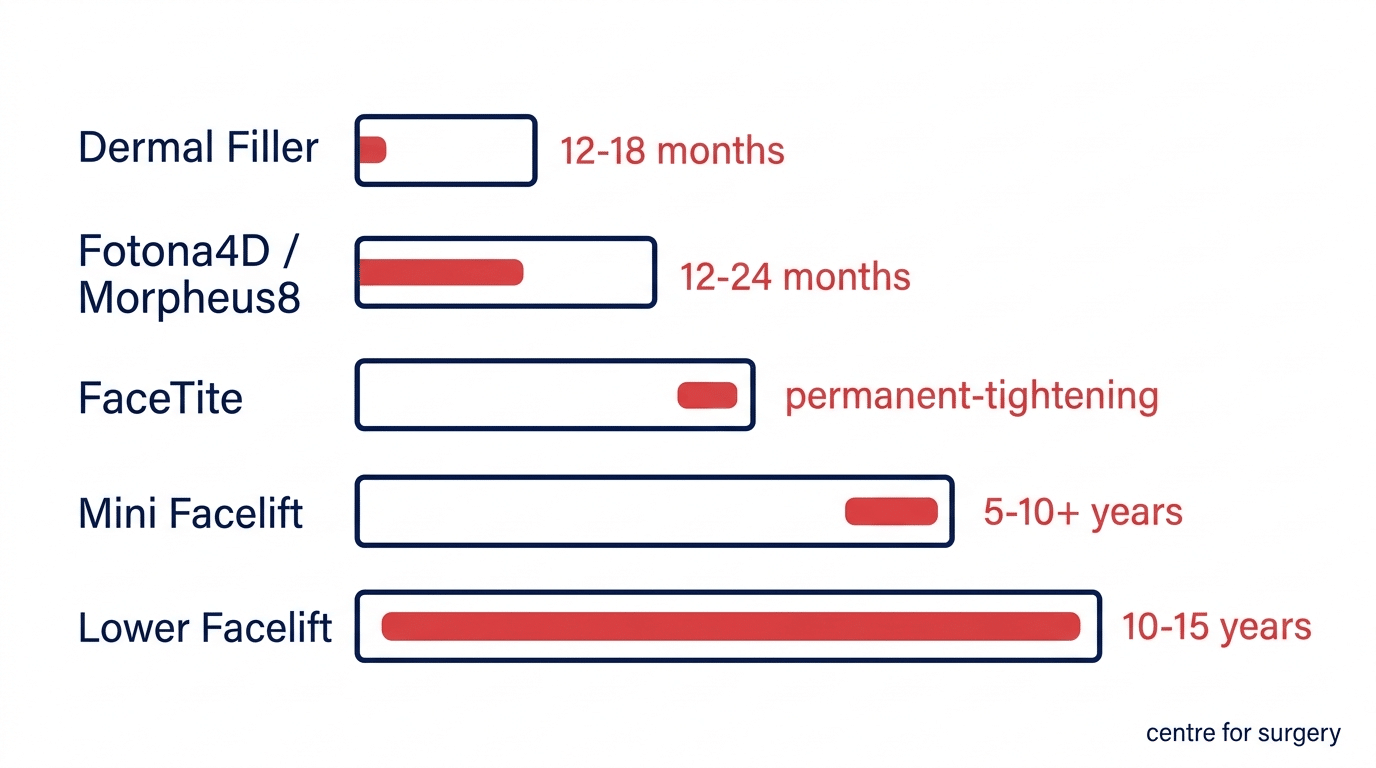
Costs vary substantially between non-surgical and surgical routes, and within each category depending on the specific treatment and how many sessions or areas are involved.
- Non-surgical treatments typically range depending on the technology, with most patients needing a course of 2–4 sessions and annual maintenance thereafter — see our non-surgical guide for a full cost breakdown by treatment.
- Mini facelift is a single procedure, priced after an in-person consultation, with results lasting 5–10+ years depending on technique.
- Lower facelift and full facelift surgery costs are always customised following an in-person consultation, reflecting surgical complexity, anaesthetic fees, and aftercare — see our surgical guide for full detail.
Prices for these treatments are on our Skin & Aesthetics price list.
Finance is available through Chrysalis Finance, subject to status.
Expert Insight
“The mistake I see most often isn’t choosing the wrong treatment category — it’s skipping the step of working out what’s actually driving the jowling in the first place. A 32-year-old with volume loss from significant weight loss and a 58-year-old with genuine skin laxity and bone resorption can both describe their concern as ‘jowls’, but they need completely different treatments. The pinch test is a good starting point, but a proper consultation looking at the whole face — cheek volume, skin quality, bone structure — is what actually gets the treatment plan right the first time.” — Dr Spyridon Vlachos, Specialist Plastic Surgeon (GMC: 7522950)
Frequently Asked Questions: Sagging Jowls
What Is the Best Treatment for Sagging Jowls?
There isn’t a single universal answer — it depends on severity and cause. For mild to moderate jowling with reasonable skin elasticity, a combination of energy-based treatment (Fotona4D or Morpheus8) and cheek filler often produces meaningful improvement. For significant jowling with substantial skin laxity, a mini facelift or lower facelift delivers the most comprehensive and lasting result. The pinch test above is a useful starting point for working out which category applies to you.
What Causes Jowls to Sag?
A combination of ligament weakening, mid-face volume loss, skin laxity from declining collagen and elastin, bone resorption in the jaw, and gravity acting on weakening facial muscles. Genetics and lifestyle factors like sun exposure and smoking influence how early and how quickly these changes appear.
How Can I Tighten My Jawline Without Surgery?
Non-surgical jawline tightening relies primarily on energy-based treatments (Fotona4D, Morpheus8, FaceTite) that stimulate collagen production and contract existing collagen, plus dermal filler to restore supportive volume where needed. These provide genuine, measurable tightening for mild to moderate cases, though results are temporary and require maintenance, unlike surgical correction.
Why Is My Jaw Sagging Even Though I’m Not Overweight?
A sagging jaw or jawline isn’t primarily about body weight — it’s driven by skin elasticity, bone structure changes, and soft tissue support, all of which can occur regardless of your weight. In fact, significant weight loss can sometimes worsen the appearance of jowls by leaving deflated fat compartments with less support than before.
Can Jowls Come Back After Treatment?
Non-surgical treatments require ongoing maintenance because they don’t stop the underlying ageing process — expect to repeat treatment roughly annually to sustain results. Surgical correction (facelift, mini facelift) removes and repositions tissue permanently, but the ageing process continues afterward in untreated areas and the tissue that remains, meaning jowls can very gradually reappear over many years, though typically far more subtly than before treatment.
Is a Sagging Chin Line the Same as Jowls?
They’re closely related but not identical. Jowls specifically refer to the sagging tissue along the sides of the jawline, while a sagging chin line more broadly describes the loss of definition along the entire lower face and jaw contour, which jowls contribute to significantly. Treatment approaches overlap substantially between the two.
What’s the Fastest Way to Reduce Jowls?
If speed matters more than permanence, dermal filler and FaceTite both produce visible improvement within days to a few weeks. If you’re asking how to reduce jowls with the most complete and lasting result rather than the fastest one, surgical correction is the more honest answer — it simply takes longer to plan and recover from. There’s a genuine trade-off between speed and permanence across every option in this guide, and it’s worth being clear with yourself about which matters more before choosing a treatment.
Does Losing Weight Help or Worsen Jowls?
It can go either way depending on how much weight and how quickly. Modest, gradual weight loss combined with good skin elasticity can slightly improve jawline definition by reducing fat volume. Significant or rapid weight loss, however, frequently worsens the appearance of jowls, because it removes volume faster than skin can retract to match — leaving looser, more deflated-looking tissue than before. This is a common reason jowls appear more suddenly after major weight loss than gradual ageing alone would explain.
Sagging Jowls at Centre for Surgery
At Centre for Surgery, we assess every patient’s jowls individually rather than defaulting to a standard treatment — because as covered above, two patients with visually similar jowling can have very different underlying causes that call for different solutions. Our consultation process looks at skin quality, volume distribution, bone structure, and your goals before recommending a non-surgical, surgical, or combination approach.
Contact Details for Booking a Consultation:
- Phone: 020 7993 4849
- Email: contact@centreforsurgery.com
- Clinic Address: 95-97 Baker Street, London W1U 6RN
We offer Finance Options with Chrysalis Finance to make treatment more accessible.