


In this guide8 sections
- What Does “Breast Implant Bottoming Out” Mean?
- Normal Settling vs Bottoming Out: What’s the Difference?
- Why Does Bottoming Out Happen?
- Bottoming Out vs Breast Sagging: Key Differences
- Can Breast Implant Bottoming Out Be Corrected?
- Techniques Used to Correct and Prevent Bottoming Out
- Frequently Asked Questions
- Bottoming Out Correction at Centre for Surgery
Breast implant “bottoming out” describes an implant that has migrated downward, below its intended position relative to the natural breast fold — changing the overall shape of the breast rather than causing the surface rippling seen with other implant concerns. It’s a genuine complication rather than simply normal settling, and telling the two apart correctly matters, since one resolves on its own and the other doesn’t. This guide explains exactly what bottoming out is, how it differs from normal implant settling and from breast sagging, what causes it, and how it’s corrected.
What Does “Breast Implant Bottoming Out” Mean?
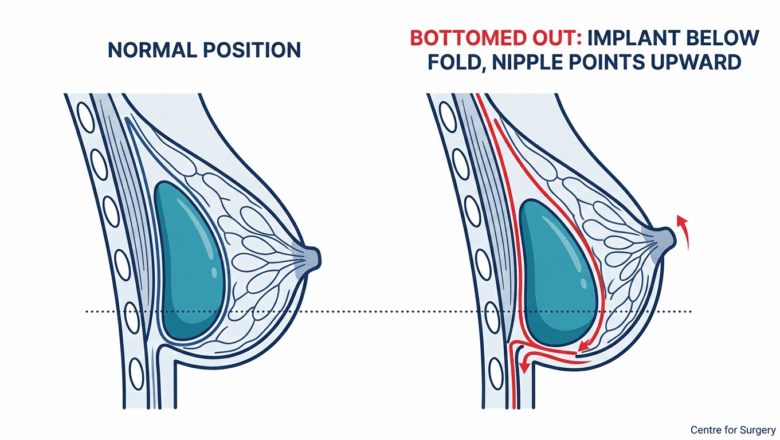
Bottoming out is the displacement of a breast implant downward, causing it to shift below the natural inframammary fold (the crease beneath the breast) and protrude excessively in the lower part of the breast. You can usually identify it by an uneven distribution of volume — the lower pole of the breast looks longer or fuller than the upper pole, giving an unbalanced, bottom-heavy appearance rather than the proportionate shape the surgery was intended to achieve. As the implant descends, the nipple often ends up pointing upward rather than forward, since the surrounding tissue has shifted downward around it while the nipple position hasn’t moved to match. If you notice these changes developing after augmentation, it’s worth having it properly assessed by a plastic surgeon rather than waiting to see if it resolves on its own — it won’t.
Normal Settling vs Bottoming Out: What’s the Difference?
It’s important to understand that breast implants do change shape and position somewhat in the months after surgery — this is completely normal, and confusing it with bottoming out causes unnecessary worry for a lot of patients.
Normal settling happens over the first few months after surgery, sometimes called “drop and fluff.” Implants often sit higher and more swollen immediately after surgery, then gradually settle into their intended, more natural final position as swelling resolves and tissue relaxes. Surgeons frequently plan for this by positioning implants slightly higher initially, specifically so they settle into the right place rather than drooping too low.
Bottoming out is different — it’s not a settling process reaching its natural conclusion, but a genuine failure of the lower pocket to hold the implant in its intended position, usually driven by skin and tissue that can’t adequately support the implant’s weight over time. Where normal settling stabilises within a few months, bottoming out tends to continue progressing if left untreated.
Why Does Bottoming Out Happen?
A few overlapping factors typically contribute:
Skin and Tissue Elasticity
Where the skin lacks sufficient elasticity or strength to support the size of implant chosen, the lower breast pocket can gradually stretch beyond its intended limits, allowing the implant to migrate downward.
Pre-Existing Ptosis (Sagging)
If there was already some degree of drooping or nipple-position change before surgery, adding an implant without also addressing that sagging — typically with a combined lift and augmentation — increases the risk of the implant settling too low afterward.
Pocket Placement
The size, shape, and position of the surgical pocket created for the implant has a direct bearing on risk. If the pocket is made too large, positioned too low, or the implant isn’t adequately supported at the base, it has room to migrate downward over time.
Implant Size Relative to Frame
Choosing an implant that’s disproportionately large for your natural tissue and skin envelope places more ongoing downward stress on the lower pole than the tissue is built to bear indefinitely.
The warning signs to watch for include a stretched distance between the nipple and the breast fold, downward bulging of the lower breast, and the nipple appearing to point upward rather than forward. Self-assessment has real limits here, since other factors can produce similar-looking changes — a proper review by your surgeon is the reliable way to confirm what’s actually happening.
Bottoming Out vs Breast Sagging: Key Differences
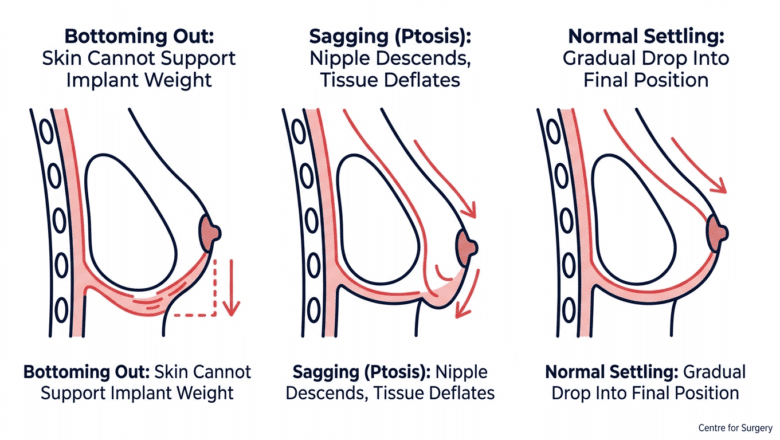
These two are often confused, but the underlying mechanism — and the fix — is different for each. Breast sagging (ptosis) is caused by a loss of skin elasticity and supportive tissue, independent of any implant — the breast appears to droop or deflate, and the nipple typically points downward. Bottoming out is specifically about the skin and pocket being unable to support the weight and position of an implant — there’s an imbalance between upper and lower pole volume, with the lower breast bulging downward, and the nipple often points upward rather than down, which is a genuinely useful distinguishing sign. In practice, bottoming out usually means the original implant size exceeded what the patient’s skin could support long-term — a smaller implant, a breast lift, or both together, would often have given a more durable result from the outset.
Can Breast Implant Bottoming Out Be Corrected?
Yes — bottoming out is corrected with revision surgery, typically combining implant exchange with mastopexy (breast lift) techniques to reposition the breast tissue and nipple correctly, and to rebuild a stable pocket that will actually hold the implant in place this time. In some cases this is done in a single procedure; in others, particularly where the tissue needs time to recover, your surgeon may recommend a staged approach — removing the implant, allowing the pocket to heal, and reinserting a new implant with additional support once the tissue has settled. Reducing the implant size at revision is often part of the solution, since a lighter implant places less ongoing strain on the repaired pocket. Where skin elasticity is significantly compromised, a breast lift — with or without implants — may give a more durable long-term result than implants alone.
Techniques Used to Correct and Prevent Bottoming Out
A combination of surgical techniques is typically used, tailored to the individual case:
- Internal bra techniques — using acellular dermal matrix (ADM) or supportive suturing to reinforce the lower pocket and hold the implant in its corrected position. Our guide to the internal bra technique covers this in detail.
- Anchoring sutures — securing the deep connective tissue of the breast to the chest wall, creating a stable barrier while the pocket heals and reducing the chance of the implant migrating downward again.
- Implant downsizing — choosing a smaller, more proportionate implant reduces ongoing stress on the repaired tissue.
- Placement change — moving the implant to a submuscular position, where appropriate, can offer additional structural support compared to subglandular placement.
Which combination is right for you depends on the extent of the bottoming out, your original implant size and placement, and the quality of your remaining skin and tissue — all assessed properly at consultation rather than guessed at from photos.
Frequently Asked Questions
How do I know if my implant is bottoming out or just settling normally?
Normal settling stabilises within a few months and doesn’t continue to worsen. Bottoming out tends to progress over time if untreated, and is usually accompanied by the nipple pointing upward and a stretched distance between the nipple and the breast fold. If you’re unsure, a consultation is the reliable way to tell the difference.
Can bottoming out fix itself without surgery?
No. Once the lower pocket has stretched and the implant has migrated downward, it doesn’t return to its correct position on its own. Supportive bras may offer some comfort but don’t correct the underlying issue.
Is bottoming out the same as breast sagging?
No — sagging is a loss of tissue elasticity affecting the breast independent of any implant, with the nipple typically pointing downward. Bottoming out is specifically the implant migrating below its intended position, usually with the nipple pointing upward as a result.
How soon after augmentation can bottoming out occur?
It can develop at any point, though it’s more commonly noticed in the months to a few years after the original surgery, as the pocket gradually stretches under the ongoing weight of the implant.
Will a smaller implant reduce my risk of bottoming out at revision surgery?
Often, yes — a lighter, more proportionate implant places less ongoing stress on the repaired pocket, which is why downsizing is frequently part of the corrective plan alongside pocket repair techniques.
Does bottoming out affect breastfeeding ability?
Bottoming out itself doesn’t typically affect the milk-producing glandular tissue, though any revision surgery involving incision changes is worth discussing with your surgeon if future breastfeeding is a priority for you.
Bottoming Out Correction at Centre for Surgery
At Centre for Surgery, breast implant revision surgery for bottoming out is performed by GMC-registered plastic surgeons, at our CQC-regulated Baker Street facility, rated Good overall, under TIVA (Total Intravenous Anaesthesia). Our medical content is reviewed by Specialist Plastic Surgeon Dr Spyridon Vlachos (GMC 7522950).
Bottoming out sits within our broader guide to common breast implant problems, alongside rippling, rupture, and symmastia. Read verified patient reviews on Google ↗ or on our own patient reviews page. We offer flexible finance options through Chrysalis Finance, for procedures over £1,500.
To book a consultation, call 020 7993 4849 or complete the contact form below.







