


In this guide12 sections
- Understanding En Bloc Capsulectomy
- What Is Capsulectomy?
- What Is an En Bloc Capsulectomy?
- Am I a Suitable Candidate for En Bloc Capsulectomy?
- Capsulectomy vs En Bloc Capsulectomy — What’s the Difference?
- Capsulectomy for Capsular Contracture
- Other Reasons for Breast Implant Removal
- What Does Recovery Involve?
- What Are the Risks of En Bloc Capsulectomy?
- What Results Can I Expect?
- Choosing a Surgeon for Capsulectomy Surgery
- En Bloc Capsulectomy at Centre for Surgery
Understanding En Bloc Capsulectomy
If you’re considering breast implant removal and trying to work out whether an en bloc capsulectomy is the right approach, this guide covers what the procedure actually involves, who’s a suitable candidate, how it differs from other capsule removal techniques, and what recovery looks like.
Breast implant surgery, like any surgical procedure, carries a small risk of complications. Most patients never experience problems, but issues such as implant rupture, capsular contracture, breast pain, or symptoms associated with Breast Implant Illness (BII) or BIA-ALCL do occasionally arise, and some patients decide implant removal — with or without replacement — is the right path forward. Understanding the available techniques helps you have a more informed conversation with your surgeon about what’s appropriate for your specific situation.
What Is Capsulectomy?
Capsulectomy is the surgical term for removing a breast implant along with the scar tissue capsule that forms around it. Every breast implant develops a capsule — this is a normal biological response, not a complication in itself. The body treats the implant as a foreign object and forms a thin layer of fibrous tissue around it. In most patients this capsule stays soft and causes no problems. In others, it thickens, hardens, or becomes symptomatic, at which point removing some or all of it may be recommended.
There are two main approaches:
Partial capsulectomy (sometimes called capsulotomy) involves surgically loosening and removing only part of the scar tissue capsule. This is typically the approach chosen for patients experiencing discomfort or aesthetic changes caused by capsular contracture, where the capsule has tightened and is squeezing the implant. By removing the affected sections, the surgeon relieves the pressure and softens the resulting shape. Implant replacement can be carried out at the same time, but it isn’t a mandatory part of the procedure.
Total capsulectomy removes the entire capsule, usually in sections rather than as one piece. If implant replacement is planned, your surgeon may recommend a different implant type or a change in placement, aimed at reducing your future risk of capsular contracture or other complications.
Both approaches share the same underlying goal: resolving discomfort and restoring a natural breast appearance while prioritising your safety throughout.
What Is an En Bloc Capsulectomy?
“En bloc” is a French term meaning “all together” or “as one piece.” In breast surgery, an en bloc capsulectomy is a technique where the implant and its surrounding capsule are removed as a single, intact unit — without opening or rupturing the capsule at any point during the procedure. The purpose is to prevent any material inside the capsule from being released into the surrounding tissue during removal.
This is a genuinely more complex and demanding operation than a standard capsulectomy, for both surgeon and patient. The capsule itself is often less than a millimetre thick and can tear easily, so removing it whole requires a larger incision than a typical implant insertion or straightforward removal, along with considerable surgical precision. Post-operatively, patients can expect more discomfort, swelling, and occasional bleeding than with a partial capsulectomy — surgeons often place temporary drains to manage fluid build-up during early healing.
Am I a Suitable Candidate for En Bloc Capsulectomy?
Not every patient seeking implant removal is a good candidate for the en bloc technique specifically. A few factors affect whether it’s achievable:
- Capsule fragility — in some patients the capsule has become so thin or delicate that removing it in one intact piece isn’t realistically possible, regardless of surgical skill.
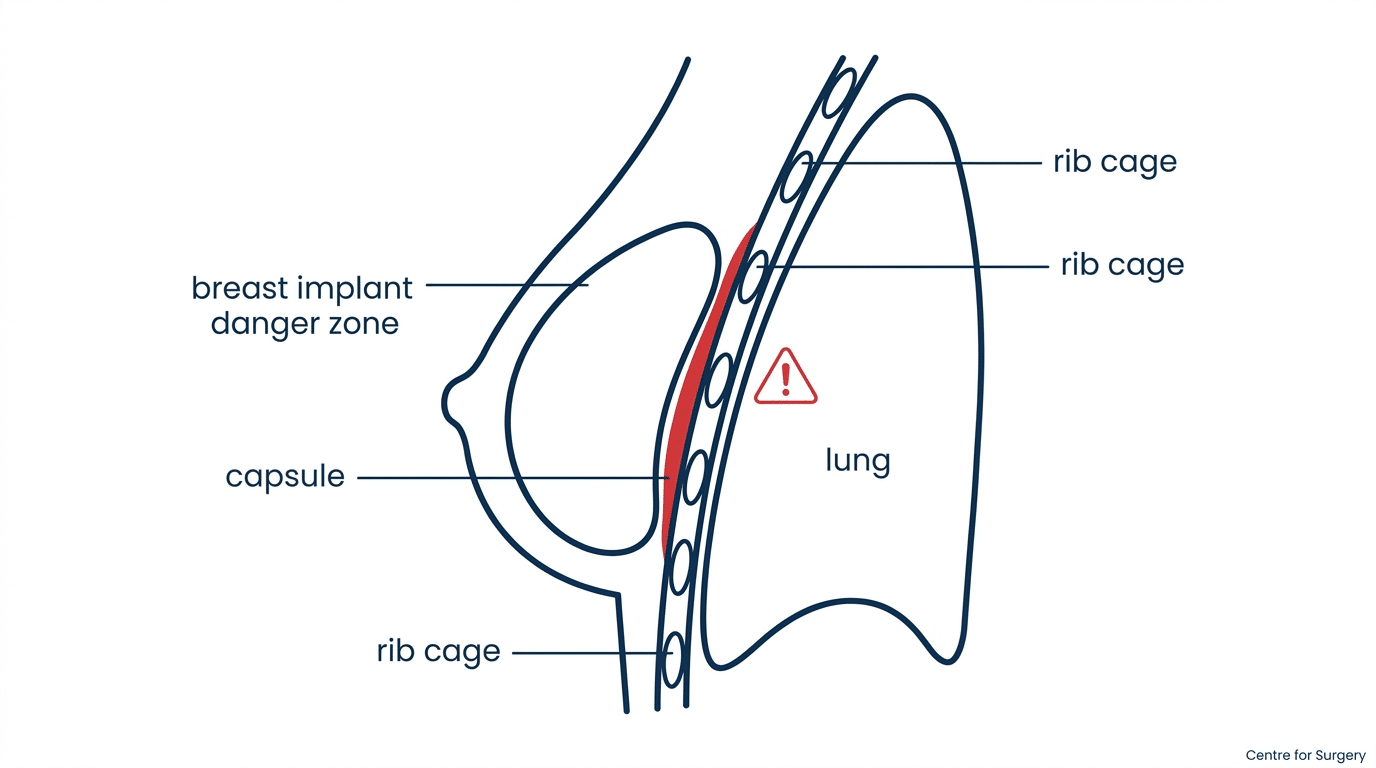
- Proximity to the rib cage — where the capsule sits close to the chest wall, deeper dissection carries a real risk of puncturing the lung cavity (pneumothorax), which increases both surgical risk and post-operative pain.
Important: because the implant capsule can lie near the ribs and lung, capsule dissection near the chest wall carries a genuine risk of pneumothorax if not approached carefully. This is one of the main reasons an experienced, specialist plastic surgeon — rather than a general or less experienced practitioner — matters so much for this specific procedure. These anatomical variables mean surgeons are generally cautious about guaranteeing an en bloc result before surgery even begins; the final decision is often confirmed intraoperatively once your surgeon can directly assess the capsule.
Beyond technique-specific factors, standard surgical fitness criteria apply. The procedure isn’t generally suitable for patients with untreated breast cancer, active infection, or who are pregnant or breastfeeding. It’s also important to flag any bleeding disorders, a compromised immune system, relevant previous surgeries, or chronic illnesses at consultation, as these all factor into your surgical plan.
To properly assess your suitability, your surgeon may request several investigations, which can include a full blood count (FBC), pregnancy test, chest X-ray, ECG, breast ultrasound, MRI, and — in some cases — a mammogram. These give your surgical team a complete picture of your health and help shape a safe, appropriately tailored surgical plan.
Capsulectomy vs En Bloc Capsulectomy — What’s the Difference?
These two terms are often used interchangeably online, but they describe meaningfully different procedures.
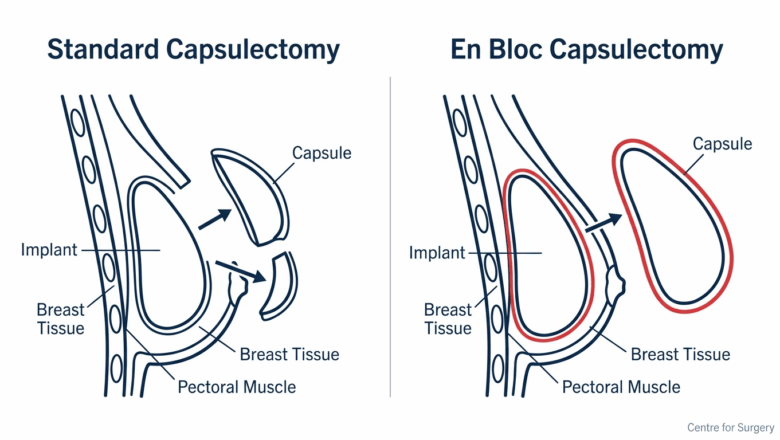
Capsulectomy is the broader term, covering both partial and total removal of the capsule. In a standard capsulectomy, the surgeon removes the capsule in sections or pieces rather than as a single unit.
En bloc capsulectomy specifically means removing the implant and the entire capsule together, intact, without cutting into it. This is considered a more invasive approach than a standard capsulectomy — it requires a larger incision and a more technically demanding dissection.
Despite its popularity online — and the number of surgeons who describe themselves as en bloc specialists — the technique itself doesn’t automatically produce a superior outcome to a well-performed partial or total capsulectomy. Most surgeons default to a standard capsulectomy where clinically appropriate, reserving en bloc removal for situations where it offers a genuine clinical advantage: implant rupture, or documented BIA-ALCL, where minimising handling of the capsule’s contents reduces the risk of spreading affected material. The right choice depends entirely on your specific circumstances, and your surgeon’s assessment at consultation.
Capsulectomy for Capsular Contracture
Capsular contracture is one of the most common reasons patients consider capsulectomy. It happens when the body’s normal capsule-forming response goes further than usual — the tissue thickens, hardens, and tightens around the implant, sometimes causing visible distortion, firmness, and pain. It can develop shortly after surgery or, in some cases, years later. Many patients never experience it at all, particularly when recommended precautions are followed at the time of the original surgery.

Capsular contracture is classified into four grades:
- Grade 1 — the breast looks natural and feels soft.
- Grade 2 — the breast looks natural but feels slightly firm.
- Grade 3 — the breast appears visibly distorted and feels firm to the touch.
- Grade 4 — the breast appears distorted, feels hard, and is often painful.
Grades 3 and 4 are the ones most likely to prompt a capsulectomy, whether partial or total, often combined with implant replacement if the patient wishes to continue with implants afterwards.
Other Reasons for Breast Implant Removal
Capsular contracture is far from the only reason patients pursue capsulectomy or implant removal. Other common indications include:
Silicone gel implant rupture — a tear in the outer shell of a silicone implant, allowing gel to migrate into surrounding tissue. This is one of the clearer indications for surgical intervention, since the ruptured implant itself needs to be removed regardless of whether replacement is planned. Modern cohesive gel tends to stay largely contained within the capsule even when a rupture occurs, which is one reason en bloc removal is often specifically recommended in this scenario.
Capsule infection — uncommon, but persistent or recurrent infection around the implant capsule can necessitate removal to properly resolve it, sometimes alongside a course of antibiotics before or after surgery.
Implant extrusion — a rare complication where the implant begins to protrude through the skin, usually related to tissue healing or positioning issues, and requires prompt surgical correction.
BIA-ALCL — Breast Implant-Associated Anaplastic Large Cell Lymphoma is a rare lymphoma that can develop in the scar capsule around certain implants. It is not breast cancer, and while rare, patients diagnosed with it require surgical removal of the implant and capsule as part of treatment. Where BIA-ALCL is suspected or confirmed, an en bloc approach is often specifically preferred, since it limits the handling and potential spread of capsule contents during removal, and the removed tissue is typically sent for pathology testing to confirm diagnosis and guide any further treatment.
Breast Implant Illness (BII) — a wide-ranging set of symptoms some patients attribute to their implants, including fatigue, joint pain, and other systemic complaints. The underlying causes of BII remain incompletely understood, and it isn’t a formally defined medical diagnosis in the way BIA-ALCL is — but some patients who experience these symptoms choose implant removal, and many report feeling better afterwards. If BII symptoms are your reason for considering removal, it’s worth discussing your expectations openly with your surgeon, since outcomes here vary between patients and the evidence base is still developing.
What Does Recovery Involve?
Recovery from en bloc capsulectomy tends to be somewhat more involved than recovery from breast augmentation alone, reflecting the more extensive dissection required.
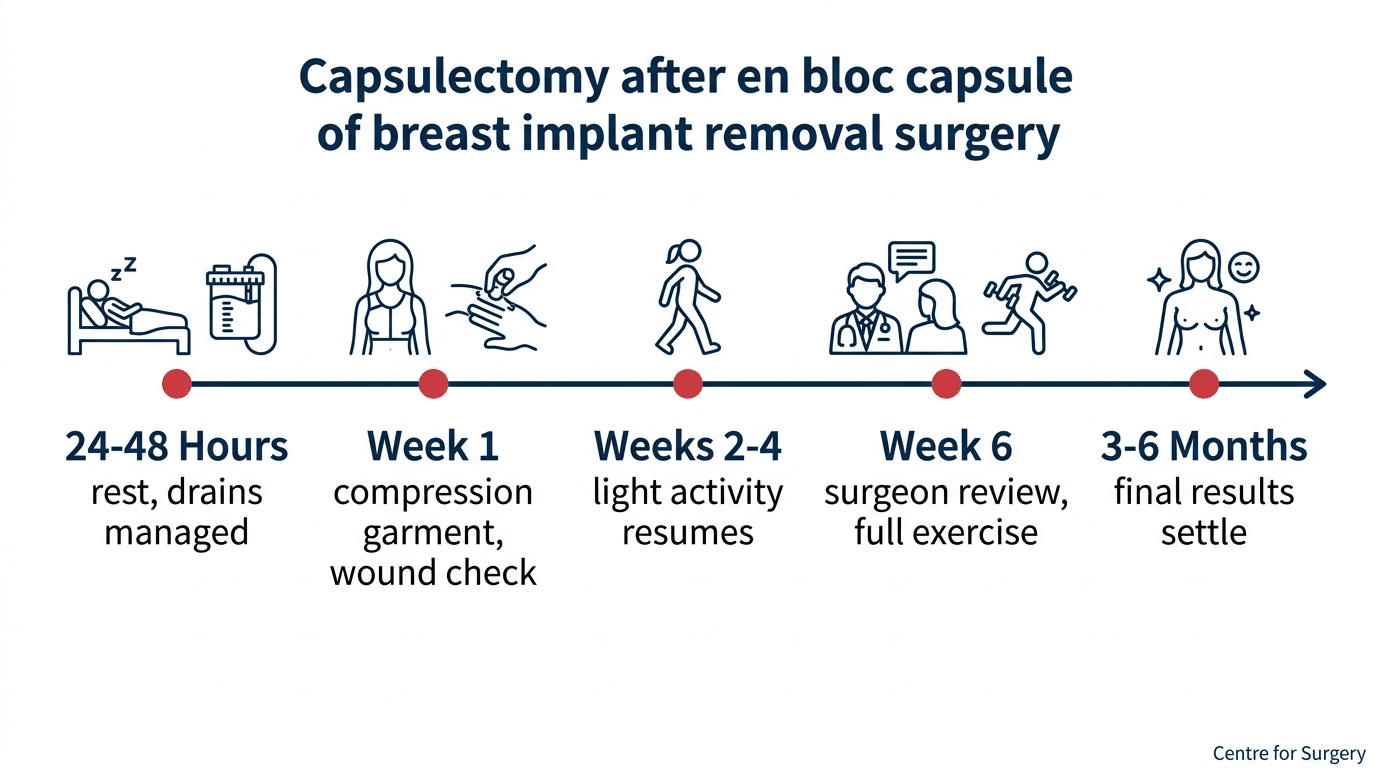
First 24–48 hours: expect swelling, bruising, and some discomfort, typically manageable with prescribed pain relief. If drains have been placed, your nursing team will show you how to manage them before you go home, and will remove them at a follow-up appointment once drainage has reduced sufficiently — usually within the first few days.
First week: rest is the priority. You’ll wear a supportive compression garment to help control swelling and support the healing tissue. Avoid lifting your arms above shoulder height and any strenuous activity. A wound check with our nursing team is typically arranged within this window.
Weeks 2–4: most patients feel significantly more comfortable by this point and can return to light daily activities and desk-based work, though heavier lifting and upper-body exercise should still be avoided. Bruising and swelling continue to settle gradually.
Week 6 and beyond: your surgeon will review your healing at this stage and confirm when you can return to full exercise. If implants weren’t replaced, you’ll begin to see how your breasts settle into their new shape — this can continue changing for several months as swelling fully resolves and tissue adapts to the change in volume.
Longer term: final results, particularly around symmetry and shape, are usually apparent by three to six months post-surgery. Scars continue to fade over the following year.
What Are the Risks of En Bloc Capsulectomy?
As with any surgical procedure, en bloc capsulectomy carries risks that should be discussed thoroughly with your surgeon before proceeding:
- Pneumothorax, where capsule tissue lies close to the chest wall
- Bleeding or haematoma, particularly given the more extensive dissection involved
- Seroma (fluid collection), which drains help to minimise during early recovery
- Infection
- Changes in breast shape, size, or symmetry, particularly where significant tissue has been removed
- Skin laxity or an “empty” appearance if implants are removed without replacement, especially in patients with larger implants or significant skin stretch
- Standard anaesthetic risks associated with TIVA
- The possibility that a fully intact en bloc removal isn’t achievable once the surgeon can directly assess the capsule, requiring a shift to standard capsulectomy during the operation itself
Your surgeon will talk through which of these are most relevant to your specific case at consultation, based on your implant history, capsule condition, and overall health.
What Results Can I Expect?
It’s natural to wonder how your breasts will look after en bloc capsulectomy. There’s no single, universal answer — the outcome depends on your implant size, the degree of breast tissue displacement that’s occurred over time, your skin elasticity, and whether you choose to have implants replaced or removed entirely.
Choosing an experienced specialist plastic surgeon is one of the most important factors in achieving a natural-looking result. You should expect new scarring from the procedure, and it’s worth having a thorough discussion with your surgeon about realistic expectations before deciding to proceed. If implants are being removed without replacement, some patients choose to combine capsulectomy with a breast lift to address any skin laxity left behind — this is worth raising at consultation if it’s a concern for you. At consultation, we can show you before-and-after photographs from patients who’ve had en bloc capsulectomy — both with and without implant replacement or a breast lift — to help you form a more concrete picture of what’s achievable in cases similar to your own.
Choosing a Surgeon for Capsulectomy Surgery
Given the technical demands of en bloc capsulectomy in particular — the thin, delicate capsule tissue, and the proximity of some capsules to the rib cage and lung — surgeon experience matters more here than in many other breast procedures. When researching a surgeon, it’s worth:
- Confirming genuine, specific experience in implant removal and capsulectomy procedures, not just breast augmentation
- Checking their credentials — specifically GMC Specialist Register registration in plastic surgery
- Asking to see relevant before-and-after photographs at consultation
- Reading independent patient reviews for a sense of real-world experience
Both en bloc and standard capsulectomy aim to resolve implant-related complications and restore comfort and confidence — the right technique for you depends on a proper assessment of your anatomy, your implants’ condition, and your goals, discussed openly with your surgeon.
En Bloc Capsulectomy at Centre for Surgery
At Centre for Surgery, en bloc capsulectomy and other implant removal procedures are performed by GMC-registered plastic surgeons, at our CQC-regulated Baker Street facility in Marylebone. Surgery is carried out under TIVA (Total Intravenous Anaesthesia) as a day case. We recommend a two-week cooling-off period between your consultation and your surgery date.
Your surgeon will assess your specific anatomy, implant history, and any relevant symptoms at consultation, and will talk you through whether en bloc removal is achievable and appropriate in your case, alongside the alternative approaches available.
Book Your Consultation
Phone: 020 7993 4849
95–97 Baker Street, Marylebone, London W1U 6RN
Contact us to schedule your consultation