


In this guide13 sections
- Key Points
- Can Botched Chin Liposuction Be Fixed?
- What Does Botched Chin Lipo Look Like?
- Why Does My Chin Look Bigger After Lipo? Swelling or a Problem?
- How Long Should You Wait Before Fixing Chin Lipo?
- Why Does Chin Liposuction Go Wrong?
- How Is Botched Chin Lipo Corrected?
- Why Is My Chin Hard After Lipo? Fibrosis and Lumps
- How to Choose a Surgeon for Chin Lipo Revision
- Risks of Chin Lipo Revision and Neck Surgery
- Frequently Asked Questions
- Chin and Neck Revision Surgery in London
- References
Key Points
- Can botched chin liposuction be corrected? In most cases the contour can be improved. What helps depends on the cause: too little fat removed, too much removed, uneven removal, loose skin, platysmal bands or scar tissue each need a different fix.
- Do not judge the result too early. Swelling, bruising and temporary firmness under the chin can last for weeks to months. Many surgeons advise waiting around six months before deciding that revision is needed, unless there is an urgent problem.
- Problems after chin lipo are not rare, but most are minor. A 2026 systematic review ↗ of 2,085 submental liposuction cases found an adverse event rate of 12.9% per procedure, mostly seromas, surface irregularities or asymmetry, and platysmal banding[1].
- Fat grafting, secondary liposuction, a neck lift or skin tightening are the main options, often combined. A neck lift is usually the answer when the problem is loose skin or platysmal bands rather than fat.
- Hard lumps are usually swelling or fibrosis that settles with time, but vigorous massage is not risk-free. Follow your own surgeon’s advice before massaging the area.
- Revision surgery is more demanding than the first operation. Choose a surgeon who performs both liposuction and neck lifts, and ask to see revision results.
If your chin or neck looks uneven, lumpy, hollow or looser than before after chin liposuction, you are not alone, and the first question is usually whether the problem is real or simply part of healing. This guide explains what a botched chin lipo can look like, how to tell it from normal swelling, how long to wait, and how surgeons correct a disappointing result, whether that means a touch-up, fat transfer or a neck lift.
It focuses on the chin and neck specifically. If your concern is liposuction elsewhere on the body, our general guide to botched liposuction and whether it can be corrected covers that, while chin liposuction recovery explains the normal healing timeline and our chin liposuction cost guide covers fees.
Can Botched Chin Liposuction Be Fixed?
Yes, in most cases the appearance can be improved, although “fixed” is a strong word and the realistic goal is a better contour rather than a flawless one. The route depends on what has gone wrong. Too much fat taken from one spot creates a hollow, which is treated by adding volume back. Too little fat removed, or fat left behind unevenly, is treated by further careful liposuction. Loose skin and visible muscle bands, which liposuction cannot tighten, are treated by tightening the neck with a neck lift.
Revision surgery is generally harder than a first operation. Scar tissue changes how the tissues move, the original fat layers have been disturbed, and the new surgeon did not see the original anatomy. A 2026 systematic review of revision neck lift surgery ↗ found only five small retrospective series covering 188 patients, with outcomes mostly judged by the surgeon rather than measured, so the evidence base for secondary neck work is sparse[6]. That is a reason to be cautious and to choose an experienced surgeon, not a reason to assume nothing can be done.
What Does Botched Chin Lipo Look Like?
“Botched” is not a medical term, and surgeons talk instead about specific problems. The most common ones after submental liposuction are:
Lumpy, wavy or irregular contour
Uneven removal of fat leaves ridges, dents or a rippled surface that is easier to see in side light or when you look down. In the 2026 systematic review, skin surface irregularities or asymmetry made up 19.1% of all reported adverse events[1].
Over-resection and a hollow under the chin
Removing too much fat, or removing it too superficially, can leave a concave, dented or “scooped” look under the jaw, sometimes with skin sticking to the tissue beneath.
Loose skin and a deflated neck
Liposuction removes fat but does not tighten skin on its own. If the skin has little elasticity, it may hang looser once the fat beneath is gone, which can make the neck look older. A series of 391 patients treated for platysmal bands noted that suture techniques do not address extensive skin laxity or excess submental fat, which is why assessment before surgery matters[5].
Visible vertical bands
Taking fat away can reveal the platysma, the thin muscle of the neck, which then shows as two vertical cords. In the systematic review, platysmal banding accounted for 18.5% of reported adverse events[1]. It is usually an anatomy problem that was already there rather than a mistake, but it needs a different operation to correct.
Asymmetry
One side may be fuller than the other, or the chin may look off-centre. Some asymmetry is normal in every face, and mild swelling can make it look worse for weeks.
Hard lumps, tightness or fibrosis
Firm, sometimes tender areas under the chin are common while tissues heal. Persistent fibrosis is less common. In a 2026 retrospective study ↗ of 435 patients having office-based ultrasound-assisted neck liposuction, fibrosis or asymmetry was reported in 3 patients (0.69%)[2].
Numbness, a weak smile or other nerve effects
The marginal mandibular nerve, which moves the corner of the lower lip, runs close to the jawline. In the same 435-patient study, four patients (0.91%) had temporary injury to this nerve and all recovered[2]. Any new weakness of the lower lip should be reported to your surgeon promptly.

Why Does My Chin Look Bigger After Lipo? Swelling or a Problem?
A chin that looks bigger, firmer or lumpier a few weeks after surgery is very often normal. Fluid collects in the treated area, bruising moves and fades, and the skin has not yet settled onto its new contour. The two things that help separate normal healing from a problem are the direction of travel and the symptoms.
- Usually normal: swelling and firmness that is slowly improving, bruising that fades from purple to yellow, tightness when you look up, mild asymmetry that varies through the day, numb patches that gradually shrink.
- Worth a call to your surgeon: a lump or swelling that is getting larger, a soft fluid-filled swelling (possible seroma), one-sided swelling with pain, redness or warmth, fever, a weak or lopsided smile, or a contour that is not improving at all.
- Emergency: rapid swelling of the neck, difficulty breathing or swallowing, or a voice change. These can signal a haematoma pressing on the airway and need urgent hospital care.
The last point is rare but real. Case reports describe large neck haematomas after submental liposuction, including one in a young woman with swallowing and breathing difficulty[4], and another in a 20-year-old man whose neck swelled suddenly a week after surgery, after vigorous manipulation and massaging of the area[3]. These are individual cases rather than rates, but they are the reason to follow your surgeon’s guidance on massage and to seek help quickly if swelling accelerates.
Our chin liposuction recovery and aftercare guide sets out the normal week-by-week picture, and how to sleep after chin liposuction covers positioning, which also affects swelling.
How Long Should You Wait Before Fixing Chin Lipo?
For a result that looks disappointing but is not worsening, the usual advice is to wait. Swelling and firmness can take months to fully resolve, and a contour that looks irregular at eight weeks may look quite different at six months. Many surgeons use around six months as a working rule before planning elective revision, although this is clinical convention rather than a figure from a trial. The systematic review found adverse events appeared a mean of 1.7 months after surgery, with a median follow-up of only 10 months, so problems may declare themselves early but may also take time to resolve[1].
Waiting does not mean doing nothing. Keep your follow-up appointments, take photographs under the same lighting every few weeks so you can judge progress honestly, and get a second opinion if something is clearly wrong. Some problems should not be left to settle: an expanding haematoma, an infection or a persistent fluid collection need prompt treatment. A scar or contour that is still unchanged after about six months is unlikely to improve much on its own, and that is the point at which most revision discussions begin.
Why Does Chin Liposuction Go Wrong?
Most disappointing results come down to a handful of causes:
- Patient selection. Liposuction treats fat. If the real problem is loose skin, platysmal bands, or a recessed chin, removing fat alone will not give a sharp jawline. Our guide to how to get rid of a double chin explains how to match the treatment to the cause.
- Technique. Taking too much from one plane, working too superficially, or using aggressive energy devices can leave dents, burns or scars. A 2026 literature review of technology-assisted liposuction found no substantial evidence that laser or ultrasound-assisted devices are superior to traditional liposuction, and noted that burns, seromas, haematomas, infections and scars were the commonest complications[8].
- Skin quality and age. Skin with less elasticity retracts less after fat is removed.
- Healing. Some people form more fibrous tissue than others, and smoking, high BMI and combining several procedures have been linked to more complications after liposuction in a five-year multicentre body liposuction study[11].
- Unrealistic expectations. A technically good result can still disappoint if the goal was a dramatic change that liposuction cannot deliver.
It helps to keep the numbers in proportion. In the 435-patient study, satisfaction was 81.6% and dissatisfaction 3.91%, with an overall complication rate of 3.45%[2]. These come from a single group of women (median age 37) treated under local anaesthetic, so they will not apply to every patient, but they show that most people are satisfied and most problems are minor.
How Is Botched Chin Lipo Corrected?
There is no single fix. A surgeon will examine the area standing and sitting, with the head in different positions, feel for fibrosis and bands, and pinch the skin to judge elasticity, then match the correction to the cause.
Fat grafting for a hollow or dent
When too much fat has been removed and the contour is depressed, surgeons can take a small amount of fat from elsewhere and inject it into the dent. Fat grafting is used to correct contour deformities in other areas, and one 2025 study looked at using fat harvested during gynaecomastia surgery to prevent contour irregularities[12]. Evidence for grafting specifically under the chin is limited, the area is delicate, and not all grafted fat survives, so smaller, staged corrections are usual and the result needs to be judged over months.
Secondary liposuction for leftover or uneven fat
If fat remains in one area or the removal was uneven, further careful liposuction can refine the contour. It is generally done after swelling has settled, using fine cannulas and a conservative approach, as scar tissue makes the planes harder to judge. Our main liposuction page explains how the technique works.
Neck lift or platysmaplasty for bands and loose skin
When the problem is skin laxity, platysmal bands or a poorly defined jaw-to-neck angle, a neck lift usually does more than another round of liposuction. A mini neck lift uses a small incision under the chin, while a full neck lift also uses incisions around the ears for more extensive laxity. Recurrent platysmal banding, persistent submental fullness and submandibular gland descent are the most frequent reasons people seek a revision neck lift[6]. A pooled analysis of 12 studies and 2,106 patients reported a band recurrence rate of 1.4%, nerve damage in 0.9% and haematoma in 1.8% after neck lift procedures involving the platysma[7], although follow-up times varied. Our guides to types of neck lift and submandibular gland reduction explain the choices, and the neck lift before and after photos show typical results.

Skin tightening for mild laxity
Energy-based devices, such as radiofrequency or laser, are sometimes used to tighten mildly loose skin without a lift. A 2026 narrative review of non-surgical neck and jawline rejuvenation describes a wide range of options, but it did not formally assess the quality of the individual studies, and it stresses careful patient selection and realistic expectations[13]. These options suit mild laxity rather than a significant contour problem. Our guide to the non-surgical neck lift sets out what each option can and cannot do.
Managing scars
Small incision scars under the chin or behind the ears are usually discreet, but if one has healed poorly, scar treatment or revision is a separate, minor step. Our liposuction scars guide covers the options.
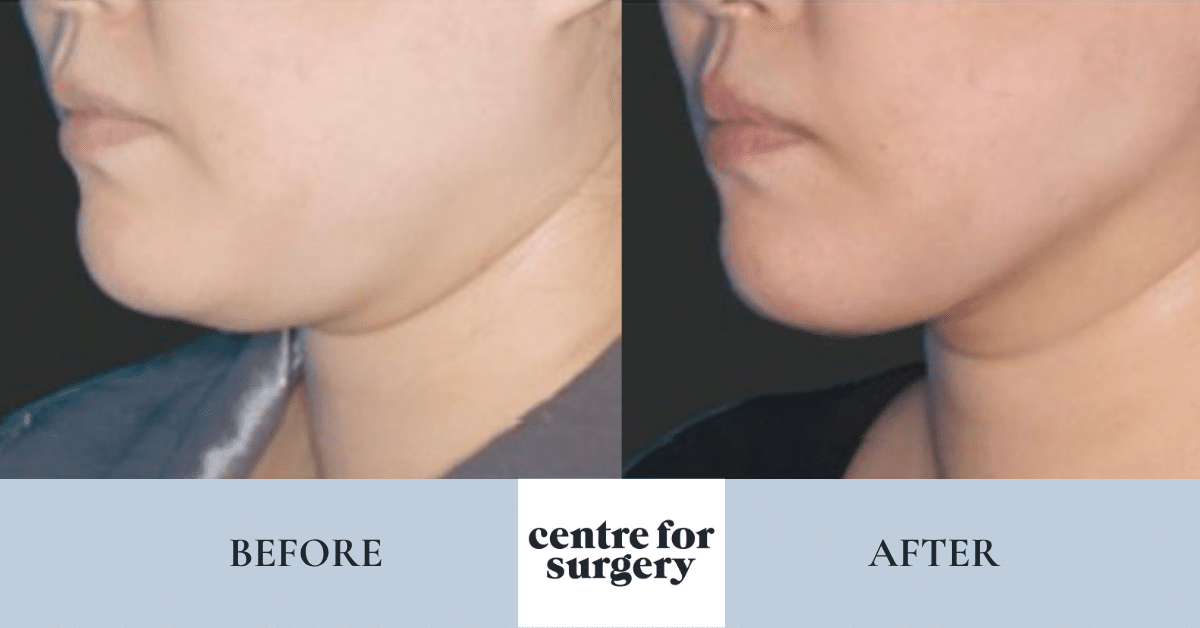
Why Is My Chin Hard After Lipo? Fibrosis and Lumps
Firmness under the chin is one of the most common worries, and also one where the internet is full of confident advice. The honest position is that most firmness reflects swelling and early scar tissue that softens over weeks to months, while true fibrosis that does not settle is uncommon.
Evidence on treating it is thin. In a series of 200 men having high-definition liposculpture of the torso, 90 developed transient fibrosis that resolved within 6 to 8 weeks with an exercise and massage protocol[10], but that was a different body area, and the study could not show that massage was what made the difference. In a retrospective comparison of 50 women after liposuction for lipoedema, an oral enzyme supplement (serrapeptase) made no measurable difference to tissue stiffness[9]. We found no good trials comparing treatments for fibrosis specifically after chin liposuction.
In practice, some surgeons use gentle massage, ultrasound therapy or, in selected cases, steroid injections, but we found no good trials supporting any of these for fibrosis after chin liposuction, and each carries its own risks. They are individual judgement calls to be made by the surgeon who has examined you. The case report of a neck haematoma after vigorous massage is a reminder that massage should be done as instructed rather than as hard as you can bear[3].
How to Choose a Surgeon for Chin Lipo Revision
Revision work calls for a surgeon who can offer the full range of corrections rather than only one tool. Questions worth asking include:
- Do you perform both liposuction and neck lifts, and how often do you do revision work on the chin and neck?
- Can I see before and after photos of revision patients, taken under consistent lighting?
- Will you obtain my operation notes, and what is your assessment of what went wrong?
- What would you do if the first correction does not give the result we hoped for?
- Where will the surgery take place, and who looks after me if there is a complication?
Check that your surgeon is on the General Medical Council specialist register for plastic surgery and that the hospital is registered with the Care Quality Commission. Be wary of anyone who promises a perfect result or tells you revision is simple. Our guide to what to expect from revision cosmetic surgery explains how a revision consultation works and why timing and expectations matter.
If you want to go back to your original surgeon, that is a reasonable first step: ask for an honest review and what they would propose. If trust has broken down, a second opinion from a surgeon who does not stand to profit from the revision is legitimate and common.
Risks of Chin Lipo Revision and Neck Surgery
Every operation has risks, and revision carries the usual ones plus a few more. Possible problems include bleeding and haematoma, infection, fluid collection (seroma), temporary or, rarely, persistent numbness, scarring, irregularities and asymmetry that need further correction, and injury to the marginal mandibular nerve. In the systematic review of revision neck lift series, complications were uncommon and mainly transient, chiefly temporary marginal mandibular nerve weakness and isolated haematoma, with no permanent nerve deficits reported, although the data were limited[6].
Across body liposuction in the five-year multicentre cohort of 1,248 patients, contour irregularities occurred in 5.8% and revision surgery was needed in 8.7%[11]. That study covered the trunk and limbs rather than the chin, so it should be read as general context, but it makes the point that a second procedure is a recognised part of liposuction care for a minority of people, not a sign of an impossible case.
Smoking and nicotine products increase wound-healing problems, and surgeons usually ask patients to stop beforehand. A stable weight also helps, since weight change alters the contour you are trying to perfect.
Frequently Asked Questions
Can chin lipo be fixed if it went wrong?
Usually it can be improved. Hollows are treated with fat grafting, uneven or leftover fat with careful secondary liposuction, and loose skin or visible bands with a neck lift. The right option depends on a hands-on examination, and the evidence for revision work is based mainly on small case series.
Can liposuction fail?
Yes. Liposuction can leave too much fat, remove too much, or leave an uneven contour, and it cannot tighten loose skin or muscle bands. A systematic review of 2,085 submental liposuction cases reported adverse events at a rate of 12.9% per procedure, most of them minor[1].
Why do I look bigger 3 weeks after liposuction?
Swelling is the usual explanation. Fluid and inflammation peak in the first days to weeks and then ease slowly, so the area can look fuller than before surgery for a time. Swelling that is increasing, painful or one-sided, or any difficulty breathing or swallowing, needs urgent medical review.
How long should I wait before revision chin liposuction?
Many surgeons advise waiting around six months, so that swelling and fibrosis have settled and the true result can be judged. This is clinical convention rather than a trial-proven threshold. Some problems, such as a haematoma or infection, should be treated straight away.
Why is my chin hard after lipo?
Firmness is common while tissues swell and heal, and it usually softens over weeks to months. Persistent fibrosis is less common: one 435-patient study reported fibrosis or asymmetry in under 1% of patients[2]. Ask your surgeon before massaging, as aggressive massage has been linked to bleeding in a case report[3].
Can a neck lift fix botched chin liposuction?
It can when the problem is loose skin, platysmal bands or a flat jaw-to-neck angle. It does not replace fat grafting for a hollow. Many patients need a combination, and a surgeon can explain which parts of your contour each step would change.
Does chin lipo last?
Fat cells removed by liposuction are not expected to regrow, but the remaining fat cells can enlarge with weight gain, and skin continues to age. In a five-year body liposuction cohort, stable contour improvement was maintained in 78.6% of patients, though that study did not look at the chin[11].
Can botched chin lipo be corrected without surgery?
Mild laxity or small irregularities may be improved with non-surgical skin tightening, and early firmness often settles with time. Hollows, bands and significant laxity generally need surgery to change meaningfully.
Chin and Neck Revision Surgery in London
If your chin or neck has not healed as you hoped, a consultation with a plastic surgeon will establish whether you need time, a touch-up, fat grafting or a neck lift, and what a realistic improvement looks like. Find out more about chin and neck liposuction at Centre for Surgery or the liposuction before and after photos.
Phone: 020 7993 4849 | Address: 95–97 Baker Street, Marylebone, London W1U 6RN
Contact us to schedule a consultation
References
- Girão YRG, Soares AC, et al. Adverse events related to submental aesthetic liposuction: a systematic review. Journal of Oral and Maxillofacial Surgery 2026. doi:10.1016/j.joms.2026.05.061 ↗
- AlQhtani A, AlSahabi A. Five steps for effective office-based neck ultrasound-assisted liposuction under local anesthesia: patient outcomes. Aesthetic Plastic Surgery 2026;50(9):3185–3192. doi:10.1007/s00266-025-05602-4 ↗
- Salloum AM, Almadani A, Kulkarni P, Alghafri A, Abouelenen H. Acute upper airway obstruction due to neck hematoma after cervical liposuction. Cureus 2026;18(1):e102531. doi:10.7759/cureus.102531 ↗
- Obeidavi Z, Garmsiri M. Subcutaneous hematoma due to submental liposuction: a case report. Journal of Surgical Case Reports 2026;2026(2):rjaf1070. doi:10.1093/jscr/rjaf1070 ↗
- Gomez DA, James IB, Turer DM, et al. Light-guided percutaneous neck rejuvenation with division of platysma bands and suture suspension: a multicenter retrospective study. Aesthetic Surgery Journal 2023;43(4):393–404. doi:10.1093/asj/sjac287 ↗
- Şibar S, Erdal AI, Genç G. Revision neck lift surgery: a systematic review of indications, techniques, and outcomes. Aesthetic Plastic Surgery 2026;50(9):3298–3306. doi:10.1007/s00266-026-05686-6 ↗
- Cambiaso-Daniel J, Giordano S, Agnelli B, La Bella L, Gualdi A. Neck lift to treat platysma bands and defining cervical angle: a systematic review and pooled analysis. Facial Plastic Surgery 2024;41(4):482–490. doi:10.1055/s-0044-1791690 ↗
- Ribas DBR, Kroumpouzos G, Costa ALM, et al. Uncovering the complications of liposuction-assisted technologies and the need for caution: a literature overview. Aesthetic Plastic Surgery 2026;50(7):2608–2625. doi:10.1007/s00266-025-05562-9 ↗
- Bruno A, Saccoccio V. Serrapeptase after liposuction for lipedema: limited evidence for antifibrotic efficacy. Aesthetic Plastic Surgery 2026;50(9):3275–3286. doi:10.1007/s00266-026-05638-0 ↗
- Fabbri M, Saad A. Defining the serratus triangle: a major pillar for male high-definition liposculpture. Aesthetic Plastic Surgery 2026;50(12):4710–4716. doi:10.1007/s00266-026-05794-3 ↗
- Gentile P, Sterodimas A. Long-term outcomes and complication profile after modern liposuction: a multicenter prospective cohort study with five-year follow-up. Aesthetic Surgery Journal 2026. doi:10.1093/asj/sjag193 ↗
- Proactive fat grafting from the breast area in gynecomastia surgery: impact on the prevention of contour irregularities and patient satisfaction. Turkish Journal of Surgery 2025. doi:10.47717/turkjsurg.2025.2025-6-14 ↗
- A dermatologist’s guide to nonsurgical rejuvenation of the neck and jawline. Journal of Clinical and Aesthetic Dermatology 2026. PubMed 42877852 ↗







