



Skin tag removal in London: laser, snip and excision
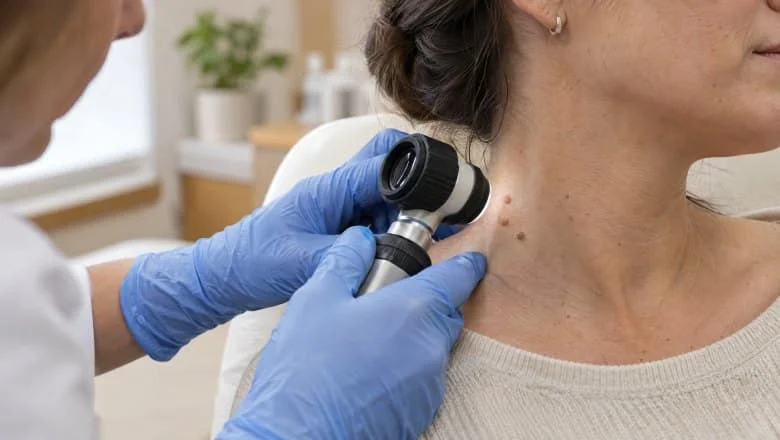
Skin tags (acrochordons) are small, soft, harmless growths that hang from the skin on a thin stalk, most often in the armpits, on the neck, on the eyelids, under the breasts and in the groin. Skin tag removal at our Baker Street hospital in London takes them off quickly under numbing cream or local anaesthetic, usually in a single session, whether you have one tag that catches on a necklace or dozens that rub under a bra strap or collar.
Small and medium tags, including tags on the face and eyelids, are removed with the erbium laser of the Fotona SP Dynamis Pro by Ida Bafende, NMC-registered aesthetic practitioner. Larger tags with a thick stalk, and any growth that needs to be sent for analysis, are removed surgically under local anaesthetic by one of our plastic surgeons. Most people are back at work the same day.
Not every small, soft growth is a skin tag. Warts, raised moles, seborrhoeic keratoses and, rarely, skin cancers can look similar, so one of our plastic surgeons examines each growth, with a dermatoscope where needed, before anything is removed. Anything that does not look clearly benign at your assessment is not lasered: an uncertain growth is removed surgically by one of our plastic surgeons and sent for analysis, and a possible skin cancer is referred to an NHS team through your GP. Our guide to common skin lumps and bumps explains how these growths differ.
“Skin tag and wart removal” is often searched as one treatment, but warts are caused by a virus and skin tags are not, so they are treated differently. Other growths can be checked at the same appointment; our lumps and bumps removal section covers the full range.
Skin tag removal at a Glance
We see and treat adults aged 18 and over only. Laser removal is only used once one of our plastic surgeons has confirmed that a growth is a typical skin tag; anything bleeding, changing or uncertain is removed surgically and sent for analysis instead.
Considering skin tag removal?Book a consultation to have your skin tags checked and the right technique agreed for each one. No obligation, and no pressure to book.
What are skin tags and what causes them?
A skin tag (acrochordon, also called a fibroepithelial polyp or soft fibroma) is a small, soft growth of skin that hangs from the surface on a thin stalk. Inside is a core of loose collagen fibres and tiny blood vessels, covered by a thin layer of skin. Skin tags themselves are benign and are not contagious. They are also very common: in a 1987 survey of 750 unselected people, 46% had at least one, and the chance of having them rose with age before levelling off at around 50[1].
What does a skin tag look like?
Most skin tags are 1–5 mm across, soft, and skin-coloured or slightly darker than the skin around them. They hang on a stalk, so they move easily when touched. Small tags (1–2 mm) often cluster around the neck and eyes, medium tags (3–5 mm) can appear anywhere, and large pedunculated tags (5 mm to 2 cm) are usually found in the armpits, groin or under the breasts, where they dangle and catch on clothing.
Where do skin tags grow?
Skin tags grow where skin rubs against skin, clothing or jewellery. In the same survey, the armpit was the commonest site, followed by the neck[1]. Other common sites are the eyelids, under the breasts where a bra band sits, the groin and inner thighs, and the upper back under bra straps.
What causes skin tags?
The exact cause is not fully understood, but friction plays a large part, which is why tags cluster in skin folds. You are more likely to develop them if you:
- are over 40
- are overweight or have deep skin folds
- are pregnant, when hormonal changes make new tags more likely
- have type 2 diabetes or insulin resistance
- have a family history of skin tags
- have certain conditions, such as Crohn’s disease (which can cause tags around the anus), acromegaly or Birt-Hogg-Dubé syndrome, a rare inherited condition
What are skin tags a warning for?
Skin tags have been linked with diabetes and with metabolic syndrome, a cluster of heart and circulation risk factors. A 2019 case-control study in the Indian Dermatology Online Journal (Tripathy et al.) compared 70 people with skin tags with 70 matched people without them: diabetes, high blood pressure and metabolic syndrome were more common in the skin tag group, but once other factors were accounted for, only a large waist measurement and low HDL (“good”) cholesterol remained independently linked[2].
That is an association in one small study, not proof that skin tags predict illness. The NHS guidance on skin tags also notes that they are more likely with obesity, type 2 diabetes and pregnancy, and your GP can advise whether any tests are sensible for you.
Skin tag vs wart vs mole: what gets mistaken for skin tags?
People often call any small growth a “skin tag”, but several lesions look similar and need different treatment. DermNet’s skin tag page lists seborrhoeic keratoses, viral warts and molluscum among the growths that can look like a skin tag.
Skin tag or wart?
Warts are caused by the human papillomavirus (HPV) and can spread; skin tags are not caused by a virus and do not spread. Warts are usually firmer and rougher, sit close to the skin rather than hanging from a stalk, and often show tiny black dots (small clotted blood vessels). They are commonest in children and on the hands and feet, while skin tags appear mostly in adults, in skin folds.
Skin tag or mole?
Moles (melanocytic naevi) are made of pigment cells, and most are flat or dome-shaped. A pale, soft, raised mole can look like a skin-coloured skin tag, but it is firmly attached to the skin, while a skin tag swings on its stalk. A mole that changes in size, shape or colour should always be checked.

Other growths that look like skin tags
- Seborrhoeic keratoses: “stuck-on”, waxy or warty growths that sit flat against the skin and are usually more pigmented
- Dermatosis papulosa nigra: multiple small, dark bumps on the cheeks and around the eyes, common in Black and other darker skin
- Cysts: firm lumps deeper in the skin, often with a small opening (punctum)
- Milia: tiny, firm white bumps sitting flat in the skin of the face
- Cherry angiomas: bright red, dome-shaped spots made of tiny blood vessels (a skin tag that has twisted on its stalk can also turn red, purple or black)
- Neurofibromas: soft, fleshy growths arising from nerve tissue that can resemble large skin tags; several of them can be a sign of neurofibromatosis, and your GP can arrange assessment
Can a skin tag be skin cancer?
Skin tags themselves are benign, but rarely something that looks like one is not. A 1996 review in Archives of Dermatology (Eads et al.) looked at 11,500 consecutive skin pathology reports: of 1,335 growths removed with a clinical diagnosis of skin tag, 5 were skin cancers, and none of those that dermatologists had judged to be typical skin tags were malignant[3]. The risk is very low, but it is why a careful examination comes first.
Have a growth checked before removal if it bleeds without being caught, grows quickly, changes colour or has uneven colour, appeared recently in adulthood and keeps growing, is one of many new growths appearing at once, or looks different from your other skin tags.
Tissue that is cut out (an excision, shave, punch or biopsy) is sent to an accredited laboratory for histology, where a pathologist examines it under the microscope. Typical skin tags are the exception: they do not need to be sent to the laboratory, but a growth that does not look like a typical skin tag is sent for histology. Laser destroys the tissue, so there is nothing to examine: that is why anything uncertain is cut out rather than lasered. Our guide to skin lesion histology results explains what the report means.
We do not treat skin cancer at Centre for Surgery. If a growth looks as though it could be a skin cancer, or a biopsy shows one, we refer you through your GP to an NHS skin cancer team, on the urgent suspected cancer pathway where that applies.
Do skin tags need to be removed, or will they go away?
Skin tags do not need to be removed for medical reasons. They are harmless, and the decision is yours, based on how much they bother you. Most skin tags stay unless they are removed, and new ones can form over time. Removal for appearance alone is not usually available on the NHS.
Reasons people choose skin tag removal
- Appearance: tags on the neck, eyelids, face or other visible areas
- Catching or shaving: tags that snag on necklaces, collars or bra straps, or get nicked by a razor
- Chafing: tags in the groin, armpits or under the breasts that rub during exercise or in warm weather
- Twisted or injured tags: tags that have been pulled or partly torn and become red, sore or scabbed
- Peace of mind: an examination to confirm that a growth is a skin tag and not something else
When can you leave a skin tag alone?
It is reasonable to leave a tag that is small, hidden and causing no symptoms. If you are pregnant, waiting until after the birth makes sense, as some tags that appear in pregnancy shrink afterwards. If your skin tends to darken after any injury, weigh that up against how much a tag bothers you. A growth that is bleeding, changing or new and unexplained should be examined rather than simply removed; our article on when a lump needs removing covers the wider question.
How are skin tags removed? Laser skin tag removal and excision
Skin tags are removed with the erbium laser or surgically, and some by electrosurgery or ligation, depending on each tag’s size, stalk, site and number. All of these are quick and are carried out under numbing cream or local anaesthetic in our day-case procedure rooms.
Laser skin tag removal with the Fotona SP Dynamis Pro
Before any laser treatment, one of our plastic surgeons examines each tag, with a dermatoscope where needed, to confirm it is benign and suitable for laser. Ida Bafende, NMC-registered aesthetic practitioner, then carries out the laser skin tag removal using the erbium (Er:YAG, 2940 nm) laser of the Fotona SP Dynamis Pro. The erbium wavelength is absorbed by water in the skin, so it vaporises the tag in thin layers with little heat spreading to the skin around it; you can read more about how the erbium laser works.
The laser is often chosen for small and medium tags, for tags on the face and eyelids, for clusters on the neck, and for darker skin, where limiting heat injury helps reduce the risk of dark marks. That is clinical reasoning rather than trial evidence: we are not aware of any published trial comparing the erbium laser with other methods for skin tags. Each tag takes seconds, the base forms a crust that lifts within 5–10 days, and no stitches are needed.
Surgical removal of large skin tags
Large tags, usually over 5 mm with a thick stalk, are removed surgically by one of our plastic surgeons. After a local anaesthetic injection, the tag is cut off at its base with fine scissors or a scalpel. A small blood vessel runs through the stalk, so the base is sealed with gentle heat or closed with one or two stitches. Surgical removal is also used for any growth that needs histology, because the laser leaves no tissue to examine.

A 2025 randomised, observer-blinded trial in Archives of Dermatological Research (Haase et al.) compared scissor snip removal with a 532 nm laser on 1,257 neck and armpit tags in 68 people[4]. At 12 weeks, 85% of snipped tags had fully healed against 71% of lasered tags, and snipping was less painful, although the laser was quicker. The laser tested is not the erbium laser we use, so the results do not transfer directly, but a laser is not automatically better than careful surgical removal.
Electrosurgery (hyfrecation) and ligation
Two other methods are used for some tags. Electrosurgery (hyfrecation) uses a fine heated probe to cut through and seal the stalk of very small tags. Ligation is used for some large tags: the stalk is tied off at its base with a fine suture in the clinic, so the tag loses its blood supply and falls off over a few days. This is not the same as tying a tag off with thread at home, which is not recommended. Your surgeon will tell you whether either method suits your tags.
Freezing (cryotherapy) is widely offered elsewhere, but we do not offer it here: we use the laser, electrosurgery, ligation or surgical removal instead. In a small randomised trial, patients and doctors rated results for skin tags more highly after the heated probe than after freezing[5], and the British Association of Dermatologists’ cryotherapy leaflet notes that frozen skin may lighten or darken, especially in darker skin.
Anaesthetic for skin tag removal
Numbing cream is enough for very small tags. A local anaesthetic injection, which stings briefly before the area goes numb, is used for larger tags and when many are treated together. If you have a very large number of tags, or would prefer not to be awake, they can be removed in one visit in our on-site theatres under TIVA (total intravenous anaesthesia), given by a consultant anaesthetist; you then need someone to take you home and stay with you for 24 hours.
How is the technique chosen for each tag?
Once your surgeon has examined each tag, the choice is usually straightforward: the laser for small, medium, facial and eyelid tags, and surgical removal for large tags and for anything that needs histology. If you have a mix of large and small tags, different methods may be used, and your surgeon explains whether they can be treated in the same session. Our page on how skin lesions are assessed and removed compares the techniques used for other growths as well.
We recommend a two-week cooling-off period between your consultation and treatment. If you have had a virtual consultation first and sent us photos of your skin tags, treatment can take place at the same visit as your in-clinic assessment, as long as the surgeon, or Ida for laser treatment, is happy they are suitable to treat on the day.
Eyelid skin tag removal and skin tags near the eye
Skin tags on the eyelids and around the eyes are common and easy to see. Eyelid skin is the thinnest on the body and the eye sits just beneath it, so eyelid skin tag removal is planned with extra care.
How are eyelid skin tags removed?
Small eyelid tags are usually removed with the erbium laser at gentle, shallow settings, which protects the delicate tissue underneath. Numbing cream or ointment is often enough; a small local anaesthetic injection, given by one of our surgeons, is used for larger or more sensitive tags. Mild redness and slight swelling for 1–2 days are normal.
Tags on the eyelid margin itself, where the lashes grow, are not lasered: they are removed by one of our facial plastic surgeons. A growth on the eyelid that bleeds, has a pearly or rolled edge, or has caused lashes to fall out is not treated as a skin tag, because a basal cell carcinoma can occasionally look like a tag in this area. If it looks as though it could be a skin cancer, we refer you through your GP to an NHS skin cancer team; if its nature is uncertain, it is biopsied and sent for analysis.
How are your eyes protected during eyelid laser treatment?
Everyone in the room wears eyewear rated for the laser. How your own eyes are protected depends on where the tag is:
- Inside the bony rim of the eye socket: Ida places internal eye shields (she is trained in their use). These are smooth, laser-safe metal shields placed on the surface of the eye after anaesthetic eye drops and a lubricating gel, and they are removed straight after treatment.
- Outside the rim: laser safety goggles or opaque external shields are placed over your closed eyelids.
If internal shields were used, your eye may feel slightly gritty or watery for a few hours. Do not rub your eyes while they are numb (about 30 minutes). Do not drive until the numbness has worn off and your vision is completely clear; we suggest someone takes you home. Leave contact lenses out for 24 hours, and leave eye make-up off for 5–7 days while the skin heals.
Get help straight away if you have eye pain, grittiness lasting more than 24 hours, sensitivity to light, blurred vision or a red eye: call the clinic on 020 7993 4849; out of hours, call NHS 111, or go to A&E if your sight is affected.
Is it a skin tag or another eyelid lump?
Not every eyelid bump is a skin tag. Yellowish patches on the inner eyelids are usually xanthelasma, tiny firm white bumps are often milia around the eyes, and small skin-coloured bumps under the lower eyelids may be syringomas. Our guide to lumps on the eyelid covers the full range, and if hooded upper eyelids also bother you, eyelid surgery is a separate procedure you can ask about.
Skin tag removal on the neck, face, armpits, groin and genital area
Where a skin tag is affects how it is removed and how you look after the skin afterwards.
Skin tags on the neck
The neck is the second commonest site after the armpit. Clusters of small tags form in the side folds, at the front where collars rub and behind the ears, and removing 10 to 30 small neck tags in one visit is not unusual. The erbium laser suits these small tags well, including tags that catch on necklaces.
Skin tags on the face
Tags on the face, cheeks and jawline are usually small and are removed with the erbium laser, leaving a small pink mark that fades as the skin heals. Tags in the beard area are often nicked when shaving, a common reason for having them removed.
Skin tags in the armpits and groin
The armpits and groin often have a mix of larger pedunculated tags of 5 mm or more and many small ones. Larger tags are removed surgically under local anaesthetic and small ones by laser; your surgeon explains whether both can be done in the same session. The skin here is sensitive but usually heals well if it is kept clean, dry and free from rubbing.
Perianal and genital skin tag removal
We also remove skin tags around the anus (perianal skin tags) and in the genital area. Genital warts and other lumps can look similar, so one of our surgeons examines them first, and removal is carried out under local anaesthetic.
Skin tags under the breasts
Tags under the breasts are common, particularly with larger breasts or extra weight, and bra friction is the main trigger. Healing is helped by keeping the fold dry and keeping bra pressure off the treated area for the first week. If the skin there is often sore or red, our guide to a rash under the breast explains the common causes.
Skin tag removal in darker skin
People with darker skin (Fitzpatrick skin types IV–VI) are more likely to develop dark marks after any injury to the skin, known as post-inflammatory hyperpigmentation. To reduce this risk, gentle laser settings are used, and you are asked to protect the treated skin from the sun and follow the skincare advice you are given for 6–8 weeks. If dark marks do appear, they usually fade over 3–6 months.
Will skin tag removal leave a scar? Side effects and risks
Skin tag removal is a minor procedure, but as with any treatment that breaks the skin, there are some risks to know about before you decide.
What kind of mark does skin tag removal leave?
Usually it leaves a small, flat mark that fades over months. After laser removal the treated spot is pink at first and gradually blends in, while a larger tag removed surgically leaves a fine line roughly the size of the tag’s base. Every method can occasionally leave a small dent or a lighter or darker patch. In the randomised trial of the heated probe and freezing, which covered four types of growth including skin tags, lighter patches, loss of colour and small sunken (atrophic) scars each affected between 3% and 6% of treated growths[5], and in the snip versus laser trial the laser caused more redness and pigment change than snipping[4].
Our article on how mole removal scars fade explains how a small removal mark settles over time, and scar revision is available if a mark stays prominent.
Other possible side effects
- brief stinging from the local anaesthetic injection, and tenderness for 1–2 days
- small spots of bleeding, which usually stop within minutes
- infection, which is uncommon: watch for pain that gets worse after 48 hours, spreading redness, pus or a fever
- temporary darker or lighter skin, more likely in darker skin and with sun exposure
Will skin tags come back after removal?
A skin tag that has been fully removed is unlikely to come back in the same spot, but new ones can form nearby. Not every tag clears first time: in the snip versus laser trial, some tags in both groups had not fully healed by 12 weeks[4], so occasionally a tag needs a second treatment.
Skin tag removal recovery and aftercare
Recovery after skin tag removal is quick, and most people go back to work and normal activities the same day.
The first two weeks
The treated spots are red at first and may show small dots of blood, which settle within minutes. Local anaesthetic wears off after 1–3 hours; mild tenderness afterwards is common, and paracetamol is usually enough. Each spot forms a tiny crust within 1–2 days, which lifts by itself over 5–10 days and leaves pink skin that fades over weeks to months.
Apply a thin layer of white soft paraffin (petroleum jelly) twice a day to keep the area moist, and do not pick at the crusts. If a larger tag was closed with stitches, you are told how to care for them and whether they need removing.
Activity, exercise and swimming
Avoid:
- swimming, communal showers and saunas for 1–2 weeks
- exercise that makes you sweat heavily for 3–4 days
- tight clothing or jewellery over the treated areas, such as necklaces, collars, bra straps and watch straps, for the first week
- picking, scratching or rubbing the treated areas
Aftercare by site
- Eyelids: leave eye make-up off for 5–7 days, and sleep with your head slightly raised for the first 2 nights to reduce swelling
- Neck: avoid tight collars and necklaces for the first week
- Armpits and groin: wear loose cotton clothing for the first few days, keep the area clean and dry, and pat it dry after showering rather than rubbing
- Under the breasts: wear a soft, loose bra or none, and keep pressure off the treated area, for the first week
Sun protection
On sun-exposed sites such as the face, neck, hands and arms, apply SPF 50+ over the treated areas for at least 6 weeks, because sun on healing skin raises the risk of long-lasting dark marks, particularly in darker skin.
When should you contact us?
Call us on 020 7993 4849 if pain gets worse after 48 hours, redness spreads well beyond the treated area, or you notice pus or a fever. The phone line is open 9am–6pm, Monday to Saturday; out of hours, call NHS 111, or 999 in an emergency.
How much does skin tag removal cost in London?
The cost of skin tag removal depends on how many tags you have, how large they are, where they are and how they are removed. Your price is confirmed at your consultation, after your assessment. The consultation fee is redeemable against your treatment.
Skin tags are priced in bands by number, with options for up to 5 tags, 6 to 15 tags and more than 15 tags, so several tags can be removed in one session. Surgical excision of a large skin tag is a separate option, and so are eyelid skin tags, with one option for a single eyelid tag and another for several. Removing many tags under TIVA is priced as its own option. You can see each of these among the skin tag removal prices in our Skin & Aesthetics price list.
Where tissue is sent for analysis, the laboratory invoices you directly.
Finance is available through Chrysalis Finance, subject to status; see our finance options page. M Sarwar Limited, trading as Centre for Surgery, is a credit broker, not a lender.
Why choose Centre for Surgery for skin tag removal
Laser skin tag removal is carried out by Ida Bafende, NMC-registered aesthetic practitioner, on the Fotona SP Dynamis Pro. Large tags, and any growth that needs to be sent for analysis, are removed by a GMC-registered consultant plastic surgeon. One of our plastic surgeons examines every growth before it is treated, so anything that is not clearly a skin tag is removed in a way that allows it to be examined.
Centre for Surgery is rated Good overall by the CQC.
You get honest advice: if a tag is better left alone, we will tell you, and there is no pressure to book. Treatment takes place at our Baker Street hospital in Marylebone, which has on-site theatres for people with very many tags who would prefer TIVA. To book, use the consultation request form on this page or call 020 7993 4849.
Skin tag removal research and references
The studies cited on this page:
- Banik R, Lubach D. Skin tags: localization and frequencies according to sex and age. Dermatologica. 1987;174(4):180-183. doi:10.1159/000249169
- Tripathy T, Singh BSTP, Kar BR. Association of skin tag with metabolic syndrome and its components: a case-control study from Eastern India. Indian Dermatol Online J. 2019;10(3):284-287. doi:10.4103/idoj.IDOJ_238_18
- Eads TJ, Chuang TY, Fabré VC, Farmer ER, Hood AF. The utility of submitting fibroepithelial polyps for histological examination. Arch Dermatol. 1996;132(12):1459-1462. PMID: 8961875
- Haase O, Winkelmann-Schirmer C, Mrowka P, Krengel S. Removal of skin tags: scissor excision versus non-ablative 532nm-LBO-laser in a randomized intraindividual controlled observer-blinded clinical trial: laser is not always better. Arch Dermatol Res. 2025;317(1):753. doi:10.1007/s00403-025-04242-7
- Sadeghzadeh-Bazargan A, Shafiei M, Atefi N, et al. Evaluation and comparison of the efficacy and safety of cryotherapy and electrosurgery in the treatment of sebaceous hyperplasia, seborrheic keratosis, cherry angioma, and skin tag: a blinded randomized clinical trial study. Health Sci Rep. 2024;7(11):e70154. doi:10.1002/hsr2.70154
What To Expect
Your skin tag removal consultation
You are seen at our Baker Street hospital, usually for about 30 minutes. We ask when your tags appeared, whether they have changed, and about anything that affects healing or skin colour, and one of our plastic surgeons examines each tag and any other lumps you would like checked.
You leave knowing which growths are typical skin tags, how each will be removed and your price. We recommend a two-week cooling-off period before treatment; if you had a virtual consultation and sent us photos first, treatment can take place at this visit when your tags are suitable.
On the day of your treatment
The skin is cleaned and numbed with cream or a small local anaesthetic injection. When the laser is used, everyone in the room wears laser eyewear, and your eyes are shielded if tags near them are treated. Small tags are lasered in seconds each, and large tags are removed surgically by one of our plastic surgeons; anything that is not a typical skin tag is sent for analysis.
Allow about 45 minutes, longer if many tags are treated. Very large sessions, some eyelid tags and anything under TIVA are booked for a separate date.
After your skin tag removal
You can go back to work the same day. Expect small red spots that crust over within a day or two; keep them moist with petroleum jelly twice a day and let the crusts lift by themselves.
Keep tight straps, collars and jewellery off the area for a week, and skip swimming and saunas for 1–2 weeks. If pain increases after 48 hours, redness spreads or you see pus, call us on 020 7993 4849.
Your results
The crusts lift within 5–10 days, leaving pink skin that settles over weeks to months into a small, flat mark. Protect healing skin on the face, neck and arms with SPF 50+ for at least 6 weeks.
If tissue was sent for histology, results usually take 3–4 weeks, and we contact you with the result. New tags can form over time, and they can be treated as they appear.
FAQs
-
It is not a good idea. The NHS advises against removing a skin tag yourself unless a GP recommends it, because of the risk of bleeding, infection and scarring. Skin tags have a small blood vessel in the stalk, so cutting one off with scissors or nail clippers can bleed more than expected, and non-sterile tools raise the risk of infection. Tying a tag off with thread, applying tea tree oil, apple cider vinegar or toothpaste, and home freezing pens are not recommended either. Just as important, a growth removed at home cannot be checked, and occasionally a “skin tag” turns out to be something else.
-
Usually not, if the reason is appearance. The NHS treats removing a skin tag for cosmetic reasons as cosmetic surgery, so GPs do not normally remove them. Under the national Evidence-Based Interventions guidance, benign skin lesions such as skin tags are only removed on the NHS if they meet at least one criterion, for example bleeding more than twice a week for at least 4 weeks, being regularly and unavoidably injured, causing repeated infections that need antibiotics, or blocking vision. Your GP should still check any growth that bleeds, grows, hurts or changes.
-
Most private medical insurers do not cover skin tag removal when it is done for appearance, because they class it as cosmetic. Some policies may consider it when a growth needs investigating, for example if it is bleeding or changing and a doctor is unsure what it is. Cover and pre-authorisation rules vary, so check your policy and speak to your insurer before treatment rather than afterwards.
-
New skin tags often appear when something changes the friction on your skin or your hormones. Common triggers are weight gain, which deepens skin folds, pregnancy, and getting older, with tags becoming more frequent from your 40s. They are also more common with insulin resistance and type 2 diabetes. If lots of new tags appear over a few months, especially alongside symptoms such as increased thirst or passing more urine, see your GP, who may suggest a blood sugar test. If a new growth is bleeding, changing quickly or looks different from your other tags, have it examined before anything is removed.
-
Most skin tags stay unless they are removed. Occasionally a tag twists on its narrow stalk and cuts off its own blood supply: it turns dark red, purple or black, may be sore for a few days, then dries up and drops off. Do not twist a tag deliberately to make this happen, because it can bleed and become infected. Some tags that appear during pregnancy shrink after the birth. A tag that has darkened but not fallen off, or one that keeps bleeding, is worth having checked.
-
Skin tags themselves are benign, meaning they are not cancerous. The small risk lies in mistaken identity: rarely, a skin cancer such as a basal cell carcinoma can look like a skin tag, particularly on the eyelid or face. That is why one of our plastic surgeons examines each growth before removal: anything uncertain is cut out and sent to the laboratory rather than lasered, and anything that looks like a skin cancer is referred through your GP to an NHS skin cancer team. Our guide to reading your histology results explains what happens to tissue that is sent for analysis.
-
Yes, but a tag on the eyelid margin, where the lashes grow, needs more care than one elsewhere on the eyelid. The laser is not used on the margin itself: lesions on the eyelid margin are removed by one of our facial plastic surgeons, who take care to avoid harming the lashes or the edge of the lid. Any eyelid growth that bleeds, has a pearly edge or has made lashes fall out is not treated as a skin tag: it is biopsied if its nature is uncertain, or referred through your GP to an NHS skin cancer team if it looks like a skin cancer. Your assessment confirms which approach suits your tag.
-
Most people feel very little. Very small tags can be removed under numbing cream; for larger or multiple tags, a local anaesthetic is injected first, which stings for a few seconds before the area goes numb. During treatment you may feel pressure or a little warmth. Once the anaesthetic wears off, after 1–3 hours, the area may feel tender for a day or two, and paracetamol is usually enough. If you are anxious about needles or have a very large number of tags, ask about TIVA at your consultation.
-
Most treated spots heal within about two weeks. A small crust forms within 1–2 days and lifts by itself over 5–10 days. The new skin underneath is pink at first and fades over weeks to months. A larger tag removed surgically can take a little longer, particularly if stitches were used. Keeping the area moist and not picking at the crusts helps it heal neatly.
-
A skin tag that has been completely removed is unlikely to come back in the same spot, but new ones can form nearby, especially in people who are prone to them. That is a new growth rather than the old one returning. Occasionally a tag does not fully clear with the first treatment and needs a second one. Reducing friction in skin folds, wearing looser clothing and, where it applies, losing weight may slow the appearance of new tags, and new ones can be treated as they appear.
-
Yes. We remove perianal skin tags (skin tags around the anus) and skin tags in the genital area. Genital warts and other lumps can look very similar, so one of our surgeons examines each growth first to confirm what it is before anything is removed. Removal is carried out under local anaesthetic. A typical skin tag does not need to be sent to the laboratory, but a growth that does not look like a typical skin tag is sent for histology.
-
A sessile skin tag has a broad, flat base instead of a narrow stalk, so it sits close to the skin rather than hanging from it. Most skin tags are pedunculated (on a stalk), which makes them easy to recognise. Sessile tags can look more like a raised mole, a wart or a seborrhoeic keratosis, so a surgeon examines them carefully before treatment. Small sessile tags can usually be treated with the laser, while anything that is not clearly a skin tag is removed surgically and sent for analysis.
-
You can have skin tags removed privately at Centre for Surgery, at our hospital at 95–97 Baker Street in Marylebone, close to Baker Street station. One of our plastic surgeons examines your tags at a consultation first, then they are removed in our procedure rooms by laser or surgically, depending on their size and where they are. Wherever you go, look for a clinic where a trained clinician examines each growth before removing it, and where anything uncertain can be sent for analysis.
-
The price depends on how many tags you have, their size, where they are (eyelid tags are priced separately) and whether a large tag needs surgical excision or many tags are removed under TIVA. Prices are banded by the number of tags, so several can be removed in one session. You can see every option among the skin tag removal prices on our price list, and your exact price is confirmed after your assessment. Where tissue is sent for analysis, the laboratory invoices you directly.