


In this guide14 sections
- Key Points
- Can Squats Give You a BBL?
- What Does “Gym BBL” Mean?
- Do Squats Make Your Bum Bigger or Smaller?
- What Are the Best Glute Exercises? What the EMG Research Shows
- How Long Do Squats Take to Show Results?
- Who Should Try Glute Training Before a BBL?
- When Does a BBL Make Sense Instead of Squats?
- BBL vs Squats: Which Is Better for You?
- Can You Do Squats After a BBL? Exercise Timeline
- Can Squats Ruin a BBL?
- Frequently Asked Questions
- Brazilian Butt Lift in London
- References
Key Points
- Squats cannot give you a BBL. Glute training builds the gluteus maximus muscle, but it cannot add fat to the buttocks, move fat from your waist to your hips or change your bone structure.
- Hip thrusts activate the glutes more than squats. In EMG studies the barbell hip thrust produced roughly double the glute activation of the back squat, yet both grew the glutes by a similar amount over 9 weeks.
- Training takes months, not weeks. Measurable glute growth appears after about 8 to 10 weeks of progressive training; a visible change in shape usually takes 6 to 12 months.
- Try training first if your goal is lift and firmness. A BBL makes more sense when the limit is fat distribution: a flat bum or square shape, hip dips or a waist-to-hip ratio that exercise has not changed.
- Exercise after a BBL is staged. Walking from day 1, light cardio from week 3, and squats and weights from 6 weeks once your surgeon is happy.
- Squats do not ruin a BBL. Transferred fat sits above the muscle, so training does not burn it off. Large weight loss can shrink it, though, as it can any fat.
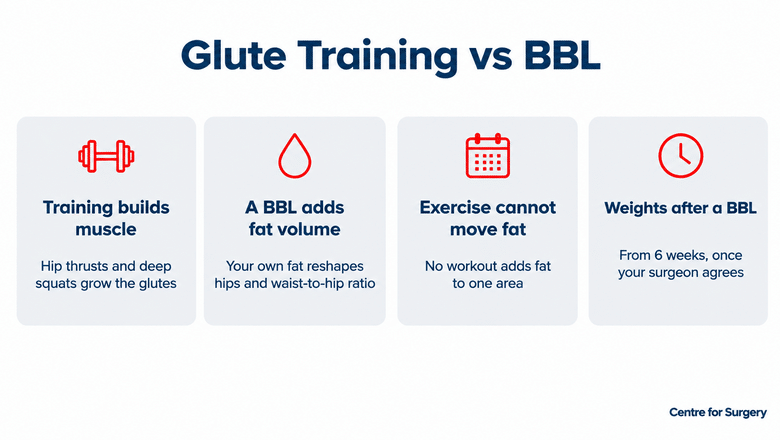
Squats cannot give you a BBL. Squats, hip thrusts and lunges build the gluteus maximus muscle, which can make your bum firmer, rounder and slightly bigger, but no exercise can add fat to the buttocks, take fat away from your waist or reshape your hips. A Brazilian butt lift (BBL) does exactly those things: it removes fat by liposuction and places it in the buttocks and hips. That is why a “gym BBL” and a surgical BBL look different, and why many people who train hard still consider surgery.
This guide compares BBL vs squats in detail: what glute training can and cannot achieve, which exercises the research says work best, how long squats take to show results, who should try training first, when a BBL makes sense instead, and how to return to the gym safely after surgery. If you have already had a BBL and want the week-by-week exercise plan, our guide on when you can work out after a BBL covers it.
Can Squats Give You a BBL?
No. The shape of your bum depends on three layers: the pelvis and hip bones, the gluteal muscles that sit on them, and the layer of fat on top. Exercise changes only the middle layer. A BBL changes the top layer, and it is the top layer that creates most of the curve people mean when they say “BBL”.
What glute training can achieve:
- Muscle growth (hypertrophy). Progressive resistance training enlarges the gluteus maximus, which adds projection and a firmer, more lifted look, especially in the upper and middle buttock.
- Better shape in lean people. If you carry little fat, extra muscle shows clearly, so a well-trained glute can look noticeably rounder.
- Lower overall body fat. Training and a calorie deficit reduce fat all over the body, which can sharpen muscle definition.
- Strength and posture. Strong glutes support your lower back, hips and knees, and they help you recover from surgery if you have it later.
What glute training cannot achieve:
- Adding fat volume. Muscle and fat are different tissues. No exercise turns muscle into fat or deposits fat in a chosen place.
- Spot reduction. You cannot burn fat from one area by working the muscle underneath. In a 12-week controlled trial, people who trained one leg with thousands of leg press repetitions lost fat, but from their arms and trunk rather than from the trained leg[1].
- A narrower waist. Side bends and twists do not slim the waist; the fat on your flanks and lower back reduces only with overall fat loss, and some of it is resistant to diet and exercise.
- Changing your frame. Pelvis width and the shape of the top of the thigh bone are fixed, and they are a large part of why some people have hip dips or a square-shaped bum.
Waist-to-hip ratio: where a BBL differs most
Much of what makes a BBL look like a BBL is the waist-to-hip ratio, the waist measurement divided by the hip measurement. A BBL changes both sides of that ratio in one operation. Liposuction of the waist, flanks and lower back (often as 360 liposuction) makes the waist smaller, and the same fat placed into the buttocks and upper hips makes the hip measurement larger. Glute training can add a little to the hip measurement through muscle, but it cannot reduce the waist in a targeted way, so the ratio moves far less.
What Does “Gym BBL” Mean?
“Gym BBL” is social media slang for a bum built through training rather than surgery, sometimes also called a “squat booty” or a natural BBL. A well-built gym BBL tends to look more athletic: firm and projecting at the upper buttock, with defined muscle at the side of the hip and a waist that stays roughly the same size. A surgical BBL tends to look softer and more curved, with more fullness at the hips and lower buttock and a more pronounced drop from the waist.
The two are not exclusive: many people who have a BBL keep training, so their result has a muscular base under the transferred fat.
Do Squats Make Your Bum Bigger or Smaller?
Squats can make your bum bigger, smaller or about the same, depending on your starting body composition and your diet:
- If you are lean, squats done with enough load usually make the bum bigger, as the extra glute muscle is not hidden under fat.
- If you carry more fat, squats combined with a calorie deficit can make the bum look smaller at first, as you lose fat faster than you gain muscle, even though it becomes firmer.
- If you train without progressive overload, such as doing the same 20 bodyweight squats every day, you will build some strength and endurance but little size.
How you squat matters. In a randomised trial comparing full squats with half squats over 10 weeks, gluteus maximus volume measured by MRI rose by 6.7% with full squats but only 2.2% with half squats[2]. Going deep (thighs at least parallel to the floor) works the glutes through a longer range and gives them more stimulus. A wider stance and sitting the hips back also shift more of the work from the thighs to the glutes. If one side of your bum is bigger or weaker than the other, our article on uneven buttocks and glute imbalance explains single-leg exercises that help.
What Are the Best Glute Exercises? What the EMG Research Shows
Electromyography (EMG) measures how strongly a muscle is activated during an exercise. It does not measure growth directly, but it shows which movements load the glutes most. The main findings are consistent:
- Hip thrusts activate the glutes more than squats. In a 2015 EMG study of 13 trained women in the Journal of Applied Biomechanics ↗, the barbell hip thrust produced mean upper gluteus maximus activation of 69.5% of maximum, against 29.4% for the back squat, and lower glute activation of 86.8% against 45.4%[3].
- Many exercises reach very high activation. A systematic review of 16 studies classed step-ups and their variations as producing the highest gluteus maximus activation, followed by hip thrust variations, deadlifts (including hex bar), split squats, lunges, the belt squat and single-leg squats[4].
- Romanian deadlifts rival the hip thrust. In trained men lifting at their maximum, the Romanian deadlift and hip thrust activated the glutes to a similar degree, while the back squat spread the work across the hips and the front of the thighs[5].
Higher activation does not automatically mean more growth, though. In a 2023 randomised trial using MRI, published in Frontiers in Physiology ↗, untrained adults did either hip thrusts or back squats for 9 weeks. Glute growth was similar in both groups, even though the hip thrust had produced greater EMG activity. The squat group also grew their quadriceps and inner thigh muscles more[6]. A 2025 systematic review and meta-analysis of 12 studies agreed: resistance training has a moderate effect on gluteus maximus size, hip thrusts are a good choice if you want to grow the glutes without building the thighs, and full-depth squats, leg press and kneeling hip extensions all work too[7].
A practical glute-building plan therefore combines several movements rather than relying on squats alone:
- Hip thrusts or glute bridges for direct glute loading with little thigh growth.
- Deep squats (back, goblet or sumo) for overall lower-body strength and glute size.
- Romanian deadlifts for the glutes and hamstrings together.
- Step-ups, split squats and lunges for single-leg work, which also corrects side-to-side differences.
- Cable or band abduction for the gluteus medius at the side of the hip, which affects the upper hip contour.
Most studies used 2 to 3 sessions a week, 3 to 4 sets per exercise and 8 to 15 repetitions taken close to failure, with the weight increased as you get stronger. Eating enough protein supports muscle growth, and a coach or physiotherapist can check your technique if you have knee or back pain.
How Long Do Squats Take to Show Results?
Strength improves within the first few weeks, mostly as your nervous system learns the movement. Muscle growth takes longer. In the trials above, measurable gluteus maximus growth on MRI appeared after 9 to 10 weeks of supervised training, at 2 sessions a week[2][6]. Changes of a few per cent are real but hard to see in the mirror, so a visible difference in shape usually takes 6 to 12 months of consistent, progressive training, and more for a large change.
After 30 days of squats, expect better strength, technique and perhaps a firmer feel, but visible glute growth after one month is unlikely. Doing 100 bodyweight squats a day mainly builds endurance; fewer, heavier sets taken close to failure are more effective for size, with rest days for recovery.
Who Should Try Glute Training Before a BBL?
Almost everyone considering a BBL benefits from a period of glute training first, and for some people training alone gives the result they want. It is worth trying first if:
- Your main goal is lift and firmness rather than a big change in size or hip shape.
- You have never trained your glutes progressively. Many people are surprised by what 6 to 12 months of structured training achieves.
- You are still losing weight. A BBL is planned around a stable weight, usually for at least 3 months, and for 6 to 12 months after major weight loss, so it makes sense to reach your target first.
- You are very lean. If your BMI is well below about 23, muscle growth will show clearly, and you may not have enough donor fat for a standard BBL.
- You are unsure about surgery. Training is low risk and low cost, and it gives you time to decide.
Training also helps if you go ahead with surgery later. Stronger glutes and better fitness make the early recovery period easier, and the muscle underneath gives the transferred fat a firm base.
When Does a BBL Make Sense Instead of Squats?
A BBL makes more sense when the thing you want to change is fat distribution rather than muscle. Typical situations include:
- A flat or square bum despite consistent training, where the muscle is developed but there is little fat over it to give a curve.
- Hip dips or a lack of upper hip fullness that training has not filled.
- A waist that does not narrow with diet and exercise, so the waist-to-hip ratio stays the same.
- Enough spare fat elsewhere, usually on the tummy, flanks, back or thighs. A BMI of about 23 to 28 usually gives enough donor fat.
At Centre for Surgery, fat is harvested by power-assisted liposuction (PAL) or VASER, then injected only into the subcutaneous layer above the gluteal muscle, never into or beneath it, using a blunt cannula under real-time ultrasound guidance on every BBL. This matters because the most serious BBL complication, fat embolism, has been linked to fat entering the muscle. A 2017 task force report in Aesthetic Surgery Journal ↗ found that surgeons who injected into deep muscle had a significantly higher rate of fatal and non-fatal fat embolism[8]. After safety recommendations were adopted, a follow-up survey found the estimated death rate fell from 1 in 3,448 to 1 in 14,952 procedures[9].
A BBL is not the only surgical option, and the right one depends on your body:
- Skinny BBL for a BMI below about 23, taking smaller amounts of fat from four or five donor sites for a modest, proportionate result.
- Mini BBL for a subtler change, using two donor areas and around half the volume of a full BBL, with exercise from 4 weeks.
- Buttock implants for very slim or muscular people without spare fat; the implant sits within the muscle, so you need to wait 8 weeks before exercising.
- Buttock lift for loose skin, often after weight loss, which neither squats nor a BBL can tighten.

360 liposuction with BBL, before and after: a narrower waist and fuller buttocks change the waist-to-hip ratio in a way training cannot. Individual results vary. See more results in our BBL before and after photos.
BBL vs Squats: Which Is Better for You?
The two are not really competitors; they change different tissues. Side by side:
- What changes: squats build muscle; a BBL moves fat from the waist, flanks or thighs to the buttocks and hips.
- Effect on the waist: squats have no targeted effect; a BBL slims the donor areas by liposuction.
- Timeline: squats take 6 to 12 months or more for visible change; a BBL shows an immediate change, with most of the result at 3 months and the final result at 3 to 6 months.
- Permanence: muscle shrinks if you stop training; the 50 to 70% of transferred fat that survives is permanent from around 6 months, although it changes with your weight.
- Risk: squats carry a small risk of strain if technique is poor; a BBL is surgery under TIVA (total intravenous anaesthesia) with risks including infection, fat necrosis and, rarely, fat embolism.
- Downtime: none for squats; 1 to 2 weeks off work and no sitting directly on the buttocks for 2 weeks after a BBL.
- Cost: a gym membership or home equipment for squats; a BBL is a significant, self-funded cost, set out in our BBL cost guide.
For many people the best answer is both: train first, decide whether the remaining limit is fat rather than muscle, and if you have a BBL, keep training afterwards to support the result.
Can You Do Squats After a BBL? Exercise Timeline
Yes, but not straight away. Activity after a BBL is staged so the transferred fat can establish a blood supply and the swelling can settle. At Centre for Surgery the usual plan is:
- Day 1: short, gentle walks around the house, increasing each day, to keep blood moving and lower the risk of clots.
- Weeks 1 to 2: walking only. No sitting directly on the buttocks for 2 weeks (have a BBL cushion ready before surgery for unavoidable sitting), and sleep on your front or side, not your back.
- Week 3: light cardio such as brisk walking, but not cycling, which puts pressure on the buttocks. You can usually sit normally for short spells from this point.
- Week 6: full exercise, including squats, hip thrusts and weights, once your surgeon has reviewed you. Start lighter than your old routine and build up over a few weeks.
You will wear a compression garment day and night for 6 weeks over the donor areas, with the buttocks left free. Our BBL recovery guide sets out each week in detail, and our article on when you can sit after a BBL explains the sitting rules. If you have a mini BBL, exercise usually restarts at 4 weeks, and after buttock implants at 8 weeks.
Can Squats Ruin a BBL?
No, squats done at the right time will not ruin a BBL. The transferred fat sits in the layer above the gluteal muscle, not inside it, so working the muscle does not burn the grafted fat off. A stronger, fuller muscle underneath can even add a little support and projection to the result.
There are three ways exercise can affect a BBL, and all are avoidable:
- Starting too early. Heavy squats or hip thrusts in the first weeks put pressure and strain on tissue that is still healing, and pressure on new fat grafts can reduce how much survives.
- Losing a lot of weight. Transferred fat behaves like the fat it came from. If heavy training and strict dieting cause significant weight loss, the buttocks shrink along with the rest of your body. Our article on BBL shrinking explains what is normal and what is not.
- Expecting training to replace lost volume. Some volume loss in the first months is expected as swelling settles and some fat is reabsorbed. Muscle growth will not add that fat back.
Fat placed above the muscle does last. In a 2019 prospective ultrasound study of 50 women in Plastic and Reconstructive Surgery ↗, subcutaneous-only gluteal fat grafting increased the fat layer by an average of 56.5%, and at 12 months the layer had decreased by an average of 18.2% from its immediate post-operative thickness, meaning most of the gain was kept[10]. Keeping your weight stable within a few kilograms is the most important thing you can do for a long-lasting result.
Frequently Asked Questions
Will 20 squats a day make my bum bigger?
Probably not by much. Twenty bodyweight squats a day improve endurance and mobility, but they quickly become too easy to stimulate further glute growth. For size, 2 to 3 sessions a week of loaded squats, hip thrusts and lunges, increasing the weight as you get stronger, works better.
Do squats make you curvier?
Squats can make you look more athletic and lifted, which some people see as curvier. They do not narrow the waist or add fat to the hips, so they change the waist-to-hip ratio only slightly. A BBL creates curves mainly by removing fat from the waist and adding it to the hips and buttocks.
How many squats a day do you need to see results?
Daily squats are not necessary. Most research programmes used 2 to 3 sessions a week of 3 to 4 sets of 8 to 15 repetitions close to failure, with rest days in between for recovery. Measurable glute growth appeared after about 9 to 10 weeks, and visible change in shape usually takes 6 months or more.
Do squats reduce belly fat?
Not directly. You cannot burn fat from one area by exercising nearby muscles. Squats use a lot of energy, so as part of regular training and a calorie deficit they help reduce overall body fat, including on the tummy. Fat that remains after reaching a stable weight may suit liposuction.
What is the difference between a gym booty and a BBL booty?
A gym booty is built from muscle, so it tends to look firm and athletic with the most projection at the upper buttock. A BBL booty is built from transferred fat, so it tends to look softer and rounder, with more fullness at the hips and a narrower waist. Many people combine both.
When can I start doing squats after a BBL?
At Centre for Surgery, squats, hip thrusts and weights restart from about 6 weeks, once your surgeon has reviewed you. Before that you can walk from day 1 and do light cardio, such as brisk walking, from week 3. Start with lighter loads than before surgery and build up gradually.
Will working out make my BBL fat go away?
Exercise does not target the transferred fat, so training itself will not make it disappear. Large weight loss from intense training and dieting can shrink it, as it would shrink any fat. Keep your weight stable after a BBL, and combine training with enough food to maintain it.
Brazilian Butt Lift in London
A Brazilian butt lift at Centre for Surgery is performed by GMC-registered surgeons at our CQC-regulated Baker Street hospital, rated Good overall by the CQC. Every BBL uses real-time ultrasound guidance to place fat only above the gluteal muscle, and the operation is a day case under TIVA, so most people go home the same day. At your consultation your surgeon will assess your donor fat, muscle and skin, talk through whether training, a BBL or another option suits your goals, and explain the exercise plan after surgery. The consultant who assesses you is the consultant who performs your surgery, further consultations before surgery are free, and we recommend a two-week cooling-off period before you go ahead. Your initial consultation is £100, redeemable against the cost of surgery if you go ahead. Finance isn’t available for BBL at Centre for Surgery, so the procedure is self-funded.
Phone: 020 7993 4849 | Address: 95–97 Baker Street, Marylebone, London W1U 6RN
Contact us to schedule a consultation
References
- Ramírez-Campillo R, Andrade DC, Campos-Jara C, et al. Regional fat changes induced by localized muscle endurance resistance training. Journal of Strength and Conditioning Research 2013;27(8):2219–2224. doi:10.1519/JSC.0b013e31827e8681 ↗
- Kubo K, Ikebukuro T, Yata H. Effects of squat training with different depths on lower limb muscle volumes. European Journal of Applied Physiology 2019;119(9):1933–1942. doi:10.1007/s00421-019-04181-y ↗
- Contreras B, Vigotsky AD, Schoenfeld BJ, Beardsley C, Cronin J. A comparison of gluteus maximus, biceps femoris, and vastus lateralis electromyographic activity in the back squat and barbell hip thrust exercises. Journal of Applied Biomechanics 2015;31(6):452–458. doi:10.1123/jab.2014-0301 ↗
- Neto WK, Soares EG, Vieira TL, et al. Gluteus maximus activation during common strength and hypertrophy exercises: a systematic review. Journal of Sports Science and Medicine 2020;19(1):195–203. PMC7039033 ↗
- Delgado J, Drinkwater EJ, Banyard HG, Haff GG, Nosaka K. Comparison between back squat, Romanian deadlift, and barbell hip thrust for leg and hip muscle activities during hip extension. Journal of Strength and Conditioning Research 2019;33(10):2595–2601. doi:10.1519/JSC.0000000000003290 ↗
- Plotkin DL, Rodas MA, Vigotsky AD, et al. Hip thrust and back squat training elicit similar gluteus muscle hypertrophy and transfer similarly to the deadlift. Frontiers in Physiology 2023;14:1279170. doi:10.3389/fphys.2023.1279170 ↗
- Krause Neto W, Krause TLV, Gama EF. The impact of resistance training on gluteus maximus hypertrophy: a systematic review and meta-analysis. Frontiers in Physiology 2025;16:1542334. doi:10.3389/fphys.2025.1542334 ↗
- Mofid MM, Teitelbaum S, Suissa D, et al. Report on mortality from gluteal fat grafting: recommendations from the ASERF Task Force. Aesthetic Surgery Journal 2017;37(7):796–806. doi:10.1093/asj/sjx004 ↗
- Rios L, Gupta V. Improvement in Brazilian butt lift (BBL) safety with the current recommendations from ASERF, ASAPS, and ISAPS. Aesthetic Surgery Journal 2020;40(8):864–870. doi:10.1093/asj/sjaa098 ↗
- Cansancao AL, Condé-Green A, David JA, Vidigal RA. Subcutaneous-only gluteal fat grafting: a prospective study of the long-term results with ultrasound analysis. Plastic and Reconstructive Surgery 2019;143(2):447–451. doi:10.1097/PRS.0000000000005203 ↗
Related Articles
- When Can You Workout After BBL?
- BBL Recovery and Aftercare: A Week-by-Week Guide
- Uneven Buttocks and Glute Imbalance: Causes, Exercises and Treatment
- How Long Does a BBL Last? Permanence, Fat Survival and Maintenance