


In this guide13 sections
- Key Points
- What Are Saggy Cheeks?
- What Causes Saggy Cheeks?
- Why Do Cheeks Start Sagging at 30?
- Impact of Facial Exercises on Sagging Cheeks
- Do Anti-Wrinkle Injections Help with Sagging Cheeks?
- How Do You Know If You Need Non-Surgical or Surgical Treatment?
- What is the Best Treatment to Get Rid of Saggy Cheeks Fast?
- What Non-Invasive Treatments Can Treat Sagging Cheeks?
- Sagging Cheeks Before and After Photos
- Cheek Lift Costs
- Expert Insight
- Saggy Cheeks Treatment in London: Discover Excellence at Centre for Surgery
Key Points
- Saggy cheeks are not simply skin stretching under gravity. The cheek contains discrete fat compartments separated by fascial walls, and they deflate at different rates — which is why the cheek loses its shape as well as its position.
- For that reason, the treatment that works depends on whether your problem is deflation (volume gone), descent (volume slipped downward), or both. Most people over 45 have both.
- Deflation responds to volume — cheek fillers or facial fat transfer. Descent needs repositioning, which means a mid-facelift or cheek lift.
- Adding volume to a descended cheek makes it heavier, not higher. This is the single most common error, and it produces the overfilled look people recognise but cannot name.
- Rapid weight loss — including on GLP-1 medication — strips facial fat faster than skin can retract, which is why cheeks can sag dramatically at any age after significant loss.
- Facial exercises do not lift descended cheeks. The evidence is weak and the mechanism does not address fat compartment loss, bone resorption or skin laxity.
- Saggy cheeks are the opposite problem to chubby cheeks and distinct from sunken cheeks, though sunken and saggy often occur together.
What Are Saggy Cheeks?
Sagging cheeks are a natural part of the ageing process that many people experience. This condition arises when the elasticity of the cheeks’ skin decreases, resulting in reduced firmness and plumpness. Over time, the skin begins to droop, contributing to the appearance of saggy cheeks, cheek wrinkles, pronounced nasolabial folds, jowls, and a less defined jawline. Some people describe the affected skin as stretchy cheeks, droopy cheeks, or simply loose face cheeks — these are all everyday descriptions of the same underlying process.
Where the cheek has hollowed rather than dropped, that is a different presentation — see our guide to sunken cheeks – Causes & Treatments
Ageing is the primary cause of sagging cheeks, which is a distinct condition from sunken cheeks. It’s a phenomenon that can start affecting individuals as they cross the 30-year mark, with the effects becoming more pronounced due to gravity’s influence over time. Besides natural ageing, several lifestyle factors can accelerate this process, including smoking, prolonged exposure to sunlight, and an unhealthy diet. These habits can significantly reduce the production of collagen and elastin in the skin, vital proteins that maintain skin’s elasticity and firmness.
To address sagging cheeks, various cosmetic solutions are available. These treatments aim to rejuvenate the facial contour and restore the youthful appearance of the cheeks. Options range from non-invasive procedures, such as dermal fillers, which add volume and lift to the cheeks, to more comprehensive surgical approaches like face and neck lifts that offer more dramatic and lasting results.
At Centre for Surgery in London, the preferred treatments for enhancing the appearance of sagging cheeks include Fat Transfer to the Face and the Mini-Facelift. These procedures are celebrated for their ability to deliver natural-looking, enduring results, helping individuals regain a more youthful, refreshed facial appearance.
What Causes Saggy Cheeks?
The volume-loss part is more specific than “the face loses fat”. The cheek is not one continuous fat layer but a set of discrete superficial and deep compartments, separated by fascial barriers, which deflate at different rates with age — the deep medial cheek, the nasolabial, and the superficial middle and lateral cheek compartments among them (Plastic and Reconstructive Surgery, 2015 ↗). That anatomy is why a cheek does not simply get smaller as it ages; it changes shape, hollowing in one place while appearing to bulge in another.
It is also why targeted treatment beats generalised filling. Restoring the specific compartment that has deflated lifts the tissue above it; adding volume indiscriminately across the cheek adds weight without restoring structure. The same principle applies to fat grafting, where technique has become increasingly compartment-specific (Plastic and Reconstructive Surgery, 2023 ↗).
Rapid weight loss, including on GLP-1 medication
One cause deserves separate mention because it has become far more common. Substantial, fast weight loss — whether through diet, surgery, or GLP-1 medications such as semaglutide and tirzepatide — removes facial fat along with fat everywhere else. The face has proportionally little of it to lose, and skin that has been stretched over a fuller cheek for years does not retract at the same speed.
The result is a face that can look a decade older within months, even when the weight loss itself is a clinical success, and even in people in their thirties. This is the presentation increasingly described online as “Ozempic face”. Our guide to how dramatic weight loss affects the face and neck covers it in more detail, and if you are taking tirzepatide, our guide to Mounjaro face explains why the change is often more marked. The practical advice is straightforward: lose weight gradually where you have the choice. Where you do not, or where the loss has already happened, volume restoration rather than skin tightening is usually the starting point.

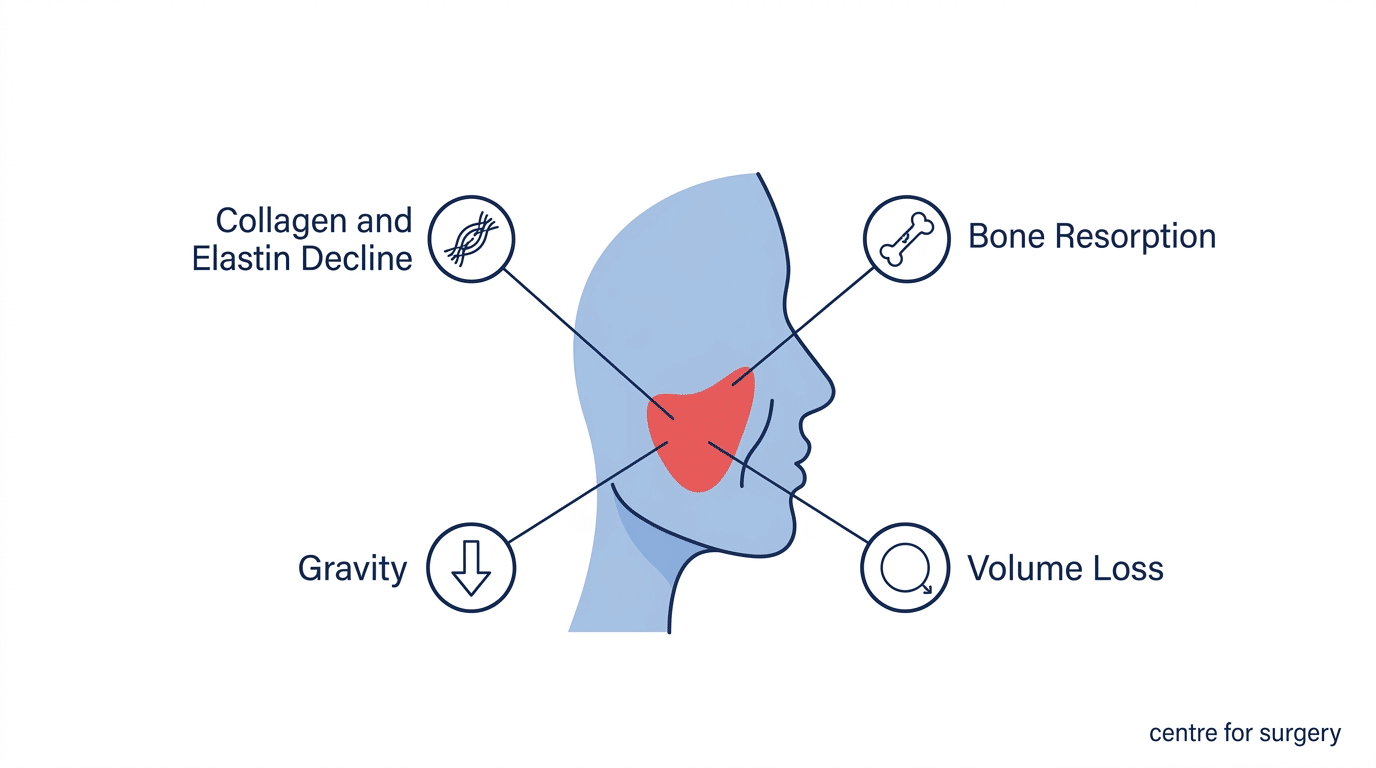
The phenomenon of sagging cheeks is predominantly a consequence of the natural ageing process. As individuals age, there is a notable decline in the body’s production of collagen and elastin, two critical proteins that help maintain skin’s elasticity and firmness. This reduction in vital skin components leads to diminished support for facial skin, causing it to sag and give rise to the appearance of sagging cheeks.
Changes in the facial bone structure further complicate this ageing process. Over time, facial bones undergo resorption, or gradual erosion, which means the increasingly less elastic skin is draped over a less-defined skeletal frame. This alteration in bone density and contour significantly contributes to the sagging appearance of cheeks, as the skin no longer has a taut, supportive structure beneath it.
The relentless force of gravity exacerbates the situation by continuously pulling the facial tissues downward, promoting skin sagging over time. While the ageing process and gravity are unavoidable natural factors, genetics also play a crucial role in determining the extent and rate at which these changes occur. Genetic predisposition influences the skin’s resilience and the timing of ageing signs, including saggy cheeks.
For the opposite concern — cheeks that are too full rather than descended — buccal fat removal is the procedure usually asked about, though it is worth understanding that removing buccal fat in someone who will later face midface descent can accelerate a hollowed look.
Environmental and lifestyle factors can accelerate the ageing process, leading to earlier or more pronounced sagging. For instance, prolonged exposure to ultraviolet (UV) radiation from the sun can accelerate the breakdown of collagen and elastin, accelerating the skin’s ageing process. Similarly, smoking is notorious for its adverse effects on skin health, including accelerated ageing, reduced collagen production, and increased skin damage. Moreover, excessive or repetitive facial expressions, such as smiling or squinting, can strain facial muscles and contribute to sagging cheeks over time.
Significant weight loss is another contributing factor to saggy cheeks. As individuals age, facial fat and volume naturally decrease, but this process can be accelerated by rapid weight loss, leading to excess sagging skin on the lower face, including the cheeks. Adopting gradual weight loss strategies can mitigate the risk of developing sagging cheeks post-weight loss.
Combatting sagging cheeks involves a multifaceted approach that encompasses preventive measures, lifestyle modifications, and cosmetic interventions. Non-surgical treatments, such as dermal fillers, Morpheus8, or Fotona4D, offer minimally invasive solutions to enhance facial contour and reduce sagging. For those seeking more dramatic and enduring results, surgical options like facelifts provide a comprehensive solution for restoring a youthful appearance to the face.
Underlying bone structure affects how early sagging shows: our guide to high versus low cheekbones – Causes & Treatments
Why Do Cheeks Start Sagging at 30?
Face sagging at 30 catches a lot of people off guard, because 30 feels early for visible ageing changes. It’s genuinely earlier than average for pronounced sagging, but not abnormal. Collagen production begins its gradual decline from the mid-20s onward — well before any visible change — so by the early 30s, some people (particularly those with a genetic predisposition, a history of significant sun exposure, or smokers) start to notice the earliest signs: slightly less bounce-back in the cheek skin, a faint softening of the cheek-to-jaw transition, or cheeks that look a little less full by the end of a long day. This is usually mild and often responds well to non-invasive treatment precisely because it’s caught early, before bone resorption and significant volume loss compound the picture. Saggy cheeks at 30 rarely need surgical correction — it’s usually the point at which prevention and light non-surgical maintenance make the most difference.
Impact of Facial Exercises on Sagging Cheeks
Engaging in regular exercise is universally acknowledged for its myriad health benefits and is an integral component of any comprehensive wellness strategy. However, when it comes to the specific concern of sagging cheeks, the efficacy of facial exercises remains a topic of debate with limited supporting evidence.
Facial exercises are designed to enhance muscle tone in the face, potentially offering a slight uplift to the cheeks. These exercises aim to strengthen facial muscles, which might contribute to a minor improvement in the appearance of sagging cheeks. Exercises such as Cheek Lifts, Fish Face, or Puffy Cheeks are among the activities suggested for those looking to target their facial muscles. While these exercises may promote a more toned facial structure, it’s important to acknowledge that they are unlikely to provide a comprehensive solution for significant sagging.
The ageing process affects the face in several complex ways beyond mere muscle tone. Key factors such as diminished skin elasticity, reduced collagen production, and the loss of facial fat significantly contribute to the development of saggy cheeks. These elements, integral to the skin’s structure and appearance, cannot be effectively countered through exercise alone.
For those considering facial exercises as part of a regime to tackle saggy cheeks, it’s crucial to integrate these activities into a broader, more holistic approach to facial care. Consulting with a specialist at Centre for Surgery can provide tailored advice and recommendations for achieving good outcomes. Such experts can offer insights into a balanced strategy that might include a combination of skincare, lifestyle adjustments, and possibly professional treatments to address sagging cheeks comprehensively.
Our companion guide covers the opposite presentation — chubby cheeks – How to Get a Slimmer Face
Moreover, it’s essential to approach weight loss with caution, especially concerning facial aesthetics. Rapid weight loss can reduce facial fat, which in turn may exacerbate the appearance of sagging skin. To avoid such outcomes, adopting a gradual weight loss plan with steady goals can help maintain a more consistent facial appearance.
Do Anti-Wrinkle Injections Help with Sagging Cheeks?
Not directly, and it’s worth being clear about this rather than letting the idea run unchallenged. This is a common question — people looking for a quick injectable fix for sagging cheeks are often hoping for a simpler fix than what’s actually needed. Anti-wrinkle injections relax specific facial muscles — it doesn’t add volume, tighten skin, or lift descended tissue, which are the three things sagging cheeks actually need addressed. In a small number of cases, careful placement can offer a very subtle indirect lift by relaxing muscles that pull the corners of the mouth or jawline downward, but this is a minor supporting effect, not a treatment for sagging cheeks in its own right. If you’re specifically looking for lift and volume, dermal filler, energy-based skin tightening, or a surgical approach will do what anti-wrinkle injections cannot.
How Do You Know If You Need Non-Surgical or Surgical Treatment?
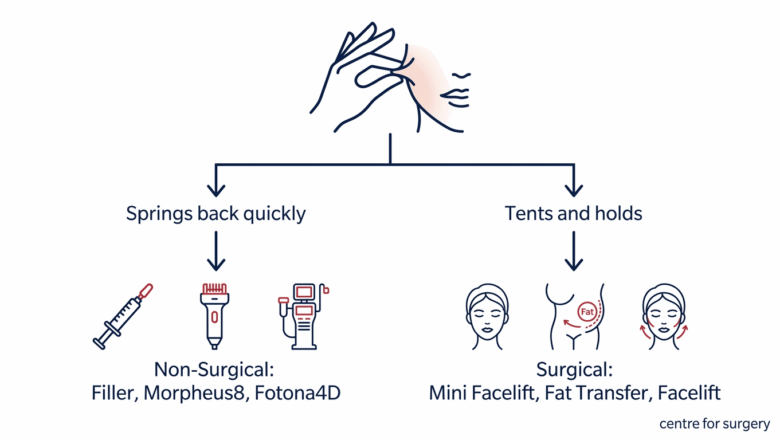
A simple starting point, before your consultation: pinch the skin over your cheek gently between two fingers. If it springs back into place quickly, non-surgical treatment — filler, energy-based tightening, or a combination — can likely produce meaningful improvement. If the skin tents and holds that shape for a moment before settling, that’s a sign of more significant skin laxity that non-surgical treatment alone won’t fully correct, and a mini facelift or facelift is more likely to deliver the result you’re after. This isn’t a substitute for an in-person assessment, but it’s a genuinely useful way to set expectations before you come in.
What is the Best Treatment to Get Rid of Saggy Cheeks Fast?
Achieving rapid, enduring results in the battle against saggy cheeks often requires surgical interventions. These procedures offer a definitive approach to restoring a youthful facial contour by directly addressing the root causes of sagging, including loss of skin elasticity, diminished facial volume, and the effects of gravity. Below, we explore the leading surgical treatments known for their effectiveness in rejuvenating the cheek area:
Facelift (Rhytidectomy)
Standing as the pinnacle of facial rejuvenation, a facelift offers a comprehensive solution to various signs of ageing across the lower and mid-face regions. This surgery involves lifting and repositioning the facial tissues, excising surplus skin, and tightening the muscles beneath. The result is a revitalised facial appearance that significantly diminishes the presence of saggy cheeks, offering a holistic transformation. Facelift surgery at Centre for Surgery is performed under TIVA (total intravenous anaesthesia) as standard, an anaesthetic approach well suited to day-case facial surgery.
Mini Facelift
Tailored for individuals seeking a less invasive option, the mini facelift focuses on the cheek area with a lighter touch. Utilising smaller incisions, this procedure provides a subtle yet effective lift, specifically targeting saggy cheeks with minimal downtime. It’s an ideal choice for those desiring significant improvements with a more discreet surgical footprint.

Fat Transfer to Face
A natural alternative to synthetic fillers, fat transfer involves liposuction to remove fat from one area of the body, then reinject it into the face. This technique enhances facial volume and contours naturally, offering a durable solution to saggy cheeks. Its popularity stems from its ability to provide natural-looking results that integrate seamlessly with the individual’s facial structure.

FaceTite
Catering to those in the early stages of facial ageing, FaceTite employs radiofrequency energy to tighten the skin non-surgically. Through minimal incisions, this procedure can offer a subtle yet noticeable improvement in skin tightness, making it a suitable option for individuals in their 30s seeking to address saggy cheeks within a concise treatment timeframe.

Why We Don’t Use Cheek Implants for Sagging Cheeks
Cheek implants are sometimes listed alongside these options elsewhere. They are offered at Centre for Surgery by Mr Shehab Jabir, our Consultant Facial Plastic Surgeon, but it’s worth being direct about why we don’t recommend them for sagging cheeks. Implants add fixed, permanent volume in a specific position — but sagging cheeks are a soft-tissue and skin-laxity problem, not primarily a lack of underlying bone structure. In our surgeons’ clinical judgement, fat transfer and mini facelift both address the actual mechanism of sagging (deflated soft tissue and loose skin) more precisely than an implant can, without the permanent foreign material or the revision surgery risk if a patient’s face continues to change with age around a fixed implant. If cheekbone projection specifically is your primary concern rather than sagging, that’s a different conversation worth having at consultation — but for sagging cheeks, we don’t consider implants the right tool.
Selecting the optimal treatment for saggy cheeks is a highly personal decision that should be made in consultation with an expert plastic surgeon. Factors such as the individual’s age, skin condition, and desired outcomes are crucial in determining the most appropriate surgical approach. At Centre for Surgery, we are dedicated to providing tailored advice and performing modern procedures to achieve good results for our patients, ensuring both men and women can enjoy a rejuvenated facial appearance with long-lasting satisfaction.
What Non-Invasive Treatments Can Treat Sagging Cheeks?
Non-invasive treatments have gained immense popularity for addressing sagging cheeks without the need for surgical intervention. These innovative procedures offer practical solutions for rejuvenating the facial appearance by tightening the skin, enhancing collagen production, and restoring volume to diminish the signs of ageing. Here, we delve into the most sought-after non-invasive treatments tailored for lifting and revitalising saggy cheeks, catering especially to individuals seeking subtle enhancements with minimal downtime.
If volume restoration is the route, our comparison of cheek augmentation options – Fillers vs Fat
Dermal Fillers
Utilising hyaluronic acid, a naturally occurring substance in the skin, dermal fillers are injected into the midface to augment volume and redefine facial contours. This quick, 20-minute procedure delivers immediate results, making it an ideal option for those seeking an instant improvement in the prominence of their facial contours with virtually no recovery period.
Non-Surgical Facelift (8 Point Lift)
This advanced technique combines the volumising effects of cheek fillers with the wrinkle-reducing properties of anti-wrinkle treatments to rejuvenate the face and cheek area comprehensively. Tailored to lift and refresh the facial appearance, the non-surgical facelift offers a holistic solution for enhancing skin texture and contour.
Morpheus8
Integrating microneedling with radiofrequency (RF) energy, Morpheus8 targets the skin’s deeper layers to refine texture, tighten skin, and stimulate collagen production. Especially effective for rejuvenating saggy cheeks, this treatment requires a series of sessions to achieve optimal results, progressively improving the skin’s firmness and overall appearance.
Fotona4D Skin Tightening
Leveraging laser technology, Fotona4D heats the skin’s deep layers to encourage collagen synthesis, leading to tightened skin and improved texture. Over multiple treatments, this procedure produces a lifting effect, rejuvenating saggy cheeks and contributing to a more youthful facial aesthetic.

Why We Don’t Offer Thread Lifts
Thread lifts are frequently marketed as a non-surgical alternative for lifting sagging cheeks, and you’ll see them listed on plenty of clinic websites. We don’t offer them at Centre for Surgery. The evidence behind PDO thread lifts is mixed at best — results are typically modest, often short-lived, and complications including thread migration, visible lumping under the skin, and asymmetry are well documented in the literature and can be genuinely difficult to correct. For patients wanting a non-surgical lift, we believe filler and energy-based treatments like Morpheus8 and Fotona4D deliver more predictable, better-evidenced results. For patients wanting lift beyond what those can achieve, a mini facelift is the more honest recommendation than a thread lift that may not hold up.
Non-invasive treatments are particularly appealing to younger patients in their 30s who prefer a less dramatic approach to addressing sagging cheeks. Among these options, cheek fillers stand out as a cost-effective and popular choice for those seeking quick, visible enhancements with no downtime. Each of these treatments provides a unique set of benefits tailored to individual needs and expectations, making it crucial to consult with a professional to determine the most suitable option for achieving desired results. Through expert guidance and tailored treatment plans, non-invasive procedures offer a promising path to restoring facial vitality and confidence without the commitment of surgery.
Our cheek fillers page sets out what the treatment involves and what it costs.
Sagging Cheeks Before and After Photos
Photographs are the most useful thing you can look at before committing, but they need reading with some care. Two points matter more than most people realise.
Check the lighting and angle match. Midface volume is extremely sensitive to how a face is lit. A cheek photographed from slightly below, with light from above, will look fuller and higher than the same cheek shot straight-on under flat light. If the “before” is harshly overhead-lit and the “after” is softly front-lit, you are looking at photography, not surgery.
Check the time interval. Fat transfer looks its best at around two weeks, when swelling flatters the result, and then loses a proportion of the graft over the following months. A one-week “after” photograph overstates what you will have at a year.
Our before and after photo gallery includes midface, fat transfer and facelift cases, photographed under consistent conditions.
Cheek Lift Costs
Understanding the financial implications is crucial when considering a cheek lift. The cost of cheek lift procedures can vary widely, influenced by factors such as the chosen method, the practitioner’s expertise, and the clinic’s location. Below, we provide an overview of typical costs associated with both invasive and non-invasive cheek lift options, helping you to plan your journey towards rejuvenating your facial appearance.
Non-Invasive Cheek Lift Costs: While non-invasive treatments are generally less costly per session than surgical alternatives, they may require multiple sessions over time to maintain the desired outcome. The exact cost can vary based on the specific treatment chosen, the number of sessions needed, and the practitioner’s experience. Considering the long-term investment when opting for non-invasive treatments is important, as periodic maintenance will be needed to preserve results.
Invasive Cheek Lift Surgery Costs: Surgical cheek lifts, on the other hand, typically involve a higher initial investment but offer longer-lasting results, potentially eliminating the need for repeat treatments. The cost of surgical cheek lifts can vary significantly depending on the procedure’s complexity and the surgeon’s qualifications.
- Fat Transfer to Face: This procedure involves transferring fat from one area of the body to the face, providing a natural way to restore volume and contour to the cheeks.
- Mini Facelift: The mini facelift targets saggy cheeks with a less invasive approach than a full facelift, offering significant improvements with a shorter recovery period.
Financing Options: Understanding that the cost of cheek lift surgery can be a significant consideration for many patients, our clinic offers finance options to help make surgical procedures more accessible. These financing plans allow patients to spread the cost of their treatment over time, making it easier to budget for the procedure without upfront financial strain.
Expert Insight
“Saggy cheeks is one of those concerns where the honest answer to ‘what’s the best treatment’ genuinely is ‘it depends’ — on age, on how much of the problem is volume loss versus skin laxity, and on how the patient feels about surgery versus ongoing maintenance. What I always push back on is the idea that more options are automatically better. We deliberately don’t offer thread lifts, or use cheek implants, for this concern, not because they don’t exist, but because in our experience they don’t outperform the treatments we do offer — and patients deserve a straight answer about that rather than a longer menu.” — Dr Spyridon Vlachos, Specialist Plastic Surgeon (GMC: 7522950)
Saggy Cheeks Treatment in London: Discover Excellence at Centre for Surgery
We specialise in up-to-date saggy cheeks treatments, offering both surgical and non-surgical options tailored to our patients’ unique needs. Whether you’re looking into cheek sagging treatment for early signs in your 30s or a more comprehensive sagging cheeks treatment later in life, our approach starts with working out how to get rid of saggy cheeks in a way that matches your specific cause and goals — rather than defaulting to whichever treatment happens to be trending. If your main question is simply how to get rid of sagging cheeks as quickly as possible, the surgical options above deliver the fastest, most definitive result; if a gradual, lower-commitment approach suits you better, the non-invasive route is equally valid. Located in the heart of London, our modern clinic on Baker Street offers a welcoming, professional environment where you can embark on your journey to facial rejuvenation with confidence.
Why Choose Centre for Surgery for Your Cheek Lift?
Our dedicated team of expert plastic surgeons possesses a deep understanding of facial anatomy, combined with a refined aesthetic sensibility, ensuring outcomes that are not only natural-looking but also harmoniously balanced with your overall facial structure. We are a CQC-regulated clinic, rated Good overall, with GMC-registered surgeons.
Your Next Steps:
Embarking on your aesthetic journey with Centre for Surgery begins with a personalised consultation with one of our expert surgeons. During this consultation, we’ll discuss your aesthetic goals, evaluate your facial structure, and recommend the most suitable treatment options.
Contact Details for Booking a Consultation:
- Phone: 020 7993 4849
- Email: contact@centreforsurgery.com
- Address: 95-97 Baker Street, London W1U 6RN
Additional Resources:
- For more detailed information about our approach and the treatments we offer, please visit our About Us page: Centre for Surgery – About Us
- Explore our Finance Options with Chrysalis Finance, to make your treatment journey more accessible: Finance Options
- Delve into our Plastic Surgery Blog for insights, tips, and patient stories: Centre for Surgery Blog
- Have questions? Our Clinic FAQs provide answers to common queries: Cosmetic Surgery FAQs
- Learn more about our Baker Street Clinic and the premium services we offer: Baker Street Clinic
At Centre for Surgery, we’re committed to excellence in patient care, delivering tailored treatments that reflect your individual needs and aesthetic aspirations. Contact us today to book your consultation and take the first step towards a rejuvenated appearance with the leading specialists in saggy cheeks treatment in London.







