


In this guide13 sections
- Key Points
- How Does Weight Loss Change Your Face?
- How Does Significant Weight Loss Affect Your Face and Neck?
- Why Does My Face Look Older After Losing Weight?
- What Is Ozempic Face and Mounjaro Face?
- How Long Does It Take for Skin to Tighten After Weight Loss?
- How to Fix a Sagging Face and Neck After Weight Loss
- What Are the Non-Surgical Options to Tighten Loose Skin on the Face and Neck?
- What Are the Surgical Options to Get Rid of Loose Skin on the Face or Neck?
- When Should You Have a Facelift or Neck Lift After Weight Loss?
- Frequently Asked Questions: Face and Neck After Weight Loss
- Face and Neck Rejuvenation After Weight Loss in London
- References
Key Points
- How does weight loss change your face? Fat is lost from the face as it is from the rest of the body, and the cheeks, temples, under-eyes and jawline are often where it shows first. Some people simply look leaner and more defined; others look hollow or tired.
- Why can the face look older? A systematic review of 13 studies concluded that massive weight loss is associated with accelerated facial ageing, with the greatest loss of volume in the mid-cheek and the most skin laxity in the central neck.
- Does the skin tighten up again? Not always. Skin biopsies taken a year after bariatric surgery showed disorganised collagen and fragmented elastic fibres, which helps explain why loose skin can persist.
- Ozempic face is the same process, usually faster. Reviews link the facial hollowing seen with weight-loss injections to rapid, large-magnitude weight loss rather than to a separate effect on the face.
- The right fix depends on what has changed. Lost volume points towards fillers or fat transfer, mild laxity towards energy-based tightening, and loose skin and jowls towards a facelift or neck lift.
- Timing matters. Treatments that add volume can shrink again if weight keeps falling, so a stable weight is usually a sensible starting point for planning.
Almost everyone who loses a lot of weight notices their face change, and the changes are not always the ones they hoped for. Health usually improves with weight loss, but the face can look gaunt, lined or older than before. Weight-loss injections have made rapid weight loss far more common, and with it the facial hollowing now widely called Ozempic face, or Mounjaro face when the injection is tirzepatide.
This guide explains how weight loss changes the face and neck, why it can make you look older, how long skin takes to recover, and what can be done about sagging skin and lost volume. It also sets out where the evidence is strong and where it is thin. If your main concern is hollow cheeks, see our guide to sunken cheeks; if it is the neck, our guide on how to get rid of turkey neck goes further.
How Does Weight Loss Change Your Face?
Weight is lost from the whole body, and the face is no exception. You cannot choose where fat comes off, so the face, neck and jawline lose fat along with everywhere else. What differs from person to person is how much, how fast, and how the skin copes.
The fat in the face is not one even layer. It sits in separate superficial and deep compartments that give the cheeks, temples and under-eyes their shape. A longitudinal CT study of 19 people found that the deep midface fat compartment shrank more with age (by 18.4%) than the superficial one (11.3%) over about 11 years, which supports the idea that loss of deep volume lets the tissue above it sag[7]. Rapid weight loss can bring about a similar shift over months rather than decades.
The commonest changes people describe are:
- Sunken or flattened cheeks and a more prominent cheekbone line.
- Hollow temples and under-eyes, which can give a tired look.
- Deeper nasolabial folds and marionette lines as the cheek support falls away.
- Jowls and a less defined jawline where the skin sags below the lower face.
- Loose or crepey neck skin, sometimes with visible bands.
Not every change is unwelcome. Some people notice a sharper jawline and cheekbones, and moderate, gradual weight loss in younger, elastic skin often leaves a face that looks well. The concerns tend to arise after large or rapid weight loss, with older skin, or after many years at a higher weight.
How Does Significant Weight Loss Affect Your Face and Neck?
When weight is gained, the skin stretches to cover the extra tissue underneath. The framework of collagen and elastin that keeps skin firm is under strain, and after weight loss it may not recoil fully. In a prospective study of 33 skin biopsies taken before and one year after bariatric surgery, researchers reported disorganised collagen and fragmented elastic fibres in the skin ↗, alongside clinical laxity[3]. That is a biopsy study of the body skin of surgical patients, not the face, but it fits what we see: skin that has been stretched does not always snap back.
On the face and neck, a 2024 systematic review of 13 studies of facial changes after medical and surgical weight loss ↗ found that the most marked loss of fat was in the mid-cheek, that skin laxity was most evident in the central neck, and that apparent age was higher in people with massive weight loss. The authors concluded that massive weight loss is associated with accelerated facial ageing[1]. The evidence base is small and the studies differ in design, so the review calls for more measurement, but its direction is consistent.
Does neck fat go away when you lose weight?
Often some of it does, because the neck loses fat along with the rest of the body. What may remain is the loose skin that the fat used to fill, and in some people a pocket of fullness under the chin that does not shrink in proportion. If the problem is fat rather than skin, our guide to getting rid of a fat neck explains the options, and chin liposuction targets fat under the chin. If the problem is skin, fat reduction alone will not tighten it.
Why do I have a turkey neck after weight loss?
Once the fat has gone, the skin and underlying muscle show what they have been hiding. Vertical bands (platysmal bands) can become visible, and the skin may look crepey or hang in folds. Our guides to platysmal bands and turkey neck cover what causes them and which treatments are used.
Why Does My Face Look Older After Losing Weight?
It can look older for three reasons that tend to arrive together. Volume loss removes the soft, rounded contours of youth. Skin that has lost its support looks looser and more lined. And shadows form where the face has hollowed, around the eyes and in the lower cheeks, which reads as tiredness.
There is some research behind this. In a pilot study of seven patients with massive weight loss (more than 100 pounds), forty blinded reviewers rated their pre-operative photographs as 5.1 years older than their real age ↗, compared with 1.2 years older for 11 comparison patients who had not lost weight[2]. It was a small, retrospective study, so the figures should be read as indicative rather than precise. Weight loss does not make everyone look older, and the perception depends on age, skin quality and how fast the loss was.
Age matters because the face is changing anyway. Sun exposure, smoking and genetics all affect how skin ages, and weight loss lands on top of them. Our guides to lifestyle factors and facial ageing and how facial skin ages over time explain what you can and cannot influence.
What Is Ozempic Face and Mounjaro Face?
“Ozempic face” is a popular term for the hollowed, aged look some people develop on weight-loss injections such as semaglutide (Ozempic, Wegovy) and tirzepatide (Mounjaro). It is not a medical diagnosis. A 2026 systematic review of 40 studies found that GLP-1 related weight loss was frequently associated with facial volume loss, dermal thinning, reduced collagen and elastin, and decreased skin elasticity, and that risk was higher with advancing age, a long history of obesity, rapid weight loss and low protein intake[4].
A 2025 review in the German journal HNO described the same picture of volume loss, skin laxity and more pronounced wrinkles, and noted that there are no systematic studies yet showing how well the available treatments work[5]. A 2026 narrative review similarly attributes these changes to rapid, large weight loss rather than to a special effect of the medicine on the face[6]. In practice, the medicines make fast weight loss easy to achieve, so the facial changes arrive sooner. Our guide to Ozempic face covers causes, prevention and treatment in full.
If you are on these medicines, do not stop them because of this article; discuss any concerns about your face and your dose with the prescriber.
How Long Does It Take for Skin to Tighten After Weight Loss?
There is no dependable timeline. Young, elastic skin and modest weight loss often adapt well over several months, whereas skin that has been stretched for years, or that has lost a large amount of weight quickly, may not return to its previous firmness. In the biopsy study above, the skin was still structurally disorganised a year after surgery[3].
Practical points that are widely recommended, though none will undo established laxity:
- Gradual loss gives skin more time to adapt than a crash diet.
- Adequate protein and hydration support general skin health; the GLP-1 skin review lists low protein intake and poor hydration among risk factors[4].
- Sun protection and stopping smoking protect the collagen you still have.
Creams, supplements and facial exercises are often marketed for tightening, but we are not aware of reliable evidence that they reverse established laxity. If you have waited and the sagging remains, treatment is the realistic route.
How to Fix a Sagging Face and Neck After Weight Loss
Treatment follows the cause. It helps to ask three questions: has volume been lost, is the skin loose, or is it both? Our guides to tightening sagging skin on your face and facial skin tightening treatments compare the options. In outline:
- Volume loss and hollowing: dermal fillers or facial fat transfer.
- Mild to moderate laxity: radiofrequency and similar energy-based treatments.
- Significant loose skin, jowls and a slack neck: facelift, neck lift and related surgery, often with fat transfer.
- Heavy upper eyelids or a low brow: eyelid surgery or a brow lift.
Many people need a combination, because volume loss and loose skin often occur together. A consultation can identify which layer is responsible for what you see in the mirror.
What Are the Non-Surgical Options to Tighten Loose Skin on the Face and Neck?
Fillers for a gaunt or sunken face
Dermal fillers containing hyaluronic acid can replace volume in the cheeks, temples and under-eyes, and they are the usual non-surgical answer to a hollow face. In one randomised, evaluator-blinded trial of 111 people treated with a hyaluronic acid midface filler and 37 untreated controls, 76% of the treated group improved at six months against 8% of controls, and the improvement was sustained in about half at 12 months[8]. That is one product in one population, so durability varies. Cheek fillers restore the midface, and tear trough filler can soften the hollows beneath the eyes, although the skin there is thin and needs careful treatment. Fillers add volume but do not remove loose skin, and if weight is still falling they may need adjusting.
Radiofrequency and skin tightening for mild laxity
Energy-based treatments warm the deeper skin to encourage firming. Morpheus8 combines microneedling with radiofrequency, and radiofrequency-assisted devices such as AccuTite work beneath the skin. A 2022 review described radiofrequency-assisted liposculpture as an option for people with early jowls, mild to moderate laxity and some fullness under the chin who want less downtime than an open operation[10], and a 2025 series reported no pigment change, scarring or prolonged redness in the practice it reviewed[11].
The evidence for how well it works and for how long is limited. A prospective study of nine patients with jowl and neck laxity after an earlier facelift found that 55% were rated as markedly improved by blinded investigators at six months, with no adverse events[9]. We are not aware of long-term data that would support a quoted duration of results. Expect a modest improvement that suits mild laxity, not the result of a lift. Our guides on radiofrequency skin tightening and facial skin tightening explain who is likely to benefit.
Anti-wrinkle injections
Anti-wrinkle injections (botulinum toxin) relax the muscles that deepen frown and forehead lines and can give a subtle lift to the brow. They are temporary and need repeating at intervals, and they do not replace lost volume or tighten loose skin.
What Are the Surgical Options to Get Rid of Loose Skin on the Face or Neck?
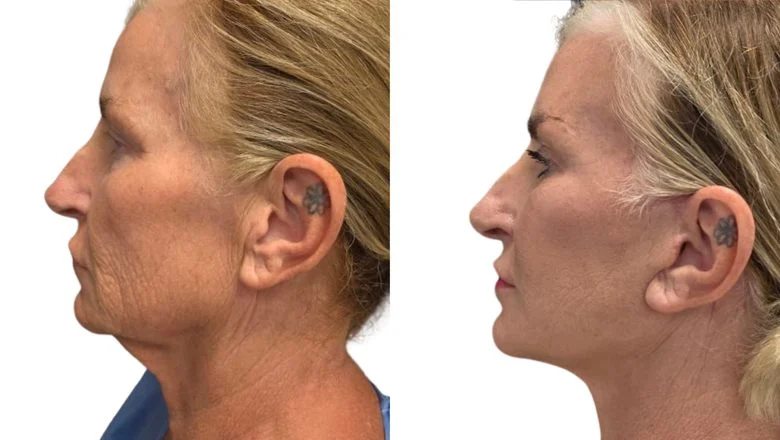
When skin is genuinely loose, surgery is the most reliable way to remove it, because it can excise excess skin and reposition the tissue beneath. In the pilot study of seven patients mentioned above, facelift reduced apparent age by about 6.0 years on blinded review, similar to the reduction in the comparison group[2]. A 2024 patient guide to cosmetic procedures after massive weight loss likewise lists facelift among the options for the face[14].
Facelift and mini facelift
A facelift addresses jowls and sagging in the lower and mid face by lifting the deeper tissues and removing excess skin, with incisions in front of and behind the ear. Male facelift surgery follows the same principles while preserving a masculine appearance, usually with less added volume. A mini facelift uses shorter incisions and focuses on the jawline, jowls and upper neck, so it suits less advanced sagging. A one-stitch facelift is generally better suited to early midface changes in people at a stable weight than to the significant laxity that follows major weight loss. The right operation is decided at assessment, and our guide to face and neck lift surgery after weight loss goes through it in detail.
Neck lift
A neck lift tightens loose neck skin and, where needed, the muscle beneath it. Our guide to the types of neck lift explains the two main approaches: removing and repositioning loose skin (cervicoplasty), and tightening the platysma muscle with fat removal beneath the chin (platysmaplasty), which is a more extensive operation. It is often combined with a facelift and sometimes with chin liposuction.
Eyelid and brow surgery
Loose upper eyelid skin and a low brow can be addressed with eyelid surgery and a brow lift, which are often combined with a facelift and neck lift for a balanced result.
Facial fat transfer
Fat transfer to the face uses your own fat, taken by liposuction from another area and injected where volume has been lost. A systematic review of 19 studies and 510 patients found that injection volumes varied widely between surgeons and areas[13], and a systematic review of temporal fat grafting highlighted unpredictable retention[12]. Grafted fat also behaves like other fat in your body, so it can shrink if you keep losing weight. Our guide to whether facial fat transfer is permanent and our comparison of fat transfer vs fillers cover this in more depth.
When Should You Have a Facelift or Neck Lift After Weight Loss?
Surgeons generally prefer weight to have been stable for some time before a lift, because further weight loss can leave new laxity and further gain can alter the result. Your surgeon will advise on timing for your situation, including whether you are still taking a weight-loss medicine. Smoking, other health conditions and the amount of loose skin all influence planning, and every operation carries risks that will be explained at consultation.
Frequently Asked Questions: Face and Neck After Weight Loss
Does losing weight change your face?
Yes. Fat is lost from the face along with the rest of the body, so the cheeks, jawline and neck usually look slimmer. Some people look more defined, while others look hollow or older, especially after large or rapid weight loss[1].
Why does my face look older after losing weight?
Fat loss removes the rounded contours of the cheeks and temples, and skin that has been stretched may not tighten fully. In a pilot study of seven patients with massive weight loss, reviewers judged their faces to look 5.1 years older than their real age before surgery[2].
Does face skin tighten after weight loss?
Sometimes, partly. Younger skin and gradual loss tend to adapt better. After large weight loss, loose skin often persists, and in one study skin biopsies still showed disorganised collagen a year after bariatric surgery[3]. Established laxity usually needs treatment.
Does neck fat go away when you lose weight?
Some does, as overall body fat falls. You cannot choose where the fat comes off, and fullness under the chin can persist in some people. Loose neck skin will not tighten through fat loss alone.
Why does my chin sag after weight loss?
As fat under the chin and along the jaw reduces, the skin there can be left without support and fold or hang. Weakness of the platysma muscle can add to the look. Treatment ranges from radiofrequency tightening for mild cases to a neck lift when the skin is loose.
How do you fix a sagging face after weight loss?
It depends on what has changed. Hollowing is treated with fillers or fat transfer, mild laxity with energy-based tightening, and significant loose skin with a facelift or neck lift, often combined with volume restoration. A consultation identifies which layer is responsible.
How can you plump your face after weight loss naturally?
You cannot target fat gain in the face, and we are not aware of reliable evidence that creams, supplements or facial exercises restore lost facial volume. Protein, hydration and sun protection support skin health generally. Restoring volume reliably means fillers or fat transfer.
What is Ozempic face?
It is an informal name for facial hollowing, volume loss and loose skin seen in some people who lose weight quickly on weight-loss injections. Reviews attribute it to rapid weight loss rather than a unique effect on the face[4][6].
How do you get rid of turkey neck after weight loss?
Mild looseness may improve with radiofrequency-based tightening, but a pronounced turkey neck, especially with visible bands, usually needs a neck lift to remove loose skin and tighten the muscle. See our turkey neck guide.
Can a facelift fix a face after weight loss?
A facelift can remove loose skin and lift sagging tissue. In one small pilot study, apparent age fell by about six years after facelift in patients with massive weight loss[2]. It does not replace lost volume, so it is often combined with fat transfer or fillers.
Face and Neck Rejuvenation After Weight Loss in London
If weight loss has left you with sagging skin or a hollow face, a consultation at our CQC-regulated hospital in Marylebone can establish whether the main issue is volume, loose skin or both, and which options are realistic for you. Your surgeon will explain the risks, recovery and alternatives, including waiting if your weight is still changing. See our facelift, neck lift and dermal filler pages for more.
Phone: 020 7993 4849 | Address: 95–97 Baker Street, Marylebone, London W1U 6RN
Contact us to schedule a consultation
References
- Jafar AB, Jacob J, Kao WK, Ho T. Soft tissue facial changes following massive weight loss secondary to medical and surgical bariatric interventions: a systematic review. Aesthetic Surgery Journal Open Forum 2024;6:ojae069. doi:10.1093/asjof/ojae069 ↗
- Couto RA, Waltzman JT, Tadisina KK, et al. Objective assessment of facial rejuvenation after massive weight loss. Aesthetic Plastic Surgery 2015;39(6):847–855. doi:10.1007/s00266-015-0540-6 ↗
- Joudatt LLC, Zotarelli-Filho IJ, de Quadros LG, et al. Histological skin assessment of patients submitted to bariatric surgery: a prospective longitudinal cohort study. Obesity Surgery 2023;33(3):836–845. doi:10.1007/s11695-023-06453-1 ↗
- Barone M, Brunetti B, D’Emilio R, Caputo MG, Tenna S, Persichetti P. Effects of GLP-1 receptor agonists on skin quality: a comprehensive literature review. Aesthetic Plastic Surgery 2026;50(13):5403–5407. doi:10.1007/s00266-026-05820-4 ↗
- Seidel DU, Bode S. Rapid weight loss through GLP-1 receptor agonists as lifestyle phenomenon and implications for plastic esthetic medicine. HNO 2025;73(11):765–770. doi:10.1007/s00106-025-01653-w ↗
- Bijoch J. Anti-obesity medications in longevity and aesthetic medicine. Journal of Clinical Medicine 2026;15(15):6026. doi:10.3390/jcm15156026 ↗
- Boehm LM, Morgan A, Hettinger P, Matloub HS. Facial aging: a quantitative analysis of midface volume changes over 11 years. Plastic and Reconstructive Surgery 2021;147(2):319–327. doi:10.1097/PRS.0000000000007518 ↗
- Ren R, Xue H, Gao Z, et al. Restoring long-lasting midface volume in the Asian face with a hyaluronic acid filler: a randomized controlled multicenter study. Journal of Cosmetic Dermatology 2024;23(6):1985–1991. doi:10.1111/jocd.16221 ↗
- Demesh D, Cristel RT, Gandhi ND, Kola E, Dayan SH. The use of radiofrequency-assisted lipolysis with radiofrequency microneedling in premature jowl and neck laxity following facialplasty. Journal of Cosmetic Dermatology 2021;20(1):93–98. doi:10.1111/jocd.13824 ↗
- Arnaoutakis D, Kochhar A, Magro I, Karimi K. The role of subcutaneous radiofrequency-assisted liposculpture in the facial plastic surgeon’s practice. Facial Plastic Surgery & Aesthetic Medicine 2022;24(S1):S11–S16. doi:10.1089/fpsam.2022.0225 ↗
- Stein MJ, Vranis NM, Aston SJ. An anatomical approach to radiofrequency-assisted facial rejuvenation: beyond the treatment gap. Aesthetic Surgery Journal 2025;45(12 Suppl 2):S1–S9. doi:10.1093/asj/sjae232 ↗
- Nasim S, Nasim H, Kauke M, Safi AF. Autologous fat grafting for cosmetic temporal augmentation: a systematic review. Frontiers in Surgery 2024;11:1410162. doi:10.3389/fsurg.2024.1410162 ↗
- Shue S, Kurlander DE, Guyuron B. Fat injection: a systematic review of injection volumes by facial subunit. Aesthetic Plastic Surgery 2018;42(5):1261–1270. doi:10.1007/s00266-017-0936-6 ↗
- Handal M, Handal J, Nevill T, Finkelstein P, Kichler K. Cosmetic procedures after massive weight loss surgery: a guide for prospective patients. Cureus 2024;16(11):e72864. doi:10.7759/cureus.72864 ↗