


In this guide16 sections
- Key Points
- How Do I Choose a Top Surgery Surgeon in the UK?
- How Do I Check a Surgeon Is on the GMC Register?
- What Qualifications Should a Top Surgery Surgeon Have?
- How Do I Check a Clinic’s CQC Rating?
- How Much Experience Should a Top Surgery Surgeon Have?
- What Should I Look for in Top Surgery Before and After Photos?
- Will the Surgeon I Meet at Consultation Do My Operation?
- What Is the Revision Policy for Top Surgery?
- What Aftercare Should a Top Surgery Clinic Provide?
- What Are the Red Flags When Choosing a Top Surgery Surgeon?
- What Questions Should I Ask at My Top Surgery Consultation?
- What Should I Ask Myself Before Top Surgery?
- Frequently Asked Questions
- FTM Top Surgery in London
- References
Key Points
- Start with what you can check yourself. Look the surgeon up on the GMC register and read the hospital’s latest CQC report before you book.
- Experience in gender-affirming chest surgery matters more than a title. Ask how many top surgeries the surgeon does each year and which techniques they offer.
- Judge healed results, not fresh ones. Ask for before and after photos taken 12 months or more after surgery, across different chest sizes and techniques.
- Know who does what. The surgeon you meet at consultation should be the surgeon who performs your operation.
- Ask about aftercare and revisions up front. Find out who you call after surgery, which follow-ups are included and what a revision would involve.
- Walk away from pressure. Time-limited discounts, no time to reflect and overseas packages with no local aftercare are red flags.
To choose the right top surgery surgeon in the UK, check that they are registered with a licence to practise on the GMC medical register ↗, that they operate in a hospital regulated by the Care Quality Commission (CQC), and that they have regular experience of gender-affirming chest surgery across a range of techniques. Then look closely at healed before and after photos, ask who will actually perform your operation, and find out exactly what aftercare and revisions are included. A good surgeon will answer all of this openly.
FTM top surgery is permanent, and the surgeon you choose shapes your scars, your nipple position and your recovery. This guide explains how to check a surgeon’s registration and qualifications, how to read a CQC rating, how to judge experience and results, which red flags to look out for, and the questions to ask your surgeon and yourself. For the practical steps before your operation, see our guide on how to prepare for top surgery; for the techniques themselves, see our overview of FTM top surgery options.
How Do I Choose a Top Surgery Surgeon in the UK?
It is easiest to put the same questions to every surgeon and clinic you are considering, and compare the answers side by side:
- Registration: is the surgeon on the GMC register with a licence to practise, and on the Specialist Register for plastic surgery?
- Regulation: is the hospital registered with the CQC, and what is its latest rating?
- Experience: how much gender-affirming chest surgery does the surgeon do, and how many techniques do they offer?
- Results: can you see healed photos of their own patients, with chests similar to yours?
- Continuity: will the surgeon you meet perform your operation and see you afterwards?
- Aftercare and revisions: what follow-up is included, and what does a revision cost?

This groundwork pays off. A 2025 long-term follow-up study in the Journal of Clinical Medicine ↗, covering patients operated on over 20 years, found that how well people felt informed before surgery was closely linked with their satisfaction with their chest and their wellbeing years later[1].
How Do I Check a Surgeon Is on the GMC Register?
Every doctor practising in the UK must be registered with the General Medical Council (GMC) and hold a licence to practise. The GMC’s online register is free to search by name or GMC reference number. For any surgeon you are considering, check:
- Registration status: registered, with a licence to practise.
- Specialist Register entry: if the surgeon is on it, the register shows their specialty, such as plastic surgery.
- Any restrictions: the register shows if a doctor currently has conditions, warnings or undertakings on their practice.
Search the GMC register ↗ using the surgeon’s full name, or their GMC number if the name is common.
Entry on the Specialist Register in plastic surgery shows that a surgeon has completed recognised specialist training. It is a strong signal, but not the only route to experience: some surgeons with substantial experience in gender-affirming chest surgery trained abroad or followed a different pathway. If a surgeon is not on the Specialist Register, ask them to explain their training and how much top surgery they do.
What Qualifications Should a Top Surgery Surgeon Have?
In the UK, “cosmetic surgeon” is not a protected title, and any doctor on the GMC register can legally offer cosmetic surgery. That is why registration and specialist training matter more than how a surgeon describes themselves. Other useful signals include:
- FRCS (Plast): the specialty fellowship examination in plastic surgery, usually taken towards the end of UK plastic surgery training.
- Professional bodies: membership of the British Association of Plastic, Reconstructive and Aesthetic Surgeons (BAPRAS) ↗ or the British Association of Aesthetic Plastic Surgeons (BAAPS) ↗, each with its own membership criteria.
- Specific training in gender-affirming surgery, such as a fellowship or an NHS post in plastic or breast surgery.
Treat these as helpful extras rather than requirements: what matters most is proper registration, training in breast and chest surgery, and regular, recent experience of the operation you want.
How Do I Check a Clinic’s CQC Rating?
In England, independent hospitals that carry out surgery must be registered with the Care Quality Commission (CQC), which inspects them and publishes its reports. Scotland, Wales and Northern Ireland have their own regulators: Healthcare Improvement Scotland, Healthcare Inspectorate Wales and the RQIA.
Search for the hospital by name on the CQC website. Each location has an overall rating and a rating for five key questions: is it safe, effective, caring, responsive and well-led? The CQC explains its ratings here ↗. When you read a report, look at:
- The overall rating and the “safe” rating, as these matter most for surgery.
- The date of the last inspection, and any concerns raised.
- The address, to make sure the rating covers the building where you will have your operation, not a separate consulting room.
Centre for Surgery is regulated by the CQC and rated Good overall by the CQC ↗. We also publish our clinical outcomes and patient safety data, and it is reasonable to ask any clinic whether it publishes its own.
How Much Experience Should a Top Surgery Surgeon Have?
There is no official minimum, but top surgery is a specialised operation and results improve with practice. Ask each surgeon how many gender-affirming chest operations they perform each year, how long they have been doing them, and what their own complication and revision rates are.
Published series give a useful benchmark. In a 2025 study of 560 patients in Aesthetic Plastic Surgery ↗, bleeding under the skin (haematoma) occurred in 10.8% of patients, but only 1.7% needed to go back to theatre, and 9% had a minor touch-up procedure[2]. A 13-year series from a Portuguese reference centre reported revision surgery in 8% of patients[3], and a systematic review found haematoma rates ranging from 0% to over 30% across studies, with higher rates after more limited, nipple-sparing incisions[4]. A surgeon who knows their own figures and explains them honestly is a good sign.
Why the range of techniques matters
There is no single top surgery. The right technique depends on your chest size, how much the chest droops, your skin elasticity, your nipple size and position, and your priorities. A surgeon who offers several techniques can recommend the one that suits your chest, rather than the only one they do. Experienced centres describe matching the technique to chest volume, droop and nipple position[5].
At Centre for Surgery we offer double incision with free nipple grafts, nipple-sparing double incision, inverted T, keyhole and periareolar top surgery, as well as top surgery without nipples. If keeping feeling matters to you, our guide to nipple sensation after top surgery compares the techniques.
What Should I Look for in Top Surgery Before and After Photos?
Before and after photos are one of the best ways to judge a surgeon’s work. Ask to see a range of their own patients, and check:
- Healed results: photos taken 12 months or more after surgery show how the scars have settled. Early photos can look neater or redder than the final result.
- Chests like yours: similar size, skin and body shape, and the technique you are likely to have.
- Scars: whether they sit along the lower border of the chest muscle, without “dog ears” (small folds of extra skin) at the ends.
- Nipples: whether they look natural for a masculine chest and are level with each other.
- Consistency: the same lighting and angle before and after, including side views, with no filters or editing.
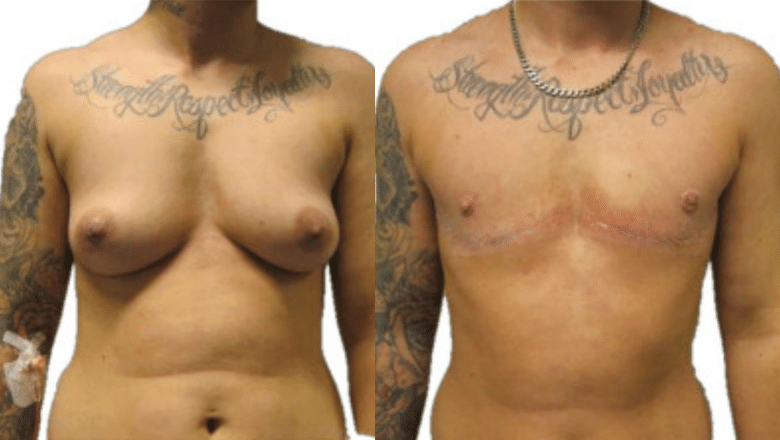
Ask whether the photos are of the surgeon who would operate on you, as a clinic gallery may include several surgeons. You can see more results in our FTM top surgery before and after photos.
Will the Surgeon I Meet at Consultation Do My Operation?
It should be, but it is worth asking. At some clinics the first appointment is with a patient adviser, a nurse or a junior doctor, and you meet the operating surgeon only briefly on the day.
Ask directly: who will I see at consultation, who will perform the operation, who gives the anaesthetic, and who will see me at follow-up? At Centre for Surgery, the consultant who assesses you at consultation is the consultant who performs your surgery, and your anaesthetic is TIVA (total intravenous anaesthesia), given by a consultant anaesthetist.
What Is the Revision Policy for Top Surgery?
Even with careful planning, some people need a small second procedure to refine their result. In an Italian series of 68 patients, additional procedures to improve appearance were carried out in 14.7% of cases[6], in line with other centres[2][3]. The most common revisions are removing dog ears, liposuction to smooth the contour, scar revision and adjusting the nipples.
Revisions are usually planned no sooner than 9 to 12 months after surgery, as much of what bothers people at three or six months improves on its own as swelling settles. Before you book, ask each clinic how often its patients need revisions, which are included and which are charged, and whether the same surgeon would do them. At Centre for Surgery, some revisions are included in your package and some are charged, and we set this out at consultation.
What Aftercare Should a Top Surgery Clinic Provide?
As a guide, good aftercare should include:
- A clear point of contact for the first 24 hours and afterwards, and advice on what to do out of hours.
- A wound check around 7 to 10 days after surgery.
- A review with your surgeon at around six weeks, and a further assessment at around three months.
- Written instructions on your compression binder, wound care, activity and returning to work.
At Centre for Surgery, all pre-operative consultations and follow-up appointments are included. You have your surgeon’s direct number for the first 24 hours; after that, call us on 020 7993 4849, 9am to 6pm, Monday to Saturday, and out of hours call NHS 111, or 999 in an emergency. If you are travelling to London, we advise staying locally until your wound check. Our FTM top surgery recovery guide sets out what happens week by week.
What Are the Red Flags When Choosing a Top Surgery Surgeon?
Be cautious of any surgeon or clinic that:
- Pressures you to book at your first appointment, or asks for a large non-refundable deposit before you have met the surgeon.
- Offers discounts with deadlines, such as a price only valid if you book this week.
- Gives you no cooling-off period and books surgery within days of your first consultation.
- Will not tell you who will operate, or will not give you the surgeon’s GMC number.
- Offers one technique for everyone, whatever their chest size or skin.
- Plays down the risks, or shows only a few early or edited photos.
- Sells packages abroad with no aftercare at home, leaving you to find help if something goes wrong.
Surgery abroad deserves particular care. A 2023 systematic review in the Annals of Plastic Surgery ↗ identified 589 patients treated for complications after cosmetic surgery performed abroad; infection was the most common, followed by wound breakdown, fluid or blood collections and tissue loss[7]. The NHS guidance on cosmetic surgery abroad ↗ explains what to check. Whatever you decide, know who will check your wounds and who will treat you if a problem develops after you fly home.
At Centre for Surgery we recommend a two-week cooling-off period between consent and surgery, and further consultations before surgery are free if you have more questions.
What Questions Should I Ask at My Top Surgery Consultation?
Write your questions down before you go, and take notes or bring someone with you.
About the surgeon
- What is your GMC number, and are you on the Specialist Register for plastic surgery?
- How many gender-affirming chest operations do you perform each year, and which techniques do you offer?
- Will you perform my whole operation and see me at follow-up?
About the technique and your result
- Which technique do you recommend for my chest, and why?
- Where will my scars be, and how long will they be?
- Can I keep my nipples attached, and what does that mean for sensation? Can I choose no nipples?
- Can I see healed photos of your patients with chests like mine?
About safety and risks
- What are the most common complications, and what are your own rates?
- Where will I have my operation, and what is the hospital’s CQC rating?
- What happens if I have a problem after surgery, including at night or at weekends?
About aftercare, revisions and cost
- How many follow-up appointments are included, and when are they?
- How often do your patients need a revision, and what would I pay for one?
- What does my quote include, and what is charged separately?
At Centre for Surgery your written quote covers the surgeon’s and anaesthetist’s fees, theatre and hospital fees, and all follow-up appointments. The compression garment and medicines are bought separately, and histology is charged separately where tissue is sent for analysis; your patient coordinator confirms these in advance. Our FTM top surgery cost guide explains current prices, and finance is available, subject to status. If you are weighing up waiting for NHS surgery, our guide to NHS vs private FTM top surgery in the UK compares the routes.
What Should I Ask Myself Before Top Surgery?
Choosing a surgeon is easier when you are clear about what you want. Before your consultation, think about:
- Your goals: as flat as possible, or some contour? Nipples kept, resized or none at all? Our non-binary top surgery page covers more flexible options.
- Your priorities: which matters more, chest shape, scar length or keeping nipple sensation? Techniques trade these off differently.
- Your timing and support: can you take around two weeks off desk work, and who will stay with you for the first 24 hours?
- Your certainty: top surgery is permanent. If you have doubts, talk them through before you consent.
You do not need a diagnosis, a GP referral or a WPATH letter for top surgery at Centre for Surgery, and top surgery is for adults aged 18 and over. A psychological report is not required, but we recommend one if you are in the early stages of exploring gender-affirming care.
Regret after top surgery is rare. In a 2023 cross-sectional study in JAMA Surgery ↗, 139 people who had a gender-affirming mastectomy at one US centre between 1990 and 2020 reported very high satisfaction with their decision and very low regret, and none had requested or undergone reversal[8]. Our article on regret after top surgery looks at the evidence in more detail.
Frequently Asked Questions
Who are the best top surgery surgeons in the UK?
There is no official ranking. The right surgeon for you is GMC-registered, ideally on the Specialist Register for plastic surgery, works in a CQC-regulated hospital, performs gender-affirming chest surgery regularly and offers several techniques. Compare healed before and after photos, ask about complication and revision rates, and choose the surgeon who explains your options clearly without pressure.
What are the signs that a plastic surgeon is good?
A good plastic surgeon examines your chest properly, explains why they recommend a technique, talks openly about risks and their own results, and shows you healed photos of their own patients. They give you written information, encourage you to take time to decide, and are the person who performs your operation and sees you afterwards.
Is a plastic surgeon better than a cosmetic surgeon for top surgery?
In the UK, “cosmetic surgeon” is not a protected title, so it says little about training. A plastic surgeon has completed surgical training that includes breast and chest reconstruction. For top surgery, look for a GMC-registered surgeon with plastic surgery training and regular experience of gender-affirming chest surgery, whatever title they use.
How old do you have to be for top surgery in the UK?
Private top surgery in the UK is generally for adults aged 18 and over, and at Centre for Surgery you must be 18 or over. NHS top surgery is also for adults and follows assessment at an NHS gender dysphoria clinic.
Is it safe to have top surgery abroad?
It can be, but it carries extra risks. Complications such as infection or wound problems may appear after you fly home, when your surgeon is no longer nearby, and flying soon after surgery raises the risk of blood clots. If you are considering surgery abroad, check the surgeon’s credentials carefully and arrange aftercare in the UK before you book.
Do I need a referral to see a top surgery surgeon privately?
Not at Centre for Surgery. You can book a consultation directly, without a GP referral, a diagnosis or a WPATH letter. Some other private providers and NHS gender services have their own requirements, so check what each one asks for before you book.
FTM Top Surgery in London
FTM top surgery at Centre for Surgery is performed by GMC-registered surgeons at our CQC-regulated Baker Street hospital, rated Good overall by the CQC, for trans men and non-binary people. We offer double incision with free nipple grafts, nipple-sparing double incision, inverted T, keyhole and periareolar top surgery, and your surgeon will recommend the technique that suits your chest and priorities. No diagnosis or referral letter is needed. The consultant who assesses you at consultation is the consultant who performs your surgery. Your initial consultation fee is redeemable against the cost of surgery if you go ahead.
Phone: 020 7993 4849 | Address: 95–97 Baker Street, Marylebone, London W1U 6RN
Contact us to schedule a consultation
References
- Kwartin S, Skorochod R, Shapira E, et al. Long-term follow-up of gender-affirming chest masculinization: what have we learned about patient satisfaction and psychological well-being? Journal of Clinical Medicine 2025;14(4):1249. doi:10.3390/jcm14041249 ↗
- Lo Russo G, Scortecci L, Ruccia F, et al. A new algorithm for masculine chest-wall contouring in 560 trans-AFAB (assigned female at birth) patients: clinical outcomes and patient-reported satisfaction using the TRANS-Q questionnaire. Aesthetic Plastic Surgery 2025;49(19):5508–5521. doi:10.1007/s00266-025-04942-5 ↗
- Catalão I, Azevedo JM, Sítima M, et al. Mastectomy in transgender patients: the experience of a Portuguese reference center. JPRAS Open 2026;48:924–932. doi:10.1016/j.jpra.2026.01.044 ↗
- Bekisz JM, Boyd CJ, Daar DA, et al. Hematoma following gender-affirming mastectomy: a systematic review of the evidence. Journal of Plastic, Reconstructive and Aesthetic Surgery 2022;75(9):3108–3121. doi:10.1016/j.bjps.2022.04.081 ↗
- Tse T, Potter E, Armstrong K. Techniques for preserving the nipple areolar complex in chest masculinization for all chest sizes. Cureus 2025;17(3):e80757. doi:10.7759/cureus.80757 ↗
- Morselli PG, Summo V, Pinto V, et al. Chest wall masculinization in female-to-male transsexuals: our treatment algorithm and life satisfaction questionnaire. Annals of Plastic Surgery 2019;83(6):629–635. doi:10.1097/SAP.0000000000002119 ↗
- Alkaelani MT, Koussayer B, Blount T, et al. Complications of medical tourism in aesthetic surgery: a systematic review. Annals of Plastic Surgery 2023;91(6):668–673. doi:10.1097/SAP.0000000000003683 ↗
- Bruce L, Khouri AN, Bolze A, et al. Long-term regret and satisfaction with decision following gender-affirming mastectomy. JAMA Surgery 2023;158(10):1070–1077. doi:10.1001/jamasurg.2023.3352 ↗

Related Articles
- What Are My Options for FTM Top Surgery?
- FTM Top Surgery Before & After Photos
- How to Prepare for Top Surgery: What to Know Before Your FTM Mastectomy
- NHS vs Private FTM Top Surgery in the UK — Routes, Waiting Times and Costs Compared






