

In this guide12 sections
- Key Points
- Do You Need to Be on HRT for FFS?
- How Does HRT Change Your Face?
- How Long Does HRT Take to Change Your Face?
- Does HRT Change Bone Structure?
- Why Do Some Surgeons Recommend Waiting on HRT Before FFS?
- Should You Stop Oestrogen Before FFS?
- Does HRT Affect FFS Recovery?
- Planning FFS Without HRT
- Frequently Asked Questions
- Facial Feminisation Surgery in London
- References
Key Points
- You do not need to be on HRT to have facial feminisation surgery (FFS). At Centre for Surgery, adults aged 18 and over can book directly, with no diagnosis, GP referral or WPATH letter.
- HRT changes soft tissue, not bone. Oestrogen gradually adds fullness to the cheeks and softens the skin, with most visible facial change over the first one to two years.
- Bone work can be done at any time. The brow ridge, jaw, chin, nasal bones and Adam’s apple do not change on hormones once puberty is complete, so forehead, jaw, chin and nose surgery does not depend on HRT.
- Some surgeons suggest waiting before soft tissue work. If you are on HRT, a period of stable hormones lets cheek volume settle before procedures such as fat transfer to the face.
- Do not stop oestrogen on your own. Our guidance is not to stop prescribed hormones without advice from your surgical team and prescriber, who review your individual clot risk before surgery.
- The evidence on continuing oestrogen is reassuring. Large FFS studies have found blood clots to be rare in people who kept taking their hormones through surgery.
No, you do not need hormone therapy before facial feminisation surgery. Facial feminisation surgery (FFS) works mainly on bone and cartilage, such as the brow ridge, jaw, chin, nose and Adam’s apple, and these are structures that feminising hormones cannot change once puberty is complete. HRT can soften the skin and add a little fullness to the cheeks over time, which some people like to have in place before soft tissue procedures, but it is not a requirement for surgery. Many people have FFS without HRT, before starting it, or alongside it.
This guide explains what HRT does and does not do to the face, why some surgeons suggest waiting before certain procedures, whether you need to stop oestrogen before surgery, and how FFS is planned without HRT. The same principles apply to chest surgery, which we cover in our guide to MTF breast augmentation without hormones.
Do You Need to Be on HRT for FFS?
No. Hormone therapy is not a condition of facial feminisation surgery at Centre for Surgery. Adults aged 18 and over can book an FFS consultation directly, and you do not need a diagnosis, a GP referral, a gender clinic letter or a WPATH letter. Your surgeon’s role is to assess your facial anatomy and explain what each procedure can achieve, not to decide whether your reasons for wanting surgery are good enough.
Older surgical protocols, particularly in the United States, often asked for a period on hormones before any gender-affirming surgery. That made more sense for chest surgery, where oestrogen grows breast tissue, than for the face, where the features that most often lead to misgendering are made of bone. FFS is also not only for trans women. Non-binary people and cisgender women who want a softer facial outline have the same procedures, and many of them never take feminising hormones.
We do ask you to bring a list of any hormones you take, including the dose, how you take them and who prescribes them. That shapes your pre-operative assessment, not your eligibility.
How Does HRT Change Your Face?
Feminising hormone therapy usually combines oestrogen with a medicine that blocks or lowers testosterone. In the face, its effects are on the soft tissues: fat, skin and hair.
- Fat redistribution. Fat tends to build up in the cheeks and mid-face and reduce slightly along the jaw, which softens the overall outline.
- Skin. The skin usually becomes softer, thinner and less oily. Acne linked to testosterone often settles.
- Facial hair. Growth slows and the hairs become finer, but most people still need laser hair removal or electrolysis for a beard area.
- Scalp hair. Lowering testosterone usually slows or stops further male-pattern hair loss, but it rarely brings back a hairline that has already receded.
These changes are real, but they are subtle. In a 2019 prospective 3D scanning study in the Journal of Sexual Medicine ↗, 27 trans women starting hormones in Amsterdam had their faces scanned at baseline, three months and twelve months. After a year, cheek tissue had moved forwards by around 1 mm and tissue over the jaw had reduced slightly, changes that had already begun by three months. Satisfaction with facial appearance increased over the same period[1].
A 2025 study using 3D photography in Brazil found a similar pattern: trans women gained volume first in the mid-face, forehead and lips at three and six months, with more widespread gains by twelve months, and the changes were described as gradual and regional rather than dramatic[2].
How Long Does HRT Take to Change Your Face?
Facial changes on oestrogen build slowly. The Endocrine Society’s clinical practice guideline sets out the expected onset and timing of feminising effects[3], and in the face that translates roughly to:
- Months 3 to 6: skin starts to soften and become less oily, and fat begins to redistribute.
- Months 6 to 12: facial hair growth slows and becomes finer. Cheek fullness becomes more noticeable.
- Years 1 to 2: most of the visible change in facial shape happens by now.
- Years 2 to 5: fat redistribution can continue slowly, so the face may keep softening a little.
The Amsterdam researchers noted that faces were still changing at twelve months and suggested that FFS after one year of hormones might, for soft tissue planning, be too early[1]. That point applies to fat and skin. It does not apply to bone.

Does HRT Change Bone Structure?
Not in the face, once puberty is complete. Testosterone during puberty shapes the facial skeleton, and those changes are permanent. Oestrogen in adulthood does not shrink or reshape bone, so the features below stay as they are on HRT:
- Brow bossing. The ridge above the eyes, often with a large frontal sinus behind it, is one of the strongest cues the brain uses to read a face as male. Forehead contouring reduces it.
- Jaw angle and width. A wide, square lower jaw is bone. Jaw contouring reduces the angle through incisions inside the mouth.
- Chin. A tall, broad or square chin is reshaped with genioplasty (chin surgery).
- Nasal skeleton. The bony and cartilage framework of the nose, including a dorsal hump and a wide bony base, does not change on hormones. Rhinoplasty addresses it.
- The Adam’s apple. The thyroid cartilage stays the same size on HRT. A tracheal shave reduces it through a small incision in a neck crease; our article on whether you can remove an Adam’s apple explains what is involved.
- Hairline shape. A high or M-shaped hairline does not move forwards on hormones. Hairline lowering or forehead contouring can shorten the forehead.
Hormones also do not raise the pitch of a voice that has already broken. Voice training with a speech and language therapist is the usual first step for people who want a more feminine voice; voice feminisation surgery is not a procedure we offer.
In short, HRT can soften the surface of the face, while FFS changes the framework underneath it. That is why many people find that hormones alone do not resolve facial dysphoria, and why bone work does not need to wait for hormones.
Why Do Some Surgeons Recommend Waiting on HRT Before FFS?
If you are already taking oestrogen, or plan to start soon, some surgeons suggest a period on stable hormones before certain procedures. The reasoning is about soft tissue, not safety:
- Volume procedures. Cheek augmentation with implants or facial fat transfer is easier to plan once the cheeks have gained whatever fullness hormones will give them. Adding volume to a face that is still filling out can risk overcorrection.
- Skin quality. Thinner, less oily skin can drape more neatly over a reshaped framework, which some surgeons feel helps fine details, such as the nasal tip, show through.
None of this applies to bone. Forehead contouring, jaw contouring, genioplasty and the bony part of rhinoplasty give the same structural result whether or not you take hormones, so they can be planned at any time. A common approach is to do bone work first and leave soft tissue fine-tuning, such as fat transfer or a lip lift, until later if needed.
The evidence also suggests that time on hormones does not make FFS safer. In a 2024 systematic review and meta-analysis in the Journal of Craniofacial Surgery ↗, which also analysed one New York surgeon’s FFS patients, how long people had been on hormones made no difference to overall complications, wound infection, haematoma, blood clots or the revision rate[4]. Waiting is a planning choice, not a requirement, to be weighed against living with facial dysphoria in the meantime.
Should You Stop Oestrogen Before FFS?
Usually not, and never on your own. Our guidance is not to stop prescribed hormones without advice from your surgical team and your prescriber. Oestrogen does raise the risk of venous thromboembolism (VTE), meaning a blood clot in a leg vein (deep vein thrombosis) or the lungs (pulmonary embolism), so your hormones, your dose and how you take them are reviewed at your pre-operative assessment alongside your other clot risk factors. If anything needs to change, you will be told what to do and when, and your prescriber should be part of that plan.
For many years, the standard advice was to stop oestrogen two to four weeks before any gender-affirming surgery. That advice came mainly from concern about long pelvic operations and from older types of oestrogen that carried a higher clot risk. Stopping has costs too: hot flushes, low mood, disturbed sleep and a return of dysphoria at a stressful time. The evidence has since moved towards continuing hormones in many cases, with each person’s clot risk assessed individually:
- FFS specifically. In a 2024 retrospective cohort study of 953 FFS patients in Plastic and Reconstructive Surgery ↗, most of whom continued full-dose hormones through surgery, one patient (0.10%) developed a VTE, a rate comparable with other cosmetic and jaw surgery. There was no difference between those who continued, reduced or stopped hormones, and the authors concluded it is reasonable to continue them[5].
- Pooled evidence. The 2024 meta-analysis pooled 11 studies: VTE occurred in 0.49% of 602 patients who stopped hormones and 0.11% of 925 who continued them. The numbers were too small for firm conclusions, and the authors recommended shared decision-making rather than one protocol for everyone[4].
- Another FFS cohort. A 2023 study of 282 FFS patients in Boston, most of whom were prescribed hormones (although many paused them before surgery) and none of whom received blood-thinning injections, recorded no VTE up to six months after surgery[6].
- Longer operations. Even in longer gender-affirming operations, a 2021 study found no increase in VTE among 212 cases where oestrogen was continued, compared with 190 where it was paused for a week[7].
These studies are reassuring, but they are mainly retrospective, and blood clots are uncommon enough that small differences are hard to detect. A review of the evidence concluded that, in the absence of definite risk factors such as smoking, a clotting disorder or cancer, the hormone plan should be agreed between surgeon and patient case by case[8]. Things that can tip the balance include a previous blood clot or a family history of clots, a known clotting disorder, smoking, a higher BMI, older age, a long-haul flight close to surgery, and the length of the operation itself, as comprehensive FFS can take four to six hours.
Whatever the plan, you can lower your risk yourself: stop all nicotine, including vaping, for four weeks before and four weeks after surgery, and get up and walk little and often from the day of surgery.
Does HRT Affect FFS Recovery?
Recovery depends on which procedures you have, not on whether you take hormones. Surgery is carried out under TIVA (total intravenous anaesthesia) for bone work and combined procedures, and some isolated soft tissue procedures can be done under local anaesthetic with sedation. A single procedure takes one to two hours; comprehensive FFS takes four to six. Most people go home the same day, and a responsible adult needs to stay with you for the first 24 hours after TIVA. Very extensive combinations may include a planned overnight stay.
- Swelling peaks around days two to three, more after bone work. Sleeping with your head raised for two weeks helps.
- A soft diet is needed for one to two weeks after jaw or chin work.
- Desk work is usually possible after 7 to 14 days following soft tissue procedures, or two to three weeks after bone work.
- Strenuous exercise and contact sport wait for six weeks, and scars should be kept out of direct sun for three months.
- Follow-up includes a wound check at one week, a surgeon review at six weeks and an assessment at three months. The final result settles at three to six months.
In the first 24 hours you have your surgeon’s direct number. After that you can call us on 020 7993 4849, 9am to 6pm, Monday to Saturday. Out of hours, call NHS 111, or 999 in an emergency. Seek help straight away for swelling that is sharply worse on one side, a fever above 38°C, spreading redness, discharge from a wound, difficulty breathing or swallowing, or a painful, swollen calf or sudden breathlessness, which can be signs of a blood clot.
Planning FFS Without HRT
If you are not taking hormones, now or in the future, your surgeon plans around the face you have now. At consultation, it helps to talk through:
- Which features matter most to you. The forehead and brow often have the largest effect on how a face is read, followed by the jaw, chin and nose, but your priorities come first.
- Whether soft tissue needs extra attention. Without the cheek fullness that oestrogen adds, some people benefit from cheek augmentation with implants or fat transfer to the face alongside bone work.
- Skin and hair. Thicker, oilier skin can limit how much fine detail shows through after rhinoplasty, and facial hair will need laser or electrolysis whatever surgery you have. If your hairline is still receding, your surgeon will take that into account when advising on hairline lowering.
- One operation or two. FFS can be done in one combined session or staged, usually upper face then lower face. Combined surgery means one anaesthetic and one recovery; staged surgery means shorter operations and two recoveries.
- Bone work planning. Where bone work is planned, CT imaging is used to build a 3D model and, where they add value, patient-specific cutting guides.
After your consultation you receive an itemised written quotation, and we recommend a two-week cooling-off period before you book. You can use that time to talk to your GP or prescriber about hormones if you are considering them, but it is not a step you have to take before surgery.
Frequently Asked Questions
Can you get FFS without HRT?
Yes. Facial feminisation surgery does not depend on hormones, as it reshapes bone and cartilage that oestrogen cannot change. At Centre for Surgery, adults aged 18 and over can have FFS without HRT, and no diagnosis, referral or WPATH letter is needed. Your surgeon plans the procedures around your current facial anatomy.
How long should you be on HRT before FFS?
There is no required time. If you are on hormones, some surgeons suggest waiting until your face has stopped changing, often one to two years, before soft tissue procedures such as fat transfer to the cheeks. Bone procedures on the forehead, jaw, chin and nose can be done at any point, and time on hormones has not been shown to make FFS safer.
Can I have FFS before starting HRT?
Yes. Bone work done before you start hormones keeps its result. If you start HRT afterwards, your cheeks may gain a little fullness and your skin may soften, which usually complements the surgery. Tell your surgeon if you might start hormones later, so they can take it into account when planning any volume procedures.
Does HRT change bone structure?
Not in the face after puberty. Oestrogen softens skin and redistributes fat, but it does not reduce the brow ridge, jaw angle, chin, nasal bones or Adam’s apple. These are the features facial feminisation surgery treats, which is why hormones alone often do not change how a face is read.
Does taking oestrogen make you look more feminine?
To a degree. Over months to years, oestrogen with a testosterone blocker usually softens the skin, adds fullness to the cheeks, slows facial hair growth and can stop further hair loss. Studies using 3D scans show these facial changes are real but subtle, and they do not alter the underlying bone structure.
When should you stop oestrogen before surgery?
For FFS, many people do not need to stop at all. Our guidance is not to stop prescribed hormones without advice from your surgical team and prescriber. Your clot risk is assessed individually before surgery, and large studies of FFS have found blood clots to be rare in people who continued their hormones.
How soon after surgery can I go back on HRT?
If you continued your hormones through surgery, there is nothing to restart. If a short pause or reduced dose was agreed for you, your surgical team and prescriber will tell you when to resume, typically once you are up and moving normally. Do not change your dose without advice.
How safe is facial feminisation surgery?
FFS is major surgery when it includes bone work, but serious complications are uncommon when it is carried out by an experienced surgeon in a regulated hospital. Risks include swelling, bleeding, infection, altered sensation and the need for revision, and they depend on the procedures you have. Your surgeon will go through them at consultation.
Facial Feminisation Surgery in London
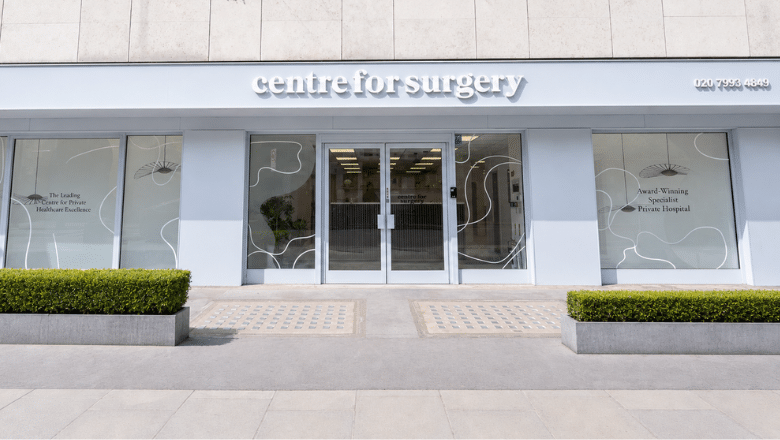
Facial feminisation surgery at Centre for Surgery is performed by GMC-registered surgeons at our CQC-regulated Baker Street hospital, rated Good overall by the CQC, for trans women, non-binary people and cisgender women aged 18 and over. Procedures include forehead contouring, hairline lowering, brow lift, rhinoplasty, eyelid surgery, cheek augmentation, lip lift, jaw contouring, genioplasty and tracheal shave, individually or combined. Hormone therapy is not required, and no diagnosis, GP referral or WPATH letter is needed. The consultant who assesses you at consultation is the consultant who performs your surgery, and we recommend a two-week cooling-off period before you book. Your initial consultation is £100, redeemable against the cost of surgery if you go ahead. Finance is available, subject to status; see our finance options.
Phone: 020 7993 4849 | Address: 95–97 Baker Street, Marylebone, London W1U 6RN
Contact us to schedule a consultation
References
- Tebbens M, Nota NM, Liberton NPTJ, et al. Gender-affirming hormone treatment induces facial feminization in transwomen and masculinization in transmen: quantification by 3D scanning and patient-reported outcome measures. Journal of Sexual Medicine 2019;16(5):746–754. doi:10.1016/j.jsxm.2019.02.011 ↗
- Mélo AM, de Souza CSP, de Oliveira Melchior M, et al. Three-dimensional facial volumetric changes in transgender individuals induced by gender-affirming hormone therapy: a stereophotogrammetric assessment. Clinical Oral Investigations 2025;29(11):493. doi:10.1007/s00784-025-06577-x ↗
- Hembree WC, Cohen-Kettenis PT, Gooren L, et al. Endocrine treatment of gender-dysphoric/gender-incongruent persons: an Endocrine Society clinical practice guideline. Journal of Clinical Endocrinology and Metabolism 2017;102(11):3869–3903. doi:10.1210/jc.2017-01658 ↗
- Laspro M, Hoffman A, Chinta S, et al. The effects of perioperative gender-affirming hormone therapy on facial feminization surgery adverse events, facial features addressed, and esthetic satisfaction: a multimodal analysis. Journal of Craniofacial Surgery 2025;36(2):600–604 (published online 2024). doi:10.1097/SCS.0000000000010840 ↗
- Li AY, Park MJ, Fick J, Ousterhout DK, Deschamps-Braly JC. Perioperative estrogen hormonal therapy does not increase venous thromboembolism risk in facial feminization surgery. Plastic and Reconstructive Surgery 2024;154(6):1309–1315. doi:10.1097/PRS.0000000000011437 ↗
- Price R, Debryn D, Mukerji S, et al. No thromboembolic complications after facial feminization surgery in transgender patients utilizing estrogen therapy: a retrospective cohort study. Transgender Health 2023;8(4):344–351. doi:10.1089/trgh.2021.0170 ↗
- Kozato A, Fox GWC, Yong PC, et al. No venous thromboembolism increase among transgender female patients remaining on estrogen for gender-affirming surgery. Journal of Clinical Endocrinology and Metabolism 2021;106(4):e1586–e1590. doi:10.1210/clinem/dgaa966 ↗
- Haveles CS, Wang MM, Arjun A, Zaila KE, Lee JC. Effect of cross-sex hormone therapy on venous thromboembolism risk in male-to-female gender-affirming surgery. Annals of Plastic Surgery 2021;86(1):109–114. doi:10.1097/SAP.0000000000002300 ↗
Related Articles
- Can You Have MTF Breast Augmentation Without Hormones?
- Can You Remove an Adam’s Apple?
- Can Cisgender Women Have Facial Feminisation Surgery?
- The Ideal Female Jawline: What Actually Defines One