


In this guide15 sections
- Key Points
- What Is the Difference Between Septoplasty and Rhinoplasty?
- Does Septoplasty Change the Shape of Your Nose?
- Should I Get Rhinoplasty or Septoplasty? How to Decide
- Can Rhinoplasty and Septoplasty Be Done Together?
- Are There Different Types of Septoplasty?
- Septoplasty vs Rhinoplasty Recovery Time
- What Is More Painful, Septoplasty or Rhinoplasty?
- Is Septoplasty Worth It? What the Evidence Says
- What Are the Risks of Septoplasty and Rhinoplasty?
- Does the NHS Cover Septoplasty or Rhinoplasty?
- Septoplasty and Rhinoplasty Consultation at Centre for Surgery
- Frequently Asked Questions
- Septoplasty and Rhinoplasty in London
- References
Key Points
- Septoplasty vs rhinoplasty in one line: septoplasty straightens the wall inside the nose (the septum) so you can breathe better, while rhinoplasty reshapes the outside of the nose to change how it looks.
- Which one you need depends on your main concern. A blocked nose with a shape you like points to septoplasty, a shape you want changed with comfortable breathing points to rhinoplasty, and both concerns point to septorhinoplasty.
- Septoplasty does not normally change how your nose looks. Every incision is inside the nostrils, so the bridge, tip and skin are left alone.
- The evidence supports septoplasty for the right patient. In a 2019 randomised trial of 203 adults, septoplasty improved quality of life more than non-surgical treatment at 12 months[1].
- Recovery differs. Most people are back at desk work 7 to 10 days after septoplasty and 10 to 14 days after septorhinoplasty, but the full result takes 2 to 3 months for septoplasty and 6 to 12 months or more for rhinoplasty.
- Funding differs too. Septoplasty is functional surgery that some insurers may cover, while cosmetic rhinoplasty is self-funded, and your exact costs are confirmed in writing after consultation.
Septoplasty vs rhinoplasty is one of the most common questions people ask before nose surgery, and the confusion is understandable because both operations are done through or on the same small organ. The difference is what each one is for. Septoplasty corrects a deviated septum to open a blocked airway, and rhinoplasty, often called a nose job, changes the size or shape of the nose you see in the mirror.
If you want to know whether to have rhinoplasty or septoplasty, start with two questions: does your nose feel blocked, and is there something about its shape you would like to change? One yes points to one operation, and two yeses point to septorhinoplasty, which combines the two. Many people also turn out to have enlarged nasal turbinates or a weak nasal valve adding to the blockage, which is why an examination matters more than a self-diagnosis.
This guide sets out how to decide between them, what recovery, pain, risk and funding look like for each, and what the research says.
What Is the Difference Between Septoplasty and Rhinoplasty?
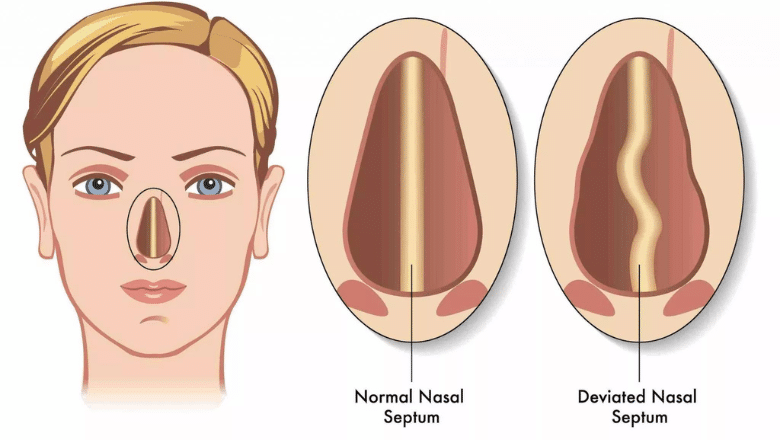
The nose has an outside you can see and an inside you cannot. The outside is a frame of bone and cartilage covered by skin, and the inside is divided into a left and right airway by the septum, a wall of cartilage at the front and bone towards the back. Septoplasty works on that wall. Rhinoplasty works on the frame.
- Septoplasty is a functional operation. It straightens a bent septum to improve airflow, with incisions inside the nostrils and no change to the outer shape. It usually takes 45 to 90 minutes and is a day-case procedure under local anaesthetic with sedation or TIVA.
- Rhinoplasty is mainly a cosmetic operation. It reshapes the bridge, tip or width of the nose, usually takes 1.5 to 3 hours under TIVA, and needs a splint on the bridge for about a week. Our guide to the different types of rhinoplasty explains the techniques.
- Septorhinoplasty does both in one operation, usually under TIVA, over around 2 to 3 hours.
Is septoplasty the same as rhinoplasty?
No. Septoplasty improves breathing and leaves the outside of the nose as it is, while rhinoplasty changes appearance. They are often confused because they are frequently done together, and because a rhinoplasty can also include some work on the airway. Surgeons use the word septorhinoplasty when both parts are planned.

Does Septoplasty Change the Shape of Your Nose?
Usually not. The surgeon lifts the lining off the septum and repositions or trims the bent cartilage and bone from inside, so the nasal bones, bridge and skin are not touched and your face looks the same afterwards.
There is one exception worth knowing about. When the front edge of the septum is badly bent towards one side, the tip of the nose can look crooked too, and straightening that part of the septum can make the nose look straighter. In a photographic study of 52 patients who had septoplasty with a caudal septal batten graft, 71% had an external nasal deformity beforehand and the deviation of the bridge improved in 61%, but there was no aesthetic change for a hump or a saddle nose[3]. In other words, any change in shape is a possible bonus, not the aim, and it is not a substitute for rhinoplasty. If a crooked look is what bothers you, our guide to fixing a crooked nose explains when the bones, the cartilage or the septum are responsible.
Does septoplasty affect your voice?
Septoplasty does not normally change your voice. People with severe blockage sometimes sound nasal or congested because air cannot pass through the nose, and once the airway is open the voice can sound clearer and less blocked.
Is septoplasty considered major surgery?
Septoplasty is a common, routine nose operation rather than major surgery. It is done as a day case, most people go home within a couple of hours of waking, and pain is usually pressure and congestion rather than sharp pain. It is still an operation under anaesthetic with real risks, and it deserves the same care as any other surgery. Our guide to anaesthesia for cosmetic surgery explains what TIVA involves.
Should I Get Rhinoplasty or Septoplasty? How to Decide
The right operation follows your main concern, and a surgeon will check it with an examination inside both nostrils, usually with a small endoscope. These are the usual patterns.
Signs you may need septoplasty
Septoplasty is worth discussing if you have persistent blockage, often worse on one side, that has not settled with steroid nasal sprays, allergy treatment or saline rinses. Other pointers are snoring or mouth breathing at night, recurrent sinus infections, frequent nosebleeds and difficulty breathing during exercise. If you are happy with how your nose looks, septoplasty is the operation that matches your goal. Our guides to the pros and cons of deviated septum surgery and breathing better after septoplasty and turbinate reduction cover it in more depth.
Signs you may need rhinoplasty
Rhinoplasty fits you if your breathing is comfortable and you are bothered by the shape: a bump on the bridge, a tip that droops or is wide, a nose that looks too large for your face, or an asymmetry. It is also the right category for a droopy nose or a saddle nose. We also offer male rhinoplasty and ultrasonic rhinoplasty. If you are unsure that surgery is right, our honest guide to whether rhinoplasty is worth it and our advice on realistic rhinoplasty expectations are good places to start. A temporary filler can smooth some contour concerns without surgery, and our non-surgical rhinoplasty can do that, but it cannot open a blocked airway.
Signs you need both
Many people have a crooked nose and a deviated septum together, particularly after a knock to the nose, and for them one operation addressing both is usually more sensible than two. A broken nose that healed crooked is a common reason, and our guide to a broken nose explains the timing of treatment.

Can Rhinoplasty and Septoplasty Be Done Together?
Yes, and the combined operation is called septorhinoplasty or septo rhinoplasty. It is a single procedure under one anaesthetic with one recovery, and our article on whether rhinoplasty and septoplasty can be done together goes through the details.
There is a surgical reason it is often the better plan when you need both. Straightening the septum frees up cartilage that would otherwise be discarded, and the surgeon can reuse it as grafts to support or reshape the nose. If septoplasty is done first and rhinoplasty later, that septal cartilage may already be gone, and grafts then have to come from the ear or rib instead. A combined operation also means one anaesthetic and one recovery rather than two. Rhinoplasty planned without checking the airway can leave a nose that looks better and still feels blocked, which is why the airway is examined first.
The evidence for combined surgery is encouraging. In a 2019 prospective cohort study of 567 patients ↗, functional septorhinoplasty, with or without turbinate reduction, produced a significant fall in nasal obstruction scores and a rise in general quality of life that was still present at 24 months[5]. Another prospective cohort of 625 patients having functional nose surgery found an average 29-point improvement in nasal obstruction scores at 24 months, and snoring-related quality of life improved in patients who snored[8].
Septorhinoplasty before and after
Our rhinoplasty before and after gallery shows more results, and individual results vary.


Septoplasty with turbinate reduction
Swollen turbinates, the ridges of tissue along the side walls of the nose, are a common second cause of blockage, and turbinate reduction is often done at the same sitting as septoplasty. A 2022 systematic review of 12 randomised trials covering 775 participants found that reducing the turbinate during septoplasty gave better subjective relief of nasal obstruction than septoplasty alone, although adverse events were more frequent when the turbinate was treated[6]. Our guide to the pros and cons of turbinate reduction with septoplasty weighs that trade-off.
Are There Different Types of Septoplasty?
Yes. Septoplasty is a family of techniques rather than one fixed operation, and the choice depends on where the bend sits and how severe it is.
- Traditional septoplasty is done entirely through the nostril with a view of the septum by direct light, and leaves no external scar.
- Endoscopic septoplasty adds a small camera for a magnified view, which helps with deviations at the back of the septum and in patients who also have sinus problems. A review of 14 studies found that endoscopic septoplasty may offer some advantages over the traditional approach, although the studies were of moderate to high risk of bias[7].
- Septoplasty with turbinate reduction treats the septum and the swollen turbinates together.
- Septorhinoplasty adds shaping of the outside of the nose.
Your surgeon will recommend the combination that suits your anatomy at consultation.
Septoplasty vs Rhinoplasty Recovery Time
Both operations leave your nose feeling more blocked at first, not less, and that surprises most people. Swelling of the lining inside the nose is the cause, and it is not a sign that surgery has failed. Our timings below follow our own treatment pages, and your surgeon will confirm yours.
- Septoplasty: home the same day, with soft internal splints usually removed at 5 to 7 days. Desk work from 7 to 10 days, light exercise from week 2, full exercise from 4 weeks and contact sport from 6 weeks. Breathing is noticeably better by around week 3, with the full benefit at 2 to 3 months.
- Rhinoplasty: an external splint comes off at about 1 week. Desk work from 7 to 10 days, glasses kept off the bridge for 6 weeks, gym work from 4 to 6 weeks and contact sport from 3 months. The initial result shows at around 3 months, and the tip keeps refining for 6 to 12 months.
- Septorhinoplasty: splints out at 7 days, 10 to 14 days off work, bruising around the eyes clearing in 10 to 14 days, and the final result at about 12 months.
Our guides to rhinoplasty recovery and rhinoplasty swelling go week by week, and when you can wear glasses after rhinoplasty answers a common practical question. If you still feel blocked after the swelling has gone, read why you might have a blocked nose after rhinoplasty.
What Is More Painful, Septoplasty or Rhinoplasty?
Most people find both uncomfortable rather than painful. After septoplasty the usual complaint is pressure and stuffiness from swelling and the internal splints, and simple painkillers such as paracetamol usually cover it. Your front teeth may feel bruised for a few days. Rhinoplasty and septorhinoplasty tend to feel heavier and more congested, with bruising and swelling that peak around days 3 to 4, and a stronger painkiller may be prescribed for a short time.
Is Septoplasty Worth It? What the Evidence Says
For the right patient, yes. Septoplasty has been tested against non-surgical treatment in a proper randomised trial. In the 2019 Lancet randomised trial ↗, 203 adults with nasal obstruction and a deviated septum were randomly assigned to septoplasty, with or without turbinate surgery, or to non-surgical management. At 12 months, quality of life scores were 72.2 in the surgery group against 63.9 in the non-surgical group, a mean difference of 8.3 points in favour of septoplasty, and the benefit was still present at 24 months. One surgical patient developed a septal abscess and two had a septal perforation[1].
A 2024 systematic review and meta-analysis of three randomised trials ↗, covering 721 participants, reached a similar conclusion: septoplasty improved nasal obstruction and sinonasal symptom scores at 6 and 12 months compared with non-surgical treatment, with low complication rates, although the authors advised caution because of the small number of trials[2]. That review found no difference in measured nasal airflow, so the benefit is in how the nose feels, and surgery is more likely to help where your symptoms match a septal cause.
A surgeon will therefore ask whether you have tried sprays and allergy treatment first. If your blockage comes from allergy, swollen turbinates or nasal valve problems rather than the septum, septoplasty on its own may not help. It often helps snoring caused by a blocked nose, although it rarely resolves snoring and sleep apnoea on its own.
What Are the Risks of Septoplasty and Rhinoplasty?
Both operations carry the general risks of surgery and anaesthesia, plus risks specific to the nose.
- Septoplasty: in a 2018 study of 5,639 patients, 3.4% had any complication, and excessive bleeding was the most frequent. Septal haematoma, a reduced sense of smell, infection and adhesions were more common when turbinate surgery was combined with septoplasty[4]. A septal perforation, which is a small hole in the septum, is another recognised risk and is more likely in smokers. Breathing can also stay blocked, in which case a further assessment finds out why.
- Rhinoplasty and septorhinoplasty: as well as bleeding and infection, risks include asymmetry, a shape you are not happy with that may need revision, temporary numbness of the tip, and persistent congestion. Our guide to rhinoplasty risks separates what is expected from what is uncommon and what is rare.
Stopping smoking and nicotine at least four weeks before and four weeks after surgery lowers the risk of poor healing and perforation. Your surgeon will go through the risks that apply to you before you consent, and we recommend a two-week cooling-off period after consent.
Does the NHS Cover Septoplasty or Rhinoplasty?
The NHS does not fund nose surgery for appearance, so cosmetic rhinoplasty is self-funded. Septoplasty is functional, and the NHS may offer it where your symptoms and examination meet local referral criteria, although waiting times vary widely between areas and some NHS commissioners restrict access, so ask your GP what applies where you live. Our guide to NHS rhinoplasty covers the rules for the cosmetic side.
For private patients, septoplasty and the functional part of a septorhinoplasty may be covered by some medical insurers, but the cosmetic part almost never is, so check your policy and get written confirmation before you book. Costs depend on how much work the septum and the outside of the nose need, whether turbinate reduction is added, and the anaesthetic, so your cost is confirmed in writing after consultation. Our rhinoplasty cost guide explains what affects it, and finance options are available subject to status.
Septoplasty and Rhinoplasty Consultation at Centre for Surgery
At Centre for Surgery, nose surgery is carried out by GMC-registered surgeons at our CQC-regulated hospital on Baker Street, and the surgeon who assesses you is the surgeon who performs your operation. The consultation looks at both parts of the question: an examination inside both nostrils, usually with an endoscope, to find out whether the septum, the turbinates or the nasal valve is responsible for any blockage, and a discussion of the outside shape of your nose, with photographs and measurements where helpful. You will hear an honest view of what is realistic and what the risks are, and you can read more about our team on the About Us page or in our clinic FAQs.
Our guide to the difference between open and closed rhinoplasty explains one more decision your surgeon will discuss with you, and if a first nose operation has not given the result you hoped for, revision rhinoplasty is a separate assessment.
Frequently Asked Questions
Is a septoplasty the same as rhinoplasty?
No. Septoplasty straightens the septum inside the nose to improve breathing and does not change the outside shape. Rhinoplasty changes how the nose looks. When both are planned together the operation is called septorhinoplasty.
Is septoplasty a major surgery?
Septoplasty is a routine day-case operation rather than major surgery. It takes around 45 to 90 minutes, all incisions are inside the nostrils, and most people go home within two hours of waking. It is still an operation under anaesthetic with real risks, including bleeding and infection.
What is more painful, septoplasty or rhinoplasty?
Neither is usually described as very painful. Septoplasty brings pressure and congestion, and paracetamol is often enough. Rhinoplasty and septorhinoplasty feel heavier, with swelling and bruising that peak around days 3 to 4.
Are there different types of septoplasty?
Yes. Traditional septoplasty is done through the nostril, endoscopic septoplasty uses a small camera for a magnified view, and either can be combined with turbinate reduction or with rhinoplasty as a septorhinoplasty. Your surgeon chooses from where the deviation sits and how severe it is.
How many days of bed rest after septoplasty?
Rest for the first day or two, then take it easy. Sleep with your head raised for two weeks, avoid blowing your nose for two weeks and avoid heavy lifting. Most people return to desk work after 7 to 10 days.
Does the NHS cover septorhinoplasty?
Not the cosmetic part. The NHS does not fund nose reshaping for appearance, although it may offer the septoplasty part where your symptoms meet its referral criteria. Some private insurers may cover the functional part but almost never the cosmetic part, so check your policy before booking.
How long is the wait for a septoplasty on the NHS?
It varies by area and by how severe your symptoms are, and it can be many months. Your GP or the local NHS trust can tell you the current wait where you live. Some patients choose private surgery to avoid waiting.
What should I know before having septoplasty?
Expect your nose to feel more blocked for the first one to two weeks, and do not judge the result before about three months. Surgery is for symptoms that match a septal cause, so medical treatment such as nasal sprays is normally tried first. If you smoke, stopping four weeks before and after surgery lowers the risk of complications.
Septoplasty and Rhinoplasty in London
If you are still asking yourself whether to have septoplasty vs rhinoplasty, a consultation with a nose surgeon will settle it, because the examination shows whether breathing, shape or both need to change. Find out more about septoplasty, rhinoplasty and septorhinoplasty at Centre for Surgery.
Phone: 020 7993 4849 | Address: 95–97 Baker Street, Marylebone, London W1U 6RN
Contact us to schedule a consultation
References
- van Egmond MMHT, Rovers MM, Hannink G, Hendriks CTM, van Heerbeek N. Septoplasty with or without concurrent turbinate surgery versus non-surgical management for nasal obstruction in adults with a deviated septum: a pragmatic, randomised controlled trial. Lancet 2019;394(10195):314–321. doi:10.1016/S0140-6736(19)30354-X ↗
- Taha HI, Elgendy MS, Ezz MR, et al. Septoplasty versus non-surgical management for deviated nasal septum: a systematic review and meta-analysis of randomized controlled trials. European Archives of Oto-Rhino-Laryngology 2024;282(2):597–610. doi:10.1007/s00405-024-08937-x ↗
- Yi JS, Jang YJ. Effect of septoplasty with a caudal septal batten graft on changes in nasal shape. Annals of Otology, Rhinology & Laryngology 2014;124(4):288–293. doi:10.1177/0003489414555899 ↗
- Dąbrowska-Bień J, Skarżyński PH, Gwizdalska I, et al. Complications in septoplasty based on a large group of 5639 patients. European Archives of Oto-Rhino-Laryngology 2018;275(7):1789–1794. doi:10.1007/s00405-018-4990-8 ↗
- Yamasaki A, Levesque PA, Bleier BS, et al. Improvement in nasal obstruction and quality of life after septorhinoplasty and turbinate surgery. Laryngoscope 2019;129(7):1554–1560. doi:10.1002/lary.27859 ↗
- Bin Lajdam G, Alaryani K, Ghaddaf AA, et al. Septoplasty versus septoplasty with turbinate reduction for nasal obstruction due to deviated nasal septum: a systematic review and meta-analysis. Rhinology 2022;60(6):411–420. doi:10.4193/Rhin22.157 ↗
- Hong CJ, Monteiro E, Badhiwala J, et al. Open versus endoscopic septoplasty techniques: a systematic review and meta-analysis. American Journal of Rhinology & Allergy 2016;30(6):436–442. doi:10.2500/ajra.2016.30.4366 ↗
- Yamasaki A, Levesque PA, Lindsay RW. Improvement in snoring-related quality-of-life outcomes after functional nasal surgery. Facial Plastic Surgery & Aesthetic Medicine 2020;22(1):25–35. doi:10.1089/fpsam.2019.29002.lin ↗







