


In this guide14 sections
- Key Points
- Can an Adam’s Apple Be Removed Completely?
- What Is the Adam’s Apple Made Of?
- How Is an Adam’s Apple Removed?
- How Much of the Adam’s Apple Can Be Removed?
- Is Adam’s Apple Removal Safe?
- Is Your Voice Affected by Adam’s Apple Removal?
- Can You Get Rid of an Adam’s Apple Without Surgery?
- Who Can Get Their Adam’s Apple Removed?
- What Is Recovery Like After Adam’s Apple Removal?
- Does an Adam’s Apple Grow Back After Surgery?
- Frequently Asked Questions
- Tracheal Shave in London
- References
Key Points
- Yes, an Adam’s apple can be removed in the sense most people mean. An operation called a tracheal shave (chondrolaryngoplasty) shaves down the bump so the front of the neck looks smoother.
- It is reduced, not removed completely. The Adam’s apple is the front of the thyroid cartilage, which forms the wall of the voice box, so only the forward-projecting part is taken away.
- The vocal cords set the limit. They attach to the inside of the cartilage roughly halfway down its front, and surgeons stop well above that point to protect the voice.
- It is a short day-case operation. It takes 30 to 60 minutes through a 2 to 3 cm incision in a natural crease under the chin or high on the neck.
- Serious complications are uncommon. Temporary hoarseness is common and usually settles within one to two weeks; a lasting change to the voice is rare.
- The result is permanent. Shaved cartilage does not grow back, and no exercise, cream or hormone can shrink an Adam’s apple without surgery.
Yes, you can have your Adam’s apple removed, but not completely. The operation, called a tracheal shave or chondrolaryngoplasty, shaves down the forward-projecting part of the thyroid cartilage that forms the bump, leaving the rest of the cartilage in place to protect your voice box and vocal cords. For most people the result is a noticeably smoother, flatter neck profile, and the change is permanent.
People ask whether an Adam’s apple can be removed for many reasons. It is one of the most common requests within facial feminisation surgery for trans women and non-binary people, and cisgender women and men with a prominent Adam’s apple ask about it too. Everyone has a thyroid cartilage, and our guide on whether a woman can have an Adam’s apple explains why it shows more in some people than others. This article explains what the Adam’s apple is, how it is removed, how much can safely be taken away, how safe the operation is and what recovery involves.
Can an Adam’s Apple Be Removed Completely?
No. The Adam’s apple is not a separate lump that can be lifted out. It is the front edge of the thyroid cartilage, the largest cartilage of the larynx (voice box). Taking the whole cartilage away would remove the front wall of the voice box and the anchor point for the vocal cords, so no surgeon removes it entirely.
What can be removed is the part that sticks out. The visible bump is formed where the two plates of the thyroid cartilage meet at the front, with a small V-shaped dip at the top (the thyroid notch). A tracheal shave trims this upper, forward-projecting part so that it no longer pushes the skin forward. In everyday language that is what “Adam’s apple removal” means, and for most people it makes the Adam’s apple much less noticeable or no longer visible at rest.
Despite its name, a tracheal shave does not touch the trachea (windpipe). The windpipe sits lower down the neck, below the larynx. The operation only reshapes the outer surface of the thyroid cartilage.
What Is the Adam’s Apple Made Of?
The Adam’s apple is cartilage, not bone. The thyroid cartilage is a shield-shaped structure made of two flat plates that join at the front of the neck. Behind it sit the vocal cords, which stretch from the inside of the cartilage at the front to two small cartilages at the back of the larynx. The cartilage protects the vocal cords and gives them a firm frame to vibrate against.
The size of the bump depends mainly on the angle at which the two plates meet. During male puberty, testosterone makes the larynx grow and the angle sharpens to roughly 90 degrees, compared with about 120 degrees in women. A sharper angle pushes the join forward against the skin, which is why the Adam’s apple is usually more prominent in men and in trans women who went through a testosterone-driven puberty. How much it shows also depends on the size of the larynx, the length of the neck and how much soft tissue covers it. A slim neck shows the cartilage more clearly than a fuller one.
The point where the vocal cords attach at the front is called the anterior commissure. It lies on the inner surface of the cartilage, below the bump. This one detail is the reason the Adam’s apple can be reduced but not removed, and it is covered in more detail below.
How Is an Adam’s Apple Removed?
Adam’s apple removal is carried out as a tracheal shave. At Centre for Surgery it is a day-case operation that takes about 30 to 60 minutes when done on its own, usually performed under TIVA (total intravenous anaesthesia), or under local anaesthetic with oral sedation where your surgeon advises it. The main steps are:
- Incision: a small horizontal cut, typically 2 to 3 cm long, is made in a natural skin crease beneath the chin or high on the neck, where it is hard to see once healed.
- Exposure: the surgeon works carefully through the tissues and neck muscles to reach the thyroid cartilage.
- Shaving: the protruding front part of the cartilage is shaved down under direct vision with a surgical burr or scalpel, keeping to a safe plane that never approaches the vocal cord attachment on the inner surface.
- Closure: the wound is closed in layers with dissolvable stitches, so there is nothing to remove afterwards.
You go home the same day. If you have sedation or TIVA, a responsible adult needs to take you home and stay with you for 24 hours. Our page on day-case cosmetic surgery explains what to expect on the day.
Some clinics offer a “scarless” tracheal shave performed through the mouth (a transoral approach). Centre for Surgery does not offer this; our tracheal shave is always performed through a small incision in the neck crease. Reviews of the literature describe both external and transoral techniques, and the main appeal of the transoral route is avoiding a neck scar[1].

How Much of the Adam’s Apple Can Be Removed?
Only the part above the vocal cord attachment, with a safety margin. The vocal cords join the inside of the thyroid cartilage at the anterior commissure, and if cartilage is removed down to that level the cords can lose their anchor. That is why the amount of cartilage that can be taken away is limited by anatomy rather than by how flat you would like your neck to be.
Recent research gives a clear picture of where that limit lies. A 2025 study of 105 trans women in The Laryngoscope ↗ measured the anterior commissure during voice surgery and found it attached 6 to 10 mm above the lower border of the thyroid cartilage, most often at 8 mm, and within about 2 mm of the midpoint of the cartilage’s front height[2]. The authors recommended leaving a 2 to 3 mm safety margin above the estimated level when it is not located directly during surgery. In practical terms, the upper part of the cartilage around the notch, which forms most of the visible bump, can be reduced, while the lower half of the front of the cartilage is left alone.
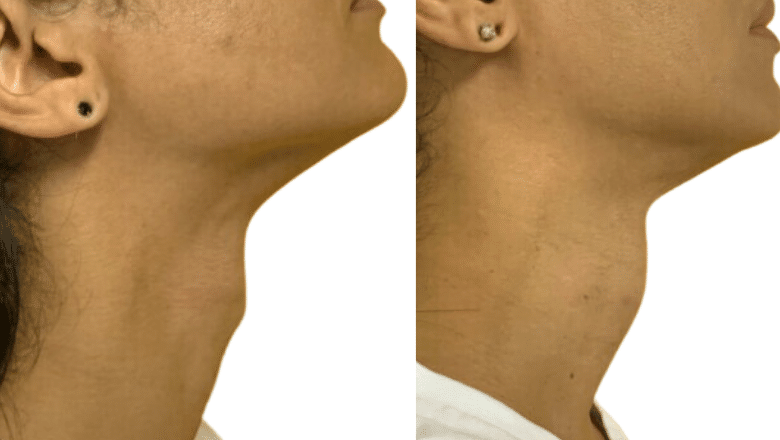
How flat your neck will look afterwards depends on your starting anatomy: the angle of the cartilage, how far it projects, your neck length and the thickness of the soft tissue over it. Most people get a clear improvement, but a small degree of prominence can remain. In a 2018 survey of 112 patients, 60% were very or completely satisfied with the appearance of their neck, 13% still felt their Adam’s apple looked too prominent, and no patient had a permanent voice change[3]. The authors concluded that the need to preserve the voice means the operation may not be 100% effective from an aesthetic point of view.
At your consultation your surgeon will examine your neck from the front and in profile, explain how much reduction is realistic for your anatomy and tell you if a small degree of prominence is likely to remain.
Is Adam’s Apple Removal Safe?
For most people, yes. A tracheal shave is a relatively small operation, and serious complications are uncommon. The side effects people notice most are short-lived. A 2019 systematic review of 69 patients in JPRAS Open ↗ found hoarseness in 36.2% and pain on swallowing in 20.3%, and 96% of the hoarseness had settled within 20 days; laryngospasm (a brief spasm of the vocal cords) occurred in 1.4%[4]. The complications in the studies it reviewed were mild and settled on their own.
A 2025 review of the operation found that the most common problems are the scar and dissatisfaction with how much cartilage was removed, while voice problems, haematoma, swallowing difficulty, fracture of the thyroid cartilage and laryngospasm are all rare[5]. The risks your surgeon will discuss with you include:
- Temporary hoarseness and throat awareness in the first one to two weeks, which is common and does not mean the vocal cords have been damaged.
- Tightness or soreness when swallowing for one to two weeks while the swelling settles.
- A lasting change to the voice, which is rare when the correct surgical plane is kept but is the most serious specific risk.
- Under-correction, where some prominence remains. Revision is possible but is technically harder on cartilage that has already been operated on.
- Over-reduction or an irregular contour, which is uncommon.
- Bleeding (haematoma), infection or wound breakdown, which are uncommon; wound problems are more likely in people who smoke.
- A visible or thickened scar, particularly if you tend to form keloid or hypertrophic scars.
Our general guide to the risks of cosmetic surgery covers the risks that apply to any operation.
Is Your Voice Affected by Adam’s Apple Removal?
It is not meant to. Temporary hoarseness is common and usually settles within one to two weeks; a lasting change to the voice is rare. A 2026 study of 35 operations in The Laryngoscope ↗ found that 18 patients (51.4%) noticed no change in their voice and 17 (48.6%) noticed a short-lived change that returned to normal, while none of 11 acoustic voice measures, including pitch, changed significantly[6].
The risk depends on technique. A 2026 systematic review of 20 studies and 760 patients found voice changes reported in 12.6% of patients overall, and much less often when the surgeon located the vocal cords during a neck-incision operation (2.8%) than when they did not (29.6%)[7]. Most of the studies relied on patients’ own reports rather than objective voice measurements. Removing the Adam’s apple also does not make your voice higher or more feminine; pitch depends on the vocal cords themselves, which the operation does not alter. We explain the evidence in full in our guide on whether a tracheal shave can affect your voice.
Can You Get Rid of an Adam’s Apple Without Surgery?
No. The Adam’s apple is cartilage, and exercises, neck stretches, massage, creams and injections cannot make cartilage smaller. Feminising hormones do not shrink it either: once the larynx has grown during puberty, oestrogen does not reverse that growth. Our article on hormone therapy before facial feminisation surgery explains which features hormones can and cannot change.
There are ways to make an Adam’s apple less noticeable without an operation: higher necklines, roll-neck and cowl-neck tops, collars, scarves and chokers, and longer hairstyles that soften the line of the neck. Some people find these are enough. If they are not, surgery is the only way to reduce the cartilage itself.
Who Can Get Their Adam’s Apple Removed?
Any adult who finds a prominent Adam’s apple a concern can be considered. At Centre for Surgery, a tracheal shave is open to:
- Trans women and non-binary people, either on its own or as part of facial feminisation surgery.
- Cisgender women with a visible Adam’s apple. Our article on facial feminisation surgery for cisgender women covers this group in more detail.
- Men who feel their Adam’s apple is too prominent.
You need to be 18 or over, as the thyroid cartilage keeps developing through puberty and should be fully mature before surgery. You also need to be in good general health and able to stop smoking and all nicotine products for four weeks before and four weeks after surgery. No diagnosis, GP referral or letter from a gender clinic is needed to book a consultation.
What Is Recovery Like After Adam’s Apple Removal?
Recovery is usually quick, and discomfort is generally mild and managed with simple painkillers. A typical pattern is:
- Days 1 to 5: mild swelling, bruising and throat awareness, often with some tightness when swallowing and a hoarse voice. Keep the incision clean and dry.
- Days 5 to 7: most people return to desk-based work. You have a wound check at one week; the stitches dissolve, so there is nothing to remove.
- Weeks 2 to 3: avoid heavy lifting and strenuous neck movements. Start silicone gel or tape on the scar from two to three weeks.
- Months 3 to 6: the scar fades and the final neck contour becomes visible as the last of the swelling settles.
Stop aspirin two weeks before surgery, and avoid aspirin and anti-inflammatory painkillers for a week afterwards unless your surgeon advises otherwise. Keep the scar out of the sun for three months and avoid swimming until the wound has fully healed. You have a surgeon review at six weeks and an assessment at three months.
Contact the clinic without delay if you have any difficulty breathing, neck swelling that is rapidly increasing, a voice change that is getting worse rather than better, a fever above 38°C or discharge from the wound. In the first 24 hours you have your surgeon’s direct number; after that you can call us on 020 7993 4849, 9am to 6pm, Monday to Saturday. Out of hours, call NHS 111, or 999 in an emergency.
Does an Adam’s Apple Grow Back After Surgery?
No. Cartilage does not regenerate once it has been shaved, so the reduction is permanent. What can change over time is how visible the remaining cartilage is, for example after significant weight loss, which reduces the soft tissue over the front of the neck. In adults the thyroid cartilage does not keep growing once puberty is over, so an Adam’s apple that has been reduced will not enlarge again on its own.
Frequently Asked Questions
Can a man have his Adam’s apple removed?
Yes. A tracheal shave is not limited to any gender. Men who feel their Adam’s apple is too prominent can have the same operation as trans women and cisgender women. As in everyone, only the forward-projecting part of the cartilage is shaved, as the rest of it protects the vocal cords. Adults over 18 can book a consultation without a referral.
Is there a surgery to remove an Adam’s apple?
Yes. The operation is called a tracheal shave, Adam’s apple shave or chondrolaryngoplasty. It reduces the bump through a small incision in a crease under the chin or high on the neck, takes 30 to 60 minutes and is done as a day case. It reduces the Adam’s apple rather than removing the whole cartilage.
Does a bigger Adam’s apple mean more testosterone?
Not on its own. Testosterone during puberty makes the larynx grow and the cartilage angle sharpen, which is why men usually have a larger Adam’s apple. How visible yours is today also depends on the size of your larynx, your neck length and the soft tissue over it, so it reflects your anatomy more than your current hormone levels.
Why is my Adam’s apple so pointy?
A pointed Adam’s apple usually means the two plates of the thyroid cartilage meet at a sharp angle, pushing the join forward against the skin. A slim neck with little fat over the cartilage makes the point show more clearly. It is a normal variation in anatomy, and a tracheal shave can soften it if it bothers you.
Will Adam’s apple removal leave a scar?
Yes, but it is small and placed to be hard to see: a 2 to 3 cm incision in a natural crease under the chin or high on the neck, closed with dissolvable stitches. It fades over three to six months. Silicone gel from two to three weeks and keeping it out of the sun for three months both help.
Do trans women have their Adam’s apple removed?
Many do. A tracheal shave is one of the most commonly requested parts of facial feminisation surgery, and it can be done on its own or combined with other facial procedures in one operation. No diagnosis, GP referral or gender clinic letter is needed at Centre for Surgery; adults over 18 can book directly.
How long does it take to recover from Adam’s apple removal?
Most people return to desk-based work after five to seven days. Hoarseness and tightness on swallowing usually settle within one to two weeks. Avoid heavy lifting and strenuous neck movements for two to three weeks. The scar and the final neck contour settle over three to six months.
When should I worry about my Adam’s apple?
A long-standing, prominent Adam’s apple is normal anatomy. See your GP if you notice a new lump in your neck, a swelling that is growing, a hoarse voice that does not settle, difficulty swallowing or pain. These need checking, as a lump near the Adam’s apple can come from the thyroid gland rather than the cartilage.
Tracheal Shave in London
Tracheal shave (Adam’s apple reduction) at Centre for Surgery is performed by GMC-registered surgeons at our CQC-regulated Baker Street hospital, rated Good overall by the CQC. It is carried out as a day case under local anaesthetic with optional sedation, or under TIVA, through a small incision in a natural neck crease, and it can be done on its own or as part of facial feminisation surgery. No diagnosis, GP referral or gender clinic letter is needed, and the consultant who assesses you at consultation is the consultant who performs your surgery. We recommend a two-week cooling-off period between your consultation and surgery. Your initial consultation fee is redeemable against the cost of surgery if you go ahead. Finance is available, subject to status; see our finance options. You can read more about the operation on our tracheal shave surgery page.
Phone: 020 7993 4849 | Address: 95–97 Baker Street, Marylebone, London W1U 6RN
Contact us to schedule a consultation
References
- de Almeida RBS, Costa CC, Ramos HVL, et al. Surgical techniques in chondrolaryngoplasty: a narrative review. Sexual Medicine Reviews 2025;13(2):237–245. doi:10.1093/sxmrev/qeaf003 ↗
- Jahnavi, Thomas JP. Anterior commissure position relative to the thyroid cartilage for safe chondrolaryngoplasty. The Laryngoscope 2025;136(5):2278–2283. doi:10.1002/lary.70325 ↗
- Cohen MB, Insalaco LF, Tonn CR, Spiegel JH. Patient satisfaction after aesthetic chondrolaryngoplasty. Plastic and Reconstructive Surgery Global Open 2018;6(10):e1877. doi:10.1097/GOX.0000000000001877 ↗
- Therattil PJ, Hazim NY, Cohen WA, Keith JD. Esthetic reduction of the thyroid cartilage: a systematic review of chondrolaryngoplasty. JPRAS Open 2019;22:27–32. doi:10.1016/j.jpra.2019.07.002 ↗
- Goslawski A, Spiegel JH. Chondrolaryngoplasty. The Journal of Craniofacial Surgery 2025;36(2):738–743. doi:10.1097/SCS.0000000000011134 ↗
- Dwyer CD, Fein M, Kridgen S, Winston J. Chondrolaryngoplasty: vocal considerations, outcomes, and effects on acoustic measures of voice. The Laryngoscope 2026;136(9):3887–3894. doi:10.1002/lary.70557 ↗
- Abu Bandora E, Chaushu H, Icht M, et al. Transgender women’s voice outcome after laryngochondroplasty: a systematic literature review. OTO Open 2026;10(3):e70264. doi:10.1002/oto2.70264 ↗

Related Articles
- Can a Tracheal Shave Affect Your Voice?
- Is It Possible for a Woman to Have an Adam’s Apple?
- Can Cisgender Women Have Facial Feminisation Surgery?
- Do I Need Hormone Therapy Before Facial Feminisation Surgery?






