


In this guide13 sections
- Key points
- What is armpit fat?
- What causes armpit fat in females?
- Why do I have armpit fat when I’m not overweight?
- Is armpit fat a sign of cancer?
- Best exercises for armpit fat: what they can and cannot do
- Do bras that hide armpit fat actually work?
- How to get rid of armpit fat permanently
- Armpit fat in men
- What does armpit fat removal cost?
- Frequently asked questions
- Why choose Centre for Surgery
- Related reading
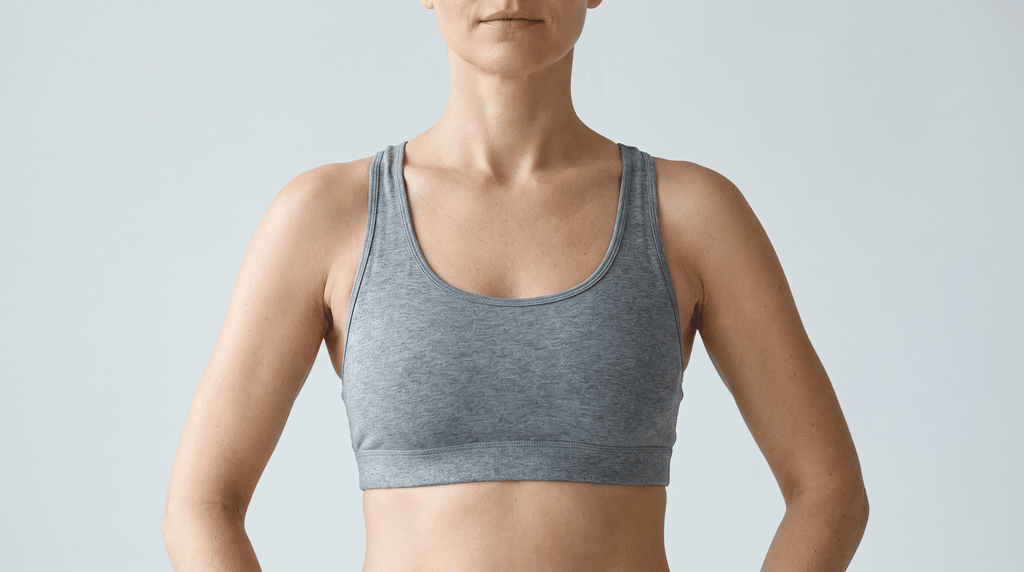
Armpit fat is one of the most common body-contouring concerns we assess. Illustrative image, not a Centre for Surgery patient.
Key points
- Armpit fat is not always fat. Three different things produce the same bulge, and only one of them responds to liposuction.
- Exercise for armpit fat builds the muscle underneath but cannot spot-reduce the fat above it — targeted fat loss is not physiologically possible.
- Accessory breast tissue is glandular, not fatty. It swells with your cycle, and it needs excision rather than liposuction.
- A poorly fitting bra creates armpit fat that is not fat at all, but displaced breast tissue pushed out by a band that is too tight.
- A new, firm or growing lump in the armpit needs a GP appointment before a cosmetic consultation, not after.
- Where it genuinely is fat, VASER liposuction removes it permanently in a day-case procedure under local anaesthetic or TIVA.
What is armpit fat?
Armpit fat is the soft bulge that sits between the top of the breast and the arm, most visible in a fitted top, a strapless dress or a sports bra. It is a genuinely common concern — and one of the more frustrating ones, because it sits in an area that clothing tends to emphasise rather than conceal.
The medical term for the region is the axilla, so the fat that accumulates there is described as axillary fat. But “armpit fat” is a description of an appearance rather than a diagnosis, and that distinction matters more here than in almost any other area of the body. Three quite different things produce a bulge in the same place, they look nearly identical from the outside, and they need three different responses.
It can occur on one side only — described clinically as unilateral axillary fat — or on both, which is bilateral. Which of the two you have is diagnostically useful rather than merely descriptive. Symmetrical, bilateral fullness that has been present for years and changes with your weight behaves like fat. Fullness that has appeared on one side only, particularly if it is recent or firm, is the pattern that warrants examination before anything cosmetic is considered.
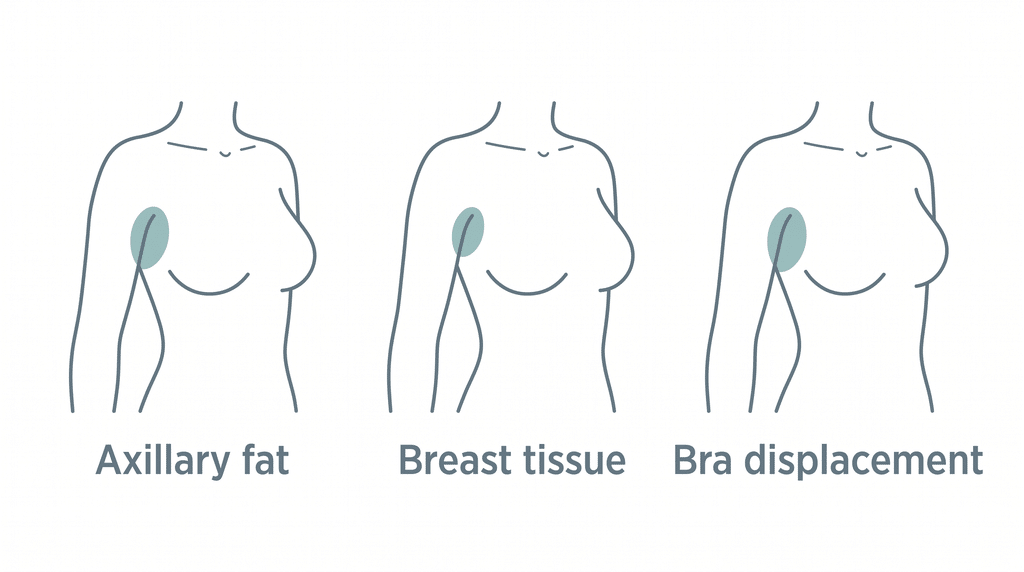
Three different causes, three different treatments: axillary fat responds to liposuction, accessory breast tissue needs excision, and bra displacement needs a better-fitting bra.
Axillary fat
Ordinary subcutaneous fat, sitting between the skin and the muscle, in a spot where the body is genetically inclined to store it. Soft, movable, and it changes size with your overall weight — though often not as much or as fast as you would like. This is the type liposuction treats.
Accessory breast tissue
Also called axillary breast tissue or a supernumerary breast, and treated by accessory breast tissue removal. This is real glandular breast tissue that developed outside the breast itself, along what is called the milk line — the embryological ridge running from the armpit to the groin. It is present from birth, though it often becomes noticeable only at puberty, during pregnancy or with hormonal change. It is gland rather than fat, so it behaves like breast tissue: it can feel firmer, it may be tender before a period, and it can swell noticeably during pregnancy and breastfeeding. Liposuction does not remove it reliably, because there is comparatively little fat to aspirate.
Bra displacement
The least discussed and possibly the most common. A band that is too tight or a cup that is too small pushes breast tissue sideways and upward, and it has to go somewhere — so it emerges at the armpit as a roll that appears when the bra goes on and vanishes when it comes off. This is not armpit fat at all. It is your own breast tissue in the wrong place, and no procedure fixes it because there is nothing to remove. The same mechanism further round the back produces a bra bulge, which is a related but distinct concern.
How to tell the three apart
| Axillary fat | Accessory breast tissue | Bra displacement | |
|---|---|---|---|
| How it feels | Soft, moves freely under the skin | Firmer, defined edges, disc-like | Feels like normal breast tissue |
| Lying flat | Softens and spreads out | Holds its shape | Not present without a bra |
| Changes with your cycle | No | Yes — often tender or fuller before a period | No |
| Changes with weight loss | Yes, though often slowly | No | No |
| Present without a bra | Yes | Yes | No — disappears entirely |
| What treats it | VASER or power-assisted liposuction (PAL) | Surgical excision, often with liposuction | A professional bra fitting |
Armpit fat has three distinct causes — subcutaneous fat, glandular accessory breast tissue, and breast tissue displaced by a poorly fitting bra. Only the first responds to liposuction, which is why accurate diagnosis matters more here than the choice of technique.
What causes armpit fat in females?
Several things, and usually more than one at once.
Genetics. Where your body stores fat is largely inherited, and the axilla is a common storage site in women. This is why armpit fat can persist in someone who is otherwise lean, and why it is often the last area to change with weight loss.
Hormonal change. Oestrogen influences fat distribution towards the breast, hip and upper-body regions. Puberty, pregnancy, breastfeeding, hormonal contraception and the perimenopausal transition can all shift the picture, sometimes quite quickly.
Weight gain. General weight gain adds volume everywhere, including here. The axilla can be disproportionately affected because it has a relatively generous fat compartment to begin with.
Accessory breast tissue. If the cause is glandular, no amount of weight loss will resolve it — it needs surgical excision. Women in this group are frequently told to lose weight for something that was never fat.
Posture and muscle tone. Rounded shoulders and a forward-rolled chest position push soft tissue forward and make any existing fullness more visible. This does not create armpit fat, but it changes how obvious it is.
Bra fit. Covered above, and worth repeating because it is so easily missed. Research on bra fitting has consistently found that a large majority of women wear the wrong size, most commonly a band that is too big and a cup that is too small.
Armpit fat in women is caused by inherited fat distribution, oestrogen’s influence on where fat is stored, glandular accessory breast tissue laid down before birth, and bra fit — usually more than one of these at once.
Why do I have armpit fat when I’m not overweight?
This is the question we hear most, and it usually has one of three answers.
The first is that fat distribution is genetic and stubbornly regional. Someone can be lean overall and still carry a defined pocket at the axilla, because that is simply where their body holds it. This is the same phenomenon that produces a lower-belly pouch or outer-thigh fullness in otherwise slim people.
The second is that it is not fat. Accessory breast tissue is far more common than most people realise. A surgical series of 967 cases published in Aesthetic Plastic Surgery puts the figure at two to six per cent of women, and notes that the two things that drive patients to seek treatment are the visible convexity and cyclical pain. It does not shrink with dieting, because glandular tissue does not behave like a fat store.
The third is bra fit, which will change nothing on a scan and everything in a mirror.
The practical test is simple. Look at the area without a bra, and then lying flat. Fat softens and spreads when you lie down. Glandular tissue holds its shape and feels firmer and more defined at its edges. And a bulge that only exists when you are wearing a bra is telling you exactly what it is.
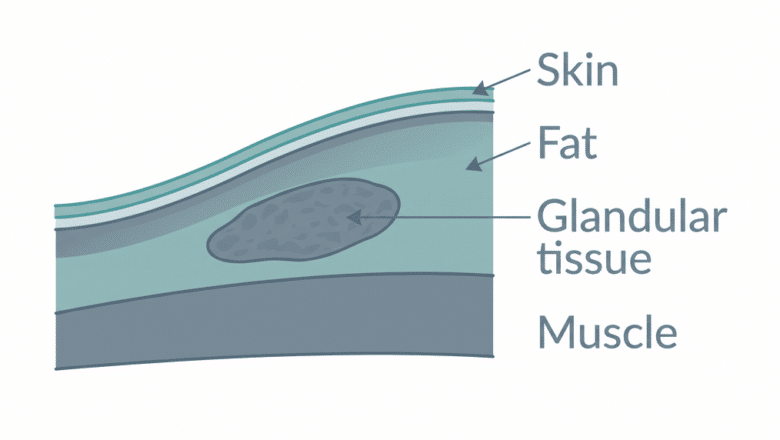
Cross-section of the armpit. Subcutaneous fat sits above the muscle; glandular tissue forms a firmer island within it, which is why the two feel different on examination.
Is armpit fat a sign of cancer?
Soft, symmetrical, long-standing fullness in both armpits is not a sign of cancer. It is a normal variation in body shape, and if it has been there for years and changes only with your weight, it is behaving like fat.
What does warrant prompt medical assessment is a lump rather than a general fullness. See your GP without delay if you notice any of the following:
- A new lump in one armpit that was not there before, particularly if it is firm, fixed in place, or does not move under the skin
- A lump that is growing, or one that persists for more than two weeks
- Any associated change in the breast — skin dimpling, nipple inversion, discharge, or a lump in the breast itself
- Skin changes over the armpit, or persistent redness
- Unexplained weight loss, night sweats or fevers alongside the lump
A firm, discrete lump may also be a lipoma or a cyst, both benign and both distinct from generalised fullness. Enlarged lymph nodes in the armpit are common and usually reactive — they swell in response to a nearby infection, a recent vaccination, or a cut on the hand or arm, and settle within a couple of weeks. But lymph nodes are also one of the first places breast cancer spreads to, and that possibility is not something to assess yourself from a website.
To be direct about it: this article is about the appearance of armpit fat, not about diagnosing lumps. If you are reading this because you have found something new and firm, close the page and book with your GP. Cosmetic assessment comes after that has been cleared, not instead of it.
Best exercises for armpit fat: what they can and cannot do
Armpit fat exercises are among the most searched solutions here, and the honest answer is that they help — but not in the way most articles imply.
What exercise cannot do is spot-reduce. Targeted fat loss from a specific area through exercising that area is not physiologically possible. Working the chest and shoulders does not preferentially burn the fat sitting on top of them. This has been tested repeatedly and the finding is consistent. Any workout promising to melt armpit fat specifically is selling something.
What exercise can do is change the shape underneath. Building the pectoralis major, the anterior deltoid and the upper back alters the contour that the overlying fat sits on, and improves the posture that makes fullness more visible. A stronger, better-aligned upper body genuinely looks different, even with the same amount of fat present.
The most useful movements for this area:
- Push-ups — chest, shoulders and the serratus anterior along the side of the ribcage, which is precisely the region in question
- Chest press and chest fly — direct pectoral work, with the fly emphasising the outer chest
- Rows and reverse fly — upper back and rear shoulder, which pull the shoulders back and open the chest
- Lateral and front raises — deltoid definition, which sharpens the shoulder-to-arm transition
- Plank variations — serratus and scapular control, which supports better posture generally
Alongside this, overall fat loss through a sustained calorie deficit will reduce fat everywhere, including here — the same principle that applies to any stubborn fat area — though the axilla is often one of the later areas to respond, which is exactly why people find it frustrating.
If you have trained consistently, reached a stable weight you are content with, and the bulge is still there, that is useful information rather than a failure. It usually means what remains is either genetically resistant fat or glandular tissue, and both have surgical answers.
Exercise cannot spot-reduce armpit fat, because targeted fat loss from a worked area is not physiologically possible. What it can do is build the chest, shoulder and upper back underneath, changing the contour the fat sits on and correcting the posture that makes fullness more visible.
Do bras that hide armpit fat actually work?
Yes, and this is worth trying before anything else, because it costs nothing and resolves a meaningful proportion of cases.
Get professionally fitted. The most common fitting error is a band that is too loose paired with a cup that is too small, which forces tissue out at the sides. A correctly fitted band sits level around the ribcage and does most of the support work, while a cup with enough volume contains the breast tissue rather than displacing it.
Beyond size, look for a bra with a wider side panel or a full-coverage cup that extends further towards the armpit, smooth seamless construction rather than a narrow band that cuts in, and a back closure that does not dig. A bra with a side-support panel is designed specifically to hold tissue forward rather than allow it to migrate.
If the bulge disappears entirely with a properly fitted bra, you have your answer and you do not need a surgeon.
How to get rid of armpit fat permanently
Where the cause is genuinely fat or glandular tissue rather than bra fit, and where diet and training have taken you as far as they can, surgical options remove it permanently. The right one depends on what is actually there.
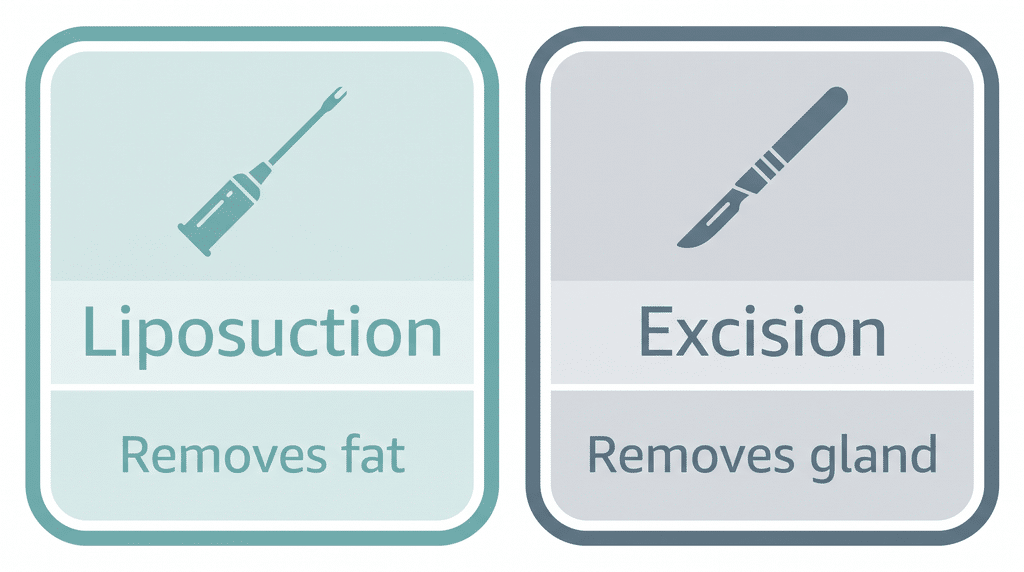
Liposuction removes fat. Excision removes gland. Which one you need depends on what is actually there, which is why assessment comes before any quote.
VASER liposuction for armpit fat
VASER liposuction is our usual choice for this area. It uses ultrasonic energy to emulsify fat before removal, separating it from the surrounding tissue rather than tearing through it — which matters in the axilla, because it is a small, anatomically busy region containing lymph nodes, nerves and blood vessels serving the arm. Precision is more valuable here than power.
The practical advantages are a more controlled result in a small area, less bruising, and a degree of skin retraction from the ultrasonic energy, which is useful where skin quality is a secondary concern. It is performed as a day case under local anaesthetic with sedation, or under TIVA where it is being combined with other areas. Most people return to desk work within a few days and wear a compression garment for a few weeks.
Fat cells removed do not return. Remaining cells can still enlarge with significant weight gain, so the result is permanent but not immune to what happens afterwards.
Power-assisted liposuction for armpit fat
Conventional liposuction also treats axillary fat effectively, and our power-assisted technique works in three stages (separation, aspiration and fat equalisation), with the equalisation stage reducing the risk of contour irregularity. In an area as small and as visible as the armpit, evenness matters more than volume removed, so the equalisation step earns its place.
Surgical excision of accessory breast tissue
Where the tissue is glandular, liposuction alone will disappoint, because gland does not aspirate the way fat does. Accessory breast tissue removal through a small incision, usually placed within the armpit crease where it is well concealed, removes it definitively. The two are often combined: liposuction to address the fatty component and reduce the overall volume, followed by direct excision of the glandular core.
The published evidence for this combined approach is reassuring. In the 967-case series cited above, mean operating time was 58 minutes, cyclical armpit pain resolved in every case, and 95.65% of patients were satisfied with the cosmetic result. Complications occurred in 16.55% of cases, and the most common by some margin was seroma, at 11.27% — a fluid collection under the healing tissue. That figure is worth knowing before surgery rather than after: it is the reason compression is worn, and the reason a follow-up appointment is scheduled rather than optional.
Any excised tissue is sent for histological examination as a matter of routine. This is standard practice, not a sign of concern. Where an accessory nipple is present without underlying glandular tissue, that is a separate and simpler procedure — see third nipple removal.
Combining with breast surgery
Armpit fullness frequently accompanies breast size or shape concerns, and the two are often treated together. Breast reduction and liposuction breast reduction both address the lateral chest as part of the procedure. Where the concern spans the bra line more broadly, treating the armpit in isolation can look odd, and a wider approach gives a more coherent result.
The same logic applies upward as well as inward. The axilla sits at the top of the treatment zone used for arm liposuction, and where the upper arm also carries stubborn fat the two are commonly done in one session. It is worth deciding this before surgery rather than after: slimming one and leaving the other can make the untreated area look more prominent than it did to begin with, simply because the contour beside it has changed.
Non-surgical skin tightening
Where the issue is mild laxity rather than volume, Morpheus8 and BodyTite use radiofrequency energy to tighten skin. These are not fat-removal treatments and will not resolve a substantial bulge, but they can refine skin quality after liposuction or in patients with modest concerns who do not want surgery.
It is worth understanding the commitment before choosing this route. Radiofrequency microneedling is not a single appointment: a course of up to six sessions spaced four to six weeks apart is typical, followed by a maintenance session roughly once a year to hold the result. Compare that with liposuction, which is one day-case procedure with a permanent result, and the arithmetic changes for most people — particularly where there is genuine volume rather than laxity alone. Where the concern is mild crepiness in someone whose fullness is age-related rather than fatty, the non-surgical route is the more proportionate answer. Being straightforward about the limits: if there is real volume there, radiofrequency will not remove it.
VASER liposuction removes axillary fat permanently, surgical excision removes glandular accessory breast tissue, and the two are often combined in one procedure. Radiofrequency skin tightening refines skin quality but removes no volume. All are day-case procedures at Centre for Surgery under local anaesthetic with sedation or TIVA — not general anaesthetic.
Armpit fat in men
Men develop axillary fullness too, and the same distinction applies — with an important addition. In men, fullness across the chest and into the armpit can represent gynaecomastia, which is glandular breast tissue rather than fat. Male breast reduction addresses this directly, and the assessment is the same one: does it feel soft and movable, or firm and disc-like beneath the nipple and extending laterally?
Where it genuinely is fat, male liposuction treats the axilla and lateral chest, commonly alongside the flanks, since treating one without the other tends to leave an obvious transition.
What does armpit fat removal cost?
Armpit fat removal is quoted according to the number of areas treated and whether excision is required alongside liposuction. The axilla is a small area, so it is very often combined with the flanks, the bra line or the arms in the same session, which is usually better value than treating it alone and gives a more even result across the whole region.
Our full pricing is set out in the liposuction cost guide, and your own figure is confirmed in writing after consultation, once a surgeon has assessed what is actually present. We do not quote for this area without examining it first, precisely because fat and gland need different operations at different prices.
Frequently asked questions
How do I get rid of fat under my armpit?
Start by establishing what it is. If it disappears without a bra, get professionally fitted. If it is soft, movable and changes with your weight, sustained fat loss and upper-body strengthening will help, though not through spot reduction. If it is firm, cyclical or unchanged by weight loss, it is likely glandular and will need excision. Where fat persists despite all of that, VASER liposuction removes it permanently.
Can you lose armpit fat with exercise alone?
You can lose fat overall through exercise and diet, and some of that will come from the armpit. What you cannot do is target it. No exercise burns fat from the specific area being worked — spot reduction has been tested and does not happen. Exercise changes the muscle and posture underneath, which alters the contour, and that is a genuine effect worth pursuing.
Is armpit fat or breast tissue — how do I tell?
Fat is soft, spreads when you lie flat, and moves freely under the skin. Accessory breast tissue feels firmer and more defined at its edges, holds its shape when lying down, and often changes through the menstrual cycle — becoming tender or fuller before a period. Cyclical change is the most useful single clue, because fat does not respond to hormones on a monthly timescale. An examination will confirm it, and ultrasound can be used where there is doubt.
Does armpit fat go away with weight loss?
Sometimes, partially. Weight loss reduces fat across the body, and the armpit will reduce along with everywhere else. But the axilla is frequently a stubborn area, and in people whose fullness is genetic or glandular, weight loss can make surprisingly little difference to this particular region while making a clear difference elsewhere.
What causes armpit fat in females specifically?
A combination of genetic fat distribution, oestrogen’s influence on where fat is stored, accessory breast tissue laid down before birth along the milk line, and bra fit. Hormonal transitions — puberty, pregnancy, breastfeeding and perimenopause — commonly mark the point at which it becomes noticeable.
Will armpit fat come back after liposuction?
The fat cells removed are gone permanently and do not regenerate. Remaining cells in the area can still enlarge if you gain significant weight, so a stable weight protects the result. Most patients who maintain their weight keep the outcome indefinitely.
Is armpit fat removal painful?
It is generally well tolerated. The procedure itself is performed under local anaesthetic with sedation or under TIVA, so nothing is felt during it. Afterwards, most people describe soreness and a bruised, tight sensation rather than sharp pain, managed with simple analgesia. The axilla is a mobile area, so movement can feel restricted for the first week.
How long is recovery after armpit liposuction?
Most people return to desk work within two to four days. Compression is worn for around four weeks. Swelling settles substantially over four to six weeks, with the final contour apparent at around three months. Full arm range of movement returns within a couple of weeks, though heavy upper-body training should wait four to six.
Can accessory breast tissue turn into cancer?
Accessory breast tissue is normal breast tissue in an unusual location, which means it carries the same — not a greater — risk profile as breast tissue generally. It can, very rarely, develop the same conditions breast tissue can. That is one reason excised tissue is routinely sent for histology, and one reason a new or changing lump in the armpit should be assessed by a doctor rather than assumed to be fat.
Do I need a GP referral for armpit fat removal?
No referral is needed for a cosmetic consultation with us. But if you have found a new, firm or growing lump, see your GP first — that is a medical question rather than a cosmetic one, and it should be answered before any aesthetic procedure is planned.
Why choose Centre for Surgery
Armpit fat is a small-area procedure that rewards accurate diagnosis far more than it rewards surgical volume. The most common error we see is a patient who has had liposuction elsewhere for what was actually glandular tissue, and is disappointed because the operation could never have worked.
Our surgeons are GMC-registered plastic surgeons, operating at our CQC-regulated day-surgery facility at 95–97 Baker Street. Assessment comes before any quote, we recommend a two-week cooling-off period, and if a properly fitted bra would solve your problem we will tell you that instead of booking you in.
To arrange a consultation, call 020 7993 4849, email contact@centreforsurgery.com, or book through our contact form.
Related reading
- Bra bulge removal
- Accessory breast tissue removal
- Third nipple removal (polythelia)
- VASER liposuction
- Breast reduction
- Male breast reduction (gynaecomastia)
- Liposuction before and after photos
- Liposuction cost guide



