



In this guide14 sections
- Breast Implant Removal vs Replacement: At a Glance
- Same First Stage, Different Endpoint
- Cost Comparison
- What You’re Left With
- Recovery: How Do They Compare?
- When Removal Makes More Sense
- When Replacement Makes More Sense
- Does NHS Funding Differ Between the Two?
- What Happens to Your Old Implants?
- Can You Decide Later?
- How Your Surgeon Helps You Decide
- Frequently Asked Questions
- Breast Implant Removal & Replacement at Centre for Surgery
- Learn More
If your breast implants are reaching the 10–15 year mark, or you’re dealing with a complication like capsular contracture or rupture, you’re facing a genuine fork in the road: remove them and go without, or replace them with new ones. Both are common, well-established procedures — but they lead to very different outcomes, costs, and recovery paths. This guide compares them head to head so you can have an informed conversation at your consultation.
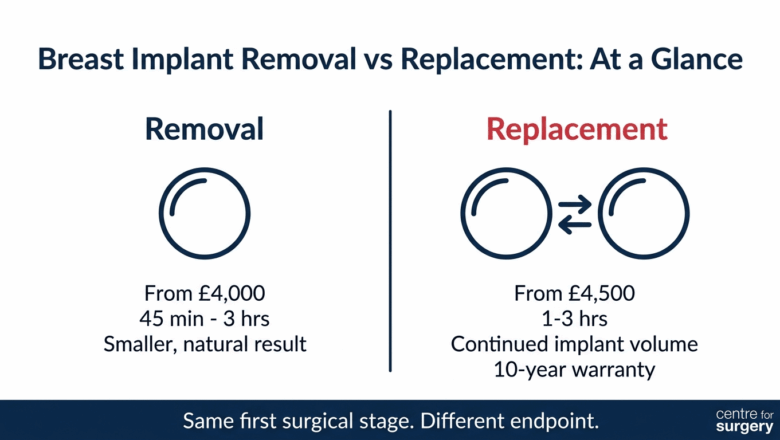
Both breast implant removal and breast implant replacement start the same way — the existing implant (and, where indicated, the surrounding capsule) is taken out. Replacement then places a new implant in the same session; removal alone leaves you without one, whether or not you combine it with a lift or fat transfer.
Breast Implant Removal vs Replacement: At a Glance
| Removal (Explantation) | Replacement (Exchange) | |
|---|---|---|
| What happens | Implant taken out, not replaced | Implant taken out, new implant placed same session |
| Starting price | See our removal cost guide | See our replacement cost guide |
| Procedure time | 45 minutes – 3 hours | 1 – 3 hours |
| Result | Smaller, natural breast — degree of sagging depends on implant size, duration, skin quality | Continued implant volume — size, shape, or texture can change |
| Desk work | 5–10 days depending on capsule work | 5–10 days depending on capsule work |
| Full exercise | 3–4 weeks (simple) to 6 weeks (capsulectomy/lift) | 4–6 weeks |
| Warranty | Not applicable | Silimed guarantee terms differ for revision surgery |
Same First Stage, Different Endpoint
It helps to understand that removal and replacement aren’t two entirely different operations — they share the same opening steps. Both start with an incision, usually through your original augmentation scar to avoid new scarring, followed by careful extraction of the existing implant. The capsule — the layer of scar tissue every implant develops — is then managed identically regardless of which path you’re on: left intact, partially removed, totally removed, or taken out en bloc with the implant, depending on its condition and the reason for surgery.
The only point where the two procedures genuinely diverge is what happens next. In removal, the pocket is closed once capsule management is complete — with or without a concurrent lift or fat transfer. In replacement, a new implant is inserted into the pocket using a no-touch technique before closure. This is worth knowing because it means your surgeon can, in many cases, keep both options genuinely open until relatively late in the consultation process — the technical groundwork is the same either way.
Cost Comparison
Removal is consistently the lower-cost option at every tier, since replacement adds the cost of the new implant itself:
- Current prices for every tier are set out in our breast implant removal cost guide and breast implant replacement cost guide.
One factor that can significantly change the replacement calculation: if your original implants were Silimed and placed at Centre for Surgery within the guarantee terms, the cost of the new implants themselves may be covered — ask at consultation. See our full breast implant removal cost guide and breast implant replacement cost guide for complete pricing breakdowns.
What You’re Left With
This is the real decision, underneath the cost comparison. Removal returns you to a smaller, natural breast — how close to your pre-augmentation appearance depends on your original implant size, how long they were in place, and your skin’s elasticity. Some patients are pleased with a soft, natural result; others find the change in volume more noticeable than they expected, particularly after larger or long-standing implants. A breast lift or fat transfer can improve shape after removal, but neither restores implant-level volume.
Replacement, by contrast, maintains your augmented volume — and gives you the opportunity to change size, shape, profile, or surface texture as part of the same operation. If you liked having implants and your only issue is a complication or their age, replacement addresses that without changing your fundamental silhouette.
Recovery: How Do They Compare?
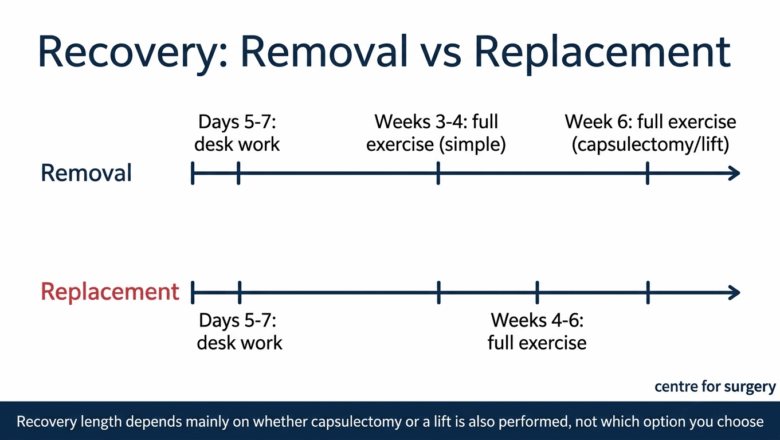
Recovery timelines are broadly similar between the two, since both involve the same initial surgical steps — the main variable in either case is whether capsulectomy or a concurrent lift is also performed, not whether a new implant goes back in.
- Straightforward procedures (no capsulectomy): desk work in 5–7 days for both; full exercise from 3–4 weeks (removal) or 4–6 weeks (replacement)
- With capsulectomy: desk work in 7–10 days for both; full exercise from 6 weeks
- With a concurrent lift: recovery follows the lift timeline for both — surgical bra worn continuously for 6 weeks, occasionally up to 8 weeks for more complex combined cases
Many patients find revision recovery — for either option — noticeably easier than their original augmentation, since the surgical planes are already established from the first procedure.
When Removal Makes More Sense
- You no longer want implants, full stop. This is valid on its own, whether or not a specific complication is present — no medical justification is required to access explant surgery.
- You’re experiencing symptoms you attribute to your implants, such as Breast Implant Illness (BII). Many patients who remove implants for BII report symptom improvement, though this can’t be guaranteed for every individual.
- You want to reduce long-term cost. Implants aren’t lifetime devices — choosing removal now avoids the cost of future replacement cycles every 10–20 years.
- You’re comfortable with a smaller, natural result, with or without a concurrent lift or fat transfer to refine shape.
When Replacement Makes More Sense
- You’re happy with having implants. The issue is age, a complication, or wanting a size or shape change — not the presence of implants themselves.
- You have textured implants and want to switch surface types. Moving to smooth Silimed implants can reduce BIA-ALCL risk while keeping your current volume.
- You want to change implant type, size or surface. New Silimed implants are covered by Silimed’s replacement guarantee for rupture caused by a manufacturing defect, where eligible, but its contracture cover applies only after a first augmentation, not revision surgery.
- Your implants are approaching or beyond the 10–15 year mark and imaging suggests they should be addressed, but you’re not ready to lose your current silhouette.
Does NHS Funding Differ Between the Two?
Yes, meaningfully. NHS funding for breast implant surgery is narrow either way, but removal has a slightly wider path to funding than replacement. Removal may be funded where implants were originally NHS-placed for reconstruction, in a confirmed medical emergency such as a ruptured implant or confirmed BIA-ALCL, or where an unrelated NHS procedure requires the implants to come out. Replacement — putting a new implant back in — is almost never NHS funded, even where the removal portion of the same operation would qualify, since replacement is considered a cosmetic choice regardless of why the original implants are coming out. If NHS funding is a genuine consideration for you, this is worth raising directly with your GP or the relevant NHS trust before your consultation with us.
What Happens to Your Old Implants?
Whichever option you choose, your removed implants don’t need to go anywhere in particular unless there’s a clinical reason. Where rupture, BIA-ALCL, or another complication is suspected, the implant (and capsule tissue, where removed) may be sent for pathological analysis to confirm the diagnosis — this is standard practice and doesn’t affect your recovery. Where there’s no specific clinical concern, most patients simply have the old implants discarded as clinical waste; some ask to see or keep them, which we’re happy to accommodate if you’d like to raise it at consultation.
Can You Decide Later?
Yes — removal and replacement don’t have to be decided in advance of surgery day, but they do need to be planned for at consultation, since the surgical approach (particularly capsule management) can differ depending on which you choose. Some patients also opt for a staged approach: removal first, followed by a decision on replacement, a lift, or fat transfer once they’ve had time to see how their breasts settle. This avoids committing to permanent implant removal or a specific new implant before you’ve seen your natural result.
How Your Surgeon Helps You Decide
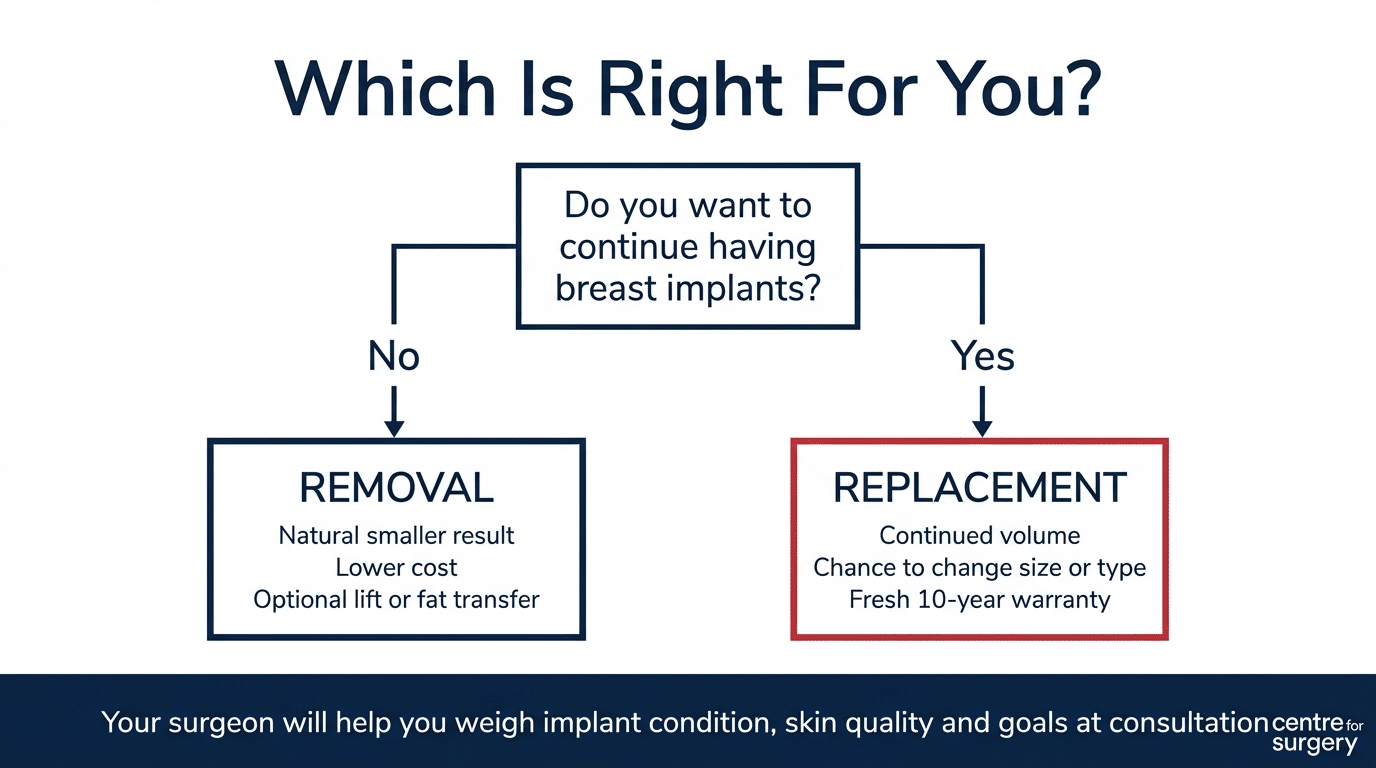
At consultation, your surgeon will assess several factors that bear directly on which option makes more sense for you — not just what you’d prefer in principle:
- The condition of your current implants and capsule — confirmed rupture, significant capsular contracture, or BIA-ALCL concerns will shape which capsule management approach is needed regardless of whether you remove or replace
- Your skin quality and elasticity — this affects how much a lift would help either path, and how noticeable the change in volume will be if you choose removal
- Your original implant size and how long they’ve been in place — larger, longer-standing implants generally mean a bigger visible difference between the two options
- Whether you’re planning future pregnancy — this can affect the timing recommendation for either option
- Your genuine preference for having implants at all — the single biggest factor, and one only you can answer
Being honest with your surgeon about that last point is worth emphasising — patients sometimes default to replacement simply because it feels like the more “normal” choice, without seriously weighing whether they’d actually prefer to go without. A good consultation should give equal, unbiased weight to both options.
Frequently Asked Questions
Is removal or replacement cheaper?
Removal is cheaper at every complexity tier, since replacement adds the cost of new implants. Current prices are in our breast implant removal and breast implant replacement cost guides.
Which has a shorter recovery?
Recovery is broadly comparable between the two — the main factor affecting recovery time is whether capsulectomy or a lift is also performed, not whether a new implant is placed.
Can I decide during my consultation rather than in advance?
You can discuss both options at consultation and your surgeon will help you weigh them up, but you do need to confirm your choice before surgery, since it affects the surgical plan. If you’re genuinely undecided, a staged approach — removal first, decide on replacement later — is a reasonable option to raise with your surgeon.
Does replacement always mean the same size implants?
No — replacement is a common opportunity to change size, profile, shape, or surface texture, not just swap like-for-like.
What if I want to remove implants but I’m worried about how I’ll look?
This is one of the most common concerns we hear at consultation. Our guide on what to expect after breast implant removal covers the factors that affect your result, and the options — lift, fat transfer — available to improve shape after removal.
Is the surgery itself different for removal versus replacement?
The opening steps are identical — incision, implant extraction, and capsule management are the same regardless of which you choose. The only difference is whether a new implant goes into the pocket before closure. This means the two procedures carry a broadly similar risk profile, with the addition of implant-specific risks (such as rippling or malposition) for replacement.
Can I switch from wanting removal to wanting replacement (or vice versa) after my consultation?
Yes, within reason — the two-week cooling-off period that applies after every consultation is exactly the time to reconsider. If you change your mind closer to your surgery date, speak to your patient coordinator as early as possible, since it may affect implant ordering for replacement.
Breast Implant Removal & Replacement at Centre for Surgery
Both procedures are performed by GMC-registered plastic surgeons at our CQC-regulated Baker Street facility, under TIVA, as day-case surgery. All capsule management approaches are available for both routes. We regularly treat patients whose original implants were placed at another clinic, including abroad.
Finance options are available through our partner Chrysalis Finance — visit our Finance Options page for details.
Book Your Consultation
Phone: 020 7993 4849
95–97 Baker Street, Marylebone, London W1U 6RN
Contact us to discuss which option is right for you
Learn More
- Breast implant removal
- Breast implant replacement
- Your options following breast implant removal
- Breast implant removal cost
- Breast implant replacement cost
- Pros and cons of breast implant removal
- Breast revision surgery







