

In this guide13 sections
- Key Points
- What Do Chickenpox Scars Look Like? Pitted Scars, Pale Marks and Raised Scars
- Why Do Chicken Pox Scar Some People and Not Others?
- Do Chickenpox Scars Go Away? Chicken Pox Marks vs Scars
- How to Get Rid of Chicken Pox Scars: Chickenpox Scars Treatment Compared
- Pale Chickenpox Scars and Raised Chicken Pox Scars
- Chicken Pox Scar Removal Cream: Which Cream Is Best?
- Chickenpox Scars in Darker Skin
- How to Prevent Chickenpox Scars
- Chicken Pox Scar Treatment and Removal in London
- Frequently Asked Questions
- References
- Talk to Us About Chickenpox Scars
Key Points
- Chickenpox leaves a lasting scar in roughly one in five people. Most scars are small, pale marks, but some are round, pitted dents that stay for life.
- Red and dark marks left after the spots heal usually fade over months. True pitted scars do not fill in by themselves, and pale scars rarely regain their colour.
- Scars form when the infection damages the deeper layer of the skin, which is more likely if spots are scratched, picked or infected.
- There is no single best treatment. Fractional CO2 laser, erbium laser, subcision, TCA CROSS and punch excision each suit a different scar shape, and the best results usually come from combining them.
- Creams and home remedies can help with colour and texture but cannot lift a pitted scar. Vitamin E can irritate the skin and has not been shown to improve scars.
Chickenpox scars are the small, round marks that some people are left with after a bout of chickenpox, most often on the face, chest, back and tummy. Many are faint and pale, but some are sunken pits that catch the light and are hard to cover with make-up. For most people they are a cosmetic worry rather than a medical one, and they are very treatable: the same techniques used for acne scar removal, including fractional CO2 laser, work well on them.
This guide explains why chickenpox scars form, the four types and what each looks like, whether they go away on their own, and how to get rid of chicken pox scars, from laser and minor surgical techniques to the creams that are worth trying and the remedies that are not. For a wider look at how scars of all kinds behave, our guide to the different types of scars is a useful starting point.
What Do Chickenpox Scars Look Like? Pitted Scars, Pale Marks and Raised Scars
Chickenpox scars are usually small, between 2 and 6 mm across, and round or oval, matching the blisters they came from. They are often scattered rather than clustered, and most people have only a handful.
The best picture of how common they are comes from a 2001 study in Pediatric Dermatology ↗, in which 986 children who had had chickenpox at least a year earlier were examined. Nearly one in five (18.7%) had at least one scar, with an average of about three scars each. Most of the scars were pale (hypopigmented); fewer were depressed, darker or raised, and only two children had keloids[1].
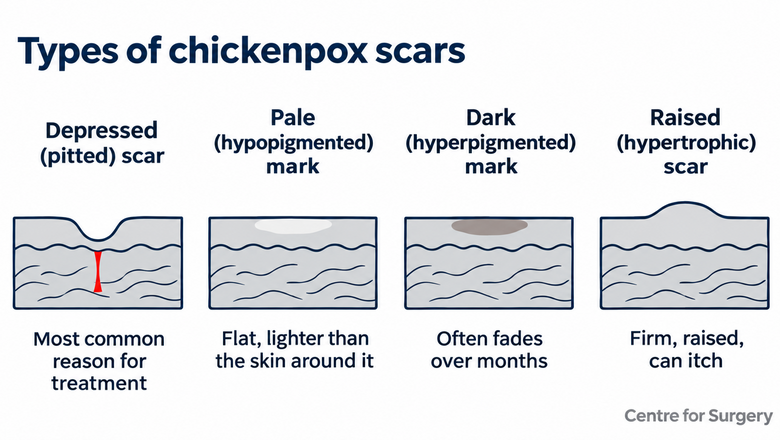
The four types behave quite differently:
- Depressed (pitted or atrophic) scars are small dents where collagen in the deeper skin has been lost. Many are tethered to the tissue below by fibrous bands, which pull the surface down. These are the scars people most often want treated.
- Pale (hypopigmented) marks are flat or very slightly sunken spots that are lighter than the surrounding skin, and they become more obvious when the rest of the skin tans.
- Dark (hyperpigmented) marks are flat brown or purplish spots caused by inflammation, and they are more common in darker skin.
- Raised (hypertrophic) scars are firm bumps that stay within the edge of the original spot and can itch. Rarely, a scar grows beyond its edge as a keloid.
Chicken Pox Scars on Face and Forehead
In the same study, 41% of the children with scars had at least one on the face, making it the second most common site after the abdomen[1]. Chicken pox scars on the face tend to sit on the temples and cheeks, and a chicken pox scar on the forehead is one of the most common reasons people ask about treatment, as it is hard to hide. Facial scars are the ones people most often seek help with, and fortunately facial skin, with its rich blood supply, generally heals well after treatment.
Why Do Chicken Pox Scar Some People and Not Others?
Chickenpox is caused by the varicella-zoster virus. Each spot starts as a red bump, becomes a fluid-filled blister, then crusts over and heals, usually within one to two weeks. Most spots affect only the outer layer of the skin (the epidermis) and heal without a trace. A scar forms when the inflammation reaches the dermis, the deeper layer that contains the skin’s collagen and gives it its structure.
Several things make that more likely:
- Scratching and picking, which tear the blister roof and dig into the healing base
- Bacterial infection of the spots, which deepens and prolongs the inflammation
- Larger or more numerous blisters, which are more common in adults and teenagers than in young children
- Skin type, as darker skin is more prone to lasting dark marks, and a small number of people form raised scars or keloids easily
Why Are Chicken Pox Scars So Deep?
Chickenpox scars often look deeper than their size suggests. When the dermis is damaged, the collagen at the base of the blister is destroyed and replaced by a thin layer of scar tissue, and fibrous strands can form that anchor the base of the scar to deeper tissue. The result is a small crater with steep sides, like a boxcar or ice pick acne scar. Its sharp edges cast a shadow, which is why the scar can be very visible in overhead lighting even when it is only a millimetre or two deep.
Do Chickenpox Scars Go Away? Chicken Pox Marks vs Scars
Not every chicken pox mark is a scar. Many of the marks left behind are temporary changes in colour, and the answer to whether they will go away depends on the type of mark:
- Red or pink marks left behind after the scabs fall off are part of normal healing, and they usually fade over a few weeks to a few months.
- Dark marks are post-inflammatory hyperpigmentation rather than true scars, and they usually fade over 6 to 12 months, sometimes longer in darker skin. Our guide to what causes hyperpigmentation explains why.
- Pitted scars may soften slightly over the first year or two as the skin remodels, but they do not fill in by themselves.
- Pale scars rarely regain their full colour, as the pigment-producing cells in them have been damaged.
If you are wondering how to know if chicken pox will scar, look at the texture once the scabs have gone: a flat mark that is red or brown will usually fade, while a dent you can feel or see in angled light is a true scar. It is usually worth waiting until a scar is at least 6 to 12 months old before starting procedures, as it will continue to change over that time. In children, marks often become less noticeable as they grow, so treatment is generally best left until adulthood.
How to Get Rid of Chicken Pox Scars: Chickenpox Scars Treatment Compared
The good news about how to get rid of chickenpox scars is that old chicken pox scar removal works just as well as treating newer scars: a scar from childhood responds to the same techniques as one from last year. There has, however, been surprisingly little research on chickenpox scars specifically. A 2021 review of varicella scar treatments ↗ gathered every study it could find, covering creams, chemical peels, microneedling, laser, subcision and grafting. Peeling with trichloroacetic acid (TCA) was the most studied method and gave moderate to excellent results, but there was not enough evidence to rank the other treatments against each other for chickenpox scars alone[2]. In practice, chickenpox scars are treated in the same way as acne scars of the same shape, where the evidence is much larger. Our guides to treatments for acne scars and how to get rid of acne scars cover that wider evidence.

The shape of each scar matters more than its cause. Narrow, deep ice pick scars need a technique that reaches the bottom of the pit; round boxcar scars with sharp edges respond to resurfacing or to being lifted; and broad rolling scars need the fibrous bands underneath to be released. Most people have a mixture, so a plan usually combines two or three treatments.
Chicken Pox Scar Removal With Fractional CO2 Laser
Fractional CO2 is the main chicken pox scar removal laser. The treatment makes thousands of microscopic columns of controlled injury in the skin, leaving the skin between them intact. As those columns heal, the skin produces new collagen, which raises the floor of shallow scars and softens their edges. It is the most widely used laser for pitted scars. A 2024 meta-analysis in the Journal of Cosmetic Dermatology ↗ of eight studies and 418 patients with atrophic acne scars found that fractional CO2 laser was more effective than fractional erbium laser, with a shorter overall downtime, but more discomfort and longer-lasting redness[3]. For facial chickenpox scars specifically, a 2024 report described good results from combining fractional CO2 laser with a needle-free pneumatic injector[4].
What to expect:
- A numbing cream is applied beforehand, and a fractional treatment takes around 30 to 45 minutes.
- The skin is red and swollen for a few days and then flakes, and most people need about 5 to 7 days before they feel ready to go back to work.
- Most people need two or three sessions, 6 to 8 weeks apart.
- Results build gradually over 3 to 6 months as new collagen forms.
Our article on how long it takes to heal after laser skin resurfacing covers recovery in more detail.

Erbium Laser Resurfacing
The erbium (Er:YAG) laser removes skin in finer layers with less heat spread than the CO2 laser. It can be used as a fractional treatment for scars or to smooth the edges of individual pits, and it is often preferred for darker skin types and for people who want slightly less downtime per session, accepting that more sessions may be needed[3]. Our page on erbium laser resurfacing explains the treatment, and our comparison of erbium laser vs CO2 laser sets out the differences.
Subcision for Rolling and Tethered Scars
Subcision is a minor procedure in which a fine needle is passed under the scar, through a tiny entry point, to cut the fibrous bands that tether it down. Once released, the scar lifts, and the small amount of bleeding under it encourages new collagen to form. It is carried out under local anaesthetic and leaves some bruising for a week or so. In a systematic review of acne scar treatments, improvement after subcision ranged from 10% to 100%, depending on the scar type and the technique[5]. Subcision works best for soft, rolling scars that flatten when the skin is stretched, and it is often followed by laser to refine the surface.

TCA CROSS for Ice Pick Chickenpox Scars
In the CROSS technique (chemical reconstruction of skin scars), a tiny amount of highly concentrated trichloroacetic acid is pressed into the base of each pit with a fine applicator. The acid triggers collagen production at the bottom of the scar, which gradually fills it from below. Unlike a full-face peel, the rest of the skin is left alone. In a pilot study of 16 people with facial chickenpox scars, four sessions two weeks apart gave excellent improvement (more than 75%) in 69% of those who completed treatment, and good improvement in the rest, with no significant complications[6]. A later review of the technique found that 83% to 100% of patients with chickenpox scars improved by more than a quarter, and that CROSS is particularly effective for ice pick scars[7].

Punch Excision for Deep Chicken Pox Scars
For deep chicken pox scar removal, where there is a single deep scar or a few, minor surgery can give the quickest result. In punch excision, the scar is removed with a small circular blade and the skin is closed with one or two fine stitches, leaving a thin line that is much less noticeable than a round pit. In punch elevation, used for boxcar scars with a healthy-looking base, the base is cut free and lifted level with the surrounding skin. Both are done under local anaesthetic, the stitches come out after about a week, and the area is often lasered a few weeks later to blend it in. These techniques are part of our scar revision service.
Morpheus8 and Microneedling
Microneedling creates tiny channels in the skin to stimulate collagen, and radiofrequency microneedling, such as Morpheus8, adds heat at a controlled depth. A systematic review of 58 studies and 1,845 patients, including people with chickenpox scars, found that both improved the appearance of scars with no serious side effects[8]. They suit shallow, rolling scars and darker skin types, where the risk of pigment change after laser is higher, and they are often combined with subcision.
Dermal Fillers
Filler injected under a broad, soft scar lifts it immediately, which can be useful for a single scar or as a trial before longer-lasting treatment. Most fillers are absorbed over 6 to 18 months, so the effect is temporary, and filler does little for narrow ice pick scars. At Centre for Surgery, injectables are given only by surgeons. Our article on whether you can fill scars with dermal fillers explains the pros and cons.
Pale Chickenpox Scars and Raised Chicken Pox Scars
Pale (White) Chickenpox Scars
Pale scars are the most common chickenpox scars and, unfortunately, the most difficult to treat, as the aim is to bring back pigment rather than to change texture. A 2022 review of laser treatment for pale scars found that fractional laser alone gives modest improvement, and that results are better when laser is combined with a topical treatment that stimulates pigment cells[9]. In a randomised study of 28 people with pale scars, 11 of the 14 treated with fractional CO2 laser plus a prostaglandin solution (latanoprost) improved by more than half[10]. Realistically, pale scars can be made less obvious but rarely disappear. Our article on white scar removal explains the options in more detail.
Raised Chicken Pox Scar or Keloid
A raised chicken pox scar is less common and usually flattens with time. Silicone gel or silicone scar sheets, steroid injections and laser can all help them settle, and our guide to whether hypertrophic scars go away explains what to expect. A keloid scar from chicken pox, one that keeps growing beyond the edge of the original spot, needs a more cautious plan; see our guide to keloid scars.
Chicken Pox Scar Removal Cream: Which Cream Is Best?
No scar cream for chicken pox can lift a pitted scar, as the problem lies in the deeper layer of skin, but creams can improve colour and surface texture, especially on newer marks.
Tretinoin and Retinol Cream for Chicken Pox Scars
Tretinoin is a prescription vitamin A cream that speeds up skin turnover, fades dark marks and encourages some collagen production. It is one of the treatments that has been studied for chickenpox scars[2], and it is a reasonable first step for dark marks and slightly uneven texture. Retinol is a milder, non-prescription version that works more slowly. Both can cause dryness and irritation at first, make the skin more sensitive to the sun, and must not be used in pregnancy.
Silicone Gel
Silicone gel is the best-supported cream-type treatment for scars that are still red or raised. It keeps the scar hydrated and helps it flatten and soften, but it does little for old, pitted scars.
Vitamin E, Coconut Oil and Home Remedies
Vitamin E is one of the most popular scar remedies, but the evidence is against it. In a double-blind study of scars after skin surgery, vitamin E either had no effect or made the scar look worse in 90% of cases, and a third of patients developed an allergic skin reaction to it[11]. Coconut oil, cocoa butter and aloe vera are pleasant moisturisers but have no good evidence of removing chickenpox scars. Lemon juice and other acidic remedies can irritate the skin and leave darker marks than before.
Sun Protection
Daily SPF 30 or higher is the simplest and most useful thing you can do for chickenpox marks. Sun exposure darkens red and brown marks and makes them last longer, and it makes pale scars stand out more as the surrounding skin tans.
Chickenpox Scars in Darker Skin
In darker skin, the main concern after chickenpox is often dark marks rather than pits, and these usually fade with time, sun protection and lightening creams. Treatments that injure the skin, including laser, peels and CROSS, carry a higher risk of temporary darkening (post-inflammatory hyperpigmentation) in darker skin. In the 2024 meta-analysis, pooled results showed no significant difference in the rate of darkening between CO2 and erbium laser, although the authors still advised caution with CO2[3]. In practice, settings are more conservative, a test patch is often sensible, skin is prepared with a lightening cream beforehand, and radiofrequency microneedling and subcision are often favoured. Our article on whether laser is safe for all skin types explains how treatment is adjusted.
How to Prevent Chickenpox Scars
If you or your child has chickenpox now, the best way to help chickenpox spots heal without scars is to stop them being damaged while they heal:
- try not to scratch, and keep fingernails short; scratch mittens or socks over the hands at night help young children
- use cooling gels, calamine lotion or a cool bath to ease the itch
- dress in loose cotton clothing
- let the scabs fall off by themselves rather than picking them
- see a GP if spots become red, hot, swollen or painful, as infected spots are more likely to scar
The NHS guide to chickenpox ↗ covers symptoms, treatment and when to get medical help. Vaccination will mean fewer scars in future: since January 2026, the chickenpox vaccine has been part of the routine NHS childhood schedule, given as a combined MMRV vaccine at one year and 18 months, as announced by the UK Health Security Agency ↗.
Chicken Pox Scar Treatment and Removal in London
At our Baker Street hospital, treatment starts with a close look at each scar. One of our doctors examines the skin under magnification and in angled light, which shows the shape and depth of each pit, and checks whether a scar is pale, dark, raised or tethered. Most people have a mixture, so the plan is built around the individual scars rather than a single machine.
Laser treatments are carried out by our team of trained GMC- or NMC-registered laser practitioners, using fractional and hybrid CO2 laser on the YouLaser Prime MT, erbium laser on the Fotona SP Dynamis Pro, and Morpheus8 radiofrequency microneedling. Subcision, TCA CROSS and punch techniques are surgeon-led. You can find out more about the people who look after you on our Meet the Team page.
Scar removal for chicken pox does not need a hospital stay: laser sessions and minor procedures are all done as day treatments, and most people are back at work within a week. For more on each treatment, see our pages on CO2 laser treatment, acne scar removal, which uses the same techniques, and how laser scar removal works. Dark marks that have not faded can be treated with laser pigmentation treatment.
Frequently Asked Questions
How to get rid of chicken pox scars quickly?
There is no overnight fix. For dark or red marks, daily sunscreen and a retinoid or lightening cream speed up fading over a few months. For pitted scars, the quickest visible change comes from punch excision or subcision, while fractional CO2 laser gives gradual improvement over several months.
Can chickenpox scars go away?
Red and dark marks usually fade within a year. Pitted scars may soften slightly but do not fill in on their own, and pale scars rarely regain full colour. Treatment can make all of them much less noticeable.
Why are chicken pox scars so deep?
When the infection or scratching damages the dermis, the collagen under the blister is lost and fibrous bands can tether the base of the scar down. This leaves a small crater with steep edges, which casts a shadow and looks deeper than it is.
Which cream is best for chicken pox scars?
For dark marks and uneven texture, a prescription retinoid such as tretinoin is the best-supported option, with daily sunscreen. Silicone gel helps red or raised scars flatten. No cream can lift an established pitted scar.
Can coconut oil remove chicken pox scars?
No. Coconut oil is a pleasant moisturiser, but there is no good evidence that it removes or fades chickenpox scars. Vitamin E oil has been studied and did not help, and it often irritated the skin.
How to fade a scar quickly?
Protect it from the sun, keep it moisturised, and use silicone gel while it is still red or raised. A retinoid cream can speed up the fading of dark marks. For older or pitted scars, laser and minor procedures give much faster results than creams.
How long does it take for scars to heal?
A wound closes within a couple of weeks, but a scar keeps changing for 12 to 18 months as it remodels. It is usually best to wait at least 6 to 12 months before treating a chickenpox scar, unless it is very deep or raised.
References
- Leung AK, Kao CP, Sauve RS. Scarring resulting from chickenpox. Pediatr Dermatol. 2001;18(5):378-380. doi:10.1046/j.1525-1470.2001.01975.x ↗
- Pour Mohammad A, Ghassemi M. Varicella-zoster scar treatments: a tertiary review. Med J Islam Repub Iran. 2021;35:136. doi:10.47176/mjiri.35.136 ↗
- Liu F, Zhou Q, Tao M, Shu L, Cao Y. Efficacy and safety of CO2 fractional laser versus Er:YAG fractional laser in the treatment of atrophic acne scar: a meta-analysis and systematic review. J Cosmet Dermatol. 2024;23(9):2768-2778. doi:10.1111/jocd.16348 ↗
- Kim KR, Shin SH, Han HS, Yoo KH, Kim BJ, Choi SY. Successful treatment of facial varicella-zoster scars with a combination of a fractional CO2 laser and pneumatic injector device. Int J Dermatol. 2024;63(2):260-261. doi:10.1111/ijd.16972 ↗
- Kravvas G, Al-Niaimi F. A systematic review of treatments for acne scarring. Part 1: non-energy-based techniques. Scars Burn Heal. 2017;3:2059513117695312. doi:10.1177/2059513117695312 ↗
- Agarwal N, Mittal A, Kuldeep C, Gupta LK, Khare AK, Mehta S. Chemical reconstruction of skin scars therapy using 100% trichloroacetic acid in the treatment of atrophic facial post varicella scars: a pilot study. J Cutan Aesthet Surg. 2013;6(3):144-147. doi:10.4103/0974-2077.118408 ↗
- Chung HJ, Al Janahi S, Cho SB, Chang YC. Chemical reconstruction of skin scars (CROSS) method for atrophic scars: a comprehensive review. J Cosmet Dermatol. 2021;20(1):18-27. doi:10.1111/jocd.13556 ↗
- Juhasz MLW, Cohen JL. Microneedling for the treatment of scars: an update for clinicians. Clin Cosmet Investig Dermatol. 2020;13:997-1003. doi:10.2147/CCID.S267192 ↗
- Baugh EG, Anagu O, Kelly KM. Laser treatment of hypopigmentation in scars: a review. Dermatol Surg. 2022;48(2):201-206. doi:10.1097/DSS.0000000000003330 ↗
- Siadat AH, Rezaei R, Asilian A, et al. Repigmentation of hypopigmented scars using combination of fractionated carbon dioxide laser with topical latanoprost vs. fractionated carbon dioxide laser alone. Indian J Dermatol. 2015;60(4):364-368. doi:10.4103/0019-5154.160481 ↗
- Baumann LS, Spencer J. The effects of topical vitamin E on the cosmetic appearance of scars. Dermatol Surg. 1999;25(4):311-315. doi:10.1046/j.1524-4725.1999.08223.x ↗
Talk to Us About Chickenpox Scars
If you have chickenpox scars you would like treated, you can book an assessment at our Baker Street clinic by calling 020 7993 4849 or using the form below. A patient coordinator will be your point of contact throughout.