In this guide12 sections
- Key Points
- What is a keloid scar?
- What causes keloid scars?
- Do keloid scars go away on their own?
- How to get rid of a keloid scar: treatment options
- Keloid removal surgery: why surgery alone is not enough
- Keloids by location
- Can you prevent keloids?
- When to see a doctor about a keloid
- Keloid scar treatment at Centre for Surgery
- Frequently asked questions
- References
Key Points
- A keloid is a scar that keeps growing past the edge of the original wound. A hypertrophic scar is also raised but stays inside the wound and usually flattens with time; a keloid rarely does.
- Keloids are far more common in brown and Black skin, in people aged roughly 10 to 30, in families with a history of keloids, and on the earlobes, chest, shoulders and upper back.
- Steroid injections are the first-line treatment. Given every four to six weeks, they flatten and soften most keloids and ease itch and pain; combining steroid with 5-fluorouracil works better than either drug alone in trials.
- Cutting a keloid out on its own often makes it come back bigger. Removal is only done with a plan to prevent recurrence, usually steroid injections into the wound afterwards, or radiotherapy in selected cases.
- Keloids are benign and do not turn into cancer, but a “scar” that bleeds, ulcerates or changes quickly should be checked by a doctor.
- If you are keloid-prone, prevention matters most: think carefully before piercings, tattoos and elective surgery, and treat any new raised scar early.
Keloid scars are thick, raised scars that grow beyond the boundaries of the wound that caused them. They can follow a piercing, a spot, a cut, a vaccination or surgery, and they can keep growing for months or years. Unlike most scars, they rarely settle on their own, and removing them carelessly can make them return larger than before.
This guide explains what a keloid is and how it differs from a hypertrophic scar, why some people get keloids and others do not, and how keloid scar treatment and keloid removal work, including the steps that stop a keloid coming back. If you are trying to work out what kind of scar you have, our guide to the different types of scars is a good place to start, and our scar revision service covers surgical options for scars of every kind.
What is a keloid scar?
A keloid is an overgrowth of scar tissue. When skin heals, cells called fibroblasts lay down collagen to close the wound. In a keloid, that repair process does not switch off: the fibroblasts keep producing thick, disorganised collagen, and the scar spreads sideways into healthy skin that was never injured.
Keloids are benign. They do not spread to other parts of the body and they are not a form of cancer. They can still cause real problems: many itch, ache or feel tender, they can catch on clothing, and on the face, ears or chest they can affect confidence a great deal.
What does a keloid look like?
- Raised and firm, often rubbery or hard to the touch
- Smooth and shiny on the surface, usually without hair
- Pink, red, purple or darker than the surrounding skin, particularly in brown and Black skin
- Wider than the original wound, sometimes with claw-like extensions at the edges
- Itchy, tender or painful, especially while it is still growing
A keloid can appear within weeks of an injury, but it can also start months later. Some people develop a keloid after an injury so minor they do not remember it, such as a spot or an insect bite.
Keloid vs hypertrophic scar: how to tell the difference
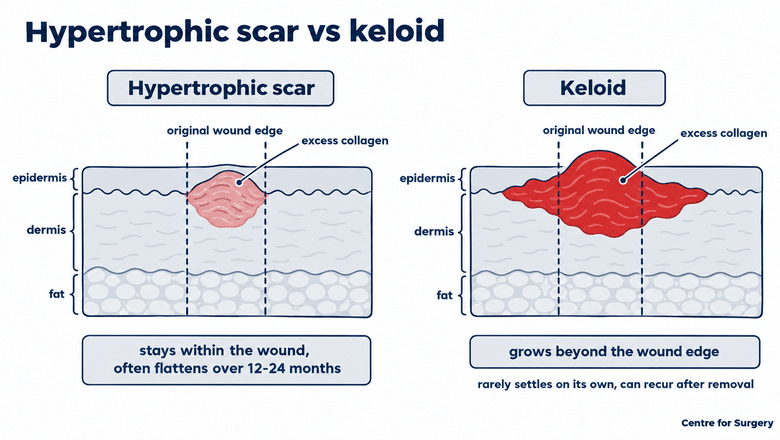
The two are often confused, and both are raised. The simplest test is geography: look at where the original cut, piercing or spot was.
- Hypertrophic scar: stays within the lines of the original wound, usually appears within a few weeks, and tends to flatten and fade over 12 to 24 months. See do hypertrophic scars go away?
- Keloid: grows beyond the original wound into normal skin, can appear months later, keeps growing, rarely improves on its own and has a high chance of returning after it is cut out.
The difference matters because the plan is different. A hypertrophic scar is often treated patiently with silicone and, if needed, steroid injections. A keloid usually needs active treatment, and surgery is approached with much more caution.
What causes keloid scars?
The exact cause is not fully understood, but keloids reflect an inflammatory response in the deeper layer of the skin (the reticular dermis) that keeps fibroblasts active long after the wound has closed[5]. Genes, skin type and the tension on the skin where the wound sits all influence how likely that is.
Who gets keloids?
- People with brown or Black skin. Keloids occur up to fifteen times more often in darker skin[5].
- Younger people. They are most common between about 10 and 30, and less common in childhood and older age.
- People with a family history. Keloids often run in families, and someone who has had one keloid is more likely to form another.
- Hormonal change. Keloids sometimes appear or grow during puberty and pregnancy.
Where keloids form, and what triggers them
Keloids are most common where skin is under constant tension or movement: the chest and breastbone, shoulders, upper back and upper arms, plus the earlobes and jawline. Typical triggers are:
- Ear and body piercings, which is why the earlobe is one of the commonest sites
- Acne and infected spots, especially on the chest, back and jawline
- Surgical incisions, including caesarean section scars
- Cuts, burns and grazes
- Vaccinations, particularly on the upper arm
- Tattoos and chickenpox
Location affects how stubborn a keloid is. In a 2026 meta-regression of 9,909 keloids ↗, low-tension sites such as the earlobe had a 70.5% lower risk of returning after treatment than high-tension sites such as the chest[6].
Do keloid scars go away on their own?
Rarely. A hypertrophic scar usually improves over a year or two, but a keloid tends to stay the same or keep growing. Some keloids stop growing after a time and become less red and less itchy, but they do not shrink away. Waiting is reasonable for a small, stable keloid that does not bother you. For a keloid that is growing, painful or itchy, earlier treatment usually works better, and a small keloid is easier to treat than a large one.
How to get rid of a keloid scar: treatment options
No single treatment cures every keloid. The international clinical recommendations on scar management ↗ conclude that combining several treatments gives the best chance of success, and advise more active early treatment of keloids rather than waiting[1]. The aim is to flatten the keloid, relieve itch and pain, and stop it growing, while keeping the risk of it coming back as low as possible.
Steroid injections (first-line treatment)
Injecting a corticosteroid, usually triamcinolone, directly into the keloid is the standard first treatment. It calms the overactive fibroblasts, softens and flattens the scar, and often relieves itch and tenderness within the first session or two.
- How it is given: into the body of the keloid with a fine needle, after numbing where helpful
- How often: every four to six weeks, usually as a course of several sessions
- What to expect: gradual flattening and softening over the course
- Side effects: thinning of the skin, lightening of skin colour at the site, and small visible blood vessels if too much is used
An international panel of 23 dermatologists and plastic surgeons who specialise in keloids agreed in a 2024 consensus study ↗ that triamcinolone 40 mg/mL, given at four-weekly intervals, is the preferred approach, and that the steroid should go into the keloid rather than the fat underneath[2]. Getting the depth right is what protects you from dents and skin thinning.
Combination injections: steroid with 5-fluorouracil
5-fluorouracil (5-FU) is a medicine that slows the dividing fibroblasts that drive keloid growth. Mixed with steroid and injected into the keloid, it improves results compared with steroid on its own. A 2023 meta-analysis of 13 studies in Plastic and Reconstructive Surgery ↗ found combination injections were about three and a half times more likely to work well than steroid alone, with fewer visible blood vessels as a side effect[3]. Whether it suits you depends on the size and site of the keloid and your medical history, so it is discussed at assessment.
Silicone gel and silicone sheets
Silicone does not shrink an established keloid on its own, but it is a useful, low-risk part of treatment, and it is the mainstay of prevention once a wound has closed. Worn for at least 12 hours a day, or applied as a gel twice a day, it can reduce thickness, redness and itch. The evidence is honest but limited: a Cochrane review of 20 trials ↗ found improvements in scar thickness and colour, but rated most studies as poor quality[7]. Read more in do silicone strips help scars heal?
Pressure therapy
Constant pressure on a scar reduces collagen production. It is most practical on the earlobe, where pressure earrings or clip-on pressure devices can be worn for months after a keloid has been removed. It is much harder to apply usefully on the chest or back.
Laser treatment
Vascular lasers can reduce redness, and fractional lasers can soften texture and help steroid or 5-FU penetrate a flatter keloid. Laser is an add-on rather than a stand-alone cure, and in brown and Black skin it needs conservative settings, as it can leave darker or lighter patches[8].
Cryotherapy and radiotherapy
Freezing (cryotherapy) can flatten small, thin keloids, often combined with injections, but it commonly leaves a pale patch, which is especially visible in darker skin[8]. Low-dose radiotherapy straight after surgical removal is one of the most effective ways of stopping a keloid returning[5]. Neither cryotherapy nor radiotherapy is offered at Centre for Surgery; where radiotherapy is clinically appropriate, it is arranged through a specialist centre.
Keloid creams and home remedies
Over-the-counter “keloid creams”, onion extract, tea tree oil, garlic and similar remedies are widely promoted, but none has good evidence for shrinking an established keloid. Silicone gel is the one topical product with reasonable evidence, and mainly for prevention and early scars. Never try to cut, tie off or burn a keloid at home: the injury can trigger a larger keloid.
Keloid removal surgery: why surgery alone is not enough
Cutting out a keloid flattens it straight away, which makes surgery sound like the obvious answer. The problem is that the operation itself is a new skin injury, in someone whose skin is already prone to keloids. Removed on its own, without any treatment afterwards, a keloid often returns, and sometimes larger than before[5].
That is why keloid removal surgery is always planned together with recurrence prevention. Surgery is usually considered when:
- the keloid is large, bulky or on a stalk, as some earlobe keloids are
- it has not responded well enough to a course of injections
- it is causing pain, infection or functional problems
The operation is planned to keep tension on the wound as low as possible. Removed tissue may be sent for histology to confirm the diagnosis; histology is charged separately, and results take three to four weeks.
Preventing a keloid from coming back after removal
The two best-studied options after surgery are steroid injections into the wound and radiotherapy. A 2026 meta-analysis of 45 studies on earlobe keloids ↗ found similar overall recurrence after excision with steroid injections (12%) and after excision with radiotherapy (13%), although steroid needed four to six monthly injections and its benefit faded over longer follow-up[4]. In practice, recurrence prevention after keloid removal at Centre for Surgery uses:
- steroid injections into the wound, starting at or soon after surgery and repeated over the following months
- silicone gel or sheets once the wound has healed, bought separately
- pressure earrings for earlobe keloids
- close follow-up, so any sign of regrowth is treated early
Where radiotherapy is the better option, for example for a large or recurrent keloid, it is arranged through a specialist centre.
Is it worth removing a keloid?
It can be, if the plan includes recurrence prevention and you are able to come back for follow-up injections. Earlobe keloids generally do well with surgery plus injections or pressure. Keloids on the chest, shoulders and upper back are under much more tension and are more likely to come back after surgery, so injections are usually tried first and surgery is reserved for selected cases. A good surgeon will tell you honestly when the risk of making a keloid worse outweighs the benefit.
Keloids by location
- Earlobe: the commonest site after piercing, and one of the most treatable. See ear keloids: causes, treatment and removal.
- Nose: usually after a nose piercing, and often confused with a simple piercing bump. See how to get rid of a keloid on a nose piercing.
- Chest, shoulders and upper back: high-tension areas where keloids often follow acne, and where recurrence after surgery is most likely.
- Caesarean section and surgical scars: a raised C-section scar is more often hypertrophic than a true keloid; see C-section scar revision.
- Face and jawline: often after acne. Treatment is usually injection-led to protect the look of the skin; for flat or sunken acne scars see how to get rid of acne scars.
- Tattoos: keloid-prone skin can form keloids along tattoo lines, so a test patch or avoiding tattoos altogether is sensible.
Can you prevent keloids?
If you have had a keloid before, or keloids run in your family, prevention is the most effective treatment of all:
- Think twice about piercings and tattoos, especially on the earlobe, chest and shoulders.
- Tell any surgeon you see that you are keloid-prone before elective surgery, so the incision and closure can be planned and prevention started early. Our guide to scar management after cosmetic surgery covers this in more detail.
- Treat acne early, particularly on the chest, back and jawline.
- Use silicone gel or sheets on new wounds once they have closed, usually for at least three months.
- Act quickly on a new raised scar. Early steroid injections are far more effective on a small, young keloid than on an established one.
When to see a doctor about a keloid
See a doctor if a scar or lump:
- is growing quickly, or is getting bigger without any injury
- bleeds, crusts, breaks down or does not heal
- appeared without any injury you can remember and does not look like your other scars
- is very painful, keeps getting infected or restricts movement
Some skin cancers and other lumps can look like a scar, so anything unusual should be examined. Centre for Surgery does not treat skin cancer: a suspected or confirmed cancer is referred to the NHS. The NHS guide to keloid scars ↗ explains what your GP can offer.
Keloid scar treatment at Centre for Surgery
At Centre for Surgery, keloids are assessed by one of our GMC-registered plastic surgeons at our CQC-regulated Baker Street hospital in Marylebone. Your surgeon will confirm whether the scar is a keloid or a hypertrophic scar, look at its size, site and history, and agree a plan with you that may combine:
- steroid injections, as a course every four to six weeks
- surgical keloid removal with recurrence prevention, where surgery is the right choice
- silicone and pressure therapy, including pressure earrings for earlobe keloids
- referral for radiotherapy through a specialist centre, where that is the most effective option
Treatment is for adults aged 18 and over. The cost depends on the size and number of keloids and the combination of treatments, so you receive a personalised written quote after your consultation. Finance is available, subject to status. For other lumps and marks, see our skin lesion removal service.
Frequently asked questions
Can keloid scars turn cancerous?
No. Keloids are benign scar tissue and do not turn into cancer. The caution is the other way round: a few skin cancers can look like a scar or a firm lump, so a “keloid” that appeared without any injury, grows quickly, bleeds or ulcerates should be examined, and sometimes a sample is sent for testing.
How can I flatten a keloid scar?
Steroid injections into the keloid are the most reliable way to flatten it, usually as a course every four to six weeks. Adding 5-fluorouracil can improve the result. Silicone gel or sheets and, on the earlobe, pressure earrings help keep it flat. Creams and home remedies do not flatten an established keloid.
Can the NHS help remove keloid scars?
Your GP can assess a keloid and may refer you to a dermatologist or plastic surgeon, particularly if it is painful, itchy, infected or restricting movement. Treatment for purely cosmetic reasons is often not funded, and access varies by area, so check with your GP.
How much does it cost to remove a keloid in the UK?
It depends on the size, number and site of the keloids, and on whether you need injections alone or surgery with follow-up injections, as most removals do. A single small keloid treated with injections costs much less than surgical removal plus a course of injections. You receive an exact written quote after your consultation.
What is inside a keloid bump?
Dense, disorganised collagen, the same protein that makes up normal scar tissue, laid down in thick bundles by overactive fibroblasts, plus small blood vessels. There is no pus or fluid to drain, which is why squeezing or lancing a keloid does not help and can make it worse.
Can a keloid come back after removal?
Yes, and without treatment afterwards it often does. Steroid injections into the wound, silicone, pressure on the earlobe and, in selected cases, radiotherapy all lower the risk. Earlobe keloids generally have a lower recurrence risk than keloids on the chest or shoulders.
Are keloids painful?
Many are not, but a large share itch, ache or feel tender, particularly while they are still growing or when clothing rubs on them. Steroid injections often relieve itch and pain early in a course of treatment, even before the keloid has flattened much.
Should I get a piercing or tattoo if I have had a keloid before?
It is safer not to, especially on the earlobe, chest and shoulders. If you do go ahead, choose an area where you have not had keloids before, look after the wound carefully and see a doctor promptly if a firm bump starts to form, as early treatment works best.
Phone: 020 7993 4849 | Address: 95–97 Baker Street, Marylebone, London W1U 6RN
Contact us to schedule a consultation
References
- Gold MH, McGuire M, Mustoe TA, et al. Updated international clinical recommendations on scar management: part 2 — algorithms for scar prevention and treatment. Dermatologic Surgery 2014;40(8):825–831. PMID 25068544 ↗
- Yin Q, Wolkerstorfer A, Lapid O, et al. KECORT study: an international e-Delphi study on the treatment of keloids using intralesional corticosteroids in clinical practice. American Journal of Clinical Dermatology 2024;25(6):1009–1017. doi:10.1007/s40257-024-00888-7 ↗
- Mavilakandy AK, Vayalapra S, Minty I, et al. Comparing combination triamcinolone acetonide and 5-fluorouracil with monotherapy triamcinolone acetonide or 5-fluorouracil in the treatment of hypertrophic scars: a systematic review and meta-analysis. Plastic and Reconstructive Surgery 2024;153(6):1318–1330. doi:10.1097/PRS.0000000000010867 ↗
- Choi SH, Kim IK, Kim SE. Which adjuvant modality is superior after auricular keloid excision: radiotherapy or triamcinolone? A systematic review and meta-analysis. Facial Plastic Surgery & Aesthetic Medicine 2026. doi:10.1177/26893614251410542 ↗
- Wojarska M, Kokot K, Borzyszkowska W, et al. Adjuvant radiotherapy following surgical excision of keloids: a systematic review of dose, fractionation, and recurrence. Life (Basel) 2026;16(5):770. doi:10.3390/life16050770 ↗
- Lin D, Duan L, Xu Y, Liu Y, Wang L. Anatomical location overrides biologically effective dose as a predictor of keloid recurrence after adjuvant radiotherapy: a systematic review and meta-regression. Strahlentherapie und Onkologie 2026. doi:10.1007/s00066-026-02548-7 ↗
- O’Brien L, Jones DJ. Silicone gel sheeting for preventing and treating hypertrophic and keloid scars. Cochrane Database of Systematic Reviews 2013;(9):CD003826. doi:10.1002/14651858.CD003826.pub3 ↗
- Abbadi OS, Abdon F, Othman ZS, Abdel Aziz K. Layered management of hypertrophic scars and keloids: from silicone and intralesional triamcinolone acetonide plus 5-fluorouracil to adjuvant strontium-90. Cureus 2026;18(1):e101893. doi:10.7759/cureus.101893 ↗