


In this guide11 sections
- What Is Tech Neck?
- Why Forward Head Posture Puts So Much Strain on the Neck
- Tech Neck Symptoms: What to Look For
- Tech Neck Hump: Is a Neck Hump Caused by Posture?
- Tech Neck Exercises: How to Fix Tech Neck with Posture and Habits
- How to Get Rid of Tech Neck: Aesthetic Treatments for Tech Neck Lines
- Surgical Treatment for Advanced Tech Neck
- How Much Does Tech Neck Treatment Cost?
- Combining Treatments for the Best Result
- Frequently Asked Questions
- Tech Neck Treatment at Centre for Surgery

Tech neck — sometimes called “text neck” — is one of the defining physical complaints of the digital age. It describes the combination of postural strain, muscular discomfort, and premature skin creasing that develops from holding the head in a forward, downward tilt for hours a day over phones, tablets, and laptops. It has two distinct sides: a functional side (neck pain, stiffness, headaches, and poor posture) and an aesthetic side (horizontal neck lines, sagging, and loss of definition). This guide covers both in full — what causes tech neck and text neck, how to recognise it, how to prevent and relieve it through posture and exercise, how to get rid of tech neck through the full range of aesthetic and surgical treatments, and honest guidance on cost.
At Centre for Surgery in London, our GMC-registered surgeons and experienced aesthetic practitioners treat the visible signs of tech neck at our CQC-regulated Baker Street clinic, rated Good overall — while always being honest about where a treatment helps and where a change of habits is what’s really needed.
What Is Tech Neck?
Tech neck is the umbrella term for the strain and damage caused by sustained forward head posture — the position almost everyone adopts when looking down at a device. The central cause is simple: when the head is held tilted forward and down for long periods, the neck and its supporting structures are placed under far more load than they are designed to carry. Over months and years, this produces both musculoskeletal symptoms and, on the skin’s surface, the deepening horizontal creases many people recognise as the cosmetic hallmark of the condition.
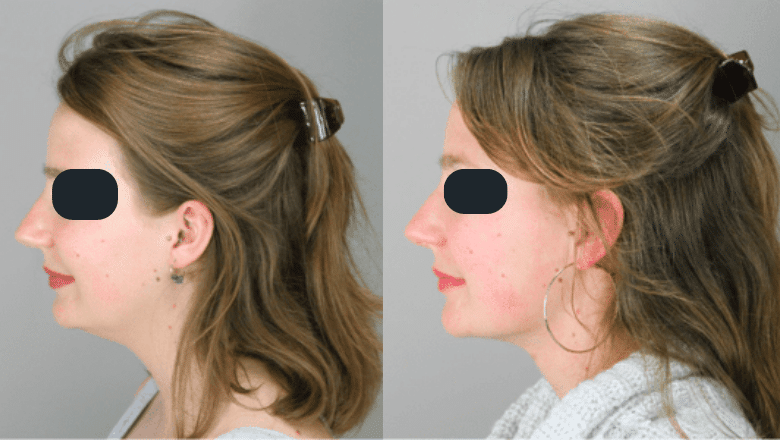
It affects a huge range of people — office workers, students, anyone whose job involves a screen, and increasingly teenagers and young adults who have grown up with smartphones. Screen time is the driving factor: the average smartphone user spends 4 to 6 hours a day on their device, often at a head angle of around 60° when texting, while office workers can easily spend 8 to 10 hours a day with their heads tilted forward at a computer. Device use is so universal that tech neck has become one of the most common posture-related concerns of modern life.
Why Forward Head Posture Puts So Much Strain on the Neck
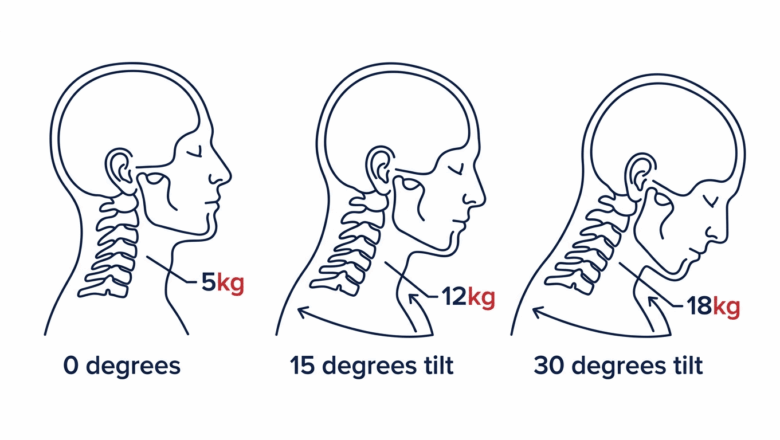
The physics of it are striking, and they explain why tech neck develops so readily. In a neutral position — spine straight, ears stacked over the shoulders — the adult head weighs around 5kg (11lbs). But as the head tilts forward, the effective force on the neck rises dramatically: at around 15° of tilt the load equates to roughly 12kg (27lbs), and at 30° it climbs to about 18kg (40lbs) — close to the weight of an eight-year-old child being supported by the neck muscles continuously. The further you look down, the harder the muscles at the back of the neck must work to hold the head up.
Sustained over hours every day, this constant load flattens the natural curve of the cervical spine, overworks and tightens the muscles at the back of the neck, and stretches and weakens the muscles of the upper back. Several specific muscle groups are affected in predictable ways: the deep neck flexors — the muscles responsible for stabilising the head — weaken over time and fail to provide adequate support, allowing the head to drift forward more easily; the upper trapezius and levator scapulae, which run from the neck to the shoulder blades, become chronically shortened and tense from continuously holding the head up against gravity, which is why tech neck so often presents as shoulder and upper-back tension rather than neck pain alone. On the skin, the repeated folding of the neck as the head bends forward etches horizontal lines into place — the same way a repeatedly folded piece of paper eventually holds a permanent crease. This is why tech neck produces both a postural and a cosmetic problem at once.
Certain factors make tech neck more likely to develop or more pronounced once it does. A prior neck injury, such as whiplash, can leave the muscles and supporting tissues weakened, making the neck less able to tolerate sustained forward posture. Pre-existing ligament laxity around the cervical spine can similarly reduce the joint stability needed to resist the strain, making symptoms appear earlier or more severely than in someone without that predisposition. Age and skin quality also interact with tech neck — the same mechanical strain produces more visible creasing in skin that has already begun to lose collagen and elastin.
Tech Neck Symptoms: What to Look For
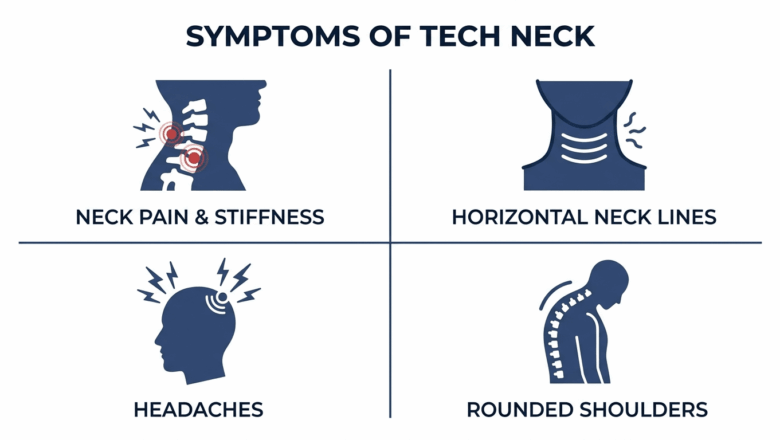
Tech neck symptoms span the functional and the aesthetic. On the functional side: neck pain and stiffness, particularly after long periods at a screen; aching or tightness across the shoulders and upper back; headaches that often begin at the base of the skull; reduced neck mobility; and, in more pronounced cases, tingling or numbness radiating into the arms and hands where nerves are affected. Posture itself changes over time, with the head sitting habitually forward and the shoulders rounding.
This is more common than most people assume, and the threshold for it is lower than you might expect. A cross-sectional study of medical students found that more than a quarter met the criteria for text neck syndrome — defined as at least three of six characteristic symptoms alongside more than four hours of daily smartphone use — and that 31.7% of those affected had a measurable degree of neck disability (DOI ↗). Being female, using four or more devices, low physical activity and more than three hours a day seated were all significantly associated with it. Four hours of phone use is an unremarkable day for most people.
On the aesthetic side, the most recognisable sign is horizontal neck lines — often called necklace lines — the deepening creases that run across the front of the neck. Alongside these, many people notice loss of firmness, crepey skin texture, and a softening of the sharp angle between the jaw and neck. Vertical platysmal bands (cords running down the neck) can also become more apparent, though these are a muscle issue rather than a direct result of screen posture.
Tech Neck Hump: Is a Neck Hump Caused by Posture?
One of the most common questions about tech neck is whether it causes the raised bump at the base of the neck — variously called a tech neck hump, a neck hump, a dowager’s hump or a buffalo hump. The answer depends on what is actually forming the lump, and the three causes need to be separated because only one of them is really about your phone.
Postural rounding. Sustained forward head posture shortens the muscles at the front of the neck and lengthens those behind it, and over time the upper back rounds forward. Early on this is a soft-tissue and posture problem rather than a fixed structural one, which is why it is the version most likely to improve with the corrective exercises below. This is the hump that tech neck genuinely causes.
A fatty pad, or a structural change in the spine. The other two causes are not tech neck at all. A discrete pad of fat over the upper back is a buffalo hump, which will not respond to posture work because it is fat rather than muscle — and which sometimes has a medical cause that needs excluding first. A true dowager’s hump is hyperkyphosis, a structural change in the curve of the upper spine. Both are covered properly in our guide to buffalo hump versus dowager’s hump, and how each is removed.
The short version: if the hump is soft, longstanding and visibly improves when you consciously straighten up, it is postural and the exercises below are the right starting point. If it does not change with posture, read the buffalo hump guide instead — the treatment is different and the assessment matters.
Tech Neck Exercises: How to Fix Tech Neck with Posture and Habits
Tech neck is caused by behaviour, so the most important treatment — and the only one that addresses the root cause — is changing how you use your devices. No aesthetic treatment will hold up well if the underlying posture continues to drive the damage, so this comes first for a reason.
Corrective exercise is not merely sensible advice — it has been measured. A controlled study of 60 university students found that eight weeks of self-managed corrective exercises, performed five days a week, reduced reported neck pain by 36.6% and measurably decreased forward head posture, head tilt angle and gaze angle on photographic analysis (DOI ↗). The same study found that sitting on a chair without a backrest while using a smartphone produced the worst head and neck angles of any position tested — worth knowing if you work from a kitchen stool or a sofa.
Raise your screens. Position phones, tablets, and monitors so the top third of the screen sits at eye level when you’re upright, so you look forward rather than down. A laptop stand and external keyboard make an enormous difference for anyone working at a laptop all day.
Take regular breaks. Every 20–30 minutes, look up, roll the shoulders back, and reset your posture. Standing up and moving periodically prevents the neck locking into one sustained position.
Mind your sitting posture. Aim to keep the ears stacked over the shoulders, the spine tall, and the shoulders back and down. Avoid using devices while slouched on a sofa or lying in bed, which forces the worst of the forward tilt.
Stretch and strengthen. Gentle daily neck and chest stretches release the tightened muscles at the front, while exercises that strengthen the deep neck flexors and upper back — drawing the shoulder blades together — counteract the rounding. Chin tucks, shoulder-blade squeezes, and chest-opening stretches are simple, effective staples. If pain is persistent, severe, or accompanied by numbness or tingling, it’s worth seeing a physiotherapist or doctor, as sustained nerve symptoms should always be assessed properly.
These measures both prevent tech neck developing and relieve the functional symptoms of existing tech neck. What they can’t do is reverse creases and skin laxity that have already set in — which is where aesthetic treatment comes in.
How to Get Rid of Tech Neck: Aesthetic Treatments for Tech Neck Lines
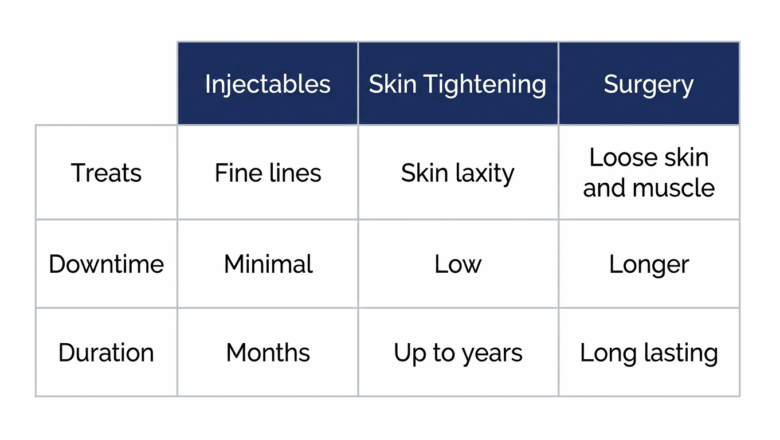
Once horizontal lines and skin laxity are established, a range of treatments can improve them. The right choice depends on how advanced the changes are — early lines respond well to non-surgical options, while significant loose skin ultimately needs surgery. An honest assessment at consultation is what matches the treatment to the problem. Our detailed guide on how to get rid of neck lines sets out the age-staged approach in full.
Bioremodelling with Profhilo and Skin Boosters
Profhilo is a hyaluronic acid injectable that hydrates the skin deeply and stimulates the body’s own collagen and elastin production, improving skin quality, firmness, and the appearance of fine horizontal lines. It’s one of the most popular first-line treatments for early tech neck lines, typically given as two sessions four weeks apart with maintenance every six to nine months. It works best on early creping and fine lines rather than deep-set creases or loose skin.
Dermal Fillers
For deeper, more established individual necklace lines, dermal fillers can be injected directly to soften the crease and restore a smoother surface. Results are visible almost immediately and settle fully over two to three weeks. Filler treats specific lines rather than overall skin quality, so it’s often combined with Profhilo for a more complete result.
Skin Tightening — Morpheus8 and Energy Devices
For tech neck lines accompanied by early skin laxity, energy-based skin tightening is often the most effective non-surgical route. Morpheus8 — radiofrequency microneedling — delivers heat into the deeper layers of the skin to stimulate collagen and tighten from within, usually over two to three sessions with results building across three to six months. It pairs particularly well with Profhilo, combining remodelling and collagen stimulation. Our full non-surgical neck lift guide explains how these treatments are layered.
Anti-Wrinkle Injections for Platysmal Bands
Where vertical platysmal bands are part of the picture, muscle relaxant injections placed along the bands relax the platysma muscle so the cords stop protruding. This is a muscle problem that skin treatments can’t address, so injections are the appropriate tool — effective for early-to-moderate banding in patients with otherwise reasonable neck skin.
Surgical Treatment for Advanced Tech Neck
Non-surgical treatments work well for early changes, but they have honest limits: no injectable or energy device removes excess skin — they tighten and remodel what’s already there. For patients with significant loose or sagging neck skin, true skin redundancy, or advanced laxity, surgery is the treatment that delivers a meaningful, lasting result.
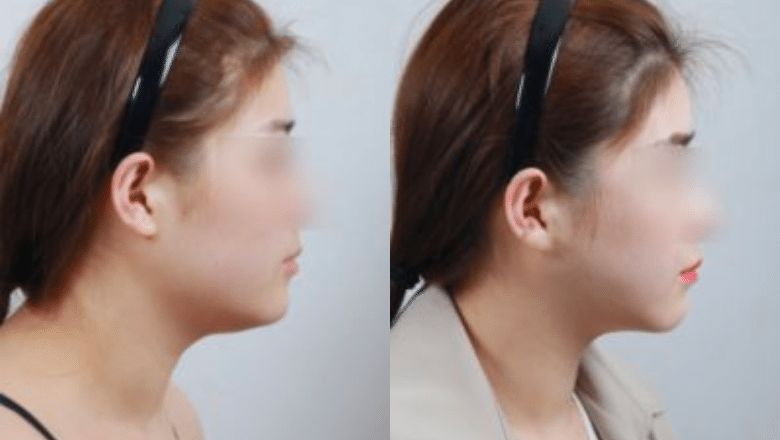
A neck lift removes redundant skin and tightens the underlying muscle. It encompasses cervicoplasty (removal of excess skin) and platysmaplasty (tightening of the neck muscles), addressing both loose skin and muscle banding to restore a defined, youthful neck contour. Full neck lift surgery is performed under TIVA (Total Intravenous Anaesthesia) as a day case. For patients whose changes are more moderate — too advanced for skin boosters but not needing a full neck lift — a mini neck lift can be a useful middle option, sometimes performed under local anaesthetic. Where excess fat under the chin contributes to the appearance, chin and neck liposuction (submental liposuction) can be performed on its own, under TIVA or local anaesthetic with sedation, or combined via the same small incision to refine the contour.
You’re likely a candidate for surgical assessment if you can pinch a significant amount of loose skin on the neck, have platysmal bands visible at rest rather than only when contracting, or have tried non-surgical treatments with disappointing results. An honest consultation will tell you whether you’re at the stage where surgery is worthwhile or whether non-surgical treatment still has more to offer.
How Much Does Tech Neck Treatment Cost?
Cost varies considerably depending on how advanced your tech neck is and which treatment genuinely matches it. A typical non-surgical plan combining Profhilo, Morpheus8, and/or anti-wrinkle injections over an initial three-to-six-month course with annual maintenance thereafter. Where surgery is needed, standalone chin and neck liposuction (see our chin liposuction cost guide) is appropriate where fat is the main concern and skin elasticity is good. A standalone neck lift addresses genuine skin excess and platysmal banding (see our neck lift cost guide). A mini neck lift is priced between these two, confirmed at consultation based on the extent of correction needed. Your exact cost is always confirmed in writing after a face-to-face assessment — see our neck lift cost guide and chin liposuction cost guide for full detail. Finance is available through Chrysalis Finance for procedures over £1,500, subject to status.
Combining Treatments for the Best Result
In practice, the most effective approach to tech neck is often a combination — and, crucially, one that starts with correcting the posture and habits driving it. Addressing the underlying cause protects whatever aesthetic treatment follows; layering Profhilo, energy-based tightening, and injectables addresses skin quality, laxity, and banding together; and where surgery is needed, non-surgical maintenance afterwards keeps the result fresh. The plan is always tailored to your specific stage of tech neck at consultation.
Frequently Asked Questions
How do you get rid of tech neck?
Start with the cause: raising your screens to eye level, taking regular breaks, and correcting sitting posture prevents further strain and stops symptoms worsening. For lines and laxity that have already developed, treatment is staged by severity — Profhilo and skin boosters for early creping, dermal fillers for established individual lines, Morpheus8 for lines with laxity, and a neck lift where skin excess or platysmal banding is significant. A consultation confirms exactly how to get rid of your specific tech neck.
Can tech neck be reversed?
The functional symptoms — pain, stiffness, poor posture — can be substantially improved and often reversed with posture correction, ergonomics, and exercise. The aesthetic changes (established lines and laxity) can be improved with treatment, though deep-set creases and significant loose skin need energy-based or surgical treatment rather than resolving on their own.
Is tech neck permanent?
Not if addressed early. Early postural changes and fine lines respond well to habit changes and non-surgical treatment. Left unaddressed for years, both the postural changes and the skin creasing become more entrenched and harder to fully reverse — which is why prevention matters.
What’s the difference between tech neck and text neck?
Nothing meaningful — “text neck” and “tech neck” describe the same condition and are used interchangeably. “Text neck” emphasises phone use specifically, while “tech neck” covers the broader pattern including laptops, tablets, and desktop monitors.
What’s the difference between tech neck and normal neck ageing?
They overlap. Normal ageing brings loss of skin elasticity over time; tech neck accelerates and adds to this through the specific mechanical strain and repeated skin folding caused by looking down at devices. Tech neck is essentially a lifestyle-driven acceleration of neck ageing, which is why it now appears in much younger people than neck lines traditionally did.
Can exercises get rid of tech neck lines?
Exercises and posture correction address the functional side — pain, stiffness, and posture — and help prevent lines worsening. They won’t erase creases already etched into the skin, which need aesthetic treatment. Both together give the best outcome.
What is the best treatment for tech neck wrinkles?
It depends on severity. Early fine lines respond to Profhilo and skin boosters; deeper individual lines to dermal fillers; lines with laxity to Morpheus8 or other energy devices; and significant loose skin to a neck lift. A consultation matches the treatment to your stage.
At what age does tech neck appear?
Increasingly early. It’s driven by device use rather than age alone, so tech neck lines and postural changes now appear in people in their twenties and thirties — far younger than neck ageing traditionally began.
Who is most at risk of developing tech neck?
Anyone with heavy daily screen use, but risk is higher for those with a prior neck injury such as whiplash, pre-existing ligament laxity around the cervical spine, or skin that has already begun losing collagen and elastin through age or sun exposure — all of which reduce the neck’s tolerance for sustained forward strain. It is also no longer only an adult concern: the paediatric literature now describes text neck syndrome in children and adolescents, and raises the possibility that sustained cervical loading during growth contributes to earlier cervical degeneration (DOI ↗).
How do you get rid of a neck hump from tech neck?
Prices for these treatments are on our Skin & Aesthetics price list.
If the hump is postural — soft, longstanding, and visibly reducing when you straighten up — corrective exercises and screen positioning are the right starting point, and the evidence above shows measurable reduction in forward head posture over eight weeks. If it is a firm fatty pad that does not change with posture, exercise will not shift it — see our guide to buffalo hump removal for how that is treated. A fixed bony curve, or a hump that has appeared recently, needs medical assessment first.
Is a dowager’s hump the same as tech neck?
No. Tech neck causes postural rounding, which is a soft-tissue pattern and largely reversible. A dowager’s hump is a structural change in the spine, and a buffalo hump is a fatty pad — different causes, different treatments. Our guide to buffalo hump versus dowager’s hump covers both in full.
Can I prevent tech neck?
Yes, largely. Raising your screens to eye level, taking regular breaks, maintaining good sitting posture, and doing simple neck and upper-back exercises all substantially reduce the strain that causes tech neck. Prevention is far easier than reversal.
Tech Neck Treatment at Centre for Surgery
Centre for Surgery treats the visible signs of tech neck with the full range of options — from Profhilo and Morpheus8 skin tightening to chin and neck liposuction and neck lift surgery — at our CQC-regulated Baker Street facility, rated Good overall. All surgical treatments are delivered by GMC-registered surgeons, and all treatments follow a thorough consultation, so your plan is matched honestly to your stage of tech neck, with clear advice on where posture and habit changes will do more than any procedure. Our medical content is reviewed by Specialist Plastic Surgeon Dr Spyridon Vlachos (GMC 7522950).
Finance options are available through our partner Chrysalis Finance for procedures over £1,500 — visit our Finance Options page for details.
Phone: 020 7993 4849 | Email: contact@centreforsurgery.com | Address: 95-97 Baker Street, London W1U 6RN