

In this guide12 sections
- Is Breast Augmentation Right for You?
- Choosing Your Implant: Silimed Cohesive Gel Silicone
- Determining Your Ideal Implant Size
- Implant Shape: Round vs Teardrop
- Implant Placement
- Incision Placement
- Choosing the Right Surgeon and Clinic
- What to Expect at Your Consultation
- Practical Things to Plan For
- A Longer-Term Reality Worth Knowing
- Frequently Asked Questions
- Breast Augmentation at Centre for Surgery
Deciding to have breast augmentation is only the first step — there’s a genuine amount to think through before your consultation, and going in prepared makes a real difference to how useful that first meeting is. This guide is a practical companion to our main breast augmentation page: rather than covering what the procedure involves, it walks through the decisions and preparation that come before and around your consultation — candidacy, implant choice, sizing, shape, placement, incision options, and what to actually expect when you sit down with your surgeon.
Is Breast Augmentation Right for You?
The first thing worth establishing, before anything else, is whether augmentation is actually the right procedure for what you’re hoping to achieve. Some women want more volume; others are more concerned with sagging or drooping, which augmentation alone won’t correct — in that case, a breast lift, or a lift combined with implants, is usually the more appropriate option. Being specific with yourself and your surgeon about what’s actually bothering you — size, shape, position, or a combination — is what allows the right procedure to be recommended, rather than defaulting to augmentation because it’s the most commonly known option.
Choosing Your Implant: Silimed Cohesive Gel Silicone
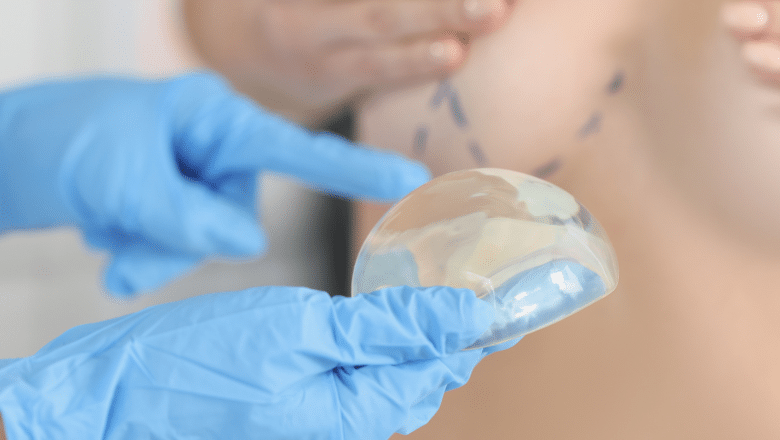
At Centre for Surgery, we use Silimed cohesive gel silicone implants exclusively — CE-marked, MHRA-approved, and backed by a Silimed replacement guarantee (rupture from a manufacturing defect, and grade III–IV contracture with textured or polyurethane implants after a first augmentation). Cohesive gel silicone holds its shape and feels significantly more natural than the saline implants that were more common in the past; saline is now rarely used in the UK, and we don’t offer it as an option.
Even if the implant shell is ever compromised, cohesive gel silicone doesn’t leak in the way older implant generations could — the gel holds together and maintains its form, which is part of why it’s become the standard choice for the vast majority of UK breast augmentation patients today. Choosing a clinic that’s transparent about a single, well-tested implant system — rather than offering older or less consistent alternatives — is worth prioritising over any other single factor when you’re comparing clinics.
Determining Your Ideal Implant Size
Implant size is measured in cubic centimetres (cc), and it’s genuinely one of the most significant decisions in the whole process. At your consultation, your surgeon will assess your chest wall, existing breast tissue, and body proportions, and you’ll be able to try on sample implants inside a bra to get a realistic sense of scale — alongside 3D imaging at some consultations to preview different sizes on your own body.
Before you get to that point, you can get a rough starting sense of scale at home using the “rice test”: fill the foot of a stocking or a sealed bag with uncooked rice (roughly 30cc per ounce, or around 236cc per cup), tie it off, and place it inside a non-padded sports bra. This isn’t a substitute for proper sizers at consultation, but it’s a genuinely useful way to arrive with a rough range in mind rather than starting from nothing.
Implant Shape: Round vs Teardrop
Silimed implants are available in both round and teardrop (anatomical) shapes, and the right choice depends on the look you’re going for.
Round implants
The more commonly chosen shape, round implants create fullness at the top of the breast and tend to produce a more noticeable cleavage effect. They’re symmetrical, so there’s no risk of visible rotation if the implant shifts slightly over time.
Teardrop implants
Designed to mimic the natural slope of the breast, with more volume at the bottom than the top, teardrop implants suit patients wanting a softer, more gradually sloped result — and can be particularly well suited to a naturally tubular breast shape. They’re not symmetrical, so precise placement matters more, and a small risk of visible rotation exists if the implant moves within the pocket.
Implant Placement
Where the implant sits relative to your chest muscle affects both how it looks and how it feels.
Subglandular
The implant sits above the muscle, directly beneath the breast tissue. This can give a slightly more defined, “augmented” look and is generally a shorter recovery, but offers less soft-tissue coverage — meaning implant edges may be more noticeable in patients with less natural tissue.
Dual-plane
The most commonly used approach, dual-plane positions the upper part of the implant beneath the muscle and the lower part beneath the breast tissue, giving good coverage with a natural transition at the upper pole. This is generally the recommended default unless your anatomy or goals point elsewhere.
Your surgeon will recommend the position best suited to your tissue thickness, goals, and lifestyle — this isn’t a decision to make from research alone, since it depends heavily on your individual anatomy.
Incision Placement
There are three main incision options for silicone implant surgery, and the right one depends on implant size, your anatomy, and your surgeon’s assessment.
Inframammary (breast crease) incision
Made along the natural fold beneath the breast, this is the most common choice in the UK, since the resulting scar is well concealed within the crease itself.
Periareolar incision
Made around the edge of the areola, this can also be discreetly placed, though it may be less suitable for larger implants or certain breast shapes.
Transaxillary (armpit) incision
Made in the armpit, leaving no scar on the breast itself, though it can be more technically demanding for precise implant placement.
Incisions typically range from around 1 to 4 inches, depending on implant size and the technique used. Your surgeon will talk through which option suits your anatomy and your implant choice specifically.
Choosing the Right Surgeon and Clinic
Choosing your surgeon matters more than any other single decision in this process. Look for a plastic surgeon on the GMC Specialist Register — the UK’s recognised standard for surgical qualification — operating from a CQC-regulated facility. Request before-and-after photographs of previous patients, and don’t let cost be the deciding factor over safety and genuine expertise; most reputable clinics, including Centre for Surgery, offer finance options to make cost less of a barrier to choosing well.
What to Expect at Your Consultation
Your consultation is your opportunity to be heard, ask questions, and get a genuinely honest assessment of what’s achievable for your anatomy — not a sales conversation. Come prepared to discuss:
- Your goals and any reference photos of a look you like
- Your full medical history, including any previous breast surgery
- Questions about implant type, size, shape, placement, and incision options
- Risks, complications, and realistic recovery expectations
- Cost and finance options
There’s no dress code for a consultation, but wearing a well-fitted, non-padded bra (or bringing one with you) makes it easier for your surgeon to assess your current shape and for you to try on sample implants during the visit.
Practical Things to Plan For
Time off work
Most patients need five to seven days off for a desk-based role, longer for physically demanding jobs — implants placed beneath the muscle generally mean a slightly longer recovery than subglandular placement.
Smoking
You’ll need to stop smoking at least two weeks before surgery and throughout recovery, since smoking measurably affects wound healing. Surgeons can and do test for compliance, and surgery may be postponed if there’s a genuine safety concern.
Exercise
Strenuous activity, including most exercise, needs to be avoided for around six weeks, with a compression garment worn during early recovery to support healing. If you’re very active, it’s worth thinking ahead about how a larger implant size might affect high-impact exercise long term, not just during recovery.
A Longer-Term Reality Worth Knowing
Breast augmentation is unlikely to be the only surgery you’ll ever have on your breasts. Implants don’t last forever — even with modern, well-tested implants like Silimed, most patients will eventually consider replacement or removal down the line, whether due to a specific complication, a change in your body over time (weight change, pregnancy, ageing), or simply wanting a different result years later. This isn’t a reason not to proceed — it’s simply worth factoring into your long-term financial and decision-making picture from the outset, rather than assuming this is a one-off procedure.
Frequently Asked Questions
What should I wear to my breast augmentation consultation?
There’s no strict requirement, but a well-fitted, non-padded bra — or bringing one to change into — makes it much easier for your surgeon to assess your anatomy and for you to try on sample implants.
Do I need to know exactly what size I want before my consultation?
No, though having a rough idea (the rice test can help with this) gives your surgeon a useful starting point. Your final decision will be shaped substantially by your consultation, sizers, and your surgeon’s assessment of what your anatomy can support.
Does Centre for Surgery offer saline implants?
No — we use Silimed cohesive gel silicone implants exclusively. Saline is rarely used in UK breast augmentation today, and we don’t consider it comparable in look, feel, or long-term reliability to modern cohesive gel silicone.
Will I definitely need another surgery in the future?
Not necessarily, but it’s realistic to expect that most patients will consider implant replacement or removal at some point over their lifetime, whether for medical reasons or simply personal choice as their body or preferences change.
Breast Augmentation at Centre for Surgery
Our plastic surgeons are registered with the General Medical Council, using Silimed cohesive gel silicone implants exclusively, and performing breast augmentation under TIVA (Total Intravenous Anaesthesia) at our CQC-regulated Baker Street facility, rated “Good” overall by the Care Quality Commission.
If you’re ready to take the next step, contact us today by calling 020 7993 4849 to book your consultation.
Related Articles
- Breast Implant Sizes: How to Choose the Right Size
- Round vs Teardrop Implants – Choosing The Best Breast Implant Shape