


In this guide13 sections
- Key Points
- What Is the Malar Fat Pad?
- Why Does the Malar Fat Pad Sag With Age?
- What Is the Difference Between the Malar Fat Pad and the Buccal Fat Pad?
- Can the Malar Fat Pad Be Removed?
- Which Procedures Lift the Malar Fat Pad?
- Is an Endoscopic Mid-Facelift Minimally Invasive?
- What Are the Risks of a Malar Fat Pad Lift?
- How Long Do Malar Fat Pad Lift Results Last?
- Mid-Facelift vs Facelift vs Fat Transfer: Which Is Right for Me?
- Frequently Asked Questions
- Malar Fat Pad Lift in London
- References
Key Points
- The malar fat pad is the cushion of fat over the cheekbone that gives the cheek its fullness. With age it tends to sink and thin, which deepens the smile line and hollows the area under the eye.
- Procedures that lift the malar fat pad are a mid-facelift, a deep plane or SMAS facelift, and a mini facelift. Fat transfer, fillers and threads add volume or give temporary lift instead of repositioning tissue.
- The malar fat pad should not be removed. Taking it out flattens the cheek and ages the face. Repositioning or replacing volume is the usual approach.
- The evidence is mostly case series. Published midface lift studies are largely surgeon-reported, with small to moderate patient numbers, so results should be read as encouraging rather than guaranteed.
- Thread lifts have the weakest long-term evidence. A 2021 meta-analysis found satisfaction fell from 98% immediately after treatment to 88% later on.
- Whether you need lifting, volume or both depends on your anatomy, which is why a face-to-face assessment matters more than the name of the procedure.
When the cheek loses its fullness and the line from nose to mouth deepens, the malar fat pad has usually moved downwards. A mid-facelift repositions this fat pad back over the cheekbone, and a mini facelift can suit milder descent. Where the main problem is lost volume rather than sagging, facial fat transfer replaces what has been lost.
This guide explains where the malar fat pad sits, why it drops, how it differs from the buccal fat pad, and which procedures lift it, with the published evidence for each. If you are not yet sure whether your concern is descent or volume loss, our guide to saggy cheeks is a useful starting point, and our overview of the signs of facial ageing shows how the midface changes alongside the rest of the face.
What Is the Malar Fat Pad?
The malar fat pad is a triangular pad of fat that sits over the cheekbone (the malar eminence), between the lower eyelid and the fold that runs from the nose to the corner of the mouth. It is often called the “apple” of the cheek, and in a youthful face it sits high, creating a smooth line from the under-eye area into a rounded cheek.
Surgeons now think of facial fat as a set of separate compartments rather than one sheet. Cadaver work has shown that the midface contains both superficial and deep fat, and that a working theory of ageing is that loss or drooping of the deep fat compartments changes the shape and contour of the face, while folds appear where thicker superficial fat meets thinner fat[1]. Terms such as malar fat pad, medial cheek fat and nasolabial fat are different ways of naming parts of that same system.
Why Does the Malar Fat Pad Sag With Age?
Malar fat pad descent is a combination of several changes happening together. The ligaments and fascia that hold the cheek up loosen, the skin loses elasticity, the fat compartments lose volume, and the bone under them gradually recedes. Older theories blamed gravity alone, and later ones emphasised volume loss, but a 2026 narrative review in Aesthetic Surgery Journal argues that these processes feed one another, with weaker soft-tissue support contributing to bone resorption around the eye socket and cheekbone[2]. That is a proposed framework rather than a proven mechanism, but it matches what surgeons see: descent and deflation usually coexist.
The visible signs are a flatter cheekbone, a hollow under the eye, a deeper smile line, and early jowls. Sun exposure, smoking, rapid weight loss and genetics all play a part, and our guide to lifestyle factors that affect facial ageing covers which of these you can influence. What lifestyle changes cannot do is move fat that has already descended, and there is no good evidence that facial exercises lift the malar fat pad.
What Is the Difference Between the Malar Fat Pad and the Buccal Fat Pad?
The malar fat pad is a superficial fat compartment over the cheekbone, and the buccal fat pad is a deeper, separate pad in the lower cheek, between the muscles that move the jaw and face. The malar pad creates the high, rounded fullness of the upper cheek. The buccal pad contributes to the roundness of the lower face, and when it is prominent it can make the face look softer or fuller.
The two are treated in opposite ways. A sinking malar fat pad is lifted or topped up, while an overly full lower cheek can be slimmed with buccal fat removal. Removing buccal fat from a face that is already losing volume can accentuate hollowing, so the decision depends on your age, your anatomy and how much volume you have to spare.

Can the Malar Fat Pad Be Removed?
It is technically possible, but it is rarely advisable. The malar fat pad is a major contributor to a healthy-looking cheek, and removing it tends to leave a flat, tired or gaunt midface. It would also be difficult to reach without visible scarring.
People who search for malar fat pad reduction are often describing something different, such as puffiness under the eye, fluid swelling over the cheekbone, or a heavy lower cheek. Our guide to malar bags explains how that kind of swelling differs from the fat pad itself. If your cheeks look full, the question is usually whether the fat has slipped downwards or whether another structure is responsible, and only an examination can tell you which.
Which Procedures Lift the Malar Fat Pad?
There are two different goals here, and procedures serve one or the other. Repositioning moves the existing fat pad back up over the cheekbone. Volume replacement adds fat or filler to restore fullness. Many patients need a combination, and the right plan depends on how much of the problem is descent and how much is deflation.
Endoscopic mid-facelift (cheek lift)
A mid-facelift is the procedure designed most specifically for the malar fat pad. Through small incisions, usually in the hairline at the temple and sometimes inside the mouth, the surgeon releases the tissues that hold the cheek down and fixes the fat pad higher on the cheekbone. Our mid-facelift service page explains the technique and who it suits.
The evidence is encouraging but mostly comes from surgeons reporting their own cases. One 2026 series of 62 patients, published in Aesthetic Plastic Surgery, fixed the malar fat pad directly to the bone at the outer eye socket; at an average of 15 months, brow height, lower eyelid length and patient-reported scores had improved, with no injury to the cheek branch of the facial nerve but temporary weakness of the forehead branch lasting over a month in three patients[3]. In a 2026 retrospective study of 113 patients in Facial Plastic Surgery ↗, an endoscopic midface lift improved upper and lower cheek fullness, the hollow under the eye and nasolabial fold depth on photographic scoring, with photographs reviewed for an average of 2.6 years and up to 17 years[4]. A review by an experienced surgeon of more than 2,500 endoscopic cases reported patient satisfaction of 90 to 95% at one year and complication rates of 3 to 10% with careful patient selection[5]. These are reports from specialist surgeons, not comparisons against other treatments, and results in other hands may differ.
Deep plane facelift and SMAS facelift
When descent also involves the jowls and neck, lifting the cheek alone is not enough. A full facelift lifts the cheek, jawline and neck in one layer of tissue. In a deep plane facelift, the surgeon releases the ligaments that tether the cheek and moves the cheek fat and underlying muscle together as one unit, which is described in the technical literature as volumising the midface[6]. In a SMAS facelift, the deeper support layer is tightened or repositioned without releasing those ligaments to the same extent.
Neither is clearly superior on the current evidence. A 2025 systematic review and meta-analysis in Aesthetic Plastic Surgery ↗ pooled 21 studies and 2,896 patients and found patient satisfaction of 94.4% after deep plane and 87.8% after SMAS facelifts, with overall complication rates of 17.2% and 10.3%, though the analysis did not compare the two techniques directly and the authors concluded that both give robust, long-term results[7]. Our guide to deep plane vs SMAS facelift explains how surgeons choose between them, and the page on what a facelift and necklift can correct sets out the wider picture, including face and neck lift surgery after weight loss.
Some surgeons now perform deep plane lifts endoscopically. A series of 393 patients reported no permanent nerve injury and revision for cosmetic concerns in 4.8%, mostly among the surgeon’s first 100 cases[8].

Mini facelift
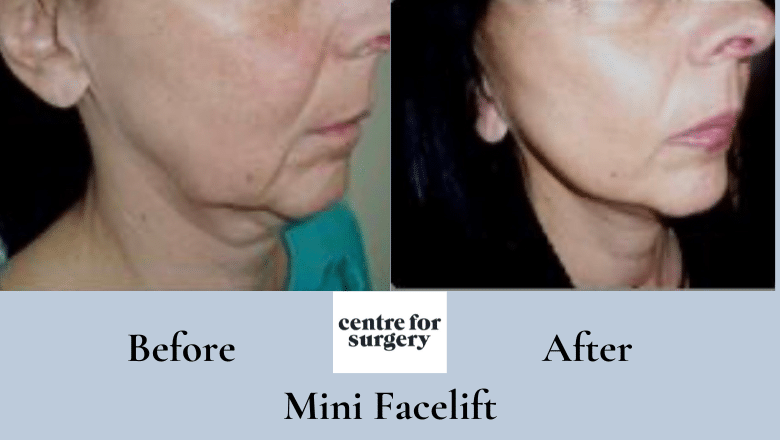
A mini facelift uses shorter incisions around the ear and addresses early to moderate sagging of the lower cheek and jawline. It can improve the cheek indirectly, but it works mainly on the lower face, so it suits patients whose malar fat pad has dropped only slightly. If the main concern is the area directly under the eye and over the cheekbone, a mid-facelift targets that region more directly.
Fat transfer to the cheeks
Facial fat transfer takes fat from another part of the body by liposuction and injects it into the cheek. It does not reposition the malar fat pad, but it restores the fullness that descent and deflation remove, and it is often combined with a facelift. A systematic review of 15 studies found that adding fat grafting to facelift surgery produced significant improvements in facial volume and aesthetic scores, and concluded that the combination is a safe and effective way of addressing both ptosis and volume loss[9].
How much fat is placed varies widely. A systematic review of 19 studies found a mean of about 1.4 mL per side in the midface, with the authors noting that amounts are mostly based on surgeon experience and vary with the anatomical terms used[10]. Some of the fat does not survive, so surgeons plan for that. If you are worried about looking overfilled, our article on looking overfilled after fat transfer to the face explains how this is avoided, and our guide on whether facial fat transfer is permanent covers longevity.
Thread lift
Thread lifts use sutures with small barbs or cones to hitch the cheek upwards without cutting the skin. They are a lighter option, but the evidence for a lasting lift is the weakest of the group. A 2021 meta-analysis of 26 studies in Aesthetic Plastic Surgery ↗ found swelling in about 35% of patients, skin dimpling in 10% and nerve-related numbness in 6%, and satisfaction that dropped from 98% immediately afterwards to 88% later on[11]. A later review of 12 studies of absorbable threads reported immediate improvement with mild complications, but the longest follow-up was two years and the authors noted that long-term efficacy data are lacking[12]. Complication rates also differ by material and design, with barbed threads and midface placement associated with more swelling and bruising[13]. Our comparison of a thread lift, FaceTite and a facelift sets out where threads fit.
Cheek fillers
Dermal filler can restore volume over the cheekbone and soften the shadow under the eye, but it adds to the cheek rather than lifting it. Filler can look natural in the right amount, yet using more to compensate for descent risks a heavy, puffy midface. Our guide to cheek fillers explains what they suit, and the article on cheek augmentation with fillers vs fat compares the two volume options. For a direct comparison, see facial fat transfer vs fillers.
Is an Endoscopic Mid-Facelift Minimally Invasive?
An endoscopic mid-facelift is less invasive than a full open facelift in the sense that it uses small incisions hidden in the hairline or mouth and avoids long scars around the ear. It is still an operation under anaesthetic, with dissection over the cheekbone and close to the branches of the facial nerve, so it should not be thought of as a quick procedure with no downtime.
We are not aware of good head-to-head trials showing that endoscopic mid-facelift recovers faster than other facelift techniques, so any suggestion that it does should be treated with caution. What can be said is that swelling and bruising are expected for the first weeks, the final contour takes months to settle, and the time off work depends on the technique, the extent of surgery and the individual. Your surgeon should give you a realistic recovery timeline at consultation, and the pictures you see should come from patients treated in the way that is proposed for you.
What Are the Risks of a Malar Fat Pad Lift?
All facial surgery carries risks, including bleeding or haematoma, infection, asymmetry, scarring, changes in sensation, and a need for revision. The most important specific risk is injury to branches of the facial nerve, which can cause temporary weakness and, rarely, longer-lasting problems. In the 62-patient series above, temporary forehead weakness lasting more than a month affected 3 patients (4.8%)[3], while the 393-patient endoscopic series recorded no permanent nerve injury[8]. Published complication rates come largely from experienced surgeons reporting their own results, and they depend on the technique, so ask any surgeon about their own figures and what they do when something goes wrong.
Smoking, certain blood-thinning medicines and some medical conditions raise the risk of complications and slow healing, so a full medical history is part of the assessment. Thread lifts carry their own risks, including visible or palpable threads, dimpling and thread extrusion[11].
How Long Do Malar Fat Pad Lift Results Last?
No lift stops ageing. The question is how long you look better than you would have done without it. In the 113-patient midface lift study, improvements were still measurable at an average of 2.6 years[4], and a systematic review found that patient satisfaction was high after both deep plane and SMAS facelifts across follow-up periods beyond one year[7]. Thread lift results are shorter-lived on the current evidence[11][12]. Longevity also depends on your skin quality, genetics, weight changes, sun exposure and smoking, so no clinic can promise a set number of years.
Mid-Facelift vs Facelift vs Fat Transfer: Which Is Right for Me?
A practical way to think about it is to separate what you can see.
- Sinking cheek and deeper smile line, little jowl or neck laxity: a mid-facelift is the most targeted option, and a mini facelift can suit milder cases.
- Cheek descent with jowls and neck laxity: a deep plane or SMAS facelift treats the whole face rather than only the midface.
- Flat or hollow cheeks with reasonably good skin tone: fat transfer or filler replaces the lost volume.
- Both descent and hollowing: a lift combined with fat transfer, which is a common pairing in the published series[9].
A physical examination, photographs from several angles and an honest conversation about what you want to change usually settle the choice. Many people are well served by a modest procedure done properly rather than the largest operation available.
Frequently Asked Questions
What are fat pads in the face?
Facial fat pads, or fat compartments, are separate pockets of fat under the skin and in deeper layers that give the face its shape. The malar fat pad over the cheekbone is one of them. They shrink and shift with age, and the pattern differs between people.
Where is the malar fat pad located?
It sits over the cheekbone, between the lower eyelid and the fold from the nose to the mouth. It is more superficial and higher on the face than the buccal fat pad, which lies in the lower cheek.
Do fat pads go away?
Facial fat does not simply disappear, but it can shrink, thin and shift position with age, weight loss and genetics. Fat that has sunk does not return to its old position by itself, which is why repositioning or volume replacement is considered.
Can you lift the malar fat pad without surgery?
Non-surgical treatments can add volume or tighten skin slightly, but none moves the fat pad the way surgery does. Thread lifts give a temporary lift with weaker long-term evidence than surgery, and there is no reliable evidence that facial exercises raise it.
How much does a mid-facelift change the cheek?
It repositions the cheek fat higher over the cheekbone, which can restore fullness, soften the line from nose to mouth and improve the hollow under the eye. The degree of change depends on your anatomy and the technique used, and it is judged at consultation using your photographs.
Is a mid-facelift better than a full facelift?
Neither is better in general. A mid-facelift works on the cheek and area under the eye, while a full facelift also treats the jowls and neck. The right one depends on where the sagging is, so a surgeon assesses your whole face rather than the cheek alone.
How long does a mid-facelift last?
No procedure stops ageing, but published midface lift series have documented improvements lasting years. In one retrospective study photographs were reviewed at an average of 2.6 years[4]. Individual longevity varies.
What is malar fat pad separation?
The phrase is used online for a visible line or bulge across the cheek that looks like the fat has split from the tissue around it. It is not a recognised diagnosis, and the cause may be fat descent, a malar mound, fluid swelling or the effect of filler. Examination is needed to tell which.
Malar Fat Pad Lift in London
A consultation with a plastic surgeon will establish whether your cheeks need lifting, volume or both, and which procedure is appropriate for your anatomy and goals. You can read about mid-facelift surgery at Centre for Surgery, or explore our wider facelift options.
Phone: 020 7993 4849 | Address: 95–97 Baker Street, Marylebone, London W1U 6RN
Contact us to schedule a consultation
References
- Rohrich RJ, Arbique GM, Wong C, Brown S, Pessa JE. The anatomy of suborbicularis fat: implications for periorbital rejuvenation. Plastic and Reconstructive Surgery 2009;124(3):946–951. doi:10.1097/PRS.0b013e3181b17b76 ↗
- Papadopoulos T. From layers to loadbearing: the face as a prestressed biotensegrity system. Aesthetic Surgery Journal 2026. doi:10.1093/asj/sjag157 ↗
- Ersan M, Yildiz HA. Endoscopic periorbital and midface rejuvenation with direct fixation: an alternative to suspension techniques. Aesthetic Plastic Surgery 2026. doi:10.1007/s00266-026-06244-w ↗
- Levin M, Simmons JK, Frankel A. Transoral-transtemporal Endotine-assisted endoscopic midface lift (TTEEM): technical considerations and objective long-term outcomes. Facial Plastic Surgery 2026. doi:10.1055/a-2982-6845 ↗
- Saltz R, Scala F. Endoscopic techniques in facial rejuvenation: indications, technical refinements, and avoidance of unsatisfactory results. Journal of Craniofacial Surgery 2026. doi:10.1097/SCS.0000000000013389 ↗
- Jacono A, Bryant LM. Extended deep plane facelift: incorporating facial retaining ligament release and composite flap shifts to maximize midface, jawline and neck rejuvenation. Clinics in Plastic Surgery 2018;45(4):527–554. doi:10.1016/j.cps.2018.06.007 ↗
- Khoury S, Almubarak Z, Khan H, Boldt G, Villemure-Poliquin N, Nichols AC. The deep plane versus SMAS facelift: a systematic review and meta-analysis. Aesthetic Plastic Surgery 2025;49(21):5895–5903. doi:10.1007/s00266-025-05118-x ↗
- Firat M. Endoscopic deep plane facelift: a classified approach. Aesthetic Surgery Journal 2025;45(10):989–1001. doi:10.1093/asj/sjaf110 ↗
- Molina-Burbano F, Smith JM, Ingargiola MJ, et al. Fat grafting to improve results of facelift: systematic review of safety and effectiveness of current treatment paradigms. Aesthetic Surgery Journal 2021;41(1):1–12. doi:10.1093/asj/sjaa002 ↗
- Shue S, Kurlander DE, Guyuron B. Fat injection: a systematic review of injection volumes by facial subunit. Aesthetic Plastic Surgery 2018;42(5):1261–1270. doi:10.1007/s00266-017-0936-6 ↗
- Niu Z, Zhang K, Yao W, et al. A meta-analysis and systematic review of the incidences of complications following facial thread-lifting. Aesthetic Plastic Surgery 2021;45(5):2148–2158. doi:10.1007/s00266-021-02256-w ↗
- Riopelle AM, Geisler AN, Eber A, Dover JS. Update on absorbable facial thread lifts. Dermatologic Surgery 2025;51(5):509–514. doi:10.1097/DSS.0000000000004521 ↗
- Ojha AS, Farahbakhsh N, Saikaly SK. An assessment and comparison of adverse effect rates in differing absorbable thread lift suture materials. Dermatologic Surgery 2025;51(3):272–276. doi:10.1097/DSS.0000000000004466 ↗







