


In this guide14 sections
- Key Points
- What Is Preservation Rhinoplasty?
- What Is Dorsal Preservation Rhinoplasty?
- Preservation Rhinoplasty vs Traditional (Structural) Rhinoplasty
- Open vs Closed Preservation Rhinoplasty
- Who Is a Good Candidate for Preservation Rhinoplasty?
- What Does a Preservation Rhinoplasty Result Look Like?
- Preservation Rhinoplasty Recovery
- Preservation Rhinoplasty Risks and Complications
- Can Preservation Rhinoplasty Be Revised?
- Preservation Rhinoplasty in London
- Frequently Asked Questions: Preservation Rhinoplasty
- Speak to Us About Preservation Rhinoplasty
- References
Key Points
- What is preservation rhinoplasty? A way of reshaping the nose that keeps the bridge, its supporting cartilage and the surrounding ligaments in place and repositions them, rather than cutting a hump off and rebuilding the bridge afterwards.
- What is dorsal preservation rhinoplasty? The version used for a bump on the bridge. The main methods are push-down, let-down, the spare roof technique and the subdorsal strip technique.
- Is preservation rhinoplasty better than traditional rhinoplasty? Not in every respect. Pooled studies show similar functional results and revision rates, better early appearance and fewer bridge irregularities, but a higher chance of a hump returning.
- Who suits it? Usually people with a straight nose and a hump, without significant deviation or complex structural problems. Your surgeon decides after examining your nose.
- Is recovery quicker? No study has shown that it is. Early swelling and bruising follow the same pattern as other rhinoplasty, and the final shape takes up to a year.
- What are the risks? The general risks of rhinoplasty, plus hump recurrence, a small step or deviation on the bridge, and narrowing of the internal nasal valve if the technique is poorly matched to the nose.
Preservation rhinoplasty is one of the most discussed ideas in modern nose surgery. Many people now ask about a preservation nose job because clinics describe it as gentler, more natural and quicker to heal. Some of that is supported by research. Some of it is not, and a good decision depends on knowing which is which.
This guide explains what preservation rhinoplasty is, how dorsal preservation works, how it compares with other types of rhinoplasty, who is a suitable candidate, what recovery involves and what the risks and revision considerations are, using published studies rather than marketing claims.
What Is Preservation Rhinoplasty?
Preservation rhinoplasty is a philosophy of nose surgery as much as a single operation. The aim is to change the shape of the nose while conserving the structures the nose already has: the bony and cartilaginous bridge, the ligaments that tether the skin and tip, and the nerves and blood vessels around them. Where a traditional operation removes tissue and then rebuilds what is needed, a preservation approach tries to move and re-set what is already there.
It is not a new idea. The concept of lowering a nasal hump without cutting it off has been known for more than a century, and it has returned in recent years as surgeons have refined the techniques[1]. A 2025 review in Annals of Plastic Surgery describes preservation and structural rhinoplasty as two ends of a continuum rather than rival camps, with many surgeons blending the two depending on the nose in front of them[2].
Preservation principles can be applied to different parts of the nose:
- The bridge (dorsum): dorsal preservation rhinoplasty, covered in detail below, is the most common use.
- The soft tissue envelope and ligaments: ligament preservation means leaving the fibrous bands that support the skin and tip undisturbed where possible.
- The tip and nostrils: the same review describes tip and alar (nostril) preservation techniques, although the evidence for these is thinner than for the bridge[2].
Preservation rhinoplasty is therefore a technique used within rhinoplasty, not a different category of treatment, and the same standards of assessment, anaesthesia and aftercare apply.
What Is Dorsal Preservation Rhinoplasty?
When people search for preservation rhinoplasty they usually mean dorsal preservation: lowering a hump on the bridge without removing it. In a traditional hump reduction the surgeon rasps or cuts away the bump, which opens the roof of the nose and often needs spreader grafts or flaps to rebuild the airway and keep the bridge straight. Our guide to the dorsal hump explains how humps form and what the options are.
In dorsal preservation, the whole bridge is kept intact and lowered as one unit. The bone and cartilage that form the hump are not discarded. Instead, tissue is removed from beneath or beside the bridge so that the roof can drop to its new, lower position and be secured there.
Push-down and let-down
These are the two most widely known impaction techniques. In a push-down, a strip of septal cartilage is removed from under the bridge and the bone is released at the sides, so that the whole roof can be pushed down into the space created. A let-down achieves the same lowering by removing small wedges of bone along the sides of the nose, letting the roof settle down onto a narrower base. Which is chosen depends on the shape of the hump and the width of the nose. A 2026 systematic review of 13 studies describes push-down, let-down and subdorsal strip methods as the main dorsal preservation approaches[3].
Subdorsal strip technique
The subdorsal strip technique removes a thin strip of septal cartilage directly below the bridge, which allows the roof to be lowered. A strip taken lower in the septum, known as the low strip technique, is another variation. Different ways of taking and securing the strip exist, and surgeons continue to compare them.
Spare roof technique
The spare roof technique takes a different route. The hump is removed in one piece, reduced in size and narrowed, and then placed back over the bridge as a graft made from the patient’s own tissue. It is sometimes grouped with the preservation family because the patient’s own hump is reused rather than discarded, although it is a modification of the roof rather than a true lowering of the intact bridge. A related method, the dorsal roof technique, has been described for both lowering and narrowing the bridge in a 52-patient series[4].
Ligament preservation
The skin of the nose is held in place by ligaments. Preservation surgery tries not to detach them, which keeps the support under the skin and, in theory, the soft contour of the bridge. The benefit of ligament preservation has been argued in the surgical literature, but we found no trials that isolate its effect on its own.
Piezo (ultrasonic) preservation
Some preservation rhinoplasty is performed with a piezoelectric instrument rather than a hammer and chisel, because it allows very precise bone cuts. Our ultrasonic rhinoplasty page explains the instrument, and the two can be combined where a surgeon judges it appropriate.
Preservation Rhinoplasty vs Traditional (Structural) Rhinoplasty
The question most people want answered is whether preservation rhinoplasty gives a better result than the traditional route. The honest answer is that it depends on what you measure.
A 2025 systematic review and meta-analysis in the Journal of Plastic, Reconstructive and Aesthetic Surgery pooled 10 studies and 1,339 patients comparing dorsal preservation with conventional dorsal reduction ↗. Preservation was associated with higher short-term satisfaction with appearance and fewer dorsal irregularities, but also with a higher rate of residual or recurrent hump. Functional scores, longer-term appearance scores and the need for revision surgery did not differ significantly between the two[5].
Other reviews point the same way, with some variation:
- A 2025 meta-analysis of six studies and 753 patients found that satisfaction with appearance was greater after preservation up to six months, with no significant difference after that, and similar improvement in nasal obstruction at one year[6].
- A 2025 meta-analysis of four randomised studies including 419 patients reported better functional and cosmetic patient-reported scores with preservation, although the authors noted moderate variation between studies on the cosmetic results[7].
- A 2026 systematic review of six studies and 662 patients found that nasal airway function was maintained or improved after dorsal preservation, with complication rates under 5% and revision rates under 2%[8].
Taken together, the studies suggest preservation is a reasonable alternative to the traditional approach for suitable noses, rather than a clear winner. The limitations are important. Most studies are observational, many come from a small number of experienced surgeons, follow-up is often short and the techniques vary from one study to the next.
Is preservation rhinoplasty better?
It can be better for the right nose and worse for the wrong one. It tends to suit a straight nose with a simple hump. A nose that needs significant reshaping, major straightening or tip work may be better served by a structural approach, or by a hybrid of the two. Our guide to dorsal hump treatment and our overview of the different types of rhinoplasty set out how those choices are made.
Preservation rhinoplasty pros and cons
- Possible advantages: the bridge is kept as one piece, which is linked to fewer dorsal irregularities and, in some studies, better early appearance scores; less need for grafts to rebuild the roof; and a smooth bridge line.
- Possible disadvantages: a higher risk of a residual or returning hump, a technically demanding operation with a recognised learning curve, and a narrower range of noses it suits.
Open vs Closed Preservation Rhinoplasty
Preservation techniques can be performed through a closed approach, with all cuts inside the nose, or an open approach, with a small cut across the columella between the nostrils. Closed preservation rhinoplasty is popular because it leaves no external scar and keeps the skin attached to the nose, which many surgeons see as consistent with the preservation philosophy. The open approach gives a better view for tip work or for more complex anatomy. Both approaches are in routine use.
Which approach is right depends on the nose and the surgeon, not on the label. Our guide to open vs closed rhinoplasty explains how each works.
Who Is a Good Candidate for Preservation Rhinoplasty?
The 2026 systematic review of 13 studies found that suitable candidates are often people with a straight nasal profile, minimal deviation of the bridge and relatively intact nasal anatomy[3]. That fits what the technique does: it lowers the bridge in one piece, so the bridge needs to be reasonably straight to begin with.
The strongest evidence on selection comes from a 2026 study in Plastic and Reconstructive Surgery of 1,191 consecutive primary rhinoplasties ↗ by one experienced surgeon. In the early cases, where push-down and let-down were used for selected noses, the revision rate was 3.4%. When the indications were widened to more complex shapes it rose to 9.9%, and after the approach was refined with stricter patient selection it fell back to 3.3%[9]. The pattern is a useful warning: the technique performs well in the right noses and less well when stretched too far.
Preservation rhinoplasty is therefore more likely to suit you if:
- you have a hump on an otherwise straight bridge;
- your nose is not significantly crooked or deviated;
- your breathing problems, if any, can be dealt with by the same operation; and
- your surgeon has experience with the technique and discusses the alternatives honestly.
It is less likely to be recommended for a large, wide or complex hump, a significantly crooked nose, or a nose where the tip or nostrils are the main concern. If you also have a blocked nose, a combined septorhinoplasty may be needed. Most surgeons will want to examine your nose, and sometimes assess it with imaging, before saying whether preservation is appropriate.
What Does a Preservation Rhinoplasty Result Look Like?
Preservation aims for a lower, smooth bridge that looks like your own nose with the bump gone, rather than a visibly “done” nose. Patient-reported results are encouraging. In a prospective single-centre study of 58 patients, scores on the Rhinoplasty Outcomes Evaluation questionnaire rose from an average of 37.9 before surgery to 81.3 at a mean follow-up of about 20 months, with the biggest gains in appearance, breathing and self-confidence[10]. That was one clinic, with no comparison group, so it shows satisfaction is high but not that the technique is superior.
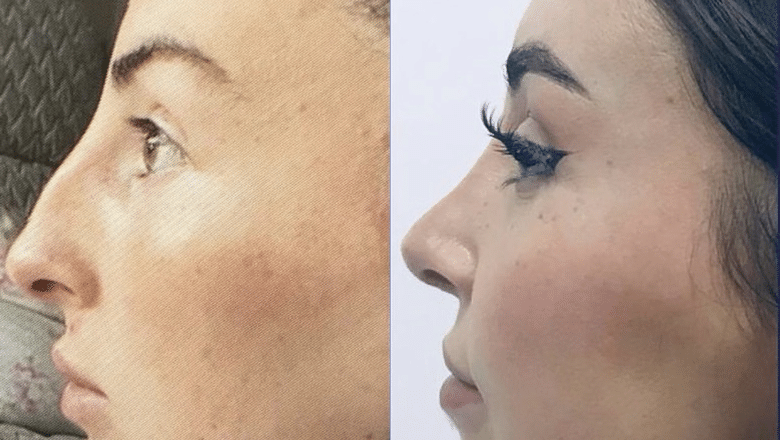
You can see more outcomes in our rhinoplasty before and after photos. Photographs show what is possible, but they cannot tell you whether a given technique was used, so ask your surgeon which approach they would use for your nose and why.
Preservation Rhinoplasty Recovery
Many clinics describe preservation rhinoplasty as having a quicker recovery. That claim is plausible, since the bridge is not rebuilt, but no study we found has shown a shorter recovery in a head-to-head comparison. What the evidence does show is better early appearance scores in some studies, which may reflect smoother contours and less visible swelling on the bridge rather than faster healing[5],[6].
You should therefore plan for the same recovery as any rhinoplasty:
- The first week: a splint protects the nose, with bruising and swelling around the eyes and a blocked, congested feeling. Keep your head raised and avoid blowing your nose.
- One to two weeks: the splint and any non-dissolving stitches come off at your first review. Many people return to desk work in this window.
- Six to eight weeks: most people return to full exercise once their surgeon agrees. Contact sports wait longer.
- Up to 12 months: the last of the swelling, especially at the tip, settles and the final shape appears.
Our rhinoplasty recovery guide covers the timeline week by week, and our guide to rhinoplasty swelling explains why the tip takes longest. Your surgeon’s own instructions always take priority over general timelines.
Preservation Rhinoplasty Risks and Complications
Preservation rhinoplasty carries the general risks of any rhinoplasty, which include bleeding, infection, breathing problems, asymmetry, numbness, scarring inside the nose and an unwanted change in shape. Our guide to rhinoplasty risks explains which are expected, uncommon and rare.
A 2022 meta-analysis of 22 studies and 5,660 patients having dorsal preservation ↗ reported low pooled rates of the main problems: hump recurrence in about 4.2%, revision surgery in about 3.5%, postoperative deviation of the nose in about 1.1% and infection in about 1.9%[11]. Those figures come from published series, which tend to be written by experienced surgeons, so results in everyday practice may differ.
Problems more specific to preservation include:
- A residual or returning hump. The pooled comparison with conventional hump reduction found a higher rate of residual or recurrent hump after preservation[5]. In one study of 823 preservation operations using the low strip technique, hump recurrence was 1.2% with a newer way of securing the septal flap, against 4.6% with conventional fixation, which shows how much technical detail matters[12].
- Narrowing of the internal nasal valve. The Annals of Plastic Surgery review names this as a technique-specific complication, alongside hump recurrence[2]. Matching the technique to the nose is intended to avoid it.
- Bridge irregularity or a small step. This is less common after preservation than after conventional reduction in the pooled data[5], but it can occur if the roof is not lowered evenly.
- A learning curve. A senior surgeon’s published account of his first 20 dorsal preservation cases describes less than ideal outcomes and how to avoid them, which is why it matters how many cases your surgeon has performed[13].
Does preservation rhinoplasty affect breathing?
The aim is to leave the internal nasal valve and airway undisturbed, and the evidence is broadly reassuring. The 2026 airway review found maintained or improved function, and the single-centre study described above measured a wider internal nasal valve angle on cone-beam CT after surgery[8],[10]. If you already have a blocked nose, tell your surgeon at the consultation, because a septum problem usually needs to be corrected at the same time.
Can Preservation Rhinoplasty Be Revised?
Yes. If a hump comes back, if the bridge is uneven or if the tip changes shape, revision surgery is possible. Clinics sometimes claim that revisions after preservation surgery are simpler because there is less scar tissue, but we found no published study that has measured this, so the claim should be treated as unproven.
What the evidence does show is that revision rates are low overall. The pooled comparison found no significant difference in the need for revision surgery between preservation and conventional dorsal reduction[5], and a systematic review of 25 studies found that about two in every hundred patients needed revision across both approaches[14]. If you are considering revision after surgery elsewhere, our revision rhinoplasty service page explains how we assess a nose that has already been operated on. Surgeons usually wait about a year, until swelling has settled, before judging whether revision is needed.
The grafts that are sometimes used to support the nose are explained in our guide to rhinoplasty grafts. Preservation techniques aim to reduce the need for them on the bridge, but grafts can still be needed in the tip or nostrils.
Preservation Rhinoplasty in London
If you are considering preservation rhinoplasty in London, the useful questions are the same wherever you go. Ask your surgeon:
- whether preservation is suitable for your nose, and what they would do if it is not;
- how many preservation operations they perform and how they manage a returning hump;
- which technique they would use (push-down, let-down, subdorsal strip or another) and why;
- whether the operation would be open or closed; and
- what follow-up and support you receive afterwards.
At Centre for Surgery, rhinoplasty is carried out at our CQC-regulated hospital on Baker Street in Marylebone by GMC-registered surgeons. Preservation techniques are discussed at consultation where they suit a patient’s anatomy and goals, alongside structural alternatives, so that the technique is matched to your nose rather than the reverse. Our rhinoplasty page explains the process from consultation to aftercare, and our guide to nose shapes and how to make your nose smaller may help you decide what you want to change.
A final point on terms: you may see this surgery described as preservation rhinoplasty, dorsal preservation, structure preservation, “preservation nose job” or, in some clinics, “conservative” rhinoplasty. They are largely interchangeable, but the method used in your own operation is what matters.
Frequently Asked Questions: Preservation Rhinoplasty
Is preservation rhinoplasty better?
It is better for some noses and not for others. Pooled studies suggest similar functional results and revision rates to the traditional approach, with better early appearance scores and fewer bridge irregularities but a higher chance of a returning hump[5]. A straight nose with a simple hump is the usual fit.
How painful is a rhinoplasty?
Most people describe an ache and pressure rather than sharp pain, and the blocked, congested feeling is often more bothersome than the discomfort. It is usually worst in the first few days and is controlled with the painkillers you are prescribed. Pain that gets worse after the first three days should be reported to your surgical team.
Can you undo a rhinoplasty?
A rhinoplasty cannot be reversed to put the nose back exactly as it was, because bone and cartilage may have been moved or removed. A revision can change the shape again, for example if too much or too little has been changed, but it is a further operation with its own risks.
What happens 10 years after rhinoplasty?
The swelling has long gone and the result is stable, although the nose continues to age like the rest of the face. Long-term data on preservation rhinoplasty are still limited. A 2023 article in Facial Plastic Surgery Clinics of North America aimed to add long-term follow-up for one dorsal preservation technique, but the technique is relatively new, so ask your surgeon what they have seen over time[15].
Is it better to get a nose job in the UK or Turkey?
The better choice is the one where the surgeon is properly trained and registered, the hospital is regulated and you have access to follow-up if something goes wrong. In the UK, hospitals are regulated by the Care Quality Commission and surgeons by the General Medical Council. If you have surgery abroad, ask how any complication would be managed once you are home.
Can you fly after a nose job?
Most surgeons advise avoiding flying for at least two to four weeks. Changes in cabin pressure can increase swelling, and sitting for a long time raises the risk of blood clots. Always confirm timings with your own surgeon before booking travel; our rhinoplasty recovery guide has more on what to avoid.
Speak to Us About Preservation Rhinoplasty
A consultation is the way to find out whether preservation techniques suit your nose. Your surgeon will examine your nose, discuss what you want to change and explain the options, including when a structural approach would be the more reliable choice.
Phone: 020 7993 4849 | Address: 95–97 Baker Street, Marylebone, London W1U 6RN
Contact us to schedule a consultation
References
- Kovacevic M, Buttler E, Haack S, et al. Dorsal preservation septorhinoplasty [article in German]. HNO 2020. doi:10.1007/s00106-020-00949-3 ↗
- Cornely RM, Abbott EN, Drjsuren N, et al. Preservation rhinoplasty in contemporary practice: integrating structural and tissue-sparing techniques along a surgical continuum. Annals of Plastic Surgery 2025;97(3S):S196–S202. doi:10.1097/SAP.0000000000004451 ↗
- Gucuk D, Knoedler L, Niederegger T, et al. Shaping the future of nasal surgery: a systematic review of preservation rhinoplasty. Aesthetic Plastic Surgery 2026;50(13):4962–4978. doi:10.1007/s00266-026-05853-9 ↗
- Taş S. Dorsal roof technique for dorsum preservation in rhinoplasty. Aesthetic Surgery Journal 2020. doi:10.1093/asj/sjz063 ↗
- Ribeiro LFS, De Freitas LR, Udoma-Udofa OC, et al. Dorsal preservation versus dorsal reduction rhinoplasty techniques for aesthetic and functional outcomes: a systematic review and meta-analysis. Journal of Plastic, Reconstructive and Aesthetic Surgery 2025. doi:10.1016/j.bjps.2025.05.044 ↗
- Kim DH, Jang DW, Hwang SH. Comparison of patient-reported outcomes between dorsal preservation and conventional dorsal hump reduction rhinoplasty: a systematic review and meta-analysis. Aesthetic Plastic Surgery 2025. doi:10.1007/s00266-025-04828-6 ↗
- Shim SR, Kim JY, Lee SM, et al. Preservation rhinoplasty versus structural rhinoplasty in dorsal hump reduction: a systematic review and meta-analysis of randomized controlled studies. Facial Plastic Surgery and Aesthetic Medicine 2025. doi:10.1089/fpsam.2024.0382 ↗
- McInerney NJ, Eustace J, Amin M. Does dorsal preservation rhinoplasty preserve nasal airway function? A systematic review. Journal of Laryngology and Otology 2026. doi:10.1017/S0022215125104052 ↗
- Saban Y, Sachanandani NS. Clarification and classification of dorsal preservation rhinoplasty: lessons from a continuous 1,191-case experience. Plastic and Reconstructive Surgery 2026. doi:10.1097/PRS.0000000000013339 ↗
- Stergiou G, Schweigler A, Finocchi V, et al. Quality of life and outcome after preservation rhinoplasty using the Rhinoplasty Outcome Evaluation questionnaire: a prospective observational single-centre study. Aesthetic Plastic Surgery 2022;46(4):1773–1779. doi:10.1007/s00266-022-02773-2 ↗
- Tham T, Bhuiya S, Wong A, et al. Clinical outcomes in dorsal preservation rhinoplasty: a meta-analysis. Facial Plastic Surgery and Aesthetic Medicine 2022. doi:10.1089/fpsam.2021.0312 ↗
- Guilarte R, Romero-López I. Preventing cheesewire and hump recurrence in low strip preservation rhinoplasty. Plastic and Reconstructive Surgery 2026;158(4):607e–614e. doi:10.1097/PRS.0000000000012653 ↗
- Toriumi DM. My first twenty rhinoplasties using dorsal preservation techniques. Facial Plastic Surgery Clinics of North America 2023. doi:10.1016/j.fsc.2022.08.008 ↗
- Foppiani JA, Joy N, Hernandez Alvarez A, et al. Dorsal preservation versus component dorsal hump reduction rhinoplasty: an assessment of patient-reported outcomes. Plastic and Reconstructive Surgery Global Open 2024. doi:10.1097/GOX.0000000000006103 ↗
- Saman M, Saban Y. Long-term follow-up with dorsal preservation rhinoplasty. Facial Plastic Surgery Clinics of North America 2023. doi:10.1016/j.fsc.2022.08.004 ↗

Related Articles
- Is Rhinoplasty Worth It? An Honest Answer from a Clinic That Sells It
- Non-Surgical vs Surgical Rhinoplasty: Which Is Right for You?
- NHS Rhinoplasty: Can You Get a Nose Job on the NHS?
- Rhinoplasty Recovery and Aftercare






