


Real fat transfer results from patients treated at our Baker Street day surgery facility, grouped by treatment area. Jump to Fat Transfer to Breasts or Calf Fat Transfer.
Results vary from patient to patient. All photos are published with written patient consent and are examples of outcomes achieved at Centre for Surgery, not guaranteed results. After photos were taken at least six months after surgery unless the caption says otherwise. No photograph has been retouched or filtered; some are cropped or masked only to protect patient privacy. Full disclaimer below, and how to read these photos — including why a fat transfer photograph is a still frame from a curve that is still falling.
Fat Transfer to Breasts — Before & After
8 photographs
Fat transfer to the breast — search engines and patients alike also describe it as fat transfer to breast before and after, or breast fat grafting — uses liposuction to harvest fat from a donor area such as the abdomen, flanks or thighs, processes it, then injects it into the breast in fine droplets. It adds modest volume without an implant, and the volume it adds is your own tissue. It suits patients who want a natural, understated increase rather than a defined change in cup size — see breast implants vs fat transfer for how the two compare.


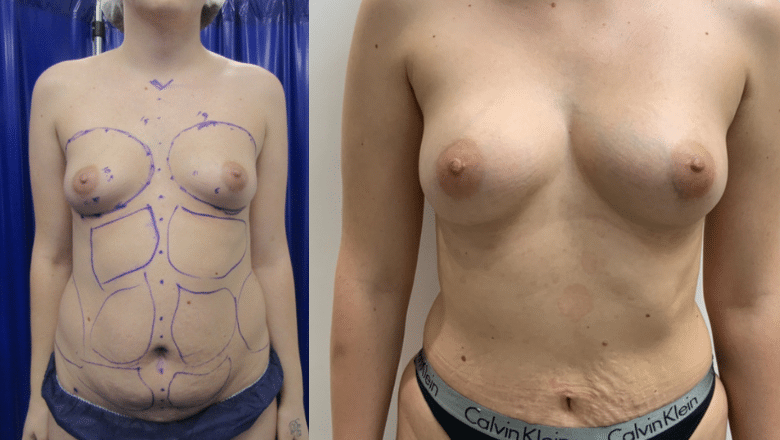
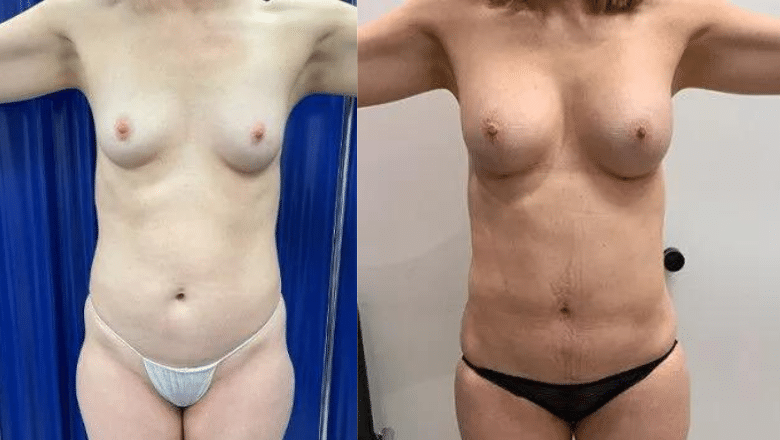

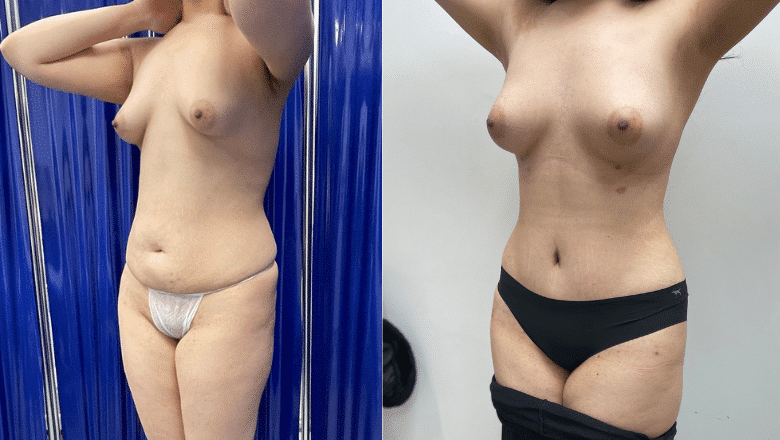
Fat Transfer to Breasts Combined With a Tummy Tuck
The fat has to come from somewhere. Where a patient is already having abdominal surgery, the tissue removed during a tummy tuck can serve as the donor site, and the two operations are performed together. The photographs below show both changes at once — the abdomen and the breast — which is why they also appear in our tummy tuck gallery.
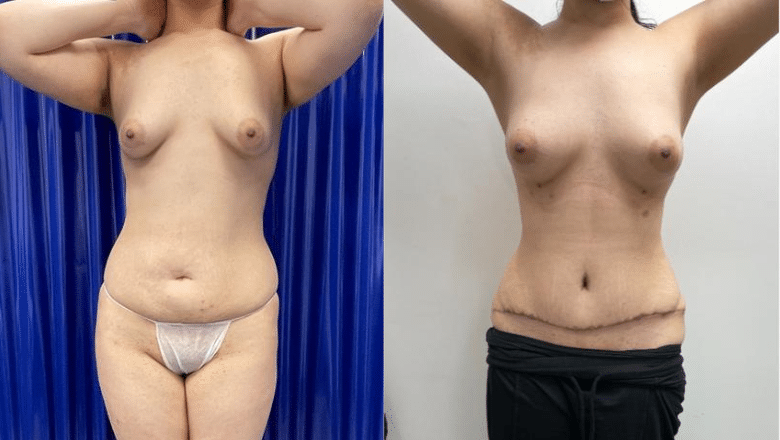

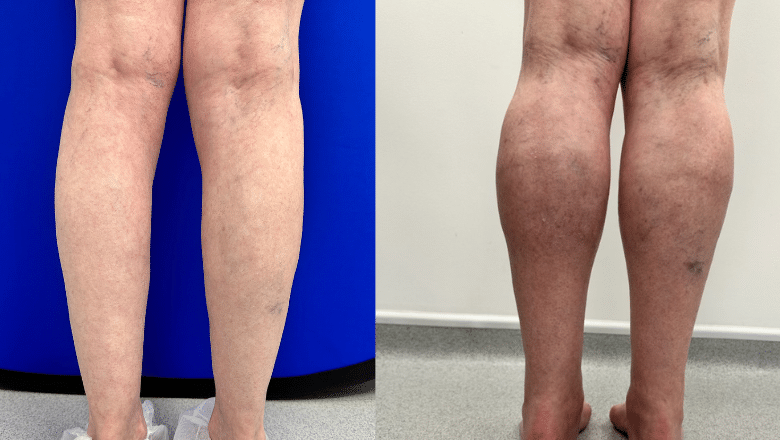
Calf Fat Transfer — Before & After
3 photographs
Calf fat transfer adds shape to the lower leg using the patient’s own fat rather than a silicone implant. The calf holds a smaller graft volume than the breast or buttock. For the implant route, see our calf augmentation gallery.


Fat Transfer to Other Areas
Buttocks. Fat transfer to the buttocks is a Brazilian Butt Lift. Those results have their own gallery — see BBL before and after photos.
Face. Facial fat transfer restores volume to the cheeks, temples and tear troughs rather than lifting or tightening. Read more on our facial fat transfer page.
How to Read Fat Transfer Photographs
Three things are worth controlling for before you draw conclusions from any fat transfer before-and-after.
Look at the donor site, not only the target. Fat transfer is two operations in one — liposuction somewhere, grafting somewhere else. A breast photograph cropped at the collarbone tells you nothing about what the abdomen looks like now. The combined tummy tuck cases above are the only ones on this page where you can see both.
Check the lighting and the posture. Grafted volume is soft and it follows gravity. Arms raised, shoulders back, and a light source above will all make a breast look fuller than it does standing at rest. Where the before and after photographs differ in stance, some of what you are seeing is stance.
Ask when the photograph was taken. This matters more for fat transfer than for any other procedure on this site, and it has its own section below.
What Stage of Healing You Are Looking At
A fat transfer photograph is a still frame taken from a curve that is still falling.
Not all grafted fat survives. In the days after surgery the treated area holds the injected volume plus swelling, and surgeons deliberately overfill to allow for what will be lost. Fat that does not establish a blood supply is reabsorbed over roughly the first three months. From about the third month the volume plateaus, and by six months what remains is what you keep — typically around 60 to 70 per cent of what was injected. Between 20 and 30 per cent of patients choose a second session to top up.
A photograph taken at six weeks sits near the top of that curve. A photograph taken at six months sits on the plateau. They are both honest photographs of the same operation, and they show different results.
The after photographs in this gallery were taken at least six months after surgery, unless the caption says otherwise, by which time most of the fat that is going to be reabsorbed has gone. For what to expect at each stage before then, see our fat transfer to breasts recovery guide and our fat transfer recovery guide.
What These Photographs Cannot Show You
How much of the volume survived to year two. A single before-and-after pair cannot show reabsorption. Only a series can, and a series is rarely published.
How the graft feels. Fat grafted to the breast feels like breast tissue because it is your own tissue. An implant does not. No photograph conveys this, and for many patients it is the reason they chose fat transfer over an implant in the first place.
Whether there was enough donor fat. Very lean patients cannot always be treated by fat transfer, because roughly double the transfer volume must be harvested. Every patient shown here had adequate donor fat. Patients who did not are not in this gallery, because they had a different operation or none at all.
Whether a second session was needed. Some of the results above may be after one procedure and some after two. The photographs do not distinguish them.
Lumps, oil cysts and fat necrosis. These are recognised complications of fat grafting. They are uncommon with careful micro-droplet technique, and they do not appear in a gallery of good results, because a gallery of good results is what a gallery is.
None of this is a reason to distrust the photographs on this page. It is a reason to treat them as the beginning of a conversation with a surgeon rather than the end of one.
About These Fat Transfer Photos
The fat transfer photos above are presented for educational purposes only and should be interpreted subjectively. They do not represent the opinion or view of any patient regarding their result, and they are not intended to suggest the result that any other patient may achieve. No two patients are alike, and no two results are necessarily alike. Only a personal consultation with your surgeon can provide you with a reasonable expectation of the results you may achieve from any specific procedure.
Fat Transfer Results: Common Questions
Can you transfer fat from your body to your breasts?
Yes. Fat transfer to the breasts, also called lipomodelling, uses liposuction to take fat from an area such as the abdomen or thighs, purifies it and injects it into the breasts in small amounts. It suits women who want a modest increase in size, often up to around one cup, or a better shape without implants.
Does fat transfer to the breasts last?
The fat that survives the first few months becomes permanent living tissue. Not all of it survives: a proportion is reabsorbed, so the breasts look fuller at first and settle over three to six months. After that, the transferred fat behaves like the rest of your body fat and changes if your weight changes.
What are the risks of fat transfer to the breasts?
Risks include some of the fat being reabsorbed, an uneven result, small lumps from fat necrosis or oil cysts, and the usual risks of liposuction where the fat is taken. Lumps occasionally need imaging to check them, so tell anyone carrying out future breast screening that you have had fat transfer.
Fat Transfer at Centre for Surgery
Fat transfer, also known as fat grafting or lipofilling, adds volume to the face, breasts, buttocks or calves using the patient’s own fat. It is performed at our Baker Street day surgery facility as a day case.
Centre for Surgery is registered with and independently inspected by the Care Quality Commission. Every surgeon on our team is registered with the General Medical Council, and you can check each one on the GMC register.
Aftercare and Follow-Up
Patients are reviewed after surgery and have direct access to their surgical team. Grafted fat settles over the first three to six months, so fat transfer results are assessed over a longer follow-up period than most procedures.
Verified Patient Reviews
We invite you to read what our fat transfer patients say on independent, verified review platforms. Every review is publicly verifiable, dated, and linked to a real named patient.
- Google Reviews: Read our Google reviews ↗ — rated 4.6 stars.
- Patient reviews page: Read patient reviews by procedure — Google and Trustpilot reviews brought together on our own site.
As a CQC-regulated provider, every surgeon on our team is GMC-registered and independently verifiable. View our CQC rating.
Related Reading
- What types of fat transfer can I have?
- How long do fat transfer results last?
- Breast implants vs fat transfer
- How to get the best fat transfer results
- Will I look overfilled after fat transfer to face?
Explore More Before and After Galleries
View our full collection of plastic surgery before and after photos, or browse related procedure galleries: BBL Before and After Photos | Breast Augmentation Before and After Photos | Tummy Tuck Before and After Photos | Liposuction Before and After Photos
We understand that investing in cosmetic surgery is a significant decision. That’s why we offer flexible finance options for eligible fat transfer procedures; finance is not available for fat transfer to the breasts or buttocks. For a full price breakdown, see our fat transfer cost guide. Learn more on our About Us page, browse our Plastic Surgery Blog, or find answers in our Clinic FAQs.
Call us today on 020 7993 4849, email contact@centreforsurgery.com, or complete the contact form below.







