


Real breast reduction (also known as boob reduction) results from patients treated at our Baker Street day surgery facility, grouped by concern. Jump to Breast Reduction, Gigantomastia & Large-Volume Reduction or Breast Liposuction.
Results vary from patient to patient. All photos are published with written patient consent and are examples of outcomes achieved at Centre for Surgery, not guaranteed results. After photos were taken at least six months after surgery unless the caption says otherwise. No photograph has been retouched or filtered; some are cropped or masked only to protect patient privacy. Full disclaimer below, and how to read these photos — including why the main benefit of this operation cannot be photographed at all.
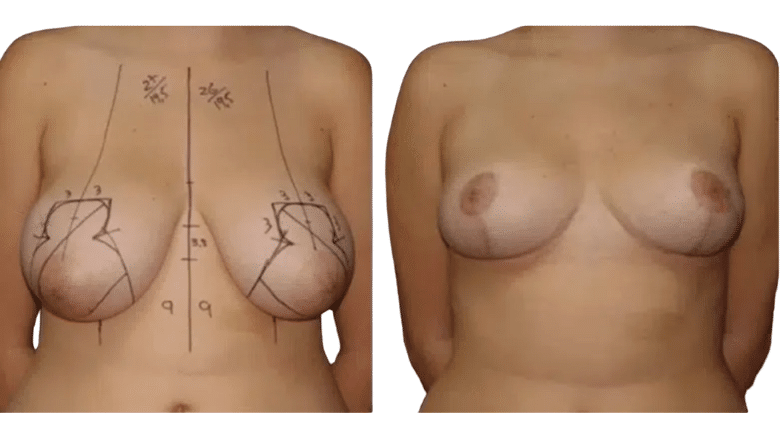
Breast Reduction — Before & After
21 photographs
Breast reduction surgery — sometimes called boob reduction, and known clinically as reduction mammaplasty or reduction mammoplasty — removes breast tissue and skin and repositions the nipple higher on a smaller breast. It is performed for physical symptoms — back, neck and shoulder pain, skin irritation beneath the breast, difficulty exercising — as often as for appearance. Read more about how much volume can be removed during a breast reduction.


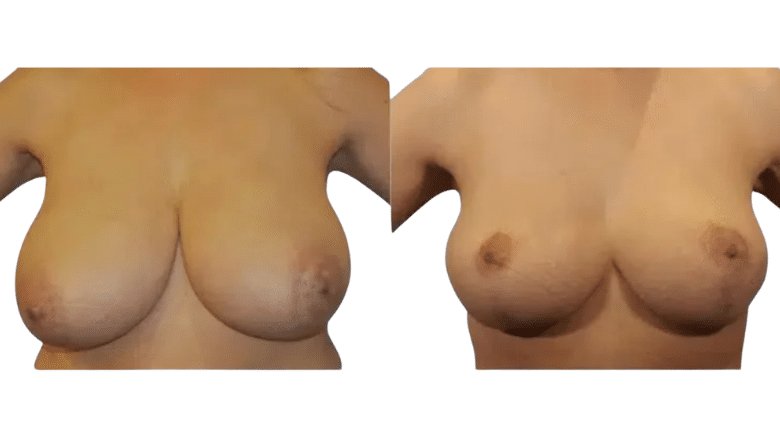




Gigantomastia and Large-Volume Reduction — Before & After
4 photographs
Gigantomastia is a rare condition causing excessive growth of breast tissue. It can develop during puberty, pregnancy or the menopause, and can cause significant physical discomfort and emotional distress. Symptoms include breast pain, back and shoulder pain, difficulty finding clothes that fit, and difficulty with physical activity. In severe cases the weight of breast tissue can lead to skin irritation, recurrent infection beneath the breast fold, and difficulty breathing.


Large-volume reduction is a different operation from a standard reduction, with different planning and a different scar burden. Where the reduction is very large, the blood supply to the nipple can be a limiting factor, and the technique required to address that has consequences for how the areola looks afterwards — something worth asking about specifically if you are considering a reduction of this size.
Breast Liposuction — Before & After
8 photographs
For a small number of patients whose breasts are largely fatty rather than glandular, and whose nipple position does not need correcting, volume can be reduced through liposuction alone. It leaves far less scarring than a standard reduction. It also cannot lift the breast, and it removes less volume — the trade is a smaller change for a smaller scar.


About These Breast Reduction Photos
The breast reduction photos above are presented for educational purposes only and should be interpreted subjectively. They do not represent the opinion or view of any patient regarding their result, and they are not intended to suggest the result that any other patient may achieve. No two patients are alike, and no two results are necessarily alike. Only a personal consultation with your surgeon can provide you with a reasonable expectation of the results you may achieve from any specific procedure. We only publish photographs of patients who have given full written consent for their images to be used.
How to Read Breast Reduction Before and After Photos
Breast reduction is the operation with the highest reported satisfaction in cosmetic surgery and the most misleading photographs, for one reason: most women have it to stop something hurting, and pain does not photograph. Everything visible in these images is secondary to the thing patients actually come for.
The main benefit is invisible
Grooving from bra straps, neck and shoulder pain, rashes and infection beneath the breast fold, being unable to run — these are the reasons for surgery, and none of them appears in a before-and-after. A patient whose photograph looks unremarkable to you may have had the most life-changing result in this gallery. Judge these images on shape if you like, but do not mistake shape for the point.
A reduction is also a lift
Tissue is removed and the nipple is moved up. Every case above is therefore also a mastopexy, which means it carries a mastopexy’s scars: around the areola, vertically down to the fold, and usually along the fold itself. As with our breast lift gallery, these photographs are taken from the front, where the vertical scar is foreshortened and the fold scar cannot be seen at all. That is the standard clinical view, and it shows the benefit in the angle that hides the cost. Ask your surgeon to show you their own patients’ scars, from below, at six months and at two years.
Grams removed is not a size
As with implant volume, the amount of tissue removed travels badly between bodies. Two kilograms off a very large breast on a tall, broad frame and 500g off a smaller breast on a petite one may produce a similar cup size and a completely different photograph. What determines your result is your starting volume, your skin quality and your chest dimensions — none of which is on display in someone else’s before shot.
Find the before photograph that looks like you
More than in any other breast operation, the before image is the informative one. Scan for the starting breast that most resembles yours in size, in droop and in how the tissue sits, then look only at that patient’s after. A dramatic transformation from a starting point unlike yours predicts nothing.
Posture, arms, camera
Arms hanging identically, shoulders level, the same distance from the lens in both frames. Standing straighter in the after photograph is very common — and often genuine, because the weight has gone — but it also changes the photograph independently of the surgery.
What Stage of Healing You’re Looking At
Two clocks run after a reduction, and they run at different speeds.
The shape settles first. In the early weeks the breast sits high and can look flat or square at the top, because tissue has been repositioned and skin closed under tension. Over the following months it relaxes, drops slightly and rounds out. A photograph at six weeks is not a photograph of the final breast.
The scars take far longer. They are firm and pink or red for months before softening. In many patients they fade substantially over roughly twelve to eighteen months, though this varies considerably with skin type, tension and individual healing, and thickened or raised scars are a recognised outcome — more so where the reduction is large and the closure under greater tension. Reduction scars fade. They do not disappear.
So an early photograph shows a shape that will change and scars near their worst; a late photograph shows a settled shape and scars at their best. Both are honest. A gallery that never states the interval is asking you to assume the flattering end of both.
The after photographs in this gallery were taken at least six months after surgery, unless the caption says otherwise. For what to expect at each stage before then, see our breast reduction recovery guide.
What These Photographs Cannot Show You
There is a limit to what any gallery can tell you, and a clinic that pretends otherwise is selling rather than informing.
- The relief. The reason most patients have this operation — the end of back, neck and shoulder pain, the end of rashes under the breast, being able to exercise — is the one thing a photograph is incapable of recording. It is also, for most women who have had it, the whole point.
- The scars. Longer here than in almost any breast procedure, permanent, and positioned precisely where a front-facing photograph does not look.
- Sensation and breastfeeding. Nipple sensation is commonly altered and may not fully return. The ability to breastfeed may be reduced or lost, and this depends on the technique, which depends on how much tissue must come out. In very large reductions the nipple may need to be moved as a graft, which changes both sensation and the appearance of the areola. A photograph will not tell you which technique was used.
- What happens afterwards. Remaining breast tissue still responds to weight change, pregnancy and time. Reduction is not a fixed point.
- Whether liposuction alone would have done it. That depends on how much of your breast is fat rather than gland, which is an examination finding, not something visible in a stranger’s photograph.
None of this is a reason to distrust before and after photographs. It is a reason to treat them as the beginning of a conversation with a surgeon rather than the end of one.
Breast Reduction Results: Common Questions
How long do breast reduction results last?
The reduction in size is long-lasting, because tissue that is removed does not grow back. The breasts can still change with weight gain, pregnancy, hormonal changes and ageing, and some descent over time is normal. Keeping a stable weight helps the result last.
What are the downsides of breast reduction surgery?
The scars are the main trade-off: around the areola, down the breast and often along the fold. Other risks include changes in nipple sensation, difficulty breastfeeding, slow healing where the scars meet, asymmetry and firm areas of fat necrosis. Studies consistently report high satisfaction, but these are worth weighing carefully.
Does the NHS still do breast reductions?
Some NHS areas fund breast reduction, but the criteria are strict and vary by area. They usually include a body mass index within a set range, documented symptoms such as back or neck pain, and evidence that other measures have been tried. Your GP can tell you the criteria where you live.
Breast Reduction (Boob Reduction) at Centre for Surgery
Centre for Surgery is a private hospital for plastic and cosmetic surgery on Baker Street in Marylebone, London, registered with and independently inspected by the Care Quality Commission. Our plastic surgeons perform the full range of breast reduction surgery — also known as boob reduction or reduction mammoplasty — for women with large and heavy breasts, including standard reduction, large-volume reduction for gigantomastia, and breast liposuction where appropriate.
Techniques and Approach
Whether you need a standard reduction, a large-volume reduction, or liposuction alone, your surgeon will recommend the technique best suited to your anatomy and your goals, and will explain the scars that come with it. All incision patterns are performed, including the lollipop and inverted-T approaches. Every plastic surgeon on our team is GMC-registered and independently verifiable on the General Medical Council register.
Functional as Well as Aesthetic
Breast reduction is performed as often for physical symptoms as for appearance. Where chronic back, neck and shoulder pain, skin irritation or difficulty exercising are part of why you are considering surgery, say so at consultation — it changes how the operation is planned and what a good result looks like for you.
Aftercare and Follow-Up
Surgery is performed at our Baker Street day surgery facility. You have your surgeon’s direct number for the first 24 hours after surgery, your surgeon will review you at regular follow-up appointments, and a full scar management programme is included as standard.
Verified Patient Reviews
We invite you to read what our breast reduction patients say on independent, verified review platforms. Every review is publicly verifiable, dated, and linked to a real named patient.
- Google Reviews: Read our Google reviews ↗ — rated 4.6 stars based on hundreds of verified patient reviews.
- Patient reviews page: Read patient reviews by procedure — Google and Trustpilot reviews brought together on our own site.
As a CQC-regulated provider, every surgeon on our team is GMC-registered and independently verifiable. View our CQC rating.
Related Reading
- How Much Volume Can Be Removed During Breast Reduction?
- Sagging Breasts After Weight Loss — Surgical Solutions
- How to Fix Saggy Breasts
Explore More Before and After Galleries
View our full collection of plastic surgery before and after photos, or browse related breast surgery galleries: Breast Augmentation Before and After Photos | Breast Lift Before and After Photos | Mummy Makeover Before and After Photos
Subject to status, we offer finance options with Chrysalis Finance. For a full price breakdown, see our breast reduction cost guide. Learn more on our About Us page, browse our Plastic Surgery Blog, or find answers in our Clinic FAQs.
To book a face-to-face consultation with a specialist breast reduction surgeon, call us on 020 7993 4849 or complete the contact form below.







