

In this guide16 sections
- Key Points
- How Many Cup Sizes Can You Go Down With a Breast Reduction?
- Breast Reduction Size Chart: Grams Removed and Cup Sizes
- How Much Do Breasts Weigh?
- Why Is Bra Size After a Breast Reduction So Hard to Predict?
- How Much Tissue Is Removed in a Breast Reduction?
- How Small Can You Go With a Breast Reduction?
- Is There a Minimum Size for a Breast Reduction?
- How Do You Choose Your Breast Reduction Size?
- Breast Reduction Before and After
- How Long Until You See Your Final Breast Size?
- Can Breasts Grow Back After a Breast Reduction?
- Will My Breasts Shrink If I Lose Weight?
- Frequently Asked Questions
- Why Choose Centre for Surgery for Breast Reduction?
- References
Key Points
- How many cup sizes can you go down? On volume alone, most breast reductions remove enough tissue for two to four cup sizes, and large reductions can go further. Surgeons plan in grams removed, not in cup letters.
- A rough conversion: each cup size holds about 130 to 150 mL in a standard bra, and more at the larger sizes most reduction patients wear, so 150 to 200 g of tissue per breast is a reasonable working figure for each cup size.
- No surgeon can promise a letter. In one study, a quarter of women reported wearing the same cup size after surgery even when more than 500 g had been removed from each breast, because bra sizing is not standardised and band size changes too.
- Relief does not depend on a big reduction. Studies show back, neck and shoulder symptoms improve as much after smaller reductions as after very large ones.
- Your final size takes time to show. Swelling settles over about three months, and the breast keeps settling into its final shape for six to twelve months.
“How many cup sizes can I go down?” and “What cup size will I be after a breast reduction?” are, after the cost of a breast reduction, the two questions we hear most at a breast reduction consultation. They sound as if they should have a simple answer: go in as an F, come out as a C. In practice, your surgeon plans the operation around how many grams of tissue to remove and how the breast will sit on your frame, and the letter on your bra afterwards depends on things the operation does not control.
This guide explains how many cup sizes a breast reduction usually takes off, gives a breast reduction size chart that converts grams removed into approximate cup sizes, answers how much breasts actually weigh, and covers what limits how small you can go, when you will see your final size, and whether breasts can grow back.
How Many Cup Sizes Can You Go Down With a Breast Reduction?
Most women who have a breast reduction have enough tissue removed to go down somewhere between two and four cup sizes, and women starting from very large breasts can go down five or six. The figure for you depends on three things: how much breast tissue there is to begin with, how much can be removed while keeping a healthy blood supply to the nipple, and what size will look in proportion to your shoulders, chest and hips.
The change on the bra label is often smaller than the change in volume, though. In a study of 69 women in the Canadian Journal of Plastic Surgery, an average of 522 g was removed from each breast, yet the change in cup size that women reported afterwards ranged from none at all to eight sizes, and a quarter said they wore the same standardised cup size as before, even when more than 500 g had been removed from each side[1]. Part of the reason is likely to be bra fit. Many women with large, heavy breasts wear a band that is too loose and a cup that is too small, so the size they quote before surgery understates their true size, and after surgery the band often changes too.
That is why your surgeon will talk to you about grams, shape and proportion rather than promise a letter, and why it helps to arrive at your consultation knowing what you want the result to do for you.

Breast Reduction Size Chart: Grams Removed and Cup Sizes
Surgeons measure a breast reduction in grams of tissue removed, but a rough conversion helps you picture what a given reduction means. A 2017 study in Plastic and Reconstructive Surgery measured the volume of commercial bras and found that each step up in cup size held about 135 mL on average, from around 130 mL on narrower bands to 150 mL on wider ones[2]. Breast tissue weighs almost the same as water, about 1.06 g per mL in a study that weighed and measured 69 surgical specimens[3], so 100 g removed is roughly 100 mL of volume. Each cup letter adds a fixed amount to the bust measurement, so the volume in each step grows as breasts get bigger, which means that at the cup and band sizes typical of breast reduction patients, 150 to 200 g of tissue per cup size is a more realistic working figure.
The chart below applies that figure using UK bra sizes, where DD, FF, GG and HH each count as a full cup size. Treat it as a rough guide rather than a prediction.
| Tissue removed per breast | Approximate change | Example (UK sizes) |
|---|---|---|
| 200 to 300 g | 1 to 2 cup sizes | E to DD or D |
| 300 to 450 g | 2 to 3 cup sizes | F to DD or D |
| 450 to 600 g | 3 to 4 cup sizes | G to E or DD |
| 600 to 800 g | 4 to 5 cup sizes | H to F or E |
| 800 to 1,000 g | 5 to 6 cup sizes | HH to F or E |
| Over 1,000 g | 6 or more cup sizes | J or larger to F or E |
Your band size changes the picture too. The same volume of breast is a different letter on a different band, so a 32FF, a 34F and a 36E hold roughly the same amount of tissue. These sister sizes are one reason two women who have the same amount removed can end up in different cup sizes, and one reason this chart is a guide rather than a promise.
How Much Do Breasts Weigh?
More than most people expect. In a 3D-scanning study of 356 women, a single breast measured anywhere from 48 mL to 3,100 mL[4], so at roughly a gram per mL, one breast can weigh from about 50 g to more than 3 kg. Body weight made a large difference: the breasts of women who were overweight or obese were two to three times the volume of those of women at a healthy body mass index (BMI), while age made no significant difference[4].
Women having a breast reduction are at the heavy end of that range. In a series of 256 women having breast reduction, the tissue removed from both breasts together averaged 982 g in women with a BMI under 30 and 1,719 g in those with a BMI of 30 or more[5], and that is only the part taken away. Carried on the chest all day, that weight pulls on the neck and shoulders, which is why so many women come to us with the symptoms described in our guide to large heavy breasts and back pain, or with deep bra strap grooves in their shoulders.
Does your cup size tell you how much your breasts weigh?
Not on its own, because the same letter holds far more tissue on a 38 band than on a 30. When surgeons weighed 395 breasts removed at mastectomy, a combined measure of band and cup size, together with BMI, predicted breast weight better than the cup letter, which on its own was not a reliable predictor[6]. Your surgeon estimates how much tissue there is from measurements and an examination at your consultation, not from your bra label.
Why Is Bra Size After a Breast Reduction So Hard to Predict?
Several things that have nothing to do with the operation itself decide which letter you wear afterwards:
- Bra sizes are not standardised. In the 2017 bra study, the same cup size held a different volume from one brand to another[2], so you may be a different size in two different shops.
- Your band size can change. Tissue that sat out towards the sides of the chest is removed, and many women find a different band fits afterwards, which moves the cup letter with it.
- Your bra before surgery may not have fitted. If you were squeezing into a smaller cup on a looser band, your true starting size was larger than the label said.
- The shape changes as well as the size. A reduction lifts the breast and moves the nipple higher, so a smaller, firmer breast fills a cup differently from a larger, lower one.
- Swelling distorts early fittings. For the first few months the breasts are fuller and sit higher than they will once they have settled.
Two women who have exactly the same amount removed may therefore end up in different cup sizes, simply because their chest width, breast shape and choice of bra differ. That is the reality of bra sizing rather than a limitation of surgery.
How Much Tissue Is Removed in a Breast Reduction?
There is no fixed amount. Depending on your starting size and your goals, a breast reduction can remove anything from around 200 g to well over 1,000 g from each breast. As a general guide:
- Small reduction: around 200 to 400 g per breast
- Moderate reduction: around 500 to 800 g per breast
- Large reduction: more than 1,000 g per breast
Four things set the upper limit for you. The first is tissue composition: breasts with a lot of dense glandular tissue are reduced by cutting tissue away, while mostly fatty breasts may suit a liposuction-based reduction, which removes less, as our guide to breast reduction for dense breasts explains. The second is your frame, because the aim is a breast in proportion to your height and chest width rather than the smallest possible size. The third is your skin: where the skin has stretched and the breast has dropped, a technique that also tightens the skin, such as the anchor pattern, is usually needed. The fourth, and the one that matters most, is the blood supply to the nipple, which travels through the tissue left behind. Removing too much can compromise it, which is why your surgeon will not go below a safe volume to reach an aesthetic target.
The tissue taken from each side is weighed during the operation, which lets your surgeon match the two breasts as closely as possible. If one breast is noticeably larger to begin with, more is removed from that side, as our guide to uneven breasts explains.
Very large reductions carry more risk. A meta-analysis of 40 studies and 5,908 patients found that removing 1,000 g or more from one breast was linked to a higher rate of complications, as were a BMI of 30 or more, smoking and diabetes[7]. For the very largest reductions, surgeons have traditionally removed the nipple and replaced it as a skin graft, but a review of 25 studies covering 1,355 women who had more than 1,000 g removed found that keeping the nipple attached to its blood supply was safe in most cases, with very low rates of nipple loss and a high chance of keeping nipple sensation[8]. Our guide to breast reduction risks covers the complications in detail.
How Small Can You Go With a Breast Reduction?
As small as is safe and in proportion, which for most women is not as small as possible. The limit is set by the blood supply to the nipple, which has to be carried by the tissue that stays behind, and by your frame: a petite woman with a narrow chest usually looks best with a smaller result than a taller woman with broad shoulders, even if both describe their goal as “a C cup”. Our ideal breast size calculator shows how height, weight and proportion shape what looks natural on you.
Is a C cup or D cup goal realistic?
Many women arrive with a specific target, most often a C or D cup. For some it is entirely achievable. For others it would be too small for their frame and look out of proportion, and for women with very large breasts or a lot of droop, reaching a C cup could mean removing so much tissue that the nipple’s blood supply is put at risk, which no surgeon should accept for an aesthetic target. If your goal is a C cup and your surgeon recommends a D or E for your frame, that is clinical judgement aimed at the best result for your body, not a refusal.
Can you go from a DD to a B cup?
Often, yes, if your frame and your tissue allow it. A DD to B reduction is three cup sizes, which usually means removing somewhere around 450 to 600 g from each breast. Our guide on how to reduce cup size from D to B covers it in detail. Going down to an A cup is rarely recommended after a breast reduction, because too little tissue would be left to keep the breast shapely and the nipple well supplied.
Is There a Minimum Size for a Breast Reduction?
Not for private surgery. Your surgeon removes as much or as little as your goals and anatomy call for, and a modest reduction of 200 to 300 g per breast can make a real difference. NHS-funded breast reduction is different: local commissioning policies usually set criteria such as a minimum amount of tissue to be removed (often around 500 g per breast), a BMI limit and documented physical symptoms, and these vary from one area to another.
The evidence does not support the idea that a reduction has to be large to be worthwhile. In a study of 59 women who had less than 1,000 g removed in total, every symptom measured improved significantly, from back, neck and shoulder pain to rashes and bra strap grooving[9]. A follow-up study of 188 women in the Annals of Plastic Surgery grouped patients by how much was removed, from under 1,000 g to over 2,000 g, and found the improvement in symptoms was no different between the groups[10]. A study of 238 women using the BREAST-Q questionnaire found satisfaction and wellbeing scores rose after surgery whether or not the reduction met the minimum weights some insurers demand, and its authors questioned those minimums[11]. The American Society of Plastic Surgeons’ clinical guideline reviewed this question and supports surgery as a first-line treatment for symptomatic large breasts regardless of the weight to be removed[12].
If your breasts are moderate in size and your main concern is that they have dropped, a lift may suit you better than a reduction; our comparison of breast reduction vs breast lift explains the difference.
How Do You Choose Your Breast Reduction Size?
Together with your surgeon, at a detailed consultation. Your surgeon takes a full medical history, examines and measures your breasts, and talks through your symptoms and what you want from the result. Before and after photographs of previous patients with similar anatomy help you see what is realistic, and there is a cooling-off period of at least two weeks between your consultation and surgery.
The most useful thing you can bring is a description of what you want the result to do rather than a cup letter. “I want to exercise without my breasts getting in the way”, “I want to buy a dress off the rail” or “I want the grooves in my shoulders to go” tells your surgeon far more than “I want to be a C cup”.
The technique shapes the result too. As well as deciding the scar, it affects the shape, projection and fullness of the upper breast, all of which change how a bra fits.
Anchor (Wise pattern) breast reduction

The anchor technique, also called the Wise pattern or inverted T, uses three incisions: around the areola, vertically from the areola to the breast crease, and horizontally along the crease. It allows the most tissue to be removed and gives the most control over shape, which makes it the usual choice for larger reductions and for breasts that have dropped significantly. Our guide to anchor incision breast reduction explains it in detail.
Lollipop (vertical scar) breast reduction
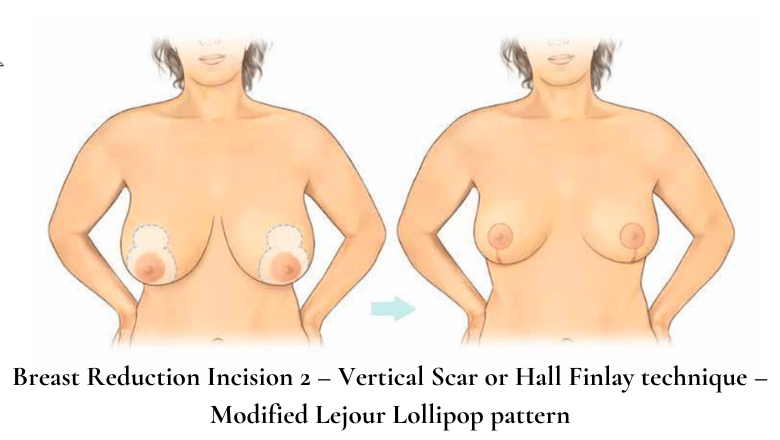
The lollipop technique, also called the vertical scar or Hall-Findlay technique, uses two incisions: around the areola and vertically down to the breast crease, without the horizontal scar along the crease. It leaves less scarring and suits moderate reductions where the breast has not dropped too far. Our comparison of anchor vs lollipop breast reduction covers the differences.
Liposuction-only breast reduction
For selected patients, typically those with fatty rather than glandular breast tissue and little droop, a liposuction breast reduction can reduce volume without the scars of a conventional reduction. It removes less tissue and does not lift the breast, but for the right patient it offers a less invasive route to a smaller size.
In most techniques the nipple and areola are moved higher and the areola is made smaller to suit the new breast, which is part of the reduction rather than a separate procedure; our guide to areola reduction cost explains how that works. What this means for sensation and breastfeeding is covered in our guide to nipple sensation after breast reduction.
Breast Reduction Before and After

You can see more results across a range of starting sizes in our breast reduction before and after photos.
How Long Until You See Your Final Breast Size?
Around three months for the size, and six to twelve months for the final shape. A study that tracked women with 3D scans for a year after breast reduction found that breast volume fell by about 12% after an anchor reduction and about 8% after a vertical reduction during the first three months as swelling settled, with little change in volume after that[13]. Shape kept changing for longer: tissue settled from the upper to the lower half of the breast over the first year, and the contour stopped changing after three to six months with the anchor technique and six to nine months with the vertical technique[13].
In practice, expect your breasts to look slightly fuller and sit higher at first. Wear the supportive post-surgical bra you are given for the first six weeks, and wait until around three months before buying a full set of new bras. Our guide to breast reduction recovery covers each stage.
Can Breasts Grow Back After a Breast Reduction?
The tissue that has been removed does not grow back, but the breast tissue that remains can still change. Significant weight gain enlarges the breasts again, pregnancy and breastfeeding change them regardless of previous surgery, and hormonal changes can too. In teenagers whose breasts are still developing, regrowth is a real possibility, which is one reason age matters, as our guide to breast reduction age explains.
The breast also settles with time. In a series of 16 women who later had a second reduction, all had developed some descent of breast tissue below the nipple after their first operation, and the second operation removed an average of 325 g per breast, compared with 615 g the first time[14]. A second reduction is possible, as our guide to having a breast reduction twice explains, but keeping your weight stable is the best way to protect your result.
Will My Breasts Shrink If I Lose Weight?
Usually, and often by more than you might expect. In a study of 106 women before and after weight-loss surgery, a 20% fall in BMI was linked to a 25% fall in breast volume[15]. In a small study of women with large breasts who lost a median of about 10 kg on a 12-week diet, each breast shrank by around 300 mL, about 19%, yet every woman still had symptoms that justified a reduction afterwards[16].
If you are planning to lose weight, it is worth doing it before your breast reduction rather than after, so that your surgeon plans around the breasts you will actually have. Our guide to how to reduce breast size covers the non-surgical options, and weight loss can also leave the breasts lower and emptier, as we explain in our guide to sagging breasts after weight loss.
Frequently Asked Questions
How many sizes do you go down after breast reduction?
Most women have enough tissue removed to go down two to four cup sizes, and very large reductions can take off five or six. The change on your bra label can be smaller than the change in volume, because bra sizing is not standardised and band size often changes too[1].
Do you look skinnier after breast reduction?
Many women feel they do. Smaller breasts make the upper body look narrower, let clothes hang closer to the body and show the waist more, so many women find they can wear a smaller top size. The effect on body weight itself is modest: in the series of 256 women above, those with a BMI of 30 or more had lost a little weight on average around five years after surgery, while those under 30 were on average slightly heavier[5]. If exercise has been difficult, being able to move comfortably is often what makes the longer-term difference.
Will my stomach look bigger after breast reduction?
It will not be bigger, but it may be more noticeable. Large breasts can hide the upper stomach, particularly from the side, so once they are smaller the tummy can look more prominent. Some women choose to have liposuction or a tummy tuck at the same time or later to keep the whole figure in proportion.
What disqualifies you from a breast reduction?
Few things rule it out completely, but some raise the risks enough that your surgeon may ask you to wait. Smoking, a BMI of 30 or more and diabetes all increase the complication rate[7], so you will be asked to stop smoking well before surgery, and you may be advised to lose weight or get your blood sugar under control first. Being pregnant or breastfeeding, still growing, or hoping for something surgery cannot deliver are other reasons to wait; our guide to breast reduction age covers the age question.
What is the downside of breast reduction?
The main trade-offs are permanent scars, which fade but do not disappear (see our guide to breast reduction scars), a possible change in nipple sensation, and a possible effect on breastfeeding. Minor wound-healing problems, particularly where the incisions meet under the breast, are fairly common and usually settle with dressings. Our guide to breast reduction risks sets out how often each complication happens.
Can my surgeon guarantee what cup size I’ll be after breast reduction?
No, and be cautious of anyone who says they can. Bra sizes are not standardised, and the final result depends on your anatomy, how you heal and which bras you buy afterwards. Your surgeon can tell you how much tissue they plan to remove and describe the expected shape and proportion of the result.
How soon can I go bra shopping after breast reduction?
Wear your supportive post-surgical bra for the first six weeks, and wait until around three months before buying a full set of new bras, when most of the swelling has gone[13]. Our tips for sleeping after breast reduction cover supporting the breasts in the early weeks.
Is breast reduction available on the NHS?
Sometimes, if you meet your local NHS criteria, which are usually based on the amount of tissue to be removed, your BMI and documented physical symptoms. Many women who would benefit clinically do not meet their local funding criteria and choose to have the operation privately.
Can I have a breast reduction if I plan to have children?
Yes, though many surgeons suggest waiting until your family is complete if you can, because pregnancy changes the size and shape of the breasts. If breastfeeding matters to you, tell your surgeon, because it influences the choice of technique; our guide to nipple sensation after breast reduction covers this.
Why Choose Centre for Surgery for Breast Reduction?
Every breast reduction at Centre for Surgery is performed by a GMC-registered plastic surgeon, at our CQC-regulated hospital on Baker Street, rated Good overall by the CQC. Your surgeon plans your reduction around your frame, your symptoms and what you want the result to do, and the surgeon who assesses you is the surgeon who performs your surgery.
Your initial consultation is £100, redeemable against the cost of your procedure if you go ahead. Finance is available through Chrysalis Finance, subject to status. See our finance options page for details.
Phone: 020 7993 4849 | Address: 95–97 Baker Street, Marylebone, London W1U 6RN
Contact us to schedule a consultation
References
- Dal Cin A, Jeans ER. Can reduction mammoplasty patients be promised a particular size postoperatively? Canadian Journal of Plastic Surgery 2005;13(1):13–15. PMC3822472
- King NM, Lovric V, Parr WCH, Walsh WR, Moradi P. What is the standard volume to increase a cup size for breast augmentation surgery? A novel three-dimensional computed tomographic approach. Plastic and Reconstructive Surgery 2017;139(5):1084–1089. doi:10.1097/PRS.0000000000003247
- Parmar C, West M, Pathak S, Nelson J, Martin L. Weight versus volume in breast surgery: an observational study. JRSM Short Reports 2011;2(11):87. doi:10.1258/shorts.2011.011070
- Coltman CE, Steele JR, McGhee DE. Breast volume is affected by body mass index but not age. Ergonomics 2017;60(11):1576–1585. doi:10.1080/00140139.2017.1330968
- Kapadia K, Marquez J, Medrano C, et al. Bilateral reduction mammaplasty facilitates subsequent weight loss in obese patients (BMI ≥30). Annals of Plastic Surgery 2021;87(5):506–508. doi:10.1097/SAP.0000000000002756
- Jolkovsky E, Miller MN, Barkhordarzadeh AD, et al. Improving documentation in plastic surgery: sister bra size group and BMI are more indicative of breast weight than cup size. Aesthetic Surgery Journal 2025;45(10):1017–1025. doi:10.1093/asj/sjaf114
- Liu D, Wu M, Xu X, et al. Risk factors and complications in reduction mammaplasty: a systematic review and meta-analysis. Aesthetic Plastic Surgery 2023;47(6):2330–2344. doi:10.1007/s00266-023-03387-y
- Bonomi F, Harder Y, Treglia G, De Monti M, Parodi C. Is free nipple grafting necessary in patients undergoing reduction mammoplasty for gigantomastia? A systematic review and meta-analysis. Journal of Plastic, Reconstructive & Aesthetic Surgery 2024;89:144–153. doi:10.1016/j.bjps.2023.12.009
- Spector JA, Karp NS. Reduction mammaplasty: a significant improvement at any size. Plastic and Reconstructive Surgery 2007;120(4):845–850. doi:10.1097/01.prs.0000277660.49802.76
- Spector JA, Singh SP, Karp NS. Outcomes after breast reduction: does size really matter? Annals of Plastic Surgery 2008;60(5):505–509. doi:10.1097/SAP.0b013e31816f76b5
- Wampler AT, Powelson IA, Homa K, Freed GL. BREAST-Q outcomes before and after bilateral reduction mammaplasty. Plastic and Reconstructive Surgery 2021;147(3):382e–390e. doi:10.1097/PRS.0000000000007605
- Perdikis G, Dillingham C, Boukovalas S, et al. American Society of Plastic Surgeons evidence-based clinical practice guideline revision: reduction mammaplasty. Plastic and Reconstructive Surgery 2022;149(3):392e–409e. doi:10.1097/PRS.0000000000008860
- Eder M, Klöppel M, Müller D, Papadopulos NA, Machens HG, Kovacs L. 3-D analysis of breast morphology changes after inverted T-scar and vertical-scar reduction mammaplasty over 12 months. Journal of Plastic, Reconstructive & Aesthetic Surgery 2013;66(6):776–786. doi:10.1016/j.bjps.2013.02.008
- Hudson DA, Skoll PJ. Repeat reduction mammaplasty. Plastic and Reconstructive Surgery 1999;104(2):401–408. doi:10.1097/00006534-199908000-00013
- Ockell J, Biörserud C, Fagevik Olsén M, Elander A, Hansson E. “Normal” breast dimensions in obese women: reference values and the effect of weight loss. Journal of Plastic, Reconstructive & Aesthetic Surgery 2024;94:187–197. doi:10.1016/j.bjps.2024.05.021
- Geiker NR, Horn J, Astrup A. Preoperative weight loss program targeting women with overweight and hypertrophy of the breast: a pilot study. Clinical Obesity 2017;7(2):98–104. doi:10.1111/cob.12175