


In this guide12 sections
- Key Points
- What is cellulite?
- What causes cellulite?
- Can you get rid of cellulite?
- How to get rid of cellulite on legs and thighs
- How to get rid of cellulite on your bum and stomach
- Do cellulite creams, massage and dry brushing work?
- Cellulite treatment that addresses the cause: CelluTite
- Am I a suitable candidate for cellulite treatment?
- How much does cellulite treatment cost in London?
- Frequently asked questions
- Speak to a plastic surgeon
Key Points
- Cellulite is a structural feature, not a disease. It affects an estimated 80–90% of post-pubertal women and around 10–20% of men, at every body weight.
- It is not caused by being overweight. Slim, active people get cellulite. It is determined largely by connective tissue architecture, hormones and genetics.
- The dimpling has a mechanical cause — fibrous bands called septae tether the skin down while fat pushes up between them.
- Most people need no treatment at all. Cellulite carries no health implication and treating it is entirely a personal choice.
- Creams, massage tools, dry brushing and wraps do not remove cellulite. They cannot reach the bands that cause it.
- Only treatments that release the septae change the structure. At Centre for Surgery that is CelluTite — cellulite subcision combined with argon plasma skin tightening in a single session.
- No treatment eliminates cellulite entirely, and any clinic promising that is overselling.
What is cellulite?
Cellulite is the dimpled, uneven skin texture that appears most often on the thighs, buttocks, hips and lower abdomen. It is widely described as an orange peel or cottage cheese appearance, and in medical writing as peau d’orange — all three describe the same surface pattern of small depressions separated by areas of fuller tissue.
It is worth stating plainly at the outset: cellulite is not a disease, not a sign of poor health, and not evidence that anything has gone wrong. A review in the International Journal of Women’s Dermatology puts its prevalence at 80–90% of post-pubertal women (Sadick, 2018 ↗). A feature present in the overwhelming majority of adult women is a variant of normal anatomy, not a pathology.
That matters, because a great deal of content on this subject — including a great deal written by clinics — frames cellulite as a defect requiring correction. It does not require anything. Treatment is worth considering only if the appearance genuinely bothers you, and a large number of people reading this will be better served by knowing what causes it than by buying anything.
If you are trying to work out whether what you have is cellulite at all rather than loose skin or stubborn fat, our guide to telling stubborn fat, skin laxity and cellulite apart covers that distinction in detail, because the three look similar and respond to completely different treatments.
What causes cellulite?
The cause is mechanical rather than metabolic.
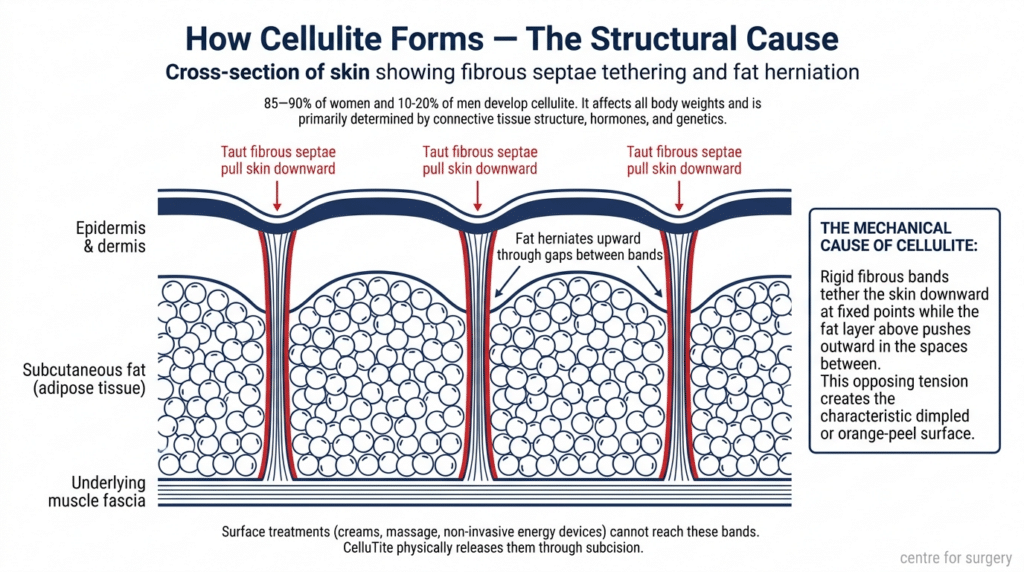
Beneath the skin, connective tissue bands called fibrous septae anchor the skin to the deeper fascia. Over time these bands become taut and rigid. The fat layer above them, under ordinary pressure, pushes outward. The result is a tug of war: the bands hold the skin down at fixed points while fat herniates upward through the gaps between them. The depressions are where the bands are anchored; the fullness between them is the fat pushing through.
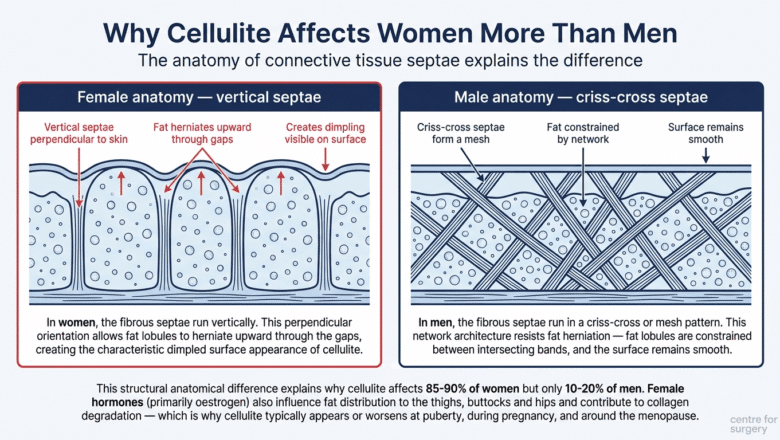
Why cellulite affects women far more than men
In women the septae run vertically, perpendicular to the skin surface, leaving gaps through which fat can herniate. In men the same bands run in a criss-cross mesh that constrains the fat and keeps the surface smooth. This single structural difference explains most of the gap between roughly 80–90% of women and 10–20% of men.
Hormones
Oestrogen influences fat distribution toward the thighs, hips and buttocks, and affects collagen turnover and connective tissue strength. This is why cellulite characteristically appears or worsens at puberty, during pregnancy, and around the menopause.
Genetics
Skin thickness, fat distribution pattern and connective tissue elasticity are all partly inherited. If your mother has cellulite in a particular pattern, you are more likely to.
Age
Skin thins and collagen production declines with age, making the underlying structure more visible. Cellulite that was barely noticeable at 25 often becomes more obvious at 45 without any change in weight.
Lifestyle
Sedentary behaviour, smoking and poor circulation can worsen the appearance. They are contributing factors, not primary causes — which is why exercise and weight management reduce severity for some people but do not resolve established cellulite for anyone.
Can you get rid of cellulite?
Honestly: no treatment eliminates cellulite completely, and you should be sceptical of any clinic that says otherwise.
What can be done is reduce it, sometimes substantially. The distinction that matters is whether a treatment reaches the fibrous bands. Anything applied to the skin surface — creams, massage, most clinic devices — does not, and therefore cannot change the structure producing the dimples. Treatments that physically release the bands do change it, and the change is durable because cut bands do not grow back.
A 2023 review in Aesthetic Plastic Surgery notes there is still no consensus on the optimal treatment approach, and proposes an evidence-based algorithm: mild cellulite is best served by lifestyle measures, moderate cellulite by non-invasive options — of which radiofrequency has the strongest evidence — and severe cellulite by minimally invasive approaches such as subcision (Menon et al., 2023 ↗). That is a more useful framework than the marketing claim that one device solves everything.
How to get rid of cellulite on legs and thighs
The thighs are the most commonly affected site, and the most commonly asked about. The mechanism is the same as elsewhere — vertical septae, fat herniating between them — but the thighs carry more of both, and the skin is under more tension when standing, which makes dimpling more visible.
What genuinely helps depends on what is driving the appearance:
Where fat volume is a significant component, reducing it can improve the overall contour, though it does not treat the dimpling itself and can occasionally make it more obvious. Our page on whether liposuction gets rid of cellulite explains why fat removal alone is the wrong tool for this problem.
Where the dimples are the concern, the septae have to be released. Nothing topical achieves this.
Where there is also loose skin — common after pregnancy or significant weight loss — the laxity needs addressing on its own terms, sometimes with a thigh lift rather than a texture treatment.
How to get rid of cellulite on your bum and stomach
The buttocks are the second most commonly treated area and often respond well, because the dimpling there is usually clearly defined and individual dimples can be targeted precisely.
On the abdomen the picture is more mixed. Abdominal surface irregularity is frequently a combination of cellulite, skin laxity and fat rather than cellulite alone, and treating only the texture leaves the other two untouched. Where a horizontal crease divides the abdomen the cause may be different again — our guide to the B belly covers that presentation.
Upper arms, knees, hips and flanks are all treatable areas, and more than one can be addressed in a single session.
Do cellulite creams, massage and dry brushing work?
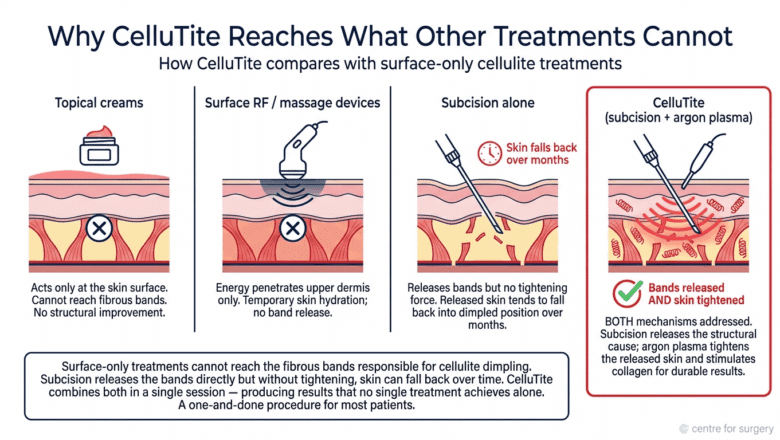
Creams, massagers, dry brushing and compression. None of them reaches the septae. Retinol creams thicken the skin slightly over months, caffeine tightens the surface for a few hours, and massage or brushing plumps it briefly — but no topical product or hand-held tool has been shown in a controlled trial to reduce cellulite dimpling. We have gone through the trials ingredient by ingredient in our review of whether cellulite creams, massagers and dry brushing work.
Exercise. Improves muscle tone beneath the fat, which can modestly improve the overall look, and is worth doing for every other reason. It does not release fibrous bands.
Weight loss. Reduces the volume of fat pushing upward, which helps some people. In others the dimpling becomes more apparent as surrounding volume decreases. Cellulite persists at low body fat percentages.
Non-invasive energy devices. Radiofrequency and laser treatments have the best evidence among non-invasive options for moderate cellulite, and can improve skin quality. They do not release established fibrous bands. Morpheus8 and Morpheus8 Body are the relevant options where skin quality and mild laxity are the main issue.
Cellulite treatment that addresses the cause: CelluTite
CelluTite is Centre for Surgery’s name for the combined procedure of cellulite subcision and argon plasma skin tightening, performed in a single session.
Stage one — subcision
A fine cannula is introduced through an entry point under 2 mm and moved beneath the skin to cut the fibrous bands tethering each dimple. As each band is released the skin above it lifts immediately. Every dimple is marked while standing and addressed individually.
A study of 200 women treated with manual subcision in a single session reported average physician-rated improvement of 8.1 and patient-rated improvement of 7.8, and noted MRI evidence that cellulite depressions correspond to significantly thickened underlying septa (Amore et al., 2018 ↗).
Stage two — argon plasma skin tightening
Argon plasma energy combined with radiofrequency is then delivered beneath the released skin. This contracts the tissue immediately and stimulates collagen production that continues to firm the skin over six to nine months.
Why both stages, and why not Cellulaze or Cellfina
Subcision performed alone tends to allow the released skin to settle back into a dimpled position over months, because nothing holds it in the lifted position. That is why we do not offer subcision as a standalone treatment.
We also use manual subcision rather than device platforms. Cellfina uses a stabilised vacuum platform that can release bands at only two depths and restricts the angles available. Cellulaze delivers laser energy at band level, which introduces thermal energy where precise mechanical cutting is sufficient and carries some risk of unintended thermal injury. Manual technique lets the surgeon reach bands running in any direction at any depth through a single entry point. We use thermal energy at the skin-tightening stage instead, where it is doing useful work.
Anaesthetic, recovery and honest risk
CelluTite is usually performed under local anaesthetic with oral sedation, or with you fully asleep where preferred or clinically indicated, and most patients go home the same day. Most patients return to desk work within two to three days, wear compression as directed, and resume strenuous exercise at four to six weeks.
Bruising is not a rare complication — it is close to universal. A 2024 systematic review and meta-analysis covering 1,254 patients, 789 of whom underwent subcision, reported bruising in 99%, pain requiring analgesia in 60%, and induration and skin discolouration each in around 7% (Foppiani et al., 2024 ↗).
How long do results last?
The bands cut during subcision do not regenerate, so treated dimples are permanently addressed and results are durable. Cellulite can still progress with age in adjacent untreated areas, and maintaining a stable weight supports the result. What CelluTite does not do — and what nothing does — is eliminate cellulite entirely.
Am I a suitable candidate for cellulite treatment?
For a large number of people the honest answer is that no treatment is needed, because there is nothing wrong. Cellulite in a healthy adult is a normal anatomical finding.
Where treatment is being considered, suitable candidates are generally:
- Aged 18 or over, with no upper age limit
- At a stable weight for at least three months
- Free of active skin infection or inflammation in the treatment area
- Non-smoking, or willing to stop four weeks either side of treatment
- Realistic about outcome — significant, durable improvement rather than perfection
CelluTite suits people with visible dimpling and some degree of skin looseness. Where the concern is surface texture without true dimpling, simpler treatments may be more appropriate. Where there is major generalised laxity after weight loss, a lift procedure may be the better option, alone or combined.
We decline a proportion of consultations for this treatment, most often because weight is still changing or because what the patient is describing is normal skin texture that surgery would not improve.
How much does cellulite treatment cost in London?
The cost of CelluTite depends on how many areas are treated and how large they are, and your surgeon gives you a fixed, itemised quote after your consultation.
Finance is available through Chrysalis Finance, subject to status. We recommend a two-week cooling-off period from the date of consent. Full pricing is set out on the CelluTite treatment page.
Frequently asked questions
Is cellulite a sign of being overweight?
No. Cellulite occurs at every body weight, including in very lean and athletic people. It is determined mainly by connective tissue structure, hormones and genetics rather than by body fat percentage.
What is the difference between cellulite and orange peel skin?
They are the same thing. Orange peel skin, cottage cheese skin and peau d’orange are all descriptions of the dimpled surface that cellulite produces. One caution: dimpling that appears on the breast is a different matter entirely and should be assessed by your GP promptly, as it can indicate an underlying condition unrelated to cellulite.
Can men get cellulite?
Yes, though far less often — around 10–20% of men, compared with 80–90% of women. The difference is anatomical: male septae run in a criss-cross pattern that resists fat herniation.
Does losing weight get rid of cellulite?
Not reliably. It reduces the fat pushing up between the bands, which helps some people, but the bands themselves are unchanged. In some patients dimpling looks more pronounced after weight loss.
Will cellulite come back after treatment?
The specific bands released during subcision do not regenerate, so treated dimples do not return. New dimpling can develop in untreated areas over time, particularly with age or significant weight change.
How many sessions of cellulite treatment will I need?
CelluTite is a single-session procedure for most patients. Occasionally, in severe or longstanding cellulite, a second session is needed to release residual tethering — this is assessed at follow-up.
Is cellulite treatment painful?
The procedure itself is well tolerated under local anaesthetic with sedation; most patients describe pulling and pressure rather than sharp pain. Afterwards, bruising is near-universal and around 60% of patients in the published data needed simple analgesia.
Speak to a plastic surgeon
If cellulite is something you would like assessed, an in-person consultation establishes what is actually causing the appearance — dimpling, laxity, fat, or a combination — and whether treatment would help. Frequently the answer is that it would not, and we would rather tell you that.
Call 020 7993 4849 or contact us to arrange a consultation at 95–97 Baker Street, Marylebone, London W1U 6RN.

Consultations take place at our CQC-regulated private hospital in Marylebone, with procedures performed by GMC-registered plastic surgeons. If you are travelling from outside London, our guide to travelling to us for surgery covers timings and accommodation, and finance options explains how treatment can be spread over a fixed term.
Further reading
- CelluTite cellulite treatment
- Do cellulite creams, massagers and dry brushing work?
- Can liposuction get rid of cellulite?
- Stubborn fat, skin laxity or cellulite: how to tell them apart
- Morpheus8 Body for skin quality and mild laxity
- Thigh lift for skin laxity
- How to get rid of body fat: what actually works






