


In this guide10 sections
- Key points
- Does liposuction get rid of cellulite?
- Can liposuction make cellulite worse?
- Why liposuction cannot treat cellulite: the mechanism
- What is the difference between cellulite and stubborn fat?
- What does treat cellulite: subcision and argon plasma
- Can you have liposuction and cellulite treatment together?
- What liposuction is genuinely good for
- Frequently asked questions
- Speak to a plastic surgeon
Key points
- No. Liposuction does not get rid of cellulite. It removes fat; cellulite is caused by fibrous bands beneath the skin that liposuction does not touch.
- It can occasionally make dimpling look worse. Removing volume from around a tethered point can deepen the depression.
- The two conditions are genuinely separate. You can have stubborn fat without cellulite, cellulite without stubborn fat, or both.
- Liposuction is still the right operation for stubborn fat — just not for dimpling.
- Releasing the fibrous bands is what changes dimpling. At Centre for Surgery that is CelluTite — subcision with argon plasma skin tightening.
- The two can be combined where a patient genuinely has both, either in one session or staged.
Does liposuction get rid of cellulite?
No — and it is worth being direct about that, because it is one of the most common misunderstandings we encounter at consultation.
Liposuction is a fat-removal operation. A cannula is passed through small incisions to break up and aspirate subcutaneous fat, reshaping the contour of an area. It is highly effective at what it does.
Cellulite is not a fat problem. The dimpling is produced by fibrous connective bands — septae — that anchor the skin to the deeper fascia and hold it down at fixed points, while fat pushes upward through the gaps between them. Removing fat does not release those bands. The tethering remains exactly as it was.
This is why patients who have liposuction expecting smoother skin are sometimes disappointed. The contour improves. The dimples do not.
If you want the fuller picture of what cellulite is and what does work on it, our main guide covers what causes cellulite and which treatments actually work. This page deals only with the liposuction question.
Can liposuction make cellulite worse?
Sometimes, yes — and this is the part that tends not to get said.
Where fat is removed from an area that has tethering points, the surrounding volume reduces while the anchored points stay exactly where they are. The depressions can therefore become relatively more pronounced rather than less. The skin also has less underlying volume to stretch it smooth.
The risk is higher where skin quality is poor, where large volumes are removed, or where liposuction is performed too superficially. It is one of the reasons that assessing skin quality and tethering before surgery matters as much as assessing fat volume.
Why liposuction cannot treat cellulite: the mechanism
The two problems sit in different tissue layers.
Liposuction works in the subcutaneous fat compartment, removing volume. The septae causing cellulite run through that compartment, from the underside of the skin down to the fascia. A liposuction cannula moves through the fat around them; it is not designed to divide them, and dividing them reliably requires a different instrument, a different plane and a different technique.
A 2023 review in Aesthetic Plastic Surgery setting out an evidence-based treatment algorithm for cellulite lists lifestyle measures for mild disease, non-invasive energy-based options for moderate disease, and minimally invasive approaches such as subcision for severe disease (Menon et al., 2023). Liposuction does not appear as a cellulite treatment in that algorithm, because it is not one.
There is a partial exception worth being accurate about. A retrospective review of 126 patients treated over 26 years described a technique using superficial liposuction with a specialised cannula combined with autologous fat grafting to fill depressions, reporting good or excellent results in the majority, with partial recurrence of cellulite among the recorded complications (Uebel et al., 2018). That is a specific surgical technique using liposuction instruments as part of a cellulite operation — not conventional liposuction, and not what a patient is buying when they book a standard liposuction procedure.
What is the difference between cellulite and stubborn fat?
They look similar in photographs and feel completely different on examination.
Stubborn fat is a thick, soft layer that yields when pinched, with normal skin over it. The problem is volume.
Cellulite is surface dimpling that becomes more obvious when the skin is pinched or the muscle tensed, and it persists at low body fat. The problem is texture, not quantity.
Skin laxity is a third thing again — skin that has lost elastic recoil and drapes rather than retracts.
Getting this wrong is the single most common reason a body contouring result disappoints. Our guide to telling stubborn fat, skin laxity and cellulite apart sets out how each is identified and what each needs.
What does treat cellulite: subcision and argon plasma
If the dimpling is what bothers you, the bands have to be released. Nothing applied to the surface does that — our guide to whether cellulite creams, massagers and dry brushing work goes through the trials — so the question is which procedure reaches them.
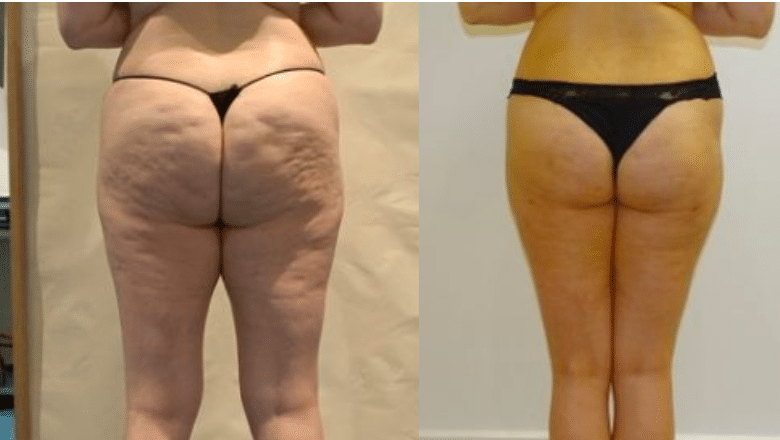
CelluTite is our combined procedure of cellulite subcision and argon plasma skin tightening, performed in a single session. A fine cannula is passed beneath the skin to cut the bands tethering each dimple, so the skin lifts immediately. Argon plasma energy is then delivered beneath the released skin to contract the tissue and stimulate collagen over the following six to nine months.
We do not offer subcision on its own, because released skin without a tightening step tends to settle back into the dimpled position over months.
Recovery is straightforward for most people — light activity within two to three days, compression as directed, strenuous exercise at four to six weeks. Bruising is close to universal rather than a rare complication. A 2024 systematic review and meta-analysis covering 1,254 patients, 789 of whom had subcision, reported bruising in 99% and pain requiring analgesia in 60% (Foppiani et al., 2024).
Can you have liposuction and cellulite treatment together?
Yes, and for patients who genuinely have both problems it often makes sense — one anaesthetic, one recovery period.
The sequencing matters. Where fat volume is significant and dimpling is mild, reducing the fat first may be enough on its own. Where dimpling is the main concern, treating the fat alone will not help and may accentuate it. Where both are marked, they are usually addressed together.
Both are carried out at our Baker Street hospital, and most patients go home the same day. CelluTite is performed under local anaesthetic with oral sedation as standard, or with you fully asleep where preferred, where multiple areas are being treated, or where it is being combined with another procedure such as liposuction.
What liposuction is genuinely good for
None of this is an argument against liposuction. It remains the most reliable way to reduce subcutaneous fat in a defined area, and results are long-lasting where weight is stable.
It is the right operation where there is a discrete fat deposit, good skin quality, and a stable weight — the abdomen, flanks, thighs, arms or under the chin. VASER liposuction and 360 liposuction suit different patterns and volumes. Our guide to common liposuction myths covers the other things it is frequently expected to do and does not.
Where skin laxity rather than fat is the issue, energy-based tightening such as Morpheus8 Body or an excisional procedure such as a thigh lift is the appropriate route.
Frequently asked questions
Does liposuction remove cellulite completely?
No. Liposuction removes fat and does not release the fibrous bands that cause cellulite dimpling. Any improvement in appearance comes from the change in overall contour, not from treating the cellulite.
Can liposuction make cellulite worse?
It can. Removing volume around fixed tethering points can make the depressions relatively more visible, particularly where skin quality is poor or large volumes are removed.
What is the best treatment for cellulite?
For established dimpling, releasing the septae is what changes the structure. At Centre for Surgery that means CelluTite — subcision with argon plasma tightening. There is no consensus in the literature on a single optimal treatment, and severity should guide the approach.
Is cellulite treatment permanent?
The bands cut during subcision do not regenerate, so treated dimples are permanently addressed. New dimpling can still develop in untreated areas with age or weight change. No treatment eliminates cellulite entirely.
Can I have liposuction and CelluTite in the same operation?
Yes. Where both are indicated they are commonly combined under one anaesthetic, usually with you fully asleep for a longer combined procedure. Your surgeon will advise whether combining or staging suits your case.
Will losing weight help my cellulite before surgery?
Weight loss reduces the fat pushing up between the bands and is worth doing before any body contouring surgery. It does not remove cellulite, and in some people dimpling becomes more visible as surrounding volume reduces.
Speak to a plastic surgeon
An in-person assessment establishes whether what you have is fat, dimpling, laxity, or a combination — and therefore which operation, if any, would actually help. If liposuction would not improve what is bothering you, we will say so.
Call 020 7993 4849 or contact us to arrange a consultation at 95–97 Baker Street, Marylebone, London W1U 6RN.
Consultations take place at our CQC-regulated private hospital in Marylebone, with all procedures performed by GMC-registered plastic surgeons. If you are travelling from outside London, our guide to travelling to us for surgery covers timings and accommodation, and finance options explains how treatment can be spread over a fixed term.
Further reading
- Cellulite treatment: what causes cellulite and what actually works
- Stubborn fat, skin laxity or cellulite: how to tell them apart
- CelluTite cellulite treatment
- Do cellulite creams work? Creams, massagers and dry brushing against the evidence
- Liposuction at Centre for Surgery
- Common liposuction myths