

In this guide9 sections
- Healing Process of Breast Augmentation Scars
- Where Are Breast Augmentation Incisions Placed?
- The Short-Scar Technique
- Breast Augmentation Scar Healing Timeline
- Factors That Influence Scar Appearance
- How to Minimise Breast Augmentation Scars
- Scar Treatment Options
- Frequently Asked Questions
- Breast Augmentation at Centre for Surgery
Breast augmentation surgery is one of the most commonly performed cosmetic procedures in the UK, and it’s completely understandable to have questions about the scarring it involves — a boob job cannot be performed without incisions, and incisions leave scars. This guide covers everything relevant: where incisions are placed, how scars heal, the short-scar technique, and the most effective ways to minimise their appearance.
Healing Process of Breast Augmentation Scars
Scarring is an inevitable part of any surgery involving an incision. When the skin is cut, the body’s healing mechanisms form a scar through three overlapping phases.
Inflammatory phase. The body’s immediate response to the wound — white blood cells and other immune components rush to the incision site to prevent infection. This is when redness and swelling around the wound are most pronounced, marking the start of healing.
Proliferation phase. The body actively rebuilds the wounded area, producing collagen to fill and close the wound. This is when the visible scar first forms.
Remodelling phase. The final and longest phase, during which collagen fibres in the scar tissue reorganise, gradually making the scar flatter and lighter in colour. This maturation process can take up to a year or longer, during which the scar’s appearance continuously evolves.
Where Are Breast Augmentation Incisions Placed?
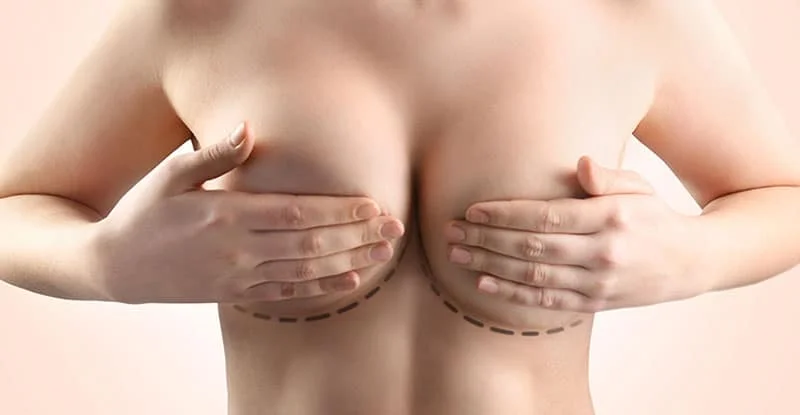
The most common incision for breast augmentation is made in the lower breast crease, known as the inframammary fold. Less commonly, incisions are made around the areola — the periareolar approach — positioned on the border between the darker areola skin and the surrounding lighter skin, which helps camouflage the resulting scar. Both approaches are designed to be as short as possible and are easily concealed by an appropriately fitting bra; inframammary scars are generally hidden by most clothing.
In the early post-operative phase, incisions appear red and are often slightly raised. With time, the colour shifts from deep red to pink, and eventually breast augmentation scars become pale white, flat, and level with the surrounding skin.
The Short-Scar Technique
Traditional breast augmentation incisions along the breast crease typically measure 5 to 7cm. For suitable candidates — generally those with good healing ability and a healthy lifestyle — refined surgical techniques can reduce this to as little as 3 to 4cm.
A key tool in achieving this is the Breast Funnel, a device that allows the surgeon to insert the implant through a smaller incision with minimal handling and contact, which also reduces the risk of bacterial contamination during insertion. At Centre for Surgery, our surgeons use the Breast Funnel as standard in all breast augmentation procedures. The implant itself matters too — Centre for Surgery uses Silimed implants exclusively, and the implant size and type you choose affect how short the incision can be, which is worth discussing with your surgeon at consultation.
The short-scar approach isn’t suitable for everyone — implant size and type, breast anatomy, and individual healing all factor into whether it’s realistic for you. Your surgeon will assess this at consultation and explain what’s achievable for your anatomy specifically.
Breast Augmentation Scar Healing Timeline
First 6 weeks: Scars appear red and raised above the surrounding skin. This is the period requiring the most care — avoiding strain, sun exposure and heavy lifting matters most now.
3 months: Scars are typically still red or pink, but noticeably calmer than in the first weeks as swelling resolves.
6 months: Widely regarded as the point where scars have substantially matured — most patients find their scars have flattened, lightened considerably, and no longer feel firm or lumpy to the touch.
12 months: Full maturation is typically complete by this point. Scars are usually pale white, flat, and at the same level as the surrounding skin, and for many patients they become almost invisible.
If you’re combining breast augmentation with a breast lift (mastopexy-augmentation), expect additional scarring beyond the implant incision alone — typically a vertical scar from the areola to the breast crease, sometimes with a scar around the areola too. The vertical scar technique used in breast lift surgery can help minimise this where appropriate. This is a genuinely different scar picture from a primary (first-time) augmentation alone, and worth discussing explicitly with your surgeon and reviewing photographic examples of if you’re considering the combined procedure.
Factors That Influence Scar Appearance
Surgical technique. Your surgeon’s precision and skill are the single biggest factor in how scars form and heal. Careful incision placement and meticulous wound closure make an inconspicuous scar far more likely.
Skin type and pigmentation. Skin tone, thickness and elasticity all influence healing. Darker skin types are more prone to hyperpigmentation, hypertrophic scarring and keloid formation — worth flagging at consultation if it’s a personal or family history.
Lifestyle factors. Smoking, excess alcohol and a poor diet are all linked to slower healing and less favourable scarring.
Primary vs. secondary surgery. A first-time (primary) augmentation typically produces the most inconspicuous scarring achievable. Combined or revision procedures — such as augmentation with a breast lift — involve more extensive incisions and a different healing picture, as noted above.
There’s no absolute guarantee of how any individual’s scars will look once healed — some people are simply more prone to raised or keloid scarring regardless of technique. What can be controlled — adherence to aftercare, nutrition, hydration and avoiding smoking — genuinely does improve the odds of a good result.
How to Minimise Breast Augmentation Scars
Follow your post-operative wound care instructions precisely — keeping the incision clean and dry as directed is the foundation everything else builds on.
Avoid sun exposure and tanning beds for at least six weeks after surgery, since UV exposure increases the risk of pigmentation that makes a healing scar more noticeable. Once fully healed, sun exposure is generally safe.
Avoid heavy lifting for the first six weeks — straining the incision increases the risk of wound breakdown and a poorer scar.
Wear your recommended post-surgical bra as directed, since supportive garments reduce swelling and protect the healing incisions.
Mind your sleep position in the early weeks, following your surgeon’s guidance to avoid unnecessary pressure on the incisions.
Avoid scrubbing or exfoliating the area while incisions are actively healing, and avoid harsh or fragranced skincare products near the scar.
Stay hydrated and eat well — a diet with adequate protein, vitamin C and zinc supports tissue repair, and good hydration supports skin elasticity throughout recovery.
Attend every follow-up appointment, so your surgical team can monitor healing and catch anything atypical early, when it’s easiest to treat.
Scar Treatment Options
Topical Treatments
Creams, gels and ointments containing silicone, onion extract or vitamin E are commonly used to help soften and flatten scars and reduce redness, though effectiveness varies between individuals and depends on how mature the scar already is.
Silicone Sheets
Self-adhesive silicone sheets, worn over the scar for several hours daily, hydrate the scar tissue and can meaningfully reduce its size and texture with consistent use.
Scar Massage
Gentle massage of a fully healed scar can help break down scar tissue, improve local circulation, and help the scar blend more seamlessly with the surrounding skin.
Laser Scar Revision
Focused laser light breaks down scar tissue and stimulates new skin cell growth, particularly effective for raised or discoloured scars. Multiple sessions are usually needed for optimal results.
Corticosteroid (Steroid) Injections
Injected directly into the scar, corticosteroids reduce inflammation and can soften and flatten hypertrophic or keloid scars, which are otherwise prone to being raised, itchy or uncomfortable.
Morpheus8
Morpheus8 combines microneedling with radiofrequency energy to stimulate collagen production and encourage new skin cell growth, and can be effective for a range of scar types including sunken or discoloured scars.
Frequently Asked Questions
Will breast augmentation scars look obvious?
For most patients, no. The most common incision — along the lower breast crease — is not prominent and is generally hidden by clothing and underwear, and the periareolar approach is similarly well disguised by the natural colour change at the areola border.
Is it possible to have a boob job without any scars?
No — breast augmentation requires an incision to insert the implant, so a scar of some kind is unavoidable. What surgeons can do is keep incisions as short as possible and position them to be as inconspicuous as they can be. Non-surgical “boob jobs” don’t exist as a way to permanently increase breast size — surgery is the only effective method.
How long do breast augmentation scars take to heal and fade?
Most breast augmentation scars are substantially matured by around 6 months, with full maturation typically complete by 12 months. Individual healing time varies with skin type, lifestyle and how closely aftercare guidance is followed.
Breast Augmentation at Centre for Surgery
Centre for Surgery is a specialist plastic surgery clinic on Baker Street in Marylebone, London, registered with and independently inspected by the Care Quality Commission. Our plastic surgeons take meticulous care over incision placement and technique, using tools such as the Breast Funnel as standard, with the goal of the most discreet scarring achievable for your anatomy.
Every plastic surgeon on our team is GMC-registered and independently verifiable on the General Medical Council register.
Verified Patient Reviews
We invite you to read what our breast augmentation patients say on independent, verified review platforms. Every review is publicly verifiable, dated, and linked to a real named patient.
- Google Reviews: Read our Google reviews ↗ — rated 4.6 stars based on hundreds of verified patient reviews.
- Patient reviews page: Read patient reviews by procedure — Google and Trustpilot reviews brought together on our own site.
As a CQC-regulated provider, every surgeon on our team is GMC-registered and independently verifiable. View our CQC rating.
Related Reading
- How Much Is a Boob Job?
- Can You Get a Breast Enlargement on the NHS?
- Effects of Tanning on Cosmetic Surgery Scars
We offer flexible finance options through Chrysalis Finance, subject to status. Learn more on our About Us page, browse our Plastic Surgery Blog, or find answers in our Clinic FAQs.
To book a consultation, call us on 020 7993 4849, email contact@centreforsurgery.com, or complete the contact form below.
Related Articles
- What Are The Most Natural Looking Breast Implants?
- Do Silicone Strips Help Cosmetic Surgery Scars Heal Better?