


Real face lift before and after results from our plastic surgeons at Centre for Surgery, Marylebone — UK patients, full SMAS facelift, mini face lift, and combined face and neck lift. Jump to a section: Facelift (Full & SMAS) | Facelift & Neck Lift | Mini Facelift.
Results vary from patient to patient. All photos are published with written patient consent and are examples of outcomes achieved at Centre for Surgery, not guaranteed results. After photos were taken at least six months after surgery unless the caption says otherwise. No photograph has been retouched or filtered; some are cropped or masked only to protect patient privacy. Full disclaimer below, and how to read these photos — including the tells that separate a real facelift result from a well-staged photograph.
Face lift before and after — full and SMAS facelift results
4 photographs
A full facelift repositions the deeper SMAS layer rather than just tightening skin, which is what produces a result that looks like a younger version of the same face rather than a pulled one. Read more about facelift surgery, the different types of facelift, and how long a facelift lasts.
A full facelift addresses the mid-face, jowls and jawline by tightening the deeper SMAS layer rather than the skin alone, producing a natural, longer-lasting result. Longer-lasting is not permanent, though; our guide to whether you can have a facelift twice covers the second operation. For a price breakdown, see our facelift cost guide.

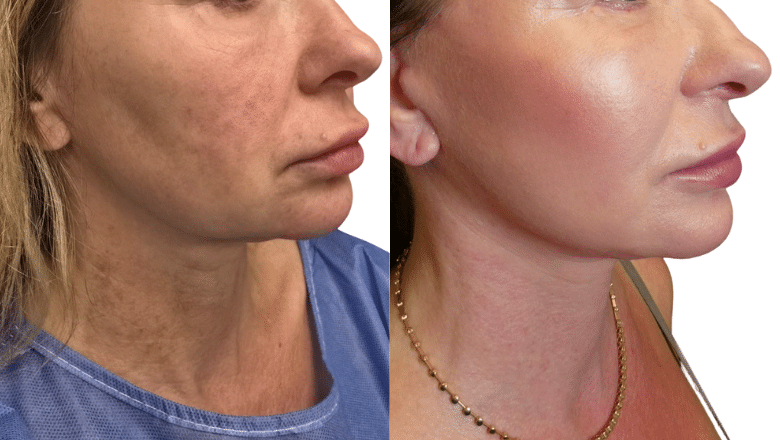


Face lift and neck lift before and after — combined results
11 photographs
Most patients over 50 have laxity in the neck as well as the face, and treating one without the other produces a mismatch. Read more about neck lift surgery and when it is combined with a facelift.
Many patients combine a facelift with a neck lift to treat the lower face and neck together, correcting jowls, submental laxity and platysmal banding in a single operation. See also our neck lift before and after photos.


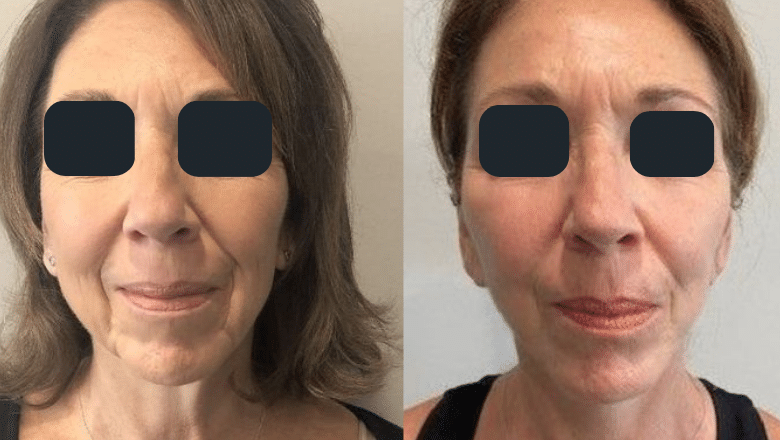
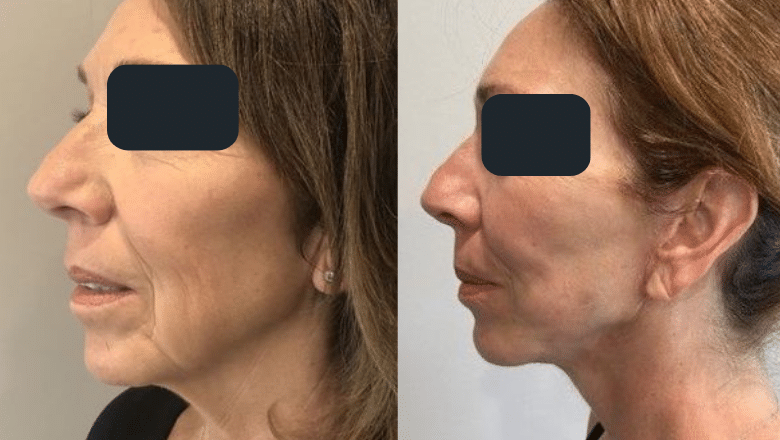
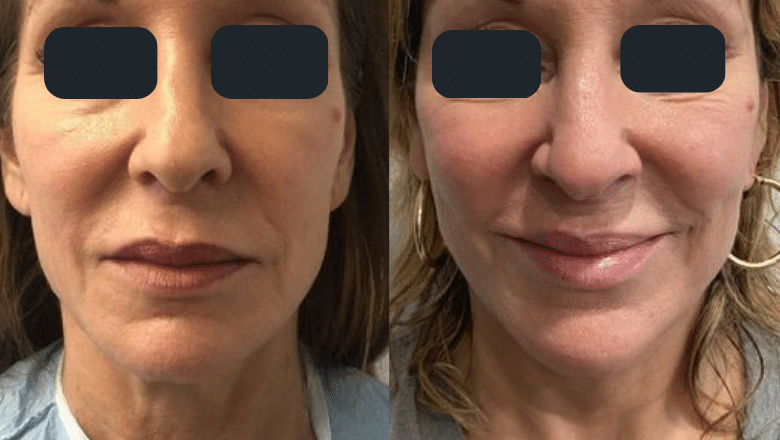
Mini face lift before and after — limited-incision results
7 photographs
A mini facelift addresses the lower face and jawline through shorter incisions, and suits earlier laxity. Read more about mini facelift, or the deep plane facelift for more advanced descent.
A mini facelift targets the lower face and jawline through shorter incisions, treating mild to moderate jowling and loss of jaw definition with a faster recovery than a full facelift.




Important Information About These Photographs
The before and after photos above are presented for educational purposes only and should be interpreted subjectively. They do not represent the opinion or view of any patient regarding their result, and they are not intended to suggest the result that any other patient may achieve. No two patients are alike, and no two results are necessarily alike. Only a personal consultation with your surgeon can provide you with a reasonable expectation of the results you may achieve from any specific procedure. We only publish photographs of patients who have given written consent for their images to be used.
How to Read Facelift Before and After Photos
A facelift is the easiest cosmetic result in the world to fake in a photograph, because the things a facelift changes — jawline definition, submental tightness, jowl shadow — can all be changed by a camera. Here is what to control for.
Watch the chin and neck
This is the single biggest tell. Lifting the chin and extending the neck stretches the skin under the jaw, sharpens the cervicomental angle and makes jowls disappear. Drop the chin toward the chest and the same neck looks slack. A “before” photographed with the chin down and an “after” with the chin up shows you a posture, not an operation. In an honest pair, the head is in the same position in both frames — check the ear, the shoulder line and how much neck is visible.
Look at the hairline and the earlobe
Facelift incisions run around the ear and into the hairline. Excessive tension on the closure produces two visible signatures: a pixie-ear deformity, where the earlobe is pulled downward and stretched into the cheek, and a displaced or bald sideburn. Both are permanent, both are visible in a side-profile photograph, and both indicate skin pulled tight rather than the deeper SMAS layer repositioned. A gallery that only shows front views may not be hiding anything — but a gallery that never shows an ear is worth a question.
Check the weight
Facial fat loss slims the face and sharpens the jaw. Photographs taken months apart may show a patient who is several kilograms lighter — a change that flatters the jawline independently of surgery. Look at the cheeks, the temples and the neck as a whole.
Check the skin, not just the shape
A facelift repositions tissue. It does not resurface skin. If the “after” shows markedly better skin texture, fewer fine lines or more even pigmentation, something else was done as well — laser, peel, or the makeup and lighting were different. Fine lines around the mouth, in particular, are essentially unchanged by a facelift. Their disappearance in an after photograph should make you curious.
Expression and lighting
Both frames should be neutral and unsmiling. A smile lifts the midface and erases jowls. Light from above deepens the nasolabial fold and the pre-jowl hollow; flat frontal light softens both. The same face can be photographed as heavy or as lifted without a scalpel entering the room.
What Stage of Healing You’re Looking At
Facelift photographs are unusual in one respect: an early photograph can look tighter than the final result.
In the first weeks the face is swollen, and swelling fills out the tissues, holds the jawline crisp and can flatter the outcome. As it resolves the face softens into its real shape. At Centre for Surgery, most patients are comfortable returning to social activities within two to three weeks, with swelling fully settled by six to eight weeks. A photograph taken at three weeks is therefore not a photograph of the result.
Numbness in front of the ear and across the cheek is normal for months and resolves gradually. Scars pass through a firm, pink phase before softening and fading, a process measured in months rather than weeks — and the incision in front of the ear is the one that is visible in a photograph, though rarely in the views galleries use.
It also matters in the other direction. A facelift does not stop ageing. A result photographed at three months and a result photographed at three years are different claims, and only one of them tells you how the operation holds up. Ask which you are looking at.
The after photographs in this gallery were taken at least six months after surgery, unless the caption says otherwise. For what to expect at each stage before then, see our facelift recovery guide.
What These Photographs Cannot Show You
There is a limit to what any gallery can tell you, and a clinic that pretends otherwise is selling rather than informing.
- The face in motion. You are looking at a still. A face that is beautiful at rest and stiff when it smiles is a poor result, and no photograph will ever reveal it. Ask to see video, or ask what happens when the patient laughs.
- Volume. Much of what reads as ageing is fat loss in the cheek and temple, not skin laxity. A facelift lifts; it does not fill. A patient whose problem is deflation will be disappointed by an operation designed for descent, and the two are indistinguishable in somebody else’s photograph.
- Sensation. Numbness, tightness and an odd awareness of the ears are normal for months. Photographs record faces, not how they feel to live in.
- The scars. They run around the ear and into the hair, exactly where a standard front or three-quarter photograph does not look. Their absence from these images is not evidence of their absence from the patient.
- How long it lasted. Almost every facelift gallery on the internet, ours included, shows results photographed within the first year. That is the flattering window. The honest question is how the face looks at five years, and the honest answer is that ageing continues from the new starting point.
None of this is a reason to distrust before and after photographs. It is a reason to treat them as the beginning of a conversation with a surgeon rather than the end of one.
Facelift Results: Common Questions
How long does a facelift last?
A facelift resets the clock rather than stopping it. Ten years on, most patients still look younger than they would have without surgery, but the face keeps ageing, and skin quality, weight stability, sun exposure and smoking all affect how long the result holds. A SMAS or deep plane facelift usually lasts longer than a mini facelift.
What is the best age for a facelift?
There is no single best age. Most people who have a facelift are in their forties to sixties, when jowls and neck laxity have developed but the skin still has reasonable elasticity. General health matters more than age, and smoking must stop at least four weeks before and four weeks after surgery.
What are the downsides of a facelift?
It is a significant operation, with two to three weeks of visible bruising and swelling, scars around the ears and temporary numbness. Risks include bleeding under the skin (haematoma), nerve injury, poor scarring, hair loss near the incisions and asymmetry. A facelift also does not change skin texture or fine lines, which need skin treatments alongside surgery.
Facelift Surgery at Centre for Surgery
Centre for Surgery is a private hospital for plastic and cosmetic surgery on Baker Street in Marylebone, London, registered with and independently inspected by the Care Quality Commission. Our Baker Street clinic is purpose-built for day-case cosmetic surgery. Our consultations are thorough and personalised, ensuring you have a clear understanding of what the procedure involves and what results are achievable for your individual anatomy.
SMAS Technique for Natural, Long-Lasting Results
Our surgeons work on the deeper structural layer of the face — the SMAS — rather than just the skin, which produces more natural, longer-lasting results than a skin-only lift. Procedures are performed under TIVA anaesthetic at our Baker Street day surgery facility, meaning you go home the same day. Every plastic surgeon on our team is GMC-registered and independently verifiable on the General Medical Council register.
Combined Procedures for Greater Impact
Many patients choose to combine their facelift with a neck lift, blepharoplasty, or chin liposuction for a more comprehensive facial rejuvenation. Our surgeons will recommend the most appropriate combination at your consultation based on your specific anatomy and goals.
Aftercare and Follow-Up
You have your surgeon’s direct number for the first 24 hours after surgery, and your surgeon will monitor your recovery at all follow-up appointments. Most patients are comfortable returning to social activities within two to three weeks, with swelling fully settled by six to eight weeks.
Verified Patient Reviews
We invite you to read what our facelift patients say on independent, verified review platforms. Every review is publicly verifiable, dated, and linked to a real named patient.
- Google Reviews: Read our Google reviews — rated 4.6 stars based on hundreds of verified patient reviews.
- Patient reviews page: Read patient reviews by procedure — Google and Trustpilot reviews brought together on our own site.
As a CQC-regulated provider, every surgeon on our team is GMC-registered and independently verifiable. View our CQC rating.
Related Reading
- Does a Facelift Involve Muscle Repair?
- Key Questions to Explore Before Deciding on Facelift Surgery
- Face and Neck Lift Surgery After Weight Loss
- How to Tighten up Sagging Jowls
Explore More Before and After Galleries
View our full collection of plastic surgery before and after photos, or browse related facial procedure galleries: Neck Lift Before and After Photos | Blepharoplasty Before and After Photos | Rhinoplasty Before and After Photos
Subject to status, we offer finance options with Chrysalis Finance. For a full price breakdown, see our facelift cost guide. Learn more on our About Us page, browse our Plastic Surgery Blog, or find answers in our Clinic FAQs.
To book a face-to-face consultation, call us today on 020 7993 4849 or complete the contact form below.



