


In this guide14 sections
- Key Points
- Does a Facelift Tighten the Muscles?
- What is a Facelift?
- What Is the SMAS Layer in a Facelift?
- Facelift Procedure
- How Is a Facelift Performed?
- Does a Neck Lift Tighten the Platysma Muscle?
- Is a Deep Plane Facelift Better Than a SMAS Facelift?
- How Long Does a Facelift Last?
- Can a Facelift Be Combined with Other Procedures?
- Facelift Risks: Nerve Injury, Haematoma and Recovery
- Frequently Asked Questions
- Considering a Facelift in London?
- References
Key Points
- Does a facelift involve muscle repair? Not in the sense of repairing a torn or weak muscle. A facelift lifts and secures the SMAS, a fibromuscular layer that sits over the facial muscles, and then re-drapes the skin.
- The SMAS is not one muscle. It is a layer of connective tissue and fat with some muscle fibres running through it, which is why people describe a facelift as “tightening the muscles”.
- The neck is the exception. In a neck lift or face and neck lift, the platysma muscle can be tightened, divided or sutured (platysmaplasty) to treat neck bands.
- SMAS plication, imbrication and SMASectomy are three ways of tightening the same layer. Which one suits you depends on how loose the tissue is and how thick the SMAS is.
- Deep plane versus SMAS: published reviews show both techniques give high satisfaction and low complication rates, and the evidence does not yet show that one lasts longer than the other.
- No facelift is permanent. Ageing continues after surgery, and the evidence on exactly how long each technique lasts is limited.
Many people ask whether a facelift (rhytidectomy) works by tightening the muscles of the face. The answer is partly yes and partly no. A facelift does not repair a facial muscle in the way an orthopaedic surgeon repairs a tendon. It lifts a deeper structural layer called the Superficial Musculoaponeurotic System (SMAS), which contains fibrous tissue, fat and some muscle fibres, and then removes the excess skin. The one place where a muscle is deliberately tightened is the neck, where a surgeon can treat the platysma during a neck lift.
This guide explains what the SMAS is, what surgeons actually do to it, when the platysma is involved, and what the research says about how techniques compare. If you are weighing up the techniques themselves, our comparison of deep plane vs SMAS facelift and our guide to the types of facelift go into more detail.
Does a Facelift Tighten the Muscles?
It depends which muscle you mean. Most facial muscles, the ones that let you smile, frown and raise your eyebrows, are not tightened or repaired in a standard facelift. They sit in deeper layers and are left alone, partly because disturbing them would risk the facial nerve branches that supply them.
What the surgeon lifts is the layer above them. The SMAS is described in the anatomical literature as a continuous fibromuscular layer in the cheek that includes muscle cells, among them those of the risorius muscle at the corner of the mouth[1]. A histology study of tissue from the midface also found striated muscle cells within the fibrous septa of the SMAS, although the authors described the function of those cells as hypothetical[2]. So when a surgeon says the SMAS is lifted, it is fair to say that some muscle-containing tissue is being repositioned. It is not accurate to say that a muscle is being repaired.
A facelift also does not make the facial muscles stronger or change how they work. The neck is the exception: the platysma, a thin sheet of muscle that can form visible vertical bands, is a recognised target in a neck lift, covered in the platysmaplasty section below.
What is a Facelift?
A facelift, or rhytidectomy, is a surgical procedure that reduces the visible signs of ageing by lifting and repositioning the deeper facial tissues and then removing surplus skin. It is not simple skin tightening. Pulling skin alone gives a short-lived and often unnatural result, which is why modern techniques work on the deeper layer as well.
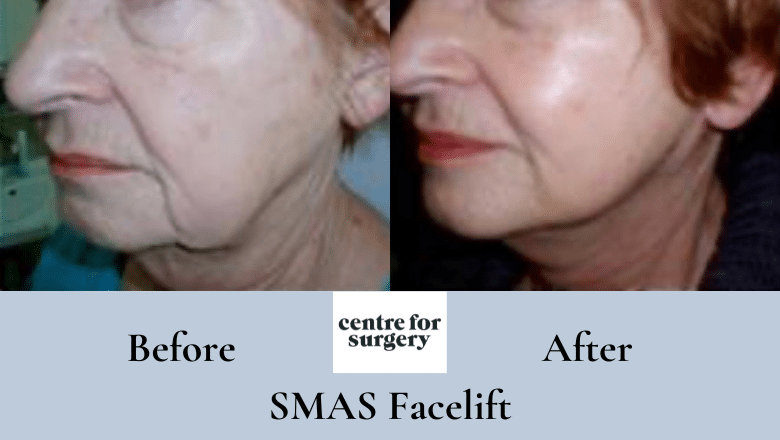
A facelift can improve the cheeks, jowls, jawline and the upper neck. In a 2024 series of 1,000 patients ↗ operated on by a single surgeon, people who completed a questionnaire a year later rated themselves, on average, about 11 years younger than their actual age[3], which is self-reported and from one surgeon’s practice, so it should be read as an illustration rather than a promise. You can compare real results in our facelift before and after photos.
For concerns limited to the neck and jawline, a standalone neck lift may be more appropriate. Equally, those with earlier signs of ageing may benefit from a mini facelift rather than a full procedure.
What Is the SMAS Layer in a Facelift?
The SMAS is a thin, continuous layer of fibrous tissue that lies beneath the skin and fat of the cheek and above the deeper facial muscles and the parotid gland. In dissection studies it appears as a sheet of connective tissue sandwiched between two fibroadipose layers, and it becomes progressively thinner as it runs from in front of the ear towards the nasolabial fold[4]. It links the skin to the muscles beneath, which is how the muscles of expression move the skin.
With age, the connective network loses some of its elasticity, and the soft tissues of the cheek and jaw descend. Researchers think that changes in this connective system contribute to the sagging of facial tissues[4]. That is the reason surgeons work on the SMAS rather than only on the skin: the SMAS gives a firm layer to anchor the lift, whereas skin stretches back.
Facelift Procedure
Facelift surgery has moved on from the old “skin-only” operations that tended to give a tight, flat look. The modern approach works on the deeper structures, with several variations tailored to the patient’s anatomy and goals. Our guide to what to expect from a facelift walks through the whole patient journey.
Different Facelift Techniques
Facelift procedures come in various forms, depending on the patient’s anatomy and aesthetic goals. Here is an overview of the main techniques.
Minimally Invasive Facelift
A less invasive approach may suit people with early signs of ageing. The one stitch facelift uses shorter incisions and is aimed at younger patients or those seeking a mild change. It focuses on lifting either the face or the neck. As less tissue is treated, the change is usually subtler and may not last as long as with a more extensive operation, and the outcome depends heavily on skin elasticity and overall condition.
SMAS Facelift
A SMAS facelift lifts the skin and then tightens and repositions the SMAS before the skin is re-draped. SMAS-based techniques are the mainstay of facelift surgery. A review of 3,400 facelifts recorded by the American Board of Plastic Surgery found that surgeons approached the SMAS by plication in 40% of cases, by a flap in 35% and by SMASectomy in 22%[5]. The three approaches are explained in the next section.
Deep Plane Facelift
A deep plane facelift works beneath the SMAS, so the skin, fat and SMAS are lifted together as one unit and the retaining ligaments that hold the cheek in place are released. Surgeons use it particularly to address the midface, nasolabial folds and marionette lines. Whether it gives longer-lasting results than a SMAS facelift is still debated, and the evidence is set out in the deep plane section further down.
Endoscopic Facelift
For patients who want small incisions, an endoscopic facelift uses a camera-guided approach to lift deeper tissues through short incisions. It is generally suited to people with good skin elasticity who want early correction of drooping in the brow and midface.
SMAS Plication, Imbrication and SMASectomy: What Is the Difference?
These three terms describe different ways of tightening the SMAS in a standard SMAS facelift:
- SMAS plication: the SMAS is folded and stitched into a tighter position, without cutting any of it away.
- SMAS imbrication: the SMAS is overlapped and sutured so that it is held more firmly in its new position.
- SMASectomy: a strip of the SMAS is cut out and the edges are stitched together, which tightens the layer by removing the excess.
No single approach suits everyone. In a series of 1,000 patients, one surgeon used plication for people with less jowl sagging, SMASectomy where the SMAS was thin or the profile was convex, and a fuller SMAS dissection for heavier jowls and marionette lines[3]. A laboratory study on 18 cadaver hemifaces ↗ found that SMAS plication gave a significantly greater horizontal and vertical lift than skin-only surgery, and that a more extensive (extended) SMAS dissection added only a modest increase in the upper and midface, with the largest extra benefit in the lower face[6]. That is a small, non-clinical study, but it supports the idea that working on the SMAS gives a firmer lift than the skin alone.
How Is a Facelift Performed?
A facelift is a complex operation. It usually begins with carefully placed incisions around the hairline and behind the ears, so that scars are discreet. The surgeon then lifts the skin to reach the SMAS.
In a SMAS lift, the surgeon tightens and repositions that layer by plication, imbrication or SMASectomy. In a deep plane lift, the dissection goes beneath the SMAS and the deeper layer is released and lifted with the skin. Once the tissues are repositioned, the skin is gently re-draped and any excess is trimmed. Sutures or surgical clips close the incisions. If the neck is being treated, the platysma is addressed at this stage, which brings us to the muscle itself.
Does a Neck Lift Tighten the Platysma Muscle?
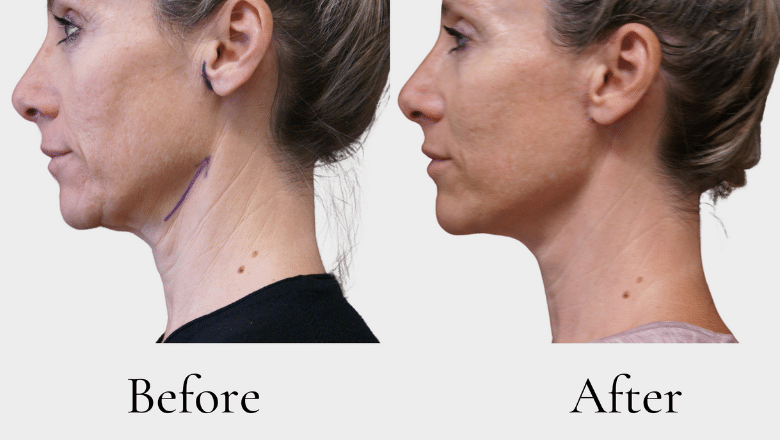
Yes, it can, and this is the one part of face and neck lifting where a muscle is deliberately treated. The platysma is a broad, thin muscle that runs from the jaw down across the neck. With age, its front edges can separate and show as vertical cords or “turkey neck” bands. Skin tightening alone does not remove these bands.
Platysmaplasty is the name for the group of techniques used to treat the platysma during a neck lift. Depending on the patient, the surgeon may stitch the muscle edges together in the midline, tighten the muscle sideways, or divide (transect) part of it so that the bands cannot pull the neck back into shape.
The evidence is mostly from case series. A 2024 systematic review and pooled analysis of 12 studies and 2,106 patients ↗ who had neck lifts involving the platysma found that bands came back in 1.4% of patients, with nerve damage in 0.9% and haematoma in 1.8%, although the authors called for longer and more standardised follow-up[7]. One prospective study of 80 patients treated with total platysma transection reported no recurrence of bands at five years, but the authors noted that the operation is long, technically demanding and should be reserved for highly motivated patients[8].
So the statement that a facelift never tightens muscle needs a caveat: when the neck is part of the plan, the platysma can be. This is why a surgeon will usually examine your neck, ask you to tense it and look for bands before recommending a combined face and neck lift.
Is a Deep Plane Facelift Better Than a SMAS Facelift?
This is the question behind many claims that a deep plane facelift is the most enduring option. The research does not support a firm answer either way.
- A 2025 meta-analysis of 47 studies and 10,766 patients ↗ found that SMAS and deep plane techniques have comparable safety. Haematoma rates were about 3% with deep techniques and 2% with SMAS techniques, and most nerve injuries were temporary. Only one study compared the two directly, and it found better midface rejuvenation with the deep technique, so the authors concluded that technique selection should be individualised[9].
- A 2025 review of 21 studies and 2,896 patients reported pooled patient satisfaction of 94.4% for deep plane and 87.8% for SMAS facelifts, with overall complication rates of 17.2% and 10.3%. The authors concluded that both give robust, long-term outcomes with high satisfaction[10]. The studies were not randomised and measured different things, so the figures should not be read as a head-to-head result.
- A systematic review of 17 studies of SMAS techniques found no consensus on a preferred method, and noted that deep layer techniques extending medial to the retaining ligaments had not been shown to improve the midface or the longevity of results significantly[11].
- A 2026 meta-analysis of 45 studies and 10,784 deep plane patients found a pooled complication rate of 6.6%, no permanent facial nerve injury and temporary nerve injury in about 1.2%. It reported favourable aesthetic outcomes, but assessed them subjectively and called for long-term follow-up to test durability[12].
In plain terms, deep plane surgery is a well-established technique with low reported complication rates, and some surgeons favour it for the midface, but the claim that it always lasts longer or avoids a pulled look is not proven. The right technique is the one that matches your anatomy, your skin and your surgeon’s experience, which is why the choice is made at consultation. If midface descent is your main concern, our guide to lifting the malar fat pad explains the options.
How Long Does a Facelift Last?
A facelift turns back the starting point of ageing but does not stop it. Your skin, bones and soft tissues continue to age, so the result gradually softens over many years. How quickly depends on your skin quality, genetics, weight changes, smoking and sun exposure, as well as the technique used.
Long-term data are limited. A review by two surgeons of 25 years and 1,089 patients noted that follow-up beyond three years was difficult, that plication and SMAS excision techniques gave consistent, reliable results, and that patient selection mattered as much as technique, with fuller necks relapsing more often and treatment of midline platysmal bands reducing recurrence of neck deformity[13]. For a detailed look, see our article on how long a facelift lasts, our guide to maintaining your facelift results, and our page on whether you can have a facelift twice.
Can a Facelift Be Combined with Other Procedures?
Many patients combine a facelift with complementary procedures for a more complete result. Common combinations include a neck lift to address loose skin and platysma banding beneath the chin, eyelid surgery (blepharoplasty) to refresh the eye area, or chin liposuction to define the jawline. Non-surgical treatments such as Morpheus8 or FaceTite can be used alongside a facelift or instead of one for people who want a less invasive approach. Our overview of procedures that complement a facelift lists more. Your surgeon will discuss the right combination at your consultation.
Facelift Risks: Nerve Injury, Haematoma and Recovery
A facelift involves working close to the facial nerve branches that supply the muscles of expression, so nerve weakness is the risk patients most often ask about. Most nerve problems after facelift surgery are temporary. In a series of 2,002 SMAS-platysma facelifts, 1.7% of patients had a weak lower lip from injury to the cervical branch of the facial nerve, and all recovered fully within three weeks to six months[14]. Other risks include haematoma (a collection of blood under the skin), infection, scarring and skin problems. Our dedicated guide to facelift complications sets out the risks and how they are managed.
Recovery varies with the extent of the operation. Expect swelling and bruising for the first few weeks, which settle gradually as the final result emerges, and a longer healing period for more extensive techniques. Our guide to facelift recovery and aftercare covers the timeline week by week, and your surgical team will give you written aftercare instructions and follow-up appointments. If you are wondering about timing, see facelift age.
Frequently Asked Questions
Does a facelift tighten muscles?
Mostly no. A facelift lifts the SMAS, a fibromuscular layer over the facial muscles, and re-drapes the skin. The platysma muscle in the neck can be tightened as part of a neck lift, which is the main exception.
Will a neck lift tighten the lower face?
A neck lift mainly treats the neck and the area under the chin. It can improve the jawline where it meets the neck, but jowls and cheek descent are usually addressed with a facelift, so the two are often combined. A consultation will show which you need.
Is SMAS the same as a deep plane facelift?
No. Both work on the SMAS, but a SMAS facelift tightens or repositions that layer separately from the skin, while a deep plane facelift lifts the skin and SMAS together as one unit and releases the retaining ligaments beneath. Reviews show both give high satisfaction.
How many years does a face lift last?
There is no fixed number. The result softens gradually as ageing continues, and published long-term follow-up is limited, with many studies tracking patients for only a few years. Skin quality, weight changes, smoking, sun exposure and technique all influence how long the improvement is visible.
What is the most common age to get a facelift?
In a review of 3,400 facelifts in the United States, the average age was 61, and 91% of patients were women[5]. People have facelifts in their 40s, 50s, 60s and beyond; the right time depends on your tissues and goals, not a particular birthday.
Does skin age faster after a facelift?
There is no good evidence that skin ages faster after a facelift. Ageing continues at its usual pace, but from a more lifted starting point, so you will generally continue to look younger than you would have without surgery.
How long does it take for facelift swelling to go down?
Most visible swelling and bruising settles over the first few weeks, though a degree of firmness or mild swelling can linger for several months. Recovery varies with the technique and the person.
What are the downsides of a face lift?
The main downsides are the downtime, scars hidden around the ears and hairline, and risks such as haematoma, infection, temporary nerve weakness and skin problems. Results are also not permanent. Your surgeon should discuss all of these before you decide.
Considering a Facelift in London?
If you would like to find out which technique would suit your face and neck, a consultation with a plastic surgeon will assess your SMAS, skin quality and any platysma banding, and explain what is realistic. Our facial plastic surgery page gives an overview of all the facial rejuvenation procedures we offer.
Phone: 020 7993 4849 | Address: 95–97 Baker Street, Marylebone, London W1U 6RN
Contact us to schedule a consultation
References
- Hwang K, Choi JH. Superficial fascia in the cheek and the superficial musculoaponeurotic system. Journal of Craniofacial Surgery 2018;29(5):1378–1382. doi:10.1097/SCS.0000000000004585 ↗
- Sandulescu T, Weniger J, Philippou S, et al. Immunohistochemical evidence of striated muscle cells within midfacial superficial musculoaponeurotic system. Annals of Anatomy 2021;234:151647. doi:10.1016/j.aanat.2020.151647 ↗
- Kim DG, Lee SH, Bae SG. An approach to selection of face-lift techniques for different types of faces: an analysis of 1000 Asian patients over 9 years. Annals of Plastic Surgery 2024;93(2):153–162. doi:10.1097/SAP.0000000000003982 ↗
- Macchi V, Tiengo C, Porzionato A, et al. Histotopographic study of the fibroadipose connective cheek system. Cells Tissues Organs 2010;191(1):47–56. doi:10.1159/000226276 ↗
- Stein MJ, Shah N, Harrast J, Zins JE, Matarasso A, Gosain AK. Clinical practice patterns in facelift surgery: a 15-year review of continuous certification tracer data from the American Board of Plastic Surgery. Aesthetic Plastic Surgery 2024;48(5):793–802. doi:10.1007/s00266-023-03841-x ↗
- Rao V, Basta MN, Jehle CC, Crozier JW, Woo AS. Quantifying the effective lift of skin-only, SMAS plication, and extended SMAS face-lift techniques in a cadaveric study. Plastic and Reconstructive Surgery 2023;151(2):223e–233e. doi:10.1097/PRS.0000000000009834 ↗
- Cambiaso-Daniel J, Giordano S, Agnelli B, et al. Neck lift to treat platysma bands and defining cervical angle: a systematic review and pooled analysis. Facial Plastic Surgery 2024. doi:10.1055/s-0044-1791690 ↗
- Meningaud JP, Pensato R, Pineau J, et al. Facelift: assessment of total platysma muscle transection to prevent the recurrence of platysmal bands. Aesthetic Plastic Surgery 2023. doi:10.1007/s00266-023-03664-w ↗
- Vayalapra S, Guerero D, Sandhu A, et al. Comparing the safety and efficacy of superficial musculoaponeurotic system and deep plane facelift techniques: a systematic review and meta-analysis. Annals of Plastic Surgery 2025. doi:10.1097/SAP.0000000000004454 ↗
- Khoury N, Almubarak A, Khan A, et al. The deep plane versus SMAS facelift: a systematic review and meta-analysis. Aesthetic Plastic Surgery 2025. doi:10.1007/s00266-025-05118-x ↗
- Schultz K, Sherif R, Ganesh Kumar N, et al. Demystifying deep layer face-lift techniques: a systematic review of superficial musculoaponeurotic system techniques. Plastic and Reconstructive Surgery 2025. doi:10.1097/PRS.0000000000012526 ↗
- Koroma A, Reji A, Burridge J, et al. Deep plane facelifts: a systematic review and meta-analysis of outcomes. Aesthetic Plastic Surgery 2026. doi:10.1007/s00266-026-06138-x ↗
- Rohrich RJ, Narasimhan K. Long-term results in face lifting: observational results and evolution of technique. Plastic and Reconstructive Surgery 2016;138(1):97–108. doi:10.1097/PRS.0000000000002318 ↗
- Daane SP, Owsley JQ. Incidence of cervical branch injury with “marginal mandibular nerve pseudo-paralysis” in patients undergoing face lift. Plastic and Reconstructive Surgery 2003;111(7):2414–2418. doi:10.1097/01.PRS.0000061004.74788.33 ↗







