



In this guide11 sections
- Age Doesn’t Tell the Whole Story
- Understanding the Ageing Process
- Facelift Age by Procedure Type
- Primary Factors for Facelift Suitability
- How to Decide the Best Time for a Facelift
- Working Proactively to Slow Down Ageing
- What to Expect Before, During and After a Facelift
- Which Procedures Can Be Combined With a Facelift?
- The Advantages of a Facelift
- Frequently Asked Questions
- Why Choose Centre for Surgery?
Quick answer: There’s no single “correct” age for a facelift — patients range from their late 30s to their 70s. What matters far more than age itself is your overall health, how much genuine benefit you’d see from surgery, and whether you’re psychologically ready for it. That said, age is a useful starting guide to which type of facelift is likely to suit you, which is what this guide focuses on.
Choosing to have a facelift is a significant decision for people wishing to address signs of ageing. We understand that choosing to have any type of cosmetic surgery is often preceded by months, if not years, of careful research. When performed by an expert facelift surgeon, the procedure can take years off your face and literally reverse facial ageing. The boost in self-confidence can be immeasurable for people who choose to undergo facelift surgery.
Given this, we’re often asked whether a facelift is suitable for everyone, and at what age. Suitability depends on several factors — age is one input into your surgeon’s assessment, but rarely the deciding one. Here we discuss facelift age in full and describe the different types of facelift options carried out at Centre for Surgery.
Age Doesn’t Tell the Whole Story
Age is a minor player when crafting the perfect treatment plan for facial rejuvenation. It’s just a number, after all. Some individuals may start to notice significant signs of facial ageing or loose skin around the neck and jawline as early as their late thirties. This can be due to a variety of factors, including genetics, major weight loss, or extensive sun exposure. Conversely, others who have been blessed with good genes and who lead a healthy lifestyle might not see signs such as jowls or loose skin on the neck until their mid-to-late fifties.
It wouldn’t make sense to recommend a facelift to someone in their fifties if they don’t have any loose skin to address. Likewise, denying a facelift to a 40-year-old patient with noticeable loose skin on the neck and face would be unfair — such a patient could genuinely benefit from facelift surgery.
Understanding the Ageing Process
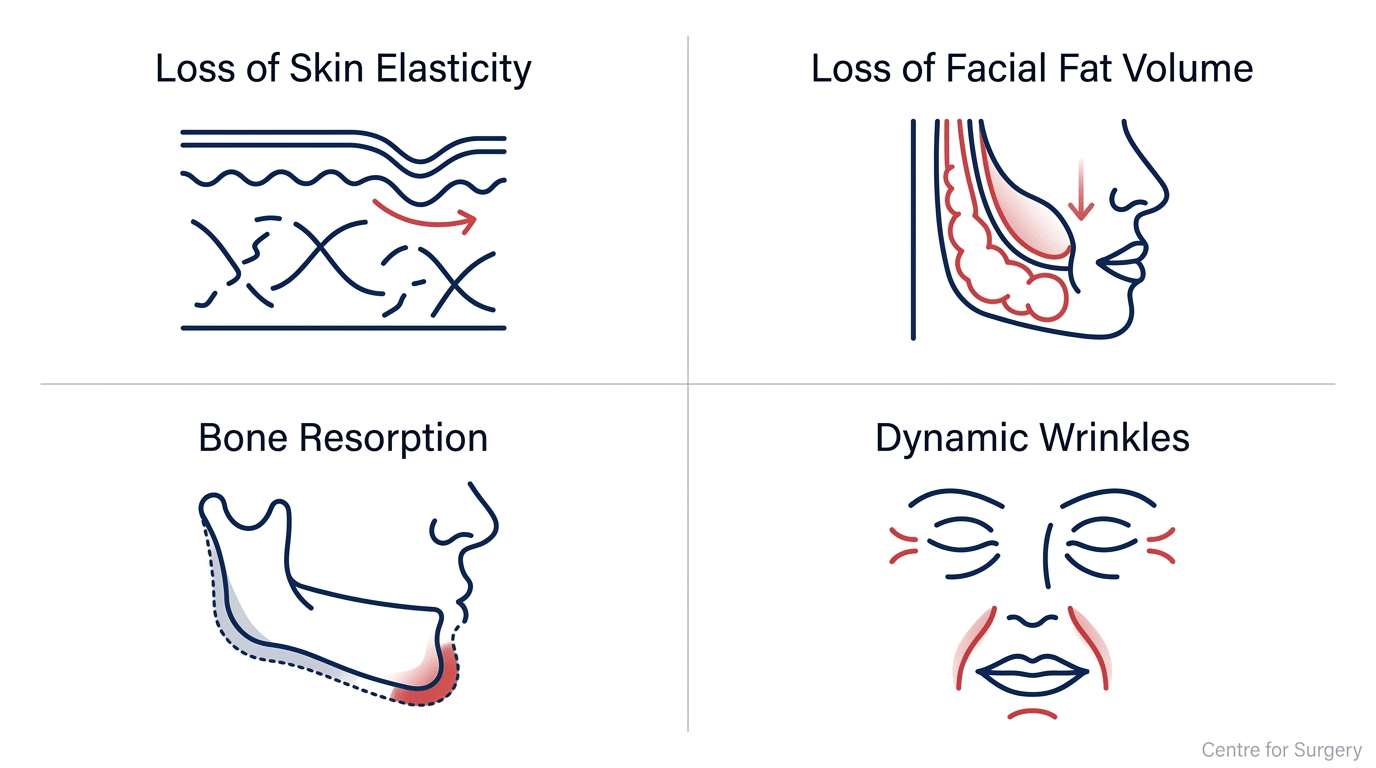
The four main mechanisms behind facial ageing — Centre for Surgery, London.
The ageing process is complex and affected by many factors, including genetics, environmental exposure, lifestyle choices, and general health. While everyone ages differently, there are some common changes that most people experience:
- Loss of skin elasticity — as we age, collagen and elastin production slows, leading to skin that’s less firm and more prone to sagging and wrinkling.
- Loss of facial fat volume — the youthful face is characterised by plump, full cheeks. As we age, facial fat loses volume and descends, which can lead to a hollow or sagging appearance.
- Bone resorption — facial bones can lose volume (“resorb”) over time, contributing to sagging and a change in facial shape.
- Dynamic wrinkles — lines that form from repeated facial movements, such as smiling or frowning, which can become deeply set and permanent over time.
Facelift procedures can help to lift and tighten sagging skin, restore lost volume, and create a more youthful, rejuvenated appearance. It’s important to understand that facelifts aren’t a cure for ageing, but rather a way to ‘reset the clock’ and improve overall appearance.
Facelift Age by Procedure Type
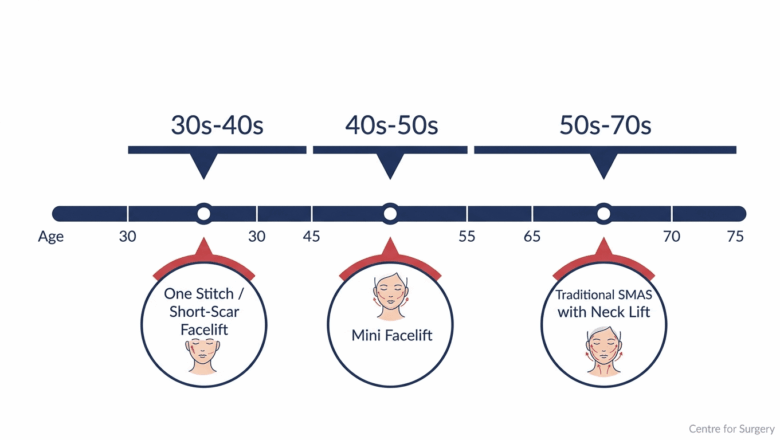
A general guide to which facelift type tends to suit which age range — though your surgeon’s assessment always takes priority over age alone — Centre for Surgery, London.
Just because you have entered your 40s or 50s and have noticed signs of facial ageing doesn’t automatically mean you’ll be suitable for a specific facelift procedure — and even if you’re at a “typical” age, not everyone will be an appropriate candidate. In our experience, most types of facelift surgery, including mini facelifts, are intended for people over 40, though the right procedure for you depends on your specific signs of ageing rather than your date of birth alone.
Short-Scar / One Stitch Facelift (typically late 30s–mid 40s)
The short-scar facelift and one stitch facelift are best suited to individuals who don’t have excess skin around the neck area — typically younger patients showing only mild to moderate signs of ageing, most often affecting the middle part of the face. The procedure is less invasive, with a rapid recovery, producing less dramatic but still noticeable results. It’s often combined with facial fat grafting to restore volume to sunken or flattened cheeks.
Mini Facelift (typically 40s–50s)
Mini facelift surgery involves incisions around the natural skin folds of the ear and is much shorter than full facelift surgery, with a correspondingly shorter recovery — most patients resume normal activities within a few days. In our experience, most mini facelift patients are aged 50 and over, though this varies with individual signs of ageing.
Traditional Facelift / SMAS Facelift (typically 50s–70s)
A traditional SMAS facelift is generally suggested for those with moderate to advanced signs of ageing. This procedure is more comprehensive, addressing not only the midface and jowls but also often including a full neck lift. The incision is larger, leading to a longer recovery period, but this provides more scope for facial enhancement — results are often more dramatic and transformative, and can take over 10 years off a person’s appearance.
Neck Lift (any age with sagging neck skin)
Neck lift surgery is beneficial for patients with sagging neck skin or a turkey neck, regardless of facial age. A person’s neck is often a significant giveaway of actual age, and correcting it is one of the most effective ways to help people feel more comfortable about themselves.
Primary Factors for Facelift Suitability
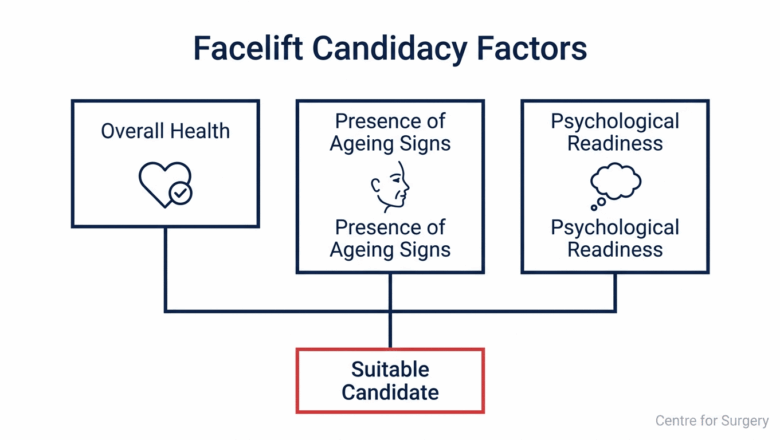
Three factors matter far more than age alone when assessing facelift suitability — Centre for Surgery, London.
The typical age range for facelift candidates spans from the late thirties to the seventies. However, age is secondary to three more crucial factors:
Overall Health
The primary consideration is your overall health, ensuring you can safely undergo the surgical process with a low risk of complications. As a facelift is an elective cosmetic procedure rather than a medically necessary one, safety standards must be stringent. Even where pre-existing medical conditions are well managed by your GP, a complex medical history could raise the risks to a level that outweighs the benefits.
Presence of Ageing Signs
The second factor is whether you have sufficient loose skin or noticeable signs of ageing that would genuinely benefit from a facelift. If someone already has a tight neckline, a well-defined jawline, and no visible jowls, there may be little scope for improvement — even the most accomplished surgeon may struggle to achieve a noticeable result with limited areas to address.
Psychological and Emotional Preparedness
The third factor is your psychological and emotional readiness. A facelift addresses issues such as a double chin, neck bands, sagging skin, and lack of jawline definition — it’s a tool for rejuvenation, not a complete transformation of your appearance. Patients with unrealistic expectations, or those considering surgery due to external pressures such as occupational or social influences, are less likely to find satisfaction, even with an excellent surgical outcome.
How to Decide the Best Time for a Facelift
There is no universally ideal age for a facelift, as suitability varies uniquely in each individual case. The best approach is to consult with a plastic surgeon at Centre for Surgery once signs of ageing begin to concern you — addressing concerns early often yields superior outcomes. During a consultation at our Baker Street clinic, you’ll undergo a thorough evaluation of your suitability, equipping you with the information needed to make an informed decision. If you’re not currently a suitable candidate for surgery, our surgeons may refer you to our cosmetic nurses for alternative non-surgical options.
There’s no need to wait until reaching a particular age before booking a consultation with a Specialist Plastic Surgeon — this notion is unnecessary and potentially counterproductive. If you’re deemed an ideal candidate and ready to proceed, there’s no added benefit in delaying the procedure solely on the basis of age. Younger, healthier patients also tend to experience more predictable and quicker healing.
Working Proactively to Slow Down Ageing
Some patients take small, proactive steps over time rather than waiting for obvious signs of ageing to appear. This gradual approach could involve anti-wrinkle injections that smooth fine lines, laser treatments that rejuvenate the skin, and dermal fillers that restore volume where needed — maintaining a youthful appearance until the point where a more significant procedure, such as a facelift, genuinely makes sense.
A sensible approach for many patients is to try non-invasive and minimally invasive treatments before considering surgery. If, however, you’ve been considering a facelift for years and are confident it will make you feel more confident, a consultation is a worthwhile next step. It’s also worth considering your reasons — if you’ve spent thousands on anti-ageing skincare products with little benefit, a facelift may be a more effective use of that investment, since topical products are primarily suited to mild signs of ageing rather than established sagging and volume loss.
What to Expect Before, During and After a Facelift
Before a Facelift
You’ll work with highly skilled, experienced plastic surgeons who collaborate with you to assess your aesthetic needs and explain the available surgical and non-surgical options, developing a personalised treatment plan for the best possible outcome. If you smoke, you must quit at least four weeks before your procedure — your GP can offer support and resources to help.
During a Facelift
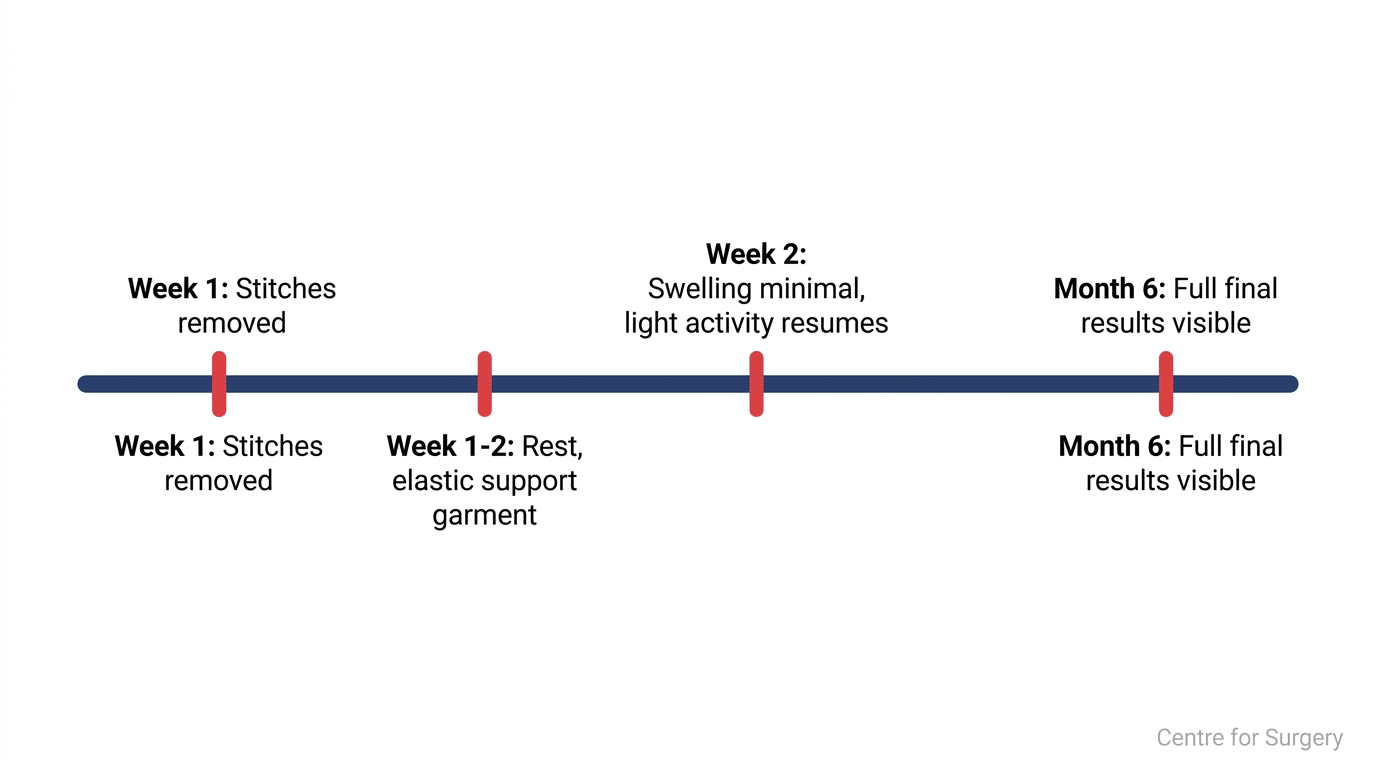
A typical facelift recovery timeline — Centre for Surgery, London.
The procedure is performed at our Baker Street clinic under TIVA (total intravenous anaesthesia) — a modern, safer approach than traditional general anaesthetic gases — ensuring you’re comfortable and pain-free throughout. The operation normally takes around 3–5 hours, though this can vary if additional procedures are performed simultaneously. Short-scar facelifts are often conducted on an outpatient basis, though you may be advised to stay for several hours post-surgery if undergoing multiple procedures. Any drain placed to remove excess fluid will be removed before you’re discharged.
Recovery After a Facelift
The recovery period following facelift surgery is a very individual process, but here’s a general guide:
- Plan to rest and take it easy for 1 to 2 weeks post-surgery.
- You’ll need to wear elastic support for about two weeks to help reduce swelling.
- Around 1 week after surgery, your surgeon will remove the stitches; by the two-week mark, swelling should be minimal.
- Some numbness or tingling is common and should decrease as you heal — your surgeon can prescribe medication if needed.
- Avoid sun exposure, smoking, and excessive alcohol to optimise results.
- The full effects of a facelift are typically not visible until around six months after the procedure.
Which Procedures Can Be Combined With a Facelift?
Facelift techniques have evolved beyond simply lifting tissue, now often incorporating superficial and deep filling of facial fat compartments to address volume deflation. Complementary techniques include:
- Facial fat grafting — the ‘lift and fill facelift’
- Chin augmentation (with a chin implant or fat transfer)
- Laser resurfacing
- Chemical peels
A typical facelift at Centre for Surgery is often a combination of a SMAS facelift with facial fat grafting and fully ablative Erbium laser resurfacing — allowing the surgeon to remove excess skin and tighten tissue, revolumise the face, and improve skin quality in a single procedure. Most hospitals in the UK lack the high-powered lasers for this final stage, so patients may only receive a partial procedure elsewhere.
The Advantages of a Facelift
A facelift is an excellent option for rejuvenating the cheeks and jawline, offering the most dramatic and satisfying results to individuals in their 40s to 70s. Benefits generally last longer in younger patients, though this depends on individual factors such as skin condition and overall health. Choosing a facelift can provide:
Reduction of Sagging Skin
Facelifts treat sagging skin, making your face appear tighter and younger.
Uplifted Corners of the Mouth
A facelift can raise the corners of your mouth, counteracting the downward turn that often comes with age.
Elimination of Jowls
Removal of drooping skin along the jawline, giving your face a more defined, youthful look.
Redefined Jawline
A facelift can sharpen the contour of your jawline.
Elevated, Plumper Cheeks
A facelift can restore volume and lift the cheeks, enhancing their youthful roundness.
Softened Facial Lines and Folds
Wrinkles and folds can be significantly reduced, resulting in a smoother, fresher appearance.
Reduction of Excess Fat and Skin in the Neck
A facelift can help remove excess fat and skin in the neck area, offering a more streamlined neck contour.
Frequently Asked Questions
What is the best age for a facelift?
There isn’t a single best age — candidates range from their late 30s to their 70s. What matters more than age is your overall health, the presence of genuine signs of ageing that would benefit from surgery, and your psychological readiness. Age is mainly useful as a guide to which type of facelift is likely to suit you.
What is the ideal age for a facelift?
The same principle applies — there’s no universally “ideal” age. Most facelift patients fall between their 40s and 70s, but suitability is genuinely individual, and a proper consultation is the only reliable way to determine the right timing for you specifically.
Do I need a facelift?
Only you can decide whether you’d genuinely benefit from one, but a useful starting point is whether non-surgical options — skincare, anti-wrinkle injections, dermal fillers — have stopped delivering meaningful improvement for your specific concerns. If you have noticeable loose skin, jowls, or neck laxity that these approaches can’t address, a facelift consultation is a reasonable next step. A surgeon can give you an honest assessment rather than a generic answer.
How do I know if I need a facelift?
Common signs include persistent jowls, loose or sagging neck skin, deep nasolabial folds, and a lower face that looks “tired” even when you’re not — particularly if these features haven’t responded to non-surgical treatments. The only reliable way to know for certain is a face-to-face consultation, where a surgeon can assess your specific anatomy rather than compare you to a generic checklist.
Am I too young for a facelift?
Not necessarily. If you’re showing genuine, specific signs of facial ageing — even in your late 30s — a short-scar or one-stitch facelift may be entirely appropriate. There’s no minimum age requirement beyond having a genuine, assessable concern; what matters is whether surgery would produce a meaningful improvement for you specifically, not an arbitrary age threshold.
Am I too old for a facelift?
Age alone rarely rules anyone out. Provided you’re in good general health and fit for elective surgery, patients well into their 60s and 70s are routinely excellent candidates — and in fact, older patients with more pronounced signs of ageing often see the most dramatic, satisfying results.
Is 40 too young for a facelift?
No. If you’re showing genuine signs of facial ageing in your 40s — or even late 30s — a short-scar, one-stitch, or mini facelift may be entirely appropriate. Age alone is never a reason to delay if you’re otherwise a suitable candidate.
Is there an age limit for facelift surgery?
There’s no strict upper age limit — overall health and fitness for surgery matter far more than the number itself. Many patients in their 60s and 70s are excellent candidates, provided they’re in good general health.
What is the average age for a facelift patient?
Most facelift patients fall somewhere between their mid-40s and mid-60s, though this varies significantly by procedure type — one-stitch and short-scar facelift patients tend to be younger (late 30s to mid-40s), while full SMAS facelift patients are more commonly in their 50s to 70s.
How long do facelift results last?
Facelift results are long-lasting but not permanent, since the ageing process continues afterwards. Many patients enjoy visible benefits for 10 years or more, particularly with a more comprehensive technique like a SMAS facelift, and results generally last longer in younger, healthier patients.
Why Choose Centre for Surgery?
Choosing Centre for Surgery means comprehensive, personalised care and good results. As a specialist cosmetic surgery clinic in London, we pride ourselves on our commitment to patient satisfaction and continuous pursuit of excellence.
Expert Team
Our surgeons are experienced in cosmetic and plastic surgery, registered with the General Medical Council and adhering strictly to high standards of practice.
Comprehensive Consultations
We believe an informed patient is a satisfied patient. Our consultations are thorough and unhurried — we listen to your concerns, answer your questions, and work with you to create a treatment plan tailored to your unique needs and goals.
Advanced Techniques
We use the latest surgical techniques and technologies to ensure effective treatments with minimal recovery time.
Exceptional Aftercare
We provide detailed aftercare instructions and ongoing support to ensure a smooth recovery, with surgeons available to address any concerns.
Safety and Comfort
Our modern clinic in Baker Street, London, is CQC-regulated and rated “Good” overall, fully equipped for a safe, comfortable surgical experience.
Transparent Pricing
Finance is available through Chrysalis Finance, subject to status; see our finance options page.
The Centre for Surgery is considered a specialist cosmetic surgery clinic in London, and our surgeons have years of experience performing all types of facelift procedures, including mini facelifts. If you would like to book a consultation, please get in touch with us today at 020 7993 4849 or complete the contact form below.
We look forward to assisting you on your facelift journey here at Centre for Surgery.

Related Articles
- Facial Skin Ageing Over Time: What to expect at 30, 40, 50
- Facelift vs Mini Facelift: What’s the Difference?
- Types of Facelift: Which One Is Right for You?






