



In this guide8 sections
- What Is Breast Implant Rippling?
- What Causes Breast Implant Rippling?
- Rippling vs Rupture vs Bottoming Out: Telling Them Apart
- Is Breast Implant Rippling Dangerous?
- How to Prevent Breast Implant Rippling
- How Is Breast Implant Rippling Treated?
- Frequently Asked Questions
- Breast Implant Rippling Treatment at Centre for Surgery
Breast implant rippling is one of the most common cosmetic concerns women raise after breast augmentation — the visible or palpable wrinkling of the implant’s surface, usually felt or seen at the upper or inner edge of the breast. It’s not dangerous, and it’s more common than most patients realise, but it can be a genuine source of frustration when the result doesn’t feel as smooth or natural as expected. This guide covers exactly why rippling happens, who’s more likely to experience it, how it differs from a ruptured or bottomed-out implant, and the treatment options that actually correct it.
What Is Breast Implant Rippling?
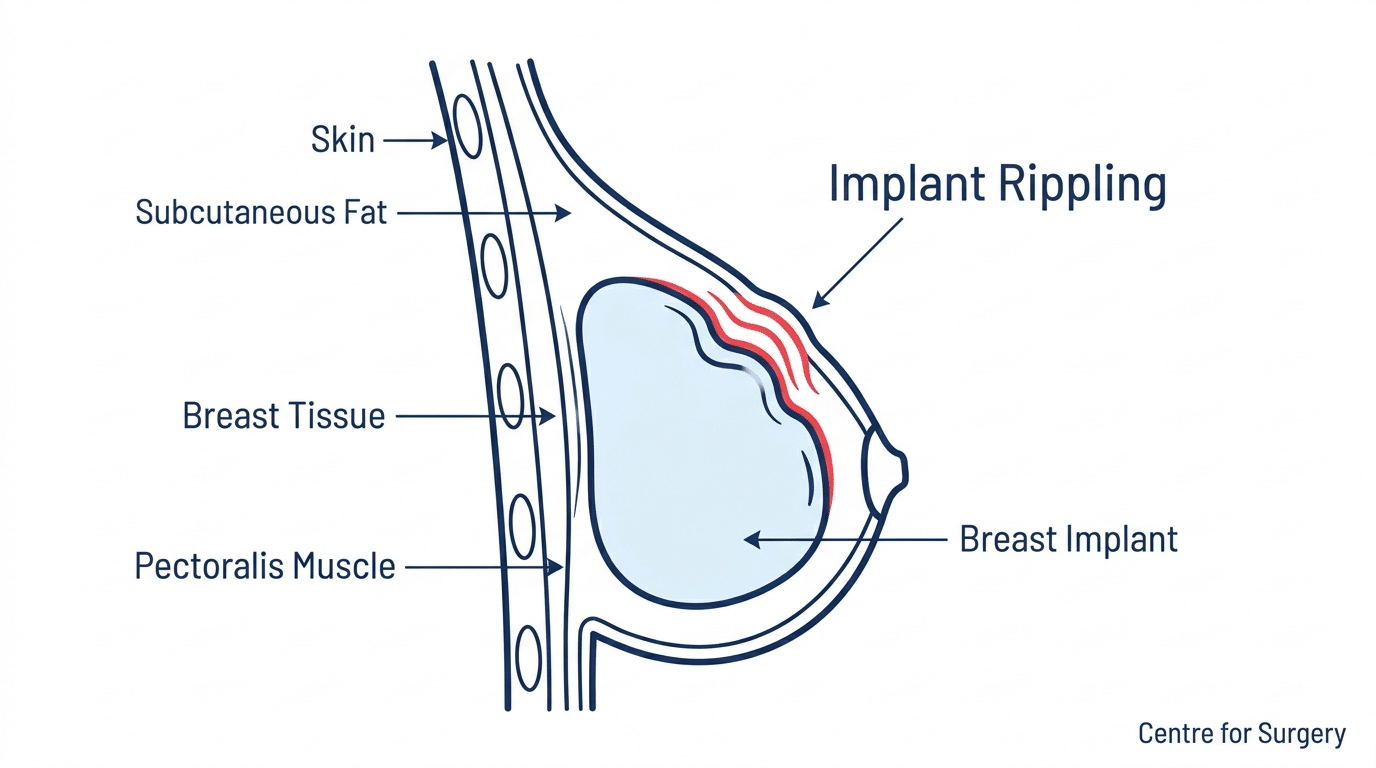
Rippling refers to visible or palpable folds and wrinkles in the implant shell, usually most noticeable at the upper pole or inner edge of the breast, closer to the cleavage. It happens when there isn’t enough natural breast tissue between the implant and the skin to smooth out and disguise the implant’s contours, so the folds in the shell itself become visible or can be felt through the skin — particularly when leaning forward or lying down. Rippling is a cosmetic issue, not a medical one, but for many women it undermines the natural look they were hoping for from their augmentation, which is exactly why it’s worth understanding properly rather than just living with it.
What Causes Breast Implant Rippling?
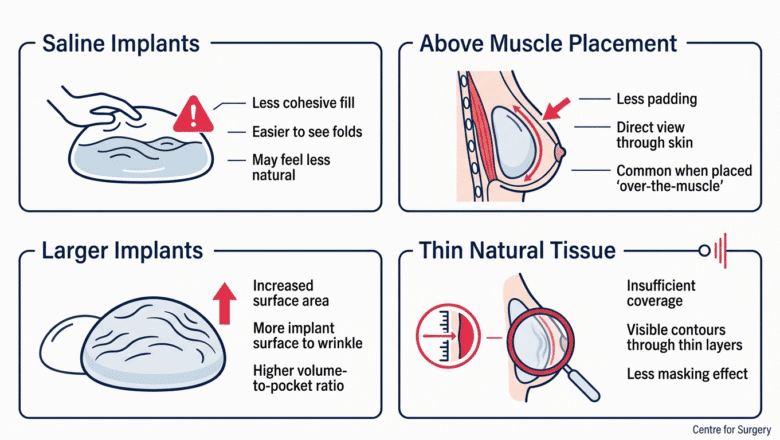
Several factors combine to determine an individual’s risk of visible rippling, and it’s rarely down to just one cause.
Implant Fill Type
Saline implants are considerably more prone to rippling than silicone. Saline is a thinner, more fluid filling, so the implant shell can fold and crease more easily, especially if it’s underfilled. Modern cohesive silicone gel holds its shape far more consistently, which is a major reason silicone has become the standard choice in the UK — it’s also why we use Silimed cohesive silicone implants exclusively at Centre for Surgery.
Implant Placement
Implants placed above the muscle (subglandular) sit closer to the skin surface with less natural coverage, so any folding in the shell is more likely to be visible. Placing the implant below the muscle (submuscular or dual plane) adds a layer of muscle coverage over the upper portion of the implant, which meaningfully reduces — though doesn’t entirely eliminate — visible rippling, particularly towards the cleavage where muscle coverage is naturally thinner. Our full guide on implant placement covers this decision in depth.
Natural Tissue Coverage
Women with very little natural breast tissue of their own have less soft-tissue padding to disguise the implant’s contours, regardless of placement or fill type. This is one of the most significant individual risk factors, and it’s specifically assessed at consultation via a simple pinch test of the upper breast tissue.
Implant Size
Larger implants place more stress on the surrounding tissue and skin envelope, and are more likely to shift slightly or show through thinner coverage than smaller, more proportionate implants.
Weight Loss After Surgery
Significant weight loss following augmentation can thin the layer of fat covering the implant, making previously well-concealed rippling suddenly more visible. This is a genuine reason to maintain a stable weight after surgery, not just for the implant’s position but for how well it stays disguised.
Rippling vs Rupture vs Bottoming Out: Telling Them Apart
Rippling is sometimes confused with other implant changes, but each has a distinct pattern worth knowing:
- Rippling — visible or palpable folds in the implant shell itself, usually at the upper or inner breast. The implant is otherwise intact and correctly positioned.
- Rupture — a tear or failure of the implant shell. Saline rupture causes visible deflation; silicone rupture is often silent and needs scanning to detect. See our full guide to breast implant rupture.
- Bottoming out — the implant has migrated downward below the natural breast fold, changing the overall shape and nipple position, rather than showing surface folds. See our guide to bottoming out.
These are genuinely different problems with different fixes, which is exactly why an accurate assessment — not a guess based on how it looks in the mirror — is worth getting from your surgeon if you’re concerned. Our full guide to common breast implant problems covers how all of these fit together.
Is Breast Implant Rippling Dangerous?
No. Rippling is a cosmetic concern, not a health risk, and doesn’t indicate anything is medically wrong with the implant. That said, a sudden or significant change in the shape or contour of your implant — rather than a gradual, stable pattern of rippling — is worth having assessed, since it can occasionally point towards rupture rather than simple rippling.
How to Prevent Breast Implant Rippling
Rippling risk is largely determined at the time of your original surgery, through decisions made jointly with your surgeon:
- Choosing cohesive silicone over saline, which holds its shape more reliably
- Selecting a proportionate implant size relative to your natural tissue and frame, rather than the largest size that will physically fit
- Placement below the muscle where appropriate for your anatomy, for additional soft-tissue coverage
- Maintaining a stable weight after surgery, since weight loss is one of the more common triggers for previously invisible rippling becoming noticeable
None of these eliminate the risk entirely, but together they meaningfully reduce it, which is why this is worth discussing properly at consultation rather than treated as a footnote.
How Is Breast Implant Rippling Treated?
Where rippling is bothersome enough to warrant correction, several revision options exist, sometimes combined:
Implant Exchange
Switching to a more cohesive silicone implant, or a different size or shape better matched to your natural tissue, is often the most direct fix — particularly for women whose original implants were saline or significantly oversized for their frame.
Changing Placement
Where the original implant was placed above the muscle, moving it below the muscle at revision surgery adds coverage over the upper pole and can significantly reduce visible rippling in that area.
Fat Transfer
Fat grafting adds a layer of your own natural tissue directly over the areas where rippling is most visible, particularly useful in the upper pole and cleavage where muscle coverage is naturally thinnest. This can be done alongside implant exchange or, for milder cases, sometimes on its own.
Your surgeon will recommend the right combination based on where the rippling is most visible, your original implant type and placement, and how much natural tissue you have available.
Frequently Asked Questions
What does breast implant rippling look like?
Visible folds or wave-like lines in the skin over the implant, most often at the upper or inner breast near the cleavage. It can also be felt as a rippled texture under the skin before it’s visible, particularly when leaning forward.
Is implant rippling dangerous?
No — it’s a cosmetic concern, not a health risk. A sudden or significant change in shape, rather than gradual rippling, is what’s worth having assessed promptly.
Does implant rippling go away on its own?
No, rippling doesn’t resolve without intervention. It can become more or less noticeable depending on weight changes and positioning, but the underlying cause — insufficient tissue coverage over the implant shell — doesn’t correct itself.
Can rippling be prevented entirely?
Not with complete certainty, but choosing cohesive silicone over saline, an appropriately sized implant, suitable placement, and maintaining a stable weight afterwards all meaningfully reduce the risk.
Is rippling more common with textured or smooth implants?
Not particularly — fill type (saline versus silicone) and placement have a far bigger impact on rippling risk than surface texture.
Can rippling happen years after surgery, not just soon after?
Yes — it’s commonly triggered later by weight loss thinning the tissue that was previously disguising the implant, even when the implant itself hasn’t moved or changed.
Breast Implant Rippling Treatment at Centre for Surgery
At Centre for Surgery, breast implant revision for rippling is performed by GMC-registered plastic surgeons, at our CQC-regulated Baker Street facility, rated Good overall, under TIVA (Total Intravenous Anaesthesia) as a day case. We use Silimed cohesive silicone implants exclusively. Our medical content is reviewed by Specialist Plastic Surgeon Dr Spyridon Vlachos (GMC 7522950).
Read verified patient reviews on Google ↗ or on our own patient reviews page. We offer flexible finance options through Chrysalis Finance, for procedures over £1,500.
To book a consultation, call 020 7993 4849 or complete the contact form below.







