

In this guide13 sections
- Breast Implant Placement
- Simple Guide to Breast Anatomy
- A Deeper Dive into Breast Implant Placement
- Subglandular Implant Placement for Breast Augmentation
- Subfascial Implant Placement
- Submuscular Breast Implant Placement
- Dual Plane Breast Implant Placement
- Recovery: How the Placements Compare
- How Implant Size Influences Placement
- Understanding the “Drop and Fluff” Phenomenon in Breast Implants
- Choosing the Right Breast Implant Placement for You
- All You Need to Know About Breast Implant Placement – Common Questions Answered
- Breast Augmentation at Centre for Surgery
Breast Implant Placement
If you are considering breast enlargement surgery, one of the most consequential decisions you will make with your surgeon is where the implant sits relative to your chest muscle. It is a technical detail that most patients only encounter at consultation, and it influences how the result looks, how it feels, how long recovery takes, and how the breast behaves when you exercise.
There is no single best placement. There is a best placement for your anatomy, your implant choice, and what you want the result to look like. This guide explains each option, who it suits, and the trade-offs involved, so that you arrive at your consultation able to ask better questions.
Simple Guide to Breast Anatomy

Understanding what your breasts are made of makes the placement decision much easier to follow.
Your breasts have three main components:
- Glandular Tissue: The glands and ducts that produce and carry breast milk.
- Fatty Tissue: The fat within the breast. This largely determines size.
- Connective Tissue: The supporting framework that gives the breast its shape and firmness.
Beneath the breast tissue lies a thin sheet of connective tissue called the pectoral fascia. Beneath that sits the pectoralis major — the large, fan-shaped chest muscle — and beneath that, the rib cage. The shape of your rib cage also affects how the breast will look after implants.
Those four layers — breast tissue, fascia, muscle, ribs — are what define the placement options. An implant can sit above the fascia, below the fascia but above the muscle, below the muscle, or partly below the muscle and partly below the breast tissue.
A Deeper Dive into Breast Implant Placement
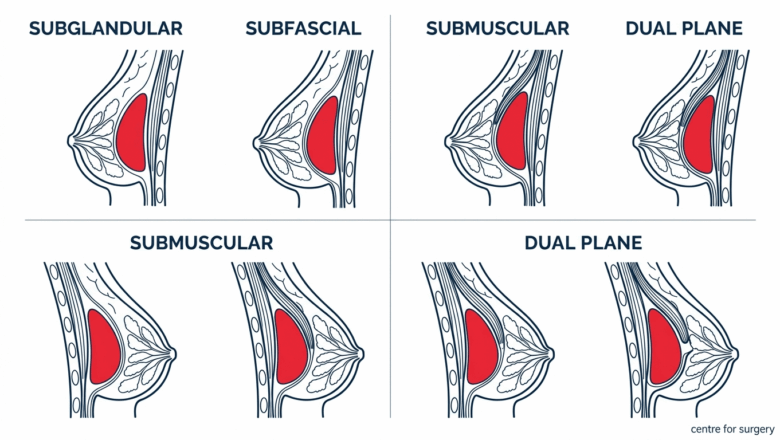
The implant can be placed above the muscle, beneath the fascia, under the muscle, or in a combined position known as the dual plane. The choice is not arbitrary. It is driven by how much natural breast tissue you have to cover the implant, the size and type of implant you want, your build, your activity level, and your aesthetic goals.
Your surgeon will assess the thickness of the soft tissue over your upper breast — often by a simple pinch test — because that measurement, more than anything else, determines whether an implant placed above the muscle would be visible or palpable at the edges.
Subglandular Implant Placement for Breast Augmentation
Subglandular placement — colloquially the ‘over the muscle’ technique — positions the implant between your natural breast tissue and the pectoralis major muscle, above the pectoral fascia.
Who is it best for?
Subglandular placement is generally suited to women who already have a reasonable amount of natural breast tissue, typically a B cup or larger. That existing tissue acts as a natural cushion, concealing the implant edges and producing a fuller, rounder upper breast.
If you have good soft tissue coverage across the upper chest and cleavage, this approach often gives an excellent result, with the implant sitting between the breast tissue and the muscle.
Advantages of Subglandular Placement
- No animation deformity: The implant is not beneath the active chest muscle, so flexing the pectoralis does not distort the breast.
- Simpler procedure: The muscle is not divided, which makes the operation less involved.
- Faster recovery: With the chest muscle undisturbed, patients typically report a shorter, more comfortable recovery.
- Predictable settling: The muscle is not pressing on the implant, so the breast reaches its final shape sooner.
- Better suited to larger implants: Where adequate tissue coverage exists, larger implants are more readily accommodated.
Drawbacks to Consider
- Visible implant edges: In women with thin breast tissue, the upper border of the implant can become visible or palpable.
- Rippling: Visible surface rippling is more likely where there is little tissue to cover the implant.
- Mammogram interference: The implant can obscure a proportion of breast tissue on mammography, though additional views can compensate.
- Higher capsular contracture rate: Rates of capsular contracture are reported to be somewhat higher with subglandular placement than with submuscular.
Subfascial Implant Placement
Subfascial placement is a distinct technique, and it is frequently — and incorrectly — used interchangeably with subglandular. The two are not the same.
In subfascial placement, the implant sits beneath the pectoral fascia but still above the pectoralis major muscle. The fascia is a thin but strong sheet of connective tissue lying directly on the muscle surface. Elevating it gives an additional layer of coverage over the implant without dividing the muscle itself.
What subfascial placement offers
- No animation deformity, because the muscle is left intact — the principal advantage it shares with subglandular placement.
- Better upper pole coverage than subglandular, because the fascia adds a layer that softens the implant edge.
- Faster, less painful recovery than submuscular placement, since the pectoralis is not divided.
- Reduced rippling compared with subglandular placement in women with modest tissue coverage.
The fascia is thin, so subfascial placement does not provide the coverage that muscle does. It occupies a genuine middle ground: more concealment than subglandular, less than submuscular, and none of the muscle-related downsides.
Subfascial placement is also an option for patients who have an existing submuscular implant and are troubled by animation deformity. We cover this in detail in our guide to changing implant placement from under the muscle to subfascial.
Submuscular Breast Implant Placement
Submuscular placement positions the implant beneath the pectoralis major. The surgeon releases the lower attachment of the muscle near the ribs, and the implant is placed behind it.
An important anatomical point: the pectoralis major is not large enough to cover the entire implant. It covers the upper portion, while the lower portion sits beneath the breast tissue. In practice, most ‘submuscular’ augmentations are therefore partial-submuscular, which is why the dual plane technique described below has become the standard refinement of this approach.
The Ideal Candidate for Submuscular Breast Implant Placement
Submuscular placement suits women with less natural breast tissue, or a smaller starting bra size. Where there is little tissue to conceal the implant, muscle coverage over the upper pole conceals the implant edge and produces a more natural upper breast contour.
The Upsides of Going Under the Muscle
- Natural upper pole: Muscle coverage softens the transition from chest to breast, avoiding an abrupt implant edge.
- Clearer mammograms: Less breast tissue is obscured on mammography.
- Less rippling: The muscle layer reduces visibility and palpability of the implant.
- Lower capsular contracture rate: Reported rates are lower than with subglandular placement.
But, There are a Few Drawbacks
- More initial discomfort: The muscle is divided, so early postoperative pain is greater.
- Longer settling period: The muscle presses on the implant initially, and it takes longer for the breast to reach its final shape.
- Animation deformity: Flexing the chest muscle can distort or flatten the breast. This matters most for people who lift weights, do CrossFit, or are otherwise pectorally active.
- Volume loss of roughly 50cc: Muscle compression means an under-the-muscle implant reads slightly smaller than the same implant placed above.
Dual Plane Breast Implant Placement
The dual plane technique is a refinement of submuscular placement, and for many patients it is the approach that best balances coverage against natural movement.
What exactly is Dual Plane Placement?
In dual plane placement, part of the implant sits behind the pectoralis muscle and part behind the breast tissue:
- The surgeon releases the lower attachment of the pectoralis muscle from the chest wall, allowing the muscle to retract upward in a controlled way.
- The implant is then positioned so the upper portion is covered by muscle and the lower portion by breast tissue.
This gives muscle coverage where it matters most — the upper pole, where an implant edge would otherwise show — while allowing the lower breast to fill out naturally.
Who’s the Perfect Candidate for Dual Plane?
- Women with Thinner Breast Tissue: Muscle coverage over the upper pole conceals the implant while the lower breast fills naturally.
- Addressing Mild Breast Sagging: Where the breast has lost some firmness through age, weight change, pregnancy or breastfeeding, dual plane can provide a modest lift. More pronounced sagging usually requires a breast lift alongside the implant.
- Tuberous Breasts: In tuberous breasts, where the breast has developed with a constricted base and a narrow footprint, dual plane placement allows the lower pole to be expanded and reshaped.
Pros of Dual Plane Placement
- Natural Look: The transition between chest wall and breast is smooth, because muscle covers the implant where the edge would otherwise be visible.
- Reduced Contracture Risk: Capsular contracture rates are lower than with subglandular placement.
- Improved Mammogram Results: Less breast tissue is obscured than with an implant placed entirely above the muscle.
Drawbacks to Consider
- Recovery Time: The muscle is divided, so discomfort and settling time are greater than with placement above the muscle.
- Animation Deformity: Still possible, particularly in those doing intensive chest training, though generally less pronounced than with full submuscular placement.
- Specific Complications: If the muscle release is not judged correctly, the implant can ride high, or the breast tissue can slide off the front of the implant, producing what is described as a ‘snoopy nose’ deformity.
- Wider Cleavage Gap: Some women notice a broader gap between the breasts. Fat transfer can refine the cleavage where this occurs.
Recovery: How the Placements Compare
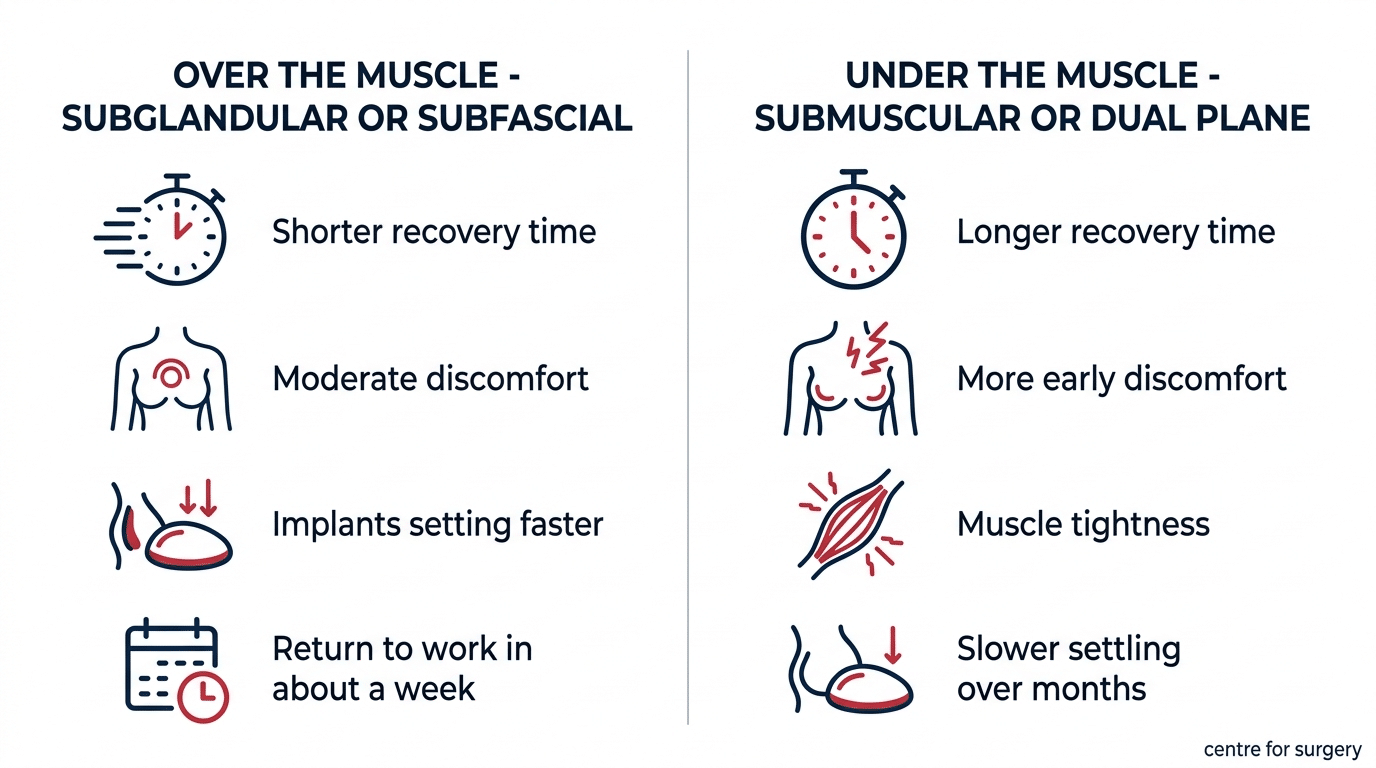
Recovery differs substantially depending on whether the chest muscle has been divided. This is one of the most practical considerations in the placement decision, and it is worth understanding before you choose.
Recovery after subglandular or subfascial placement
The pectoralis muscle is not divided, so recovery is generally shorter and more comfortable:
- Early discomfort is typically moderate and manageable with simple analgesia.
- Most patients return to desk-based work within about a week.
- Swelling settles relatively quickly, and the breast reaches its final shape sooner.
- Upper body movement is less restricted in the first fortnight.
Recovery after submuscular or dual plane placement
Dividing the muscle means more early discomfort and a longer settling period:
- The first three to five days are the most uncomfortable, with a tight, gripping sensation across the chest.
- Muscle spasm is common in the first week and settles with time and prescribed medication.
- The implants sit high and feel firm at first, before dropping into position over the following months.
- Chest exercises — push-ups, planks, bench press — are avoided for longer.
What is the same for everyone
Regardless of placement, expect a supportive surgical bra for several weeks, no heavy lifting in the early period, and a graduated return to exercise guided by your surgeon. Full settling of the final breast shape takes months rather than weeks in every case.
The recovery difference is real, but it should not by itself decide the placement. A faster recovery is poor compensation for a visible implant edge you will live with for years.
How Implant Size Influences Placement
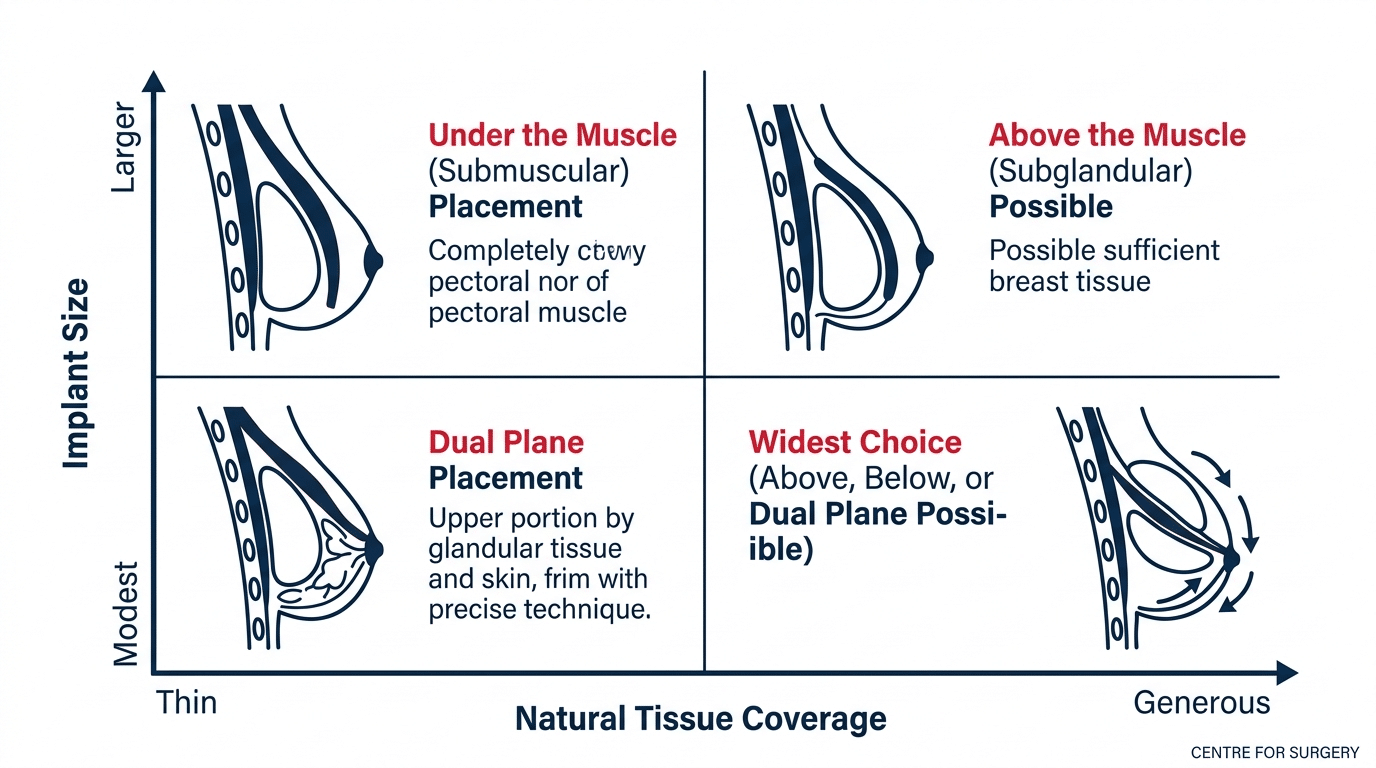
Implant size and implant placement are not independent decisions. They constrain one another, and this surprises many patients.
The soft tissue over your breast has a finite capacity to conceal an implant. Where the implant is large relative to the tissue available to cover it, placing it above the muscle risks a visibly artificial upper pole, palpable edges, and rippling. In those circumstances, muscle coverage is not simply preferable — it may be the only way to achieve an acceptable result.
The relationship works in both directions:
- Larger implant, thin tissue: Muscle coverage is usually necessary. Submuscular or dual plane placement.
- Larger implant, generous tissue: Subglandular or subfascial placement may be feasible, since existing tissue can conceal the implant.
- Modest implant, thin tissue: Dual plane placement often gives the most natural result.
- Modest implant, generous tissue: The widest range of options is available.
Remember also that submuscular placement compresses the implant slightly, costing roughly 50cc of apparent volume. If you are targeting a particular result under the muscle, the implant chosen may need to be marginally larger than the equivalent placed above it.
This is why size and placement are settled together at consultation, with implant sizers and an assessment of your tissue, rather than decided separately in advance. Our guide to choosing the right breast implant size covers the sizing process in more detail.
Understanding the “Drop and Fluff” Phenomenon in Breast Implants
Have you ever heard the terms “drop and fluff” related to breast augmentation? It is an essential part of understanding what happens after surgery, particularly where the implant sits under the muscle.
What’s Behind “Drop and Fluff”?
When implants are positioned beneath the pectoralis major, they initially look and feel wrong to most patients. There are two reasons:
- High and Tight: The muscle exerts pressure on the implant, pushing it high on the chest and giving a swollen, full appearance in the upper breast.
- Rock-like Rigidity: Rather than the soft feel most patients expect, the implants feel stiff and unyielding. This is normal, and it is not the finished result.
Over the following weeks and months, the pectoral muscle relaxes and the breast tissue accommodates the implant. The muscle loosens, the tissue stretches, and the implant settles.
The “Drop” refers to the implant descending into its intended position, giving a more natural breast silhouette.
The “Fluff”: As muscle and tissue accommodate the implant, the lower breast fills out and rounds. The breast becomes softer and more natural in appearance and feel.
The areola, which may initially point downward, returns to a forward-facing position as the implant drops.
When Does “Drop and Fluff” Happen?
Significant change typically begins around three months after surgery. Individual timelines vary — some see the settled result sooner, others later. Placement matters here too: implants above the muscle settle faster, because there is no muscle pressing on them.
Choosing the Right Breast Implant Placement for You
Breast augmentation is highly individualised. The following factors all bear on the placement decision:
- Existing Breast Tissue: The single most important factor. The thickness and quality of tissue over the upper breast determines how well an implant can be concealed without muscle coverage.
- Implant Size: Larger implants relative to your tissue increase the case for muscle coverage.
- Activity Level: Weight training, CrossFit and other chest-intensive activity strengthen the case for placement above the muscle, to avoid animation deformity.
- Body Type: Frame and chest wall shape affect what will look proportionate.
- Medical and Health History: Prior surgery, health conditions and healing history all influence the surgical approach.
- Goals and Aesthetic Expectations: Whether you want a subtle or a pronounced result.
At consultation with a Centre for Surgery plastic surgeon, the process involves:
- A thorough physical examination, including assessment of soft tissue thickness over the upper breast.
- Discussion of your goals and preferences for the result.
- Review of the advantages and drawbacks of each placement option as they apply to your anatomy.
- An informed decision, made jointly, based on that assessment.
Summarised:
- Subglandular: Above the fascia and muscle. Suited to women with good existing breast tissue who want to avoid animation deformity.
- Subfascial: Beneath the fascia, above the muscle. Adds a layer of coverage without dividing the muscle.
- Submuscular: Beneath the pectoralis. Suited to women with little breast tissue.
- Dual Plane: Partly beneath the muscle, partly beneath the breast tissue. Versatile, and the most common approach in modern practice.
There is no universally best method. The right placement depends on your anatomy, your goals, and your surgeon’s assessment.
All You Need to Know About Breast Implant Placement – Common Questions Answered
Is putting the implant under or over the muscle the better choice?
Neither is inherently better. If you have fuller natural breasts, placement over the muscle may suit you well. With less breast tissue, under the muscle or dual plane is generally recommended. Your surgeon will advise after examining you and discussing what you want the result to look like.
What is the difference between subglandular and subfascial placement?
They are different planes and are often confused. Subglandular places the implant directly beneath the breast tissue, above the pectoral fascia. Subfascial places it beneath that fascia but still above the muscle. Subfascial placement gives slightly more coverage over the implant edge while retaining the main benefit of both — no animation deformity, because the muscle is untouched.
Do breasts look smaller with implants placed under the muscle?
Slightly, yes. Muscle compression means an implant under the muscle reads around 50cc smaller than the same implant placed above it. The result is also typically subtler and more natural. If you have a specific size in mind, the implant chosen may need to be marginally larger.
How can I figure out if my implants are beneath the muscle?
Place your hands on your hips and press inward, which contracts the chest muscle. If the upper portion of the implant flattens or the breast changes shape, the implant is likely under the muscle. If nothing changes, it is probably above it.
Can implants over the muscle still achieve a natural look?
Yes, where there is sufficient breast tissue to cover the implant. In leaner women with thin tissue, an implant above the muscle is more likely to show its edges, which is why muscle or fascial coverage is usually advised in that situation.
Will I lose any volume with under-the-muscle implants?
Around 50cc, as a general guide. If you are aiming for a 300cc result, a 350cc implant may be needed under the muscle to achieve it.
Is the pain more intense for implants placed beneath the muscle?
Yes. The muscle is divided during the procedure, so postoperative pain is greater, particularly in the first few days. It is manageable with prescribed pain relief and settles steadily.
How long can I expect these implants to last?
Most implants last between 10 and 20 years, though some are removed or exchanged earlier for aesthetic or clinical reasons. Implants are not lifetime devices, and revision surgery should be anticipated at some point.
Will Breast Implants Affect My Ability to Breastfeed a Baby?
Implant placement itself should not interfere with breastfeeding, since implants sit beneath the breast tissue or muscle rather than within the milk-producing glandular tissue. The incision site is more relevant — incisions around the areola carry a somewhat greater risk of affecting milk ducts. Discuss any plans for future breastfeeding with your surgeon at consultation.
Do Breast Implants Feel Different to Touch?
Yes. Implant material, size and placement all affect how natural the breast feels. Silicone implants generally feel closer to natural breast tissue than saline, particularly when not excessively large, and greater tissue or muscle coverage over the implant makes it less palpable.
Is it okay to do push-ups after getting breast implants?
Not initially, and particularly not with implants under the muscle. Push-ups, planks and bench press load the pectoralis directly, which can affect implant position while healing is underway. Your surgeon will advise when to resume chest exercise. A supportive sports bra is important when you return to training.
Will My Implants Look Bigger if I Lose Weight?
The implants do not change size, but they may appear more prominent in proportion to a smaller frame, particularly if you lose fat from the upper torso and back.
Will my implants grow in size?
No. The implants remain the same size. As swelling settles and the breast recovers, they may appear fuller as tissue accommodates them.
Which implant gives the most natural appearance?
Silicone implants generally give the closest look and feel to natural breast tissue. Placement matters as much as material, however — an appropriately sized implant with adequate coverage will look natural in a way that an oversized implant will not, whatever it is made of.
Why do my new implants seem so tiny?
Swelling and muscle tightness immediately after surgery can make the result look smaller and sit higher than expected. As the implant settles and the tissue relaxes, the breast fills out.
Can I opt for larger implants after my initial augmentation?
Yes. Once the body has fully adjusted to the initial implant, upsizing is possible. Discuss this with your surgeon, as changing implant size may also mean changing placement.
How long should I wait if I want bigger implants?
Between six months and a year is typical, allowing full settling before any revision.
Is Breast Implant Surgery Worth It?
That is a personal judgement. Breast augmentation is elective surgery with real risks and a genuine recovery. It can be a good decision for someone with realistic expectations who has thought it through carefully, and a poor one for someone expecting it to resolve something it cannot. A thorough consultation, where your surgeon is candid about what surgery can and cannot achieve, is the right place to work that out.
Breast Augmentation at Centre for Surgery
Centre for Surgery is an independent clinic at 95–97 Baker Street in London, rated “Good” overall by the Care Quality Commission.
Plastic surgeons
Breast augmentation is performed by GMC-registered plastic surgeons. Our medical content is reviewed by Specialist Plastic Surgeon Dr Spyridon Vlachos (GMC 7522950).
Silimed implants
We use Silimed breast implants exclusively, supplied with a replacement guarantee.
Day-case surgery under TIVA
Breast augmentation is performed as a day case under total intravenous anaesthesia, avoiding inhalational agents and allowing a quicker, clearer recovery with less postoperative nausea.
No-touch implant insertion
Implants are inserted using a no-touch technique to minimise the risk of bacterial contamination, which is associated with capsular contracture.
Honest case selection and a two-week cooling-off period
We tell patients when surgery is not the right answer, or when their expectations do not match what surgery can deliver. We recommend a two-week cooling-off period between consultation and surgery.
Book your consultation
A face-to-face consultation with your surgeon is required before any procedure. You will discuss your goals, be examined, and review the placement and implant options that suit your anatomy.
Phone: 020 7993 4849
Email: contact@centreforsurgery.com
Address: 95–97 Baker Street, London W1U 6RN
For procedures over £1,500, finance is available through Chrysalis Finance, subject to status. See our finance options for details.