



In this guide13 sections
- What Are Saddlebags?
- What Causes Saddlebags?
- Why Exercise Alone Rarely Resolves Saddlebags
- Is It Fat, Loose Skin, or Both?
- Treatment Options for Saddlebags
- Am I a Suitable Candidate?
- How Is Treatment Performed?
- Recovery
- How Much Does Saddlebag Treatment Cost?
- Are the Results Permanent?
- Why Choose Centre for Surgery?
- Frequently Asked Questions
- Learn More
Before reading on, one thing worth ruling out. If the fat on your outer thighs is symmetrical on both sides, tender or painful to press, bruises easily, feels heavy, and has stayed put through sustained diet and exercise while the rest of you has changed shape — that pattern can indicate lipoedema, a long-term condition rather than ordinary stubborn fat. It is frequently mistaken for saddlebags and commonly goes undiagnosed for years. Our lipoedema treatment page sets out how it is assessed and what the options are.
Saddlebags — the pockets of fat over the outer hips and upper thighs — can be treated with power-assisted liposuction (PAL) or VASER liposuction where the cause is mainly fat, BodyTite where mild to moderate skin laxity is also present, or a thigh lift where skin excess is more significant. This guide covers what actually causes saddlebags, why exercise alone rarely resolves them, an honest comparison of every treatment option available at Centre for Surgery, and specific answers on cost, recovery and results.
What Are Saddlebags?
Saddlebags are the localised pockets of fat that sit over the outer hips and upper thighs, directly beneath where a saddle would sit — hence the name. They’re extremely common and, in most cases, a completely normal variant of female body shape rather than a medical concern: this fat pattern typically develops during puberty in response to oestrogen, and many women carry some degree of it throughout adulthood. The clinical term for a more pronounced, generalised version of this pattern — extending across the hips, buttocks and knees — is trochanteric lipodystrophy.
Whether saddlebags bother you is entirely personal. Fuller hips are considered desirable in many contexts, and plenty of people are unconcerned by them. For others, they’re a genuine source of frustration — clothing that doesn’t sit right, a silhouette that doesn’t match their goals — and it’s entirely reasonable to look into treatment if that’s the case.
What Causes Saddlebags?
- Genetics: where your body preferentially stores fat is substantially inherited. If saddlebags run in your family, you’re statistically more likely to develop them regardless of your overall weight or fitness level.
- Hormones: oestrogen encourages fat storage specifically around the hips and thighs, which is why saddlebags typically become more prominent during puberty and can fluctuate with pregnancy or hormonal changes — and why women are more prone to them than men.
- Reduced muscle tone: a sedentary lifestyle and long periods of sitting can lead to reduced tone in the gluteal muscles over time, which can make the fat above and around them more noticeable rather than causing it directly.
- Ageing: as metabolism slows and skin loses elasticity with age, saddlebags can become more prominent even without significant weight change.
Why Exercise Alone Rarely Resolves Saddlebags
Exercise is valuable for overall health and can improve muscle tone in the area, but it’s worth understanding its real limitations here rather than expecting more than it can deliver. Squats, lunges and leg raises tone the underlying muscle, which can improve the look of the area — but toning muscle doesn’t remove the fat sitting above it.
The more fundamental issue is that exercise burns fat by shrinking fat cells, not by removing them — the number of fat cells in the saddlebag area stays the same regardless of how much you exercise. This is also why the area tends to be one of the last places the body sheds fat from during weight loss, and one of the quickest to regain it if old habits return: the fat cells are primed and waiting, not gone. Spot-reduction — targeting fat loss to one specific area through exercise — isn’t physiologically possible anywhere on the body, and the saddlebag area is a particularly stubborn example of this. For a permanent change to the fat itself, rather than a temporary reduction in its size, surgical fat removal is genuinely the only reliable route.
Is It Fat, Loose Skin, or Both?

This distinction matters more than which specific technology or brand name a treatment carries, because fat and loose skin need genuinely different solutions. If your saddlebags are mainly fat with reasonably elastic skin, liposuction alone is often sufficient — the skin retracts naturally once the fat beneath it is removed. If skin laxity is also present — common with age or after weight loss — a treatment that also addresses the skin, such as BodyTite or, for more significant laxity, a thigh lift, is more appropriate. Your surgeon assesses which category you fall into at consultation; it isn’t something you can reliably judge from a mirror.
Treatment Options for Saddlebags

Power-Assisted Liposuction
Liposuction is the most established, direct route to removing saddlebag fat where skin elasticity is good. Small, strategically placed incisions allow a thin cannula to remove fat with precise contouring, redistributing what remains for a smooth result rather than leaving irregularities. It’s a fat-only procedure — it doesn’t tighten skin — so it’s best suited to patients whose skin will retract naturally once the fat beneath it is gone. See our liposuction cost guide for current prices.
VASER Liposuction
VASER liposuction uses ultrasonic energy to emulsify fat before it’s removed, often preferred for denser or more fibrous tissue, and can produce a modest additional skin-tightening effect alongside fat removal. Priced identically to PAL for the same treatment area; your surgeon recommends the technique based on your tissue quality, not cost.
BodyTite
BodyTite uses radiofrequency energy to remove fat and tighten skin simultaneously through the same small incisions used for liposuction — a genuinely useful option for patients with mild to moderate skin laxity alongside fat, who want more tightening than liposuction alone provides without the longer incision a thigh lift requires. It’s worth being clear about where it sits relative to liposuction rather than presenting one as categorically superior: liposuction remains the more established, more widely used technique for straightforward fat removal with good skin elasticity, while BodyTite earns its place specifically where skin quality is also a genuine concern. Many patients do best with a combination of the two rather than either alone. From for thighs (a “large area” under our BodyTite pricing tiers). See also: BodyTite vs Liposuction.
Prices for these treatments are on our Skin & Aesthetics price list.
Thigh Lift (Outer/Lateral)
Where skin laxity is more significant — most often following substantial weight loss — an outer (lateral) thigh lift surgically removes excess skin rather than relying on it to retract or tighten. This is the appropriate route where energy-based treatments like BodyTite won’t produce enough tightening on their own. Often combined with a lower body lift for patients with more extensive concerns. Priced individually at consultation.
A Note on Sagging Buttocks
Saddlebags are sometimes accompanied by loose buttock skin, particularly after significant weight loss — a related but distinct concern addressed by a buttock lift rather than by treating the saddlebags themselves. The two are frequently assessed together at consultation where both are present. Fat that sits directly beneath the buttock crease, rather than on the outer thigh, is a different deposit known as a banana roll, and it is treated more conservatively because the crease itself has to be preserved.
Am I a Suitable Candidate?
Good candidates for saddlebag treatment generally meet the following criteria, properly assessed at consultation:
- Excess fat and/or skin laxity over the outer hips and thighs that hasn’t responded adequately to diet and exercise
- 18 years or older
- A BMI below 30 for liposuction-based treatments — above this threshold, surgical risk increases and weight loss is recommended first
- Physically and mentally healthy, with no active medical conditions that would significantly increase surgical risk
- Non-smoker, or willing to stop smoking for at least two weeks before surgery and throughout recovery
- Realistic expectations — treatment reshapes the outer thigh and hip contour; it isn’t a weight-loss method and won’t produce significant overall weight change
How Is Treatment Performed?
All procedures are performed as a day case at our CQC-regulated Baker Street facility under TIVA (Total Intravenous Anaesthesia), delivered entirely intravenously without inhaled anaesthetic gases — allowing continuous depth monitoring throughout and a smoother, faster recovery than traditional gas-based general anaesthesia.
Where liposuction is performed, the outer thigh is first infiltrated with a solution combining local anaesthetic and a vasoconstrictor, which softens the fat and reduces bleeding, bruising and swelling. A cannula then removes the fat through tiny incisions, preserving the surrounding stromal network and blood vessels to avoid rippling or asymmetry, before the remaining fat is redistributed for a smooth, contoured result. Where BodyTite is used, the same small incisions allow a probe to deliver radiofrequency energy that liquefies fat for removal while simultaneously tightening the skin above it.
Recovery
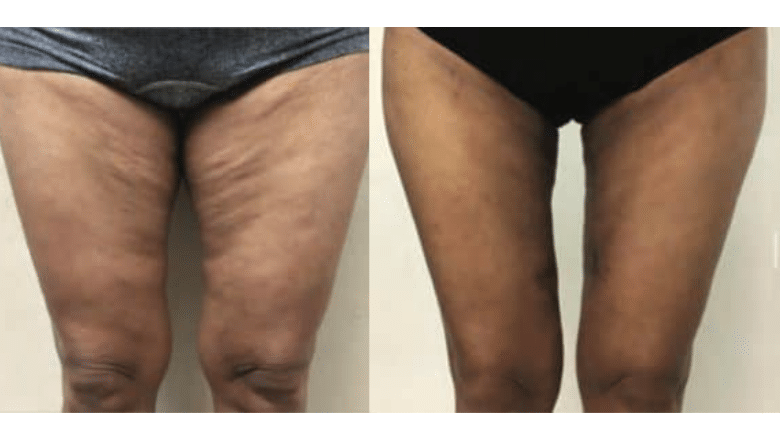
Swelling is normal for the first 7 to 10 days following liposuction, managed with a compression garment worn around the hips and thighs — continuously for the first three weeks except when bathing, then during the day only for a further three weeks. Most patients take two to three days off work, avoid strenuous exercise for two weeks, and resume mild exercise after that point, returning to normal day-to-day activity by around six weeks. Results are visible immediately, though full settling of swelling can take three to five months. Recovery from BodyTite alone is typically quicker — most patients are back to normal activities within 2 to 3 days, with skin-tightening results developing gradually over 3 to 6 months as collagen production continues.
How Much Does Saddlebag Treatment Cost?
- Liposuction (PAL or VASER, one area): see our liposuction cost guide
- Outer thigh lift: priced individually at consultation
All packages include your surgeon’s fee, TIVA anaesthesia, theatre time at our CQC-regulated Baker Street facility, dissolvable sutures, your surgeon’s direct number for the first 24 hours, a wound check, and your six-week surgeon review. Compression garments and postoperative medication are purchased separately ahead of your surgery date. Finance is available through Chrysalis Finance, subject to status. Your initial consultation fee is redeemable against the cost of your procedure if you proceed. Saddlebag treatment is a cosmetic procedure and isn’t available on the NHS or covered by private medical insurance.
Are the Results Permanent?
Surgical fat removal — liposuction or BodyTite — is effectively permanent provided your weight remains stable afterwards. Fat cells removed don’t return, though natural ageing continues and significant future weight gain can still add new fat to the area or elsewhere on the body. BodyTite’s skin-tightening effect can last several years, particularly when weight is maintained, but isn’t equivalent to the surgical removal a thigh lift achieves where laxity is significant.
Why Choose Centre for Surgery?
Whichever treatment is right for your anatomy, it’s performed by a GMC-registered plastic surgeon at our purpose-built, CQC-regulated private hospital on Baker Street, which holds a CQC “Good” rating. TIVA is used as standard for all procedures, giving a smoother, safer anaesthetic experience with faster recovery than traditional gas-based general anaesthesia.
We offer the full range of relevant treatments — power-assisted liposuction, VASER, BodyTite, and surgical thigh lift — so your surgeon recommends the option that genuinely fits your anatomy, rather than defaulting to whichever is easiest to describe. Every package includes unlimited pre-operative consultations, a recommended two-week cooling-off period, full pre-operative medical assessment, a dedicated patient coordinator throughout, and full aftercare through your follow-up reviews.
Book Your Consultation
Phone: 020 7993 4849
95–97 Baker Street, Marylebone, London W1U 6RN
Contact us to schedule your consultation
Your initial in-person consultation fee is redeemable against the cost of surgery if you proceed.
Frequently Asked Questions
What causes saddlebags?
Genetics and hormones — particularly oestrogen — are the main drivers, alongside reduced muscle tone and age-related changes in skin elasticity. They’re a common, largely normal variant of body shape rather than a medical problem.
Can exercise get rid of saddlebags?
Exercise tones the underlying muscle and supports overall fat loss, but it can’t spot-reduce fat from this one area — it shrinks fat cells rather than removing them, which is why the area is notoriously resistant to diet and exercise and quick to regain fat if old habits return.
Is liposuction or BodyTite better for saddlebags?
It depends on your skin quality. Liposuction alone suits fat with good skin elasticity. BodyTite adds skin tightening for patients with mild to moderate laxity. Neither is categorically better — your surgeon recommends based on your specific anatomy.
How much does saddlebag removal cost?
Current prices are set out in our liposuction cost guide and BodyTite cost guide, and an outer thigh lift is priced individually at consultation based on the extent of skin excess.
Are saddlebags a sign of being overweight?
No. Saddlebags are largely genetic and hormonal, and can appear on people at any weight, including those who are otherwise slim.
Will there be visible scarring?
Liposuction and BodyTite use small incisions that are typically barely visible once healed. A thigh lift leaves a longer scar positioned to be as discreet as possible; final scar appearance isn’t clear until a year or more after surgery.
Learn More
- Liposuction
- VASER liposuction
- BodyTite
- BodyTite vs Liposuction
- BodyTite cost
- Thigh lift
- Thigh lift cost
- Thigh liposuction
- Buttock lift







