


In this guide12 sections
- Key Points
- What Is Chest Contouring in Top Surgery?
- Do You Need Liposuction With Top Surgery?
- How Do Surgeons Avoid Dog Ears After Top Surgery?
- Where Should Nipples Be After Top Surgery?
- Can You Combine Top Surgery With Other Body Contouring?
- How Can I Get the Best Results From Top Surgery?
- What Are Top Surgery Results Like With a Larger Chest?
- When Is a Top Surgery Revision Worth Considering?
- Frequently Asked Questions
- FTM Top Surgery in London
- References
Key Points
- Chest contouring is part of top surgery, not an optional extra. As well as removing breast tissue, your surgeon shapes the whole chest so it blends smoothly into the sides, armpits and upper abdomen.
- Liposuction is the main contouring tool. It is used at the side of the chest and the armpit area to remove the fullness that removing breast tissue alone leaves behind, and research links it with fewer revision operations.
- Dog ears are mostly prevented during surgery. Careful scar planning and liposuction at the ends of the incisions reduce the small folds of skin that can form under the arms.
- Nipple size and position make a big difference. A masculine nipple and areola are smaller, more oval and sit further out to the side than most people expect.
- You can protect your result. Reach a stable weight before surgery, stop all nicotine for four weeks before and after, wear your binder for six weeks and follow scar care advice.
- Give it time before judging. The chest keeps settling for months, and a revision, if needed, is not considered before 9 to 12 months.
Yes, liposuction is commonly combined with top surgery, and it is one of the main ways surgeons contour the chest for a flat, natural-looking result. Removing the breast tissue creates a flat chest, but the fat at the side of the chest and in front of the armpit often stays behind. Without contouring, that leftover fullness can make the chest look boxy, leave a bulge under the arms or create dog ears at the ends of the scars. Liposuction blends the chest into the sides of the body so it looks natural.
This guide explains what chest contouring means in FTM top surgery, where liposuction is used, how dog ears are avoided, how nipples are planned, what can be combined with top surgery, what you can do yourself and when a revision makes sense. If you are still weighing up techniques, our guide to FTM top surgery options is a good place to start.
What Is Chest Contouring in Top Surgery?
Chest contouring is the part of top surgery that shapes the chest once the breast tissue has been removed. The aim is a chest that looks masculine or flat from the front, from the side and when you lift your arms. That means attention to:
- The side of the chest: between the outer edge of the chest muscle and the back, where fat often remains.
- The armpit area: the fold of fat in front of the armpit that can bulge in a fitted t-shirt.
- The lower chest: the old crease under the breast is removed so the chest runs smoothly into the abdomen.
- Scar position and length: along the lower border of the chest muscle, and long enough to avoid folds at the ends.
- The nipples: resized and placed where they would sit on a masculine chest.
The technique matters as much as how it is done. Your surgeon chooses between double incision top surgery, nipple-sparing double incision, inverted T, keyhole and periareolar surgery based on your chest size, skin elasticity and how far the chest droops. Removing too little skin for the chest is a common reason for a second operation. In a large 2017 series in Plastic and Reconstructive Surgery, aesthetic revisions were needed in 34% of people with moderate chests and looser skin who had a circumareolar operation, compared with 8.8% of similar people who had a double incision with free nipple grafts[1].
Do You Need Liposuction With Top Surgery?
Not everyone needs it, but most people benefit from some liposuction, especially at the sides of the chest. It depends on how much fat sits outside the breast tissue, how firm your skin is and the shape you want. A small, firm chest may need very little; a larger chest or more fullness under the arms usually needs more.
At Centre for Surgery, liposuction is incorporated into top surgery wherever it is needed, as part of the same operation. With double incision surgery, it is used to contour the side of the chest and the armpit area, reducing the risk of leftover fullness and folds at the ends of the scars. The whole operation, including this contouring, usually takes two to three hours.
The evidence supports this approach. In a 2023 study of 73 people having masculinising chest surgery, published in the Journal of Plastic, Reconstructive and Aesthetic Surgery ↗, liposuction was added in about a third of cases, and it was linked with a significantly lower rate of revision surgery[2]. The overall revision rate in that series was 5.4%.
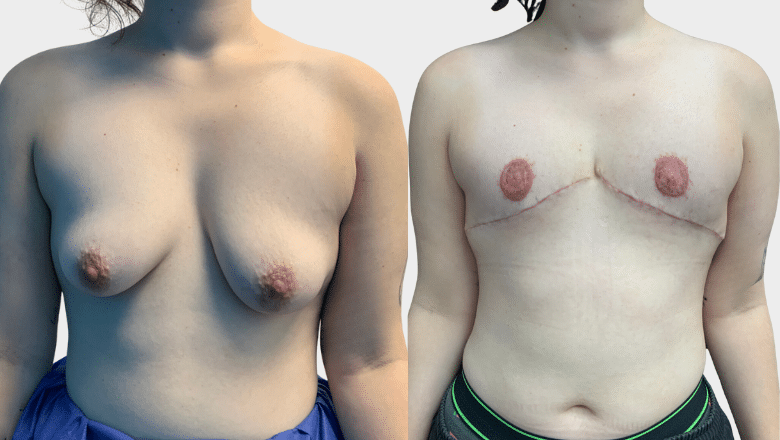
Liposuction with keyhole and periareolar top surgery
In keyhole top surgery, the breast tissue is removed through a small cut at the lower edge of the areola, and liposuction helps to flatten and shape the chest. No skin is removed, so keyhole suits only small chests with firm, elastic skin. Periareolar top surgery is a different operation: a ring of skin is removed around the areola, tightening the skin and making the areola smaller. It suits small to moderate chests, and liposuction refines the contour in the same way.

What liposuction cannot do
Liposuction removes fat, not skin or breast gland. If the skin is loose or the chest droops, it cannot tighten it, and a technique that removes skin is needed. It also cannot build muscle. Some people want more chest definition after they have healed, and in that case pec implants after top surgery are an option, either in the same operation as top surgery or once the chest has settled.
How Do Surgeons Avoid Dog Ears After Top Surgery?
Dog ears are small folds or puckers of skin and fat at the ends of a scar. After top surgery they usually form at the outer ends of the double incision scars, under the arms, and sometimes at the inner ends near the breastbone.
Most dog ears are prevented during the first operation, in three main ways:
- Liposuction at the ends of the incisions: thinning the fat at the side of the chest and armpit area so the tissue lies flat when it is closed.
- Planning the scar length: a scar that follows the chest muscle far enough towards the armpit avoids bunching at the end, balanced against keeping it as short as possible.
- Matching the technique to the chest: removing enough skin so there is no excess to gather at the ends.
Even with careful planning, some puckering at the scar ends is common in the first months. Much of it is swelling, and it often settles on its own over three to six months as the skin tightens. A 2017 surgical series in Aesthetic Plastic Surgery describes this trade-off: the authors favour a longer scar that follows the chest muscle, and the only revisions in their group were one for a dog ear near the armpit and one for nipple reconstruction[3]. If a fold is still there once the chest has fully settled, it can usually be removed under local anaesthetic. Our guide to dog ears after surgery explains more.
Where Should Nipples Be After Top Surgery?
On a masculine chest, the nipples usually sit lower and further out to the side than people expect, and the areolas are smaller and more oval than before surgery.
In a 2020 study in Aesthetic Plastic Surgery ↗, the authors note that the male nipple and areola are smaller, oval and more lateral, and that grafts placed without allowing for this can look wrong. When grafts were shaped with these features in mind, 90.7% of patients were satisfied with their nipples, compared with 58.1% with the conventional approach[4]. Another 2020 study described placing the nipples at about the level of the fourth rib near the lower border of the chest muscle, two thirds of the way from the middle of the chest to the front of the armpit; all the patients who replied to the survey were satisfied with their nipple position[5].
How much control your surgeon has depends on the technique:
- Double incision with free nipple grafts: the nipples are resized and grafted wherever they look best, giving the most control. Nipple feeling is reduced.
- Nipple-sparing double incision and inverted T: the nipple stays attached to a pedicle of tissue, so the areola can be made smaller but can only move so far.
- Periareolar: the areola is reduced in size, but its position changes little.
- Keyhole: the nipple and areola are not usually resized or moved.
Your nipples are marked with you sitting upright on the day of surgery, as the chest changes shape when you lie down. Some people choose to have no nipples at all, for a smooth, flat chest; this is one of the options on our non-binary top surgery page.
Can You Combine Top Surgery With Other Body Contouring?
Yes. For many trans men and non-binary people, fat at the hips, thighs, flanks or abdomen keeps a curvier outline even after top surgery and testosterone. Body masculinisation surgery brings together the procedures that address this, and both chest and body surgery are carried out at our Baker Street hospital, so you do not need to be referred between providers.
The procedures that can be planned alongside top surgery include:
- Liposuction of the hips, outer thighs, buttocks, flanks or abdomen, for a straighter, narrower outline.
- Abdominoplasty (tummy tuck), which removes loose skin and fat from the abdomen and tightens the muscles, useful after weight loss.
- Arm lift or thigh lift, where loose skin is the main problem.
- Body implants, such as pectoral or calf implants.
Liposuction of these areas can often be done in the same operation as top surgery. Whether that suits you, or a sequenced plan is better, depends on how many areas are involved, the total operating time and your general health. Your surgeon will give you a written plan at consultation. For non-binary people who want a more neutral outline, the same techniques can be adapted to your goals. Pec implants, which add volume rather than remove it, can be placed at the same time as top surgery in suitable patients or added later.
How Can I Get the Best Results From Top Surgery?
Surgical technique sets the shape of your chest, but what you do before and after the operation affects how it heals and how the scars look.

Reach a stable weight first
Liposuction removes fat cells permanently, but the fat that remains can still grow if you gain a lot of weight, and losing a lot of weight after surgery can leave loose skin. Have surgery at a weight you can comfortably keep, and if you plan to lose weight, do so first. A very high BMI can also make anaesthesia less safe, and your surgeon may suggest waiting until it is lower.
Stop all nicotine
Nicotine narrows the small blood vessels that heal wounds and keep nipple grafts alive. We ask everyone to stop smoking, vaping, patches and nicotine gum for at least four weeks before and four weeks after surgery. In a 2021 series of 72 double incision operations, nicotine use was linked with a higher rate of haematoma, a collection of blood under the skin that can need a return to theatre[6]. Stop aspirin two weeks before surgery too, unless a doctor has prescribed it for your heart, in which case ask them first.
Wear your compression binder for six weeks
The binder goes on before you leave the hospital. It controls swelling, supports the healing tissue and helps the skin settle onto the new chest contour, which matters even more where liposuction has been used. Wear it day and night for six weeks, taking it off only to wash. The binder and take-home medicines are bought separately.
Follow your aftercare closely
Top surgery is performed under TIVA (total intravenous anaesthesia), and you go home with a responsible adult who stays with you for the first 24 hours. If drains are used, they are usually removed once the fluid output drops. Your first wound check is at day 7 to 10, with a surgeon review at six weeks and an assessment at three months. Sleep on your back for at least two weeks, avoid lifting your arms above your shoulders in the early weeks, and most people are back at desk work within about two weeks. Our FTM top surgery recovery guide sets out the full timeline.
Look after your scars
Once the wounds have healed, silicone gel or sheets can be used from about six weeks after surgery, with gentle massage once your surgeon is happy. Protect the scars from the sun for three months with clothing or a high-factor sunscreen. Tension from heavy lifting in the first six weeks can widen them. Our guide to top surgery scars covers treatment options.
Return to exercise from six weeks
Walking is encouraged from the first days. Strenuous exercise, heavy lifting and chest training wait until about six weeks, and then build up gradually. Once healed, building the chest muscles can add definition to a flat chest. Our article on working out after top surgery has a week-by-week plan.
What Are Top Surgery Results Like With a Larger Chest?
People with larger chests or more fullness at the sides can get very good results, but the plan is different. A larger chest with more droop usually needs a double incision with free nipple grafts, which removes the excess skin and lets the nipples be moved to the right place. More liposuction at the sides of the chest and armpit area is usually needed too.
Double incision is also a reliable option in terms of safety. A 2023 systematic review and meta-analysis in the Journal of Plastic, Reconstructive and Aesthetic Surgery ↗, covering 3,055 people having chest masculinisation, found the lowest complication rates with double incision and free nipple grafts, followed by pedicled nipple techniques and then periareolar techniques[7]. The trade-off is longer scars and reduced nipple feeling, which your surgeon will explain alongside the benefits.
When Is a Top Surgery Revision Worth Considering?
Wait 9 to 12 months before deciding. Swelling goes down, the skin tightens and the scars soften for many months, so much of what bothers people at three or six months, such as small dog ears or uneven fullness at the sides, improves on its own.
Most people do not need a revision. In a 2026 series of 87 people from a Portuguese reference centre, 8.0% needed a secondary operation, and the average satisfaction score among those who replied was 8.5 out of 10[8]. When a revision is needed, the most common types are:
- Dog ear correction, usually a short procedure under local anaesthetic.
- Further liposuction to refine the contour at the sides of the chest or armpit area.
- Scar revision, where a scar has stretched or thickened.
- Nipple adjustment, for size, position or a graft that did not take fully.
Some revisions are included in your top surgery package and some are charged; we set this out at consultation. If something worries you earlier, such as a wound problem, a hard swelling or a dark nipple graft, contact us straight away.
Frequently Asked Questions
Does top surgery include liposuction?
At Centre for Surgery, liposuction is incorporated into top surgery wherever it is needed to contour the chest, as part of the same operation. It is most often used at the side of the chest and the armpit area to remove leftover fullness and reduce the risk of dog ears. How much you need is assessed at consultation.
How painful is chest liposuction?
Liposuction adds some soreness and bruising at the sides of the chest, usually described as a deep ache, like a strong muscle strain. It is most noticeable in the first week and is usually controlled with simple pain relief and your compression binder. Bruising fades over two to three weeks.
Do breasts grow back after top surgery?
No. The breast gland is removed during top surgery and does not grow back. A thin layer of fat is left under the skin to avoid a hollow look, and this fat can still increase with weight gain, which may make the chest look fuller. Keeping a stable weight protects your result.
Do they remove nipples during top surgery?
It depends on the technique. With double incision and free nipple grafts, the nipples are removed, resized and grafted back in a masculine position. With keyhole, periareolar and nipple-sparing techniques, they stay attached. Some people choose to have no nipples at all for a smooth, flat chest.
What disqualifies you from top surgery?
We will not go ahead if you are under 18, cannot stop all nicotine for four weeks before and after surgery, have an uncontrolled condition such as diabetes or high blood pressure, or have a BMI too high for safe anaesthesia. Most of these can change, and your surgeon will explain what would need to.
What are the recovery tips for top surgery?
Wear your binder for six weeks, sleep on your back for at least two weeks, keep your arms below shoulder height early on and avoid heavy lifting and strenuous exercise until six weeks. Stay off nicotine, attend your wound check at day 7 to 10 and protect your scars from the sun for three months.
Can I have body masculinisation at the same time as top surgery?
Often, yes. Liposuction of the hips, thighs or flanks can be done in the same operation as top surgery, or as a sequenced plan, depending on the areas involved, the operating time and your health. Your surgeon will give you a written plan at consultation.
How long after top surgery can you get a revision?
Usually not before 9 to 12 months. Swelling, skin tightening and scar maturing all continue for many months, and many early concerns, such as small dog ears or uneven fullness, settle on their own. Any problem with healing in the early weeks should be reported to the clinic straight away.
FTM Top Surgery in London
FTM top surgery at Centre for Surgery is performed by GMC-registered surgeons at our CQC-regulated Baker Street hospital, rated Good overall by the CQC, for trans men and non-binary people. We offer double incision with free nipple grafts, nipple-sparing double incision, inverted T, keyhole and periareolar top surgery, with liposuction contouring planned into your operation where it is needed. No diagnosis or referral letter is needed, and the consultant who assesses you at consultation is the consultant who performs your surgery. All pre-operative consultations and follow-up appointments are included. Your initial consultation is £100, redeemable against the cost of surgery if you go ahead; our FTM top surgery cost guide explains what the price includes, and you can see real results in our top surgery before and after photos. Finance is available, subject to status.
Phone: 020 7993 4849 | Address: 95–97 Baker Street, Marylebone, London W1U 6RN
Contact us to schedule a consultation
References
- Bluebond-Langner R, Berli JU, Sabino J, et al. Top surgery in transgender men: how far can you push the envelope? Plastic and Reconstructive Surgery 2017;139(4):873e–882e. doi:10.1097/PRS.0000000000003225 ↗
- Kuruoglu D, Alsayed AS, Melson VA, et al. Masculinizing chest wall gender-affirming surgery: clinical outcomes of 73 subcutaneous mastectomies using the double-incision and semicircular incision techniques. Journal of Plastic, Reconstructive and Aesthetic Surgery 2023;85:515–522. doi:10.1016/j.bjps.2023.02.020 ↗
- Lo Russo G, Tanini S, Innocenti M. Masculine chest-wall contouring in FtM transgender: a personal approach. Aesthetic Plastic Surgery 2017;41(2):369–374. doi:10.1007/s00266-017-0796-0 ↗
- Bustos SS, Forte AJ, Ciudad P, Manrique OJ. The nipple split sharing vs. conventional nipple graft technique in chest wall masculinization surgery: can we improve patient satisfaction and aesthetic outcomes? Aesthetic Plastic Surgery 2020;44(5):1478–1486. doi:10.1007/s00266-020-01803-1 ↗
- Ayyala HS, Mukherjee TJ, Le TM, et al. A three-step technique for optimal nipple position in transgender chest masculinization. Aesthetic Surgery Journal 2020;40(11):NP619–NP625. doi:10.1093/asj/sjaa150 ↗
- Naides AI, Schultz JJ, Shulzhenko NO, Keith JD. Chest masculinization technique and outcomes in 72 double-incision chest-contouring procedures with free nipple grafting. Plastic and Reconstructive Surgery Global Open 2021;9(3):e3459. doi:10.1097/GOX.0000000000003459 ↗
- Zhu J, Wang E, Liu S, et al. Impact of surgical technique on outcome measures in chest masculinization: a systematic review and meta-analysis. Journal of Plastic, Reconstructive and Aesthetic Surgery 2023;87:109–116. doi:10.1016/j.bjps.2023.09.002 ↗
- Catalão I, Azevedo JM, Sítima M, et al. Mastectomy in transgender patients: the experience of a Portuguese reference center. JPRAS Open 2026;48:924–932. doi:10.1016/j.jpra.2026.01.044 ↗

Related Articles
- What Are My Options for FTM Top Surgery?
- Dog Ears After Surgery: Causes, Symptoms and Treatment
- Can You Get Pec Implants After Top Surgery?
- Top Surgery Scars: How They Heal, Fade and Can Be Treated






