


In this guide17 sections
- Key Points
- Philtrum Meaning: What Is the Philtrum of the Upper Lip?
- What Is a Long Philtrum?
- How to Measure Your Philtrum Length
- What Does a Long Philtrum Look Like?
- What Causes a Long Philtrum?
- Long Philtrum in Women and in Men
- Smooth, Flat or Missing Philtrum: What Does It Mean?
- What If My Philtrum Is Short?
- How to Fix a Long Philtrum Naturally: What Works Without Surgery?
- Does Lip Filler Fix a Long Philtrum?
- How to Shorten Your Philtrum: Treatment Options
- Philtrum Shortening Surgery: Scars, Risks and How Long It Lasts
- Which Long Philtrum Treatment Is Right for You?
- Frequently Asked Questions
- Long Philtrum Treatment at Centre for Surgery
- References
Key Points
- The philtrum is the groove between your nose and upper lip. It runs from the base of the nose down to the Cupid’s bow, with a raised ridge (a philtral column) on each side.
- A long philtrum means a longer than usual distance from nose to lip. There is no single cut-off. Around 11 to 13 mm for women and 13 to 15 mm for men is often quoted as a rough guide, and men’s philtrums are longer on average.
- The philtrum gets longer with age. The upper lip lengthens, more skin and less pink lip shows, and less of the upper teeth can be seen at rest.
- There is no good evidence that exercises shorten it. Filler and a lip flip can change how the lip looks for a while, but neither removes skin.
- A lip lift is the operation that shortens it. It removes a strip of skin under the nose, leaves a permanent scar, and is planned around your own face rather than a target number.
The philtrum is the vertical groove in the middle of the upper lip, running from the base of the nose down to the upper edge of the pink lip at the Cupid’s bow. A long philtrum simply means this distance between the nose and the upper lip is longer than usual for your face, so the skin above the lip looks tall and the pink part of the upper lip can look thin. If you have noticed this in photos or in the mirror, you may want to know whether it is normal, why it happens and how to shorten a philtrum if it bothers you.
A longer philtrum can simply be part of the face you were born with, and it also gets longer with age[1]. The nose changes with age too, as our guide to whether your nose keeps growing explains, which is why the nose and upper lip are assessed together. Lip filler adds volume but does not remove the extra skin, so it is not always the right answer for a long upper lip.
At Centre for Surgery in London, our surgeons treat philtrum-related concerns with lip lift surgery and, where appropriate, dermal lip fillers at our CQC-regulated Baker Street clinic. This guide explains what the philtrum is, what counts as long, how to measure it, what causes it, what you can and cannot change without surgery, and how a lip lift works, including its scars and risks.
Philtrum Meaning: What Is the Philtrum of the Upper Lip?
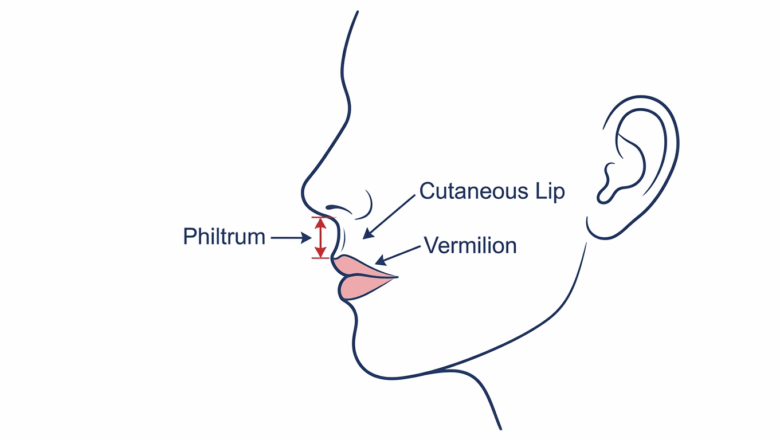
The philtrum is the shallow vertical groove running from the base of the nose, just below the columella (the strip of skin between the nostrils), down to the Cupid’s bow of the upper lip. It is bordered on each side by a raised ridge called a philtral column, sometimes searched for as “philtrum columns”. At the bottom, the two columns meet the lip border at the peaks of the Cupid’s bow.
When surgeons assess this area, they think about two parts of the upper lip: the cutaneous lip, which is the skin between the nose and the pink lip, and the vermilion, which is the pink lip itself. A long philtrum means there is a lot of cutaneous lip compared with vermilion. Knowing which part is out of proportion matters, because a lack of pink-lip volume and too much skin length are different problems with different treatments.
The shape of the philtrum varies a great deal from person to person. In a 2026 study of 99 adults of European background, the most common shape was a parallel philtrum, seen in 55.7% of people. Philtrum height and width were both greater in men than in women, and both tended to increase with age[2]. Differences in the depth of the groove and the height of the ridges are part of this normal variation, which is why some people describe their philtrum as deep, wide, flat or prominent.
What Is a Long Philtrum?
A long philtrum is a greater than average distance between the base of the nose and the upper lip border. It is a description of proportion rather than a diagnosis: a philtrum that looks long on one face may look in proportion on another.
Ideal Philtrum Length
There is no single ideal philtrum length. Aesthetic guides often quote around 11 to 13 millimetres for women and 13 to 15 millimetres for men, measured from the base of the nose to the upper lip border, and a philtrum above these ranges is often described as long. Treat these figures as a rough guide rather than a medical cut-off. What looks balanced depends on the rest of your face, and men’s philtrums are longer on average than women’s[2]. For context, in the lip lift studies included in a 2026 systematic review, average philtrum length was about 14 mm before surgery and about 11 to 12 mm afterwards[3].
A commonly used guide to lower-face balance is that the distance from the lower lip to the bottom of the chin should be roughly twice the length of the philtrum, an ideal chin-to-philtrum ratio of about 2:1. Like the millimetre ranges, this is a rule of thumb, not a number your face has to meet.
Tooth Show and Upper Lip Proportions
Surgeons pay as much attention to how the lip sits as to millimetres. The first marker is incisor show at rest: how much of the upper front teeth you can see when the lips are relaxed and slightly parted. A 1978 survey of tooth display found that the amount of upper front tooth on show gradually reduces with age, while more of the lower teeth show[4]. A long philtrum drapes the upper lip lower over the teeth, so little or none of the upper teeth may be visible.
More is not always better, though. In a 2025 online survey, 570 people rated computer-generated images of women’s faces, edited to show different degrees of philtrum shortening. Overall, the most preferred lips showed between 0 and 1 mm of the upper front teeth, and the least preferred mostly showed 4 mm[5]. This is one reason a lip lift is planned around your own proportions rather than a fixed amount of tooth show.
The second marker is the upper lip in profile. A long cutaneous lip can make the area under the nose look flat and long from the side, and the pink lip can look thin even when it has reasonable volume.
How to Measure Your Philtrum Length
You can get a rough idea of your philtrum length at home with a ruler and a mirror:
- Relax your face, with your lips lightly together, and look straight ahead with your head level.
- Find the point in the middle where the base of the nose meets the upper lip.
- Measure straight down the midline to the upper edge of the pink lip, at the dip of the Cupid’s bow.
- Repeat the measurement a few times and take the average.
Measurements taken from selfies are unreliable. Head tilt, camera distance and lens distortion all change how long the philtrum appears, and smiling pulls the lip upwards. If you are wondering whether your philtrum is too long, the number is only part of the answer: how much of your upper teeth and pink lip show when you are relaxed matters just as much. At consultation, a surgeon will also look at how much gum shows when you smile.
What Does a Long Philtrum Look Like?
A long upper lip tends to produce a recognisable set of features. The upper lip can look thin even when it has reasonable volume, because more of it sits as skin and less shows as pink lip. The upper teeth may disappear from view when you speak or rest with your lips apart. The lower third of the face can look longer, and the Cupid’s bow can look flatter and less defined. Some of these changes also happen with age, so a naturally long philtrum can make a younger face look a little older than it is.
Whether a long philtrum is attractive is a matter of personal and cultural taste, and plenty of people with a longer philtrum have no wish to change it. It only becomes a treatment question if it bothers you. Our post on the different lip shapes covers how philtrum length fits with overall lip shape.
Philtrum length has also become one of the measurements traded in online appearance communities, where a millimetre reading taken from a selfie is turned into a rating. Two things are worth knowing: the measurement is very sensitive to head tilt and camera distance, and the “ideal” ranges quoted online are often presented as if there were one correct number, when real faces vary widely. Our guide to looksmaxxing covers why that scoring is unreliable and what repeatedly doing it can do to how people feel about their own faces.
What Causes a Long Philtrum?

Genetics and Natural Face Shape
A long philtrum can simply be part of the face you were born with, present from a young age and sometimes shared with other family members. As with all facial proportions, there is wide natural variation, and a longer philtrum is not an abnormality. It becomes a treatment consideration only if you are bothered by how it looks.
Ageing
The philtrum gets longer with age. In a 2008 study combining measurements from 182 standardised photographs with MRI scans of 30 women aged 20 to 35 and 30 women aged 65 to 80 ↗, the upper lip was significantly longer in older people. The photographs showed more skin and less visible pink lip with age, and the scans showed the lip becoming thinner, but the researchers could not show a loss of volume[1]. In other words, the upper lip became longer and thinner with age, but the study did not find that it lost volume. Over the same years, less of the upper front teeth tends to show when the lips are at rest[4].
Previous Surgery
Surgery around the nose can change the area where the philtrum begins. Some rhinoplasty techniques alter the columella or the base of the nose, which can change the distance between the nose and the lip and the way the upper lip sits. If you feel your upper lip changed after nose surgery, mention it at consultation, as the nose and lip need to be assessed together.
Overfilled Lips and Filler Migration
Lip filler that has been overfilled, or that has spread beyond the lip border, can blur the line between the pink lip and the skin above it and create a heavy, shelf-like upper lip. Our article on lip filler migration explains how this happens. Uneven migration can also make the two sides of the mouth look different, as covered in our post on asymmetrical lips causes and treatments. Whether repeated filler can stretch the upper lip over time is uncertain. If you have had a lot of filler, a surgeon may suggest dissolving it before any further treatment is planned, so that your natural lip proportions can be assessed.
Long Philtrum in Women and in Men
Philtrum length differs by sex. In the 2026 study of 99 adults, philtrum height was significantly greater in men than in women[2], so the same measurement can look unremarkable on one face and noticeable on another. The distance also matters relative to the rest of the face: a 16 mm philtrum on a long lower face looks different from the same measurement on a short one.
The surgical aim differs too. For women, the usual aim is to show a little of the upper teeth at rest and more of the pink upper lip. For men, the operation is planned more conservatively. The male upper lip naturally has a longer skin height than the female upper lip, and shortening it is one of the changes used to feminise the lower face[6], so removing too much in a man can make the lower face look more feminine.
This is one of the reasons a lip lift is planned around your own proportions rather than to a fixed target measurement.
Smooth, Flat or Missing Philtrum: What Does It Mean?
Some people search for “no philtrum” or “missing philtrum” because the groove above their lip is very shallow. Everyone has a philtrum area between the nose and the lip, but the groove and ridges are much more defined in some people than in others. In an adult who is otherwise well, a shallow philtrum can simply be normal variation, and on its own it is not a diagnosis.
A smooth philtrum is, however, one of three characteristic facial features of foetal alcohol syndrome, together with short eye openings (short palpebral fissures) and a thin upper lip. Foetal alcohol syndrome is part of a group of conditions called foetal alcohol spectrum disorders (FASD), caused by exposure to alcohol before birth[7]. Diagnosis is made by a specialist team and depends on the whole picture, including growth, development and other physical features, not on the lip alone. If you have concerns about a child’s facial features, growth or development, speak to your GP or health visitor. This is not something a cosmetic clinic diagnoses or treats.
What If My Philtrum Is Short?
A short philtrum is a small distance between the nose and the lip. There is no simple cosmetic operation to lengthen one: operations that lengthen the philtrum are reconstructive procedures, used for example in cleft lip surgery. Where a short upper lip comes with a lot of tooth or gum show at rest, the cause may be the position of the upper jaw or teeth rather than the lip itself, and an orthodontist or maxillofacial surgeon can assess this.
How to Fix a Long Philtrum Naturally: What Works Without Surgery?
Can you shorten a philtrum naturally? There is no good evidence that you can. The length of the philtrum comes from the skin and underlying structure of the upper lip, and nothing done at home removes skin. Some things can change how the area looks, and in one study of older women having a facelift, a strong medical skin peel around the mouth shortened it slightly.
Facial Exercises and Mewing
Facial exercises are promoted online as a way to fix a long philtrum, but there is no good evidence that they change its length. A 2025 systematic review of 12 studies of facial exercises, myofunctional therapy and facial massage in 321 women ↗ found that the improvements reported were limited to areas such as the cheeks, jawline and around the eyes, and concluded that the evidence was not strong enough to show these techniques work[8]. Our guide to mewing looks at a similar claim that tongue posture can reshape the face.
Make-Up and Lip Liner
Lip liner drawn just above the natural border of the upper lip can make the pink lip look taller and the philtrum look shorter, particularly in photos. This changes how the area looks rather than its length, and it is easy to overdo.
Skin Treatments
A 2026 study looked at whether a strong chemical peel shortens the philtrum. Of 100 white women having a facelift (average age 67), the 50 who also had a phenol-croton oil peel around the mouth had their philtrum shortened by an average of 9.3% at a follow-up visit at least three months later, while the 50 without the peel showed no significant change[9]. This was a retrospective study of older women having a facelift, so it does not tell us whether a peel on its own would help a younger person with a naturally long philtrum. A phenol-croton oil peel is also a medical treatment, not a natural one.
Filler and Lip Flip
Lip filler and a lip flip can both change how a long philtrum looks for a limited time, but neither removes skin. Both are covered below.
Does Lip Filler Fix a Long Philtrum?
This is a key point to understand before treating a long upper lip. Dermal filler adds volume to the pink lip. It does not remove the extra skin that makes a philtrum long. In the 2008 study of the ageing upper lip, the researchers concluded that because the lip lengthens without measurable volume loss, adding volume alone does not treat the cause and may lead to an unnatural, over-inflated look[1].
Filler can still change the measurements a little. In a 2025 study using 3D imaging, 33 white women over 30 were measured before and after hyaluronic acid lip filler and compared with 30 women under 30. After filler, the pink part of the lips was taller and the skin height between the nose and the upper lip border was smaller[10]. So filler may make a long philtrum look a little less noticeable, especially when the pink lip is also thin. But it removes no skin, the effect fades as the filler breaks down, and in a long philtrum with good lip volume, adding more can make the lip project forward beneath an unchanged stretch of skin, without improving how much of the upper teeth show.
This does not mean filler has no role. For people whose main concern is thin lips with a normal philtrum length, lip fillers remain a reasonable option, as covered in our post on thin lips causes and treatments. The right treatment depends on the right diagnosis: volume problems respond to volume, and length problems need shortening.
How to Shorten Your Philtrum: Treatment Options

Lip Lift Surgery (Philtrum Shortening Surgery)
A lip lift is the operation that shortens the philtrum by removing skin. The classic technique, the subnasal or bullhorn lip lift, removes a measured strip of skin from just beneath the base of the nose and closes the gap. This lifts the upper lip, shows more of the pink lip and more of the upper teeth. The incision follows the crease where the nose meets the lip, where the scar is partly hidden by the shadow of the nose. Our posts on the bullhorn lip lift and bullhorn vs corner lip lift explain the technique variations in detail.
The evidence for the operation is encouraging but limited. A 2026 systematic review of seven studies including 1,754 patients ↗ found that bullhorn techniques and their modifications reduced philtrum length from 14.0–14.5 mm to 10.8–12.0 mm, increased the height of the pink upper lip from 5–6 mm to 7–9 mm, and increased upper tooth show from 1.5–2 mm to 3.5–5 mm. Patient satisfaction was high, complications were mainly mild and temporary, and the rate of revision surgery ranged from 0.6% to 6.7%, although the reviewers rated the overall quality of the studies as moderate[3].
The amount of skin removed is the key planning decision. It is based on your existing philtrum length, your tooth show and how much gum shows when you smile, and it is kept conservative, because removing too much can leave too much tooth and gum on show. This is assessed carefully in people who already show a lot of gum when smiling, as covered in our post on gummy smile treatment.
At Centre for Surgery, lip lifts are carried out by GMC-registered plastic surgeons. The procedure is performed under local anaesthetic in around 60 to 90 minutes as a day case, with sutures removed at around one week. The first couple of weeks are the most visible part of recovery, and the scar continues to fade over the following months. Our lip lift surgery page covers the procedure journey in full, and our lip lift cost guide sets out current London pricing.
Lip Flip: A Subtle, Temporary Alternative
A lip flip uses small anti-wrinkle injections along the upper lip border to relax the muscle that curls the lip inward, so the pink lip rolls slightly outward. This shows more pink lip without adding volume and can make a long philtrum a little less noticeable. It does not shorten the skin, the effect is subtle, and it wears off over a few months. A lip flip treatment can suit people with a mild concern who prefer a non-surgical option, or who want a sense of the general direction of a lip lift result first.
Lip Filler: For Volume Problems, Not Length Problems
As explained above, filler addresses the volume of the pink lip rather than the length of the philtrum. It suits people whose main concern is thin lips, and it can be used alongside a lip lift by people who want both lift and volume.
Philtrum Shortening Surgery: Scars, Risks and How Long It Lasts
A lip lift always leaves a scar. It sits in the crease along the base of the nose, where it is partly hidden, and in the early weeks it looks like a fine pink line that fades over several months. Scars do not always settle well, though. In an analysis of 25 online reviews written by people unhappy after a lip lift, concerns about the scar were the most common complaint (15 of the 25), followed by distortion of the nose or nostrils (6) and an uneven lip (5)[11]. Other risks include swelling, bruising, temporary changes in sensation, infection, asymmetry, a wider or more visible scar, and removing too little or too much skin. Your surgeon will go through these with you at consultation.
The skin that is removed does not grow back, so the change is long-lasting, but the lip continues to age. In a study of 52 patients who had a 5 mm subnasal lip lift between 2006 and 2020, the improvement was maintained over time with a slow decline. Lip show improved by an average of 48.2%: 50.1% in patients less than five years after surgery and 40.3% in those five or more years after, a difference that was not statistically significant[12]. Our guide to how long a lip lift lasts covers this in more detail.
Which Long Philtrum Treatment Is Right for You?
The honest answer depends on a proper assessment of your anatomy, but the general principles are straightforward. If your philtrum measures long, your upper teeth are hidden at rest and your upper lip looks thin despite reasonable volume, the problem is vertical length, and a lip lift is the treatment that addresses it. If your philtrum length is normal but your lips lack volume, filler is the more appropriate choice. If your concern is mild and you would like a non-surgical option first, a lip flip offers a subtle, temporary change. And if you have had a lot of filler in the past, migration and stretching need to be assessed first, as dissolving may be needed before your natural proportions can be judged.
Frequently Asked Questions
What is the ideal philtrum length?
There is no single ideal. Around 11 to 13 millimetres for women and 13 to 15 millimetres for men is often quoted as a rough guide, but facial balance matters more than any single number. The philtrum’s length relative to the chin and how much of the upper teeth show at rest are just as important.
How do I know if I have a long philtrum?
Measure from the point where your nose meets your upper lip down to the edge of the pink lip in the middle. If the distance is above the rough ranges given earlier, little or none of your upper teeth show when your lips are relaxed and parted, and your upper lip looks thin despite reasonable fullness, you may have a long philtrum. A surgeon can measure it properly and tell you whether it is out of proportion for your face.
How do you fix a long philtrum naturally?
There is no good evidence that facial exercises, massage or tongue posture shorten a philtrum[8]. Lip liner can make it look shorter in photos. Filler and a lip flip change how the lip looks for a limited time, and a lip lift is the operation that shortens it.
Does lip filler shorten the philtrum?
Not in the way surgery does. Filler can make the pink lip taller and the skin above it measure a little shorter[10], but it removes no skin and the effect fades as the filler breaks down. Where the main problem is a long philtrum rather than thin lips, adding volume alone can make the upper lip look heavy.
Why is my philtrum so prominent?
The depth of the groove and the height of the philtral columns vary naturally, so a prominent or very defined philtrum is often just your normal anatomy. Filler placed in or above the lip can also make the area look more pronounced. If a bump or swelling above your lip is new, growing or changing, ask your GP to check it.
Is it normal to have no philtrum?
Everyone has a philtrum area, but in some people the groove is very shallow and the ridges are hard to see. In an adult who is otherwise well, this can simply be normal variation. A smooth philtrum is one of the features doctors look at, alongside other features, when assessing a child for foetal alcohol spectrum disorders[7], so speak to your GP or health visitor if you have concerns about a child’s development.
Is a lip lift scar visible?
There will always be a scar. It is placed in the natural crease at the base of the nose, where it is partly hidden, and it is pink at first and fades over several months. How well it settles varies between people, and scarring was the most common complaint in an analysis of online reviews from dissatisfied lip lift patients[11].
How long does a lip lift last?
The skin removed does not grow back, so the change is long-lasting, but the upper lip continues to age gradually. In a study of 52 patients, including some who were five or more years past surgery, the improvement was maintained with a slow decline over time[12].
Should I have a lip lift or rhinoplasty first?
If you are considering both, they should be planned together, since changes to the base of the nose affect how the philtrum looks. Your surgeon will advise on order and timing, and both rhinoplasty and a lip lift can be discussed within one treatment plan at consultation.
Long Philtrum Treatment at Centre for Surgery
Centre for Surgery performs lip lift surgery and lip filler treatment at our CQC-regulated Baker Street clinic in central London. If you are considering a lip lift, your consultation is with a GMC-registered plastic surgeon, who will measure your philtrum, assess your tooth show and lip proportions, and recommend the treatment that addresses your anatomy, which may be no treatment at all, rather than defaulting to the most requested option.
Finance options are available through our partner Chrysalis Finance, subject to status. Visit our Finance Options page for details.
Phone: 020 7993 4849 | Email: contact@centreforsurgery.com | Address: 95-97 Baker Street, London W1U 6RN
References
- Iblher N, Kloepper J, Penna V, et al. Changes in the aging upper lip: a photomorphometric and MRI-based study (on a quest to find the right rejuvenation approach). Journal of Plastic, Reconstructive & Aesthetic Surgery 2008;61(10):1170–1176. doi:10.1016/j.bjps.2008.06.001 ↗
- Eltarhoni R, Soames R, Lamb C. Philtrum morphology and its dental correlates: a cross-sectional study of sex and age variation. Anatomical Science International 2026. Published online 3 January 2026. doi:10.1007/s12565-025-00913-7 ↗
- Komisarek O, Banasiak Ł, Olichwer V, et al. The bullhorn and beyond: evidence-based review and clinical recommendations for lip lift techniques. Journal of Cosmetic Dermatology 2026;25(3):e70703. doi:10.1111/jocd.70703 ↗
- Vig RG, Brundo GC. The kinetics of anterior tooth display. The Journal of Prosthetic Dentistry 1978;39(5):502–504. doi:10.1016/s0022-3913(78)80179-6 ↗
- Zeng R, Glaue E, Moellhoff N, et al. Revealing the perfect smile: how philtrum length shapes lip beauty. Aesthetic Plastic Surgery 2025;49(13):3561–3571. doi:10.1007/s00266-025-04752-9 ↗
- Salibian AA, Bluebond-Langner R. Lip lift. Facial Plastic Surgery Clinics of North America 2019;27(2):261–266. doi:10.1016/j.fsc.2019.01.004 ↗
- Del Campo M, Jones KL. A review of the physical features of the fetal alcohol spectrum disorders. European Journal of Medical Genetics 2017;60(1):55–64. doi:10.1016/j.ejmg.2016.10.004 ↗
- Seraj SS, Moses O, Kamel Y, et al. Efficacy of conservative techniques for mechanical facial rejuvenation: a systematic review. Aesthetic Surgery Journal Open Forum 2025;7:ojaf144. doi:10.1093/asjof/ojaf144 ↗
- Janssen PL, Darras O, Fraiman E, et al. Adjunct perioral phenol-croton oil peel shortens philtrum length in patients undergoing primary facelift. Aesthetic Surgery Journal 2026;46(4):433–440. doi:10.1093/asj/sjaf262 ↗
- Cardoso JF, do Valle C, Neppelenbroek KH, et al. Comparative 3D analysis of lip rejuvenation: investigating effects before and after soft-tissue filler compared with controls. Aesthetic Plastic Surgery 2025;49(3):875–884. doi:10.1007/s00266-024-04410-6 ↗
- Hayat J, Alfadhly A, Jafar AB. Patient-reported dissatisfaction after lip lift: insights from a thematic analysis of RealSelf reviews. Aesthetic Surgery Journal Open Forum 2025;7:ojaf129. doi:10.1093/asjof/ojaf129 ↗
- Nagy C, Bamba R, Perkins SW. Rejuvenating the aging upper lip: the longevity of the subnasal lip lift procedure. Facial Plastic Surgery & Aesthetic Medicine 2022;24(2):95–101. doi:10.1089/fpsam.2021.0077 ↗







